
Choosing from bridesmaid dress color ideas feels like a style decision until you realize it’s three decisions at once. It’s a photography decision, a skin tone decision and a venue decision, and a shade that wins on one can quietly lose on the other two. I file this brief before every wedding season, and the pattern repeats: the colors that look best on a screen aren’t always the ones that hold up in a ballroom at dusk. Below are 30 color entries across jewel tones, earth tones, pastels, neutrals and darks, each with bridesmaid dress photography tips, skin tone guidance and notes on bridesmaid color and venue matching, plus sourcing from BHLDN, Azazie, David’s Bridal and Anthropologie. Whether your wedding is a Southern garden ceremony or a New England barn reception, you’ll find a shade that suits the light and the lineup. Start with the quick decision tool.
Choose Your Bridesmaid Color
Before you commit to any of the 30 bridesmaid dress color ideas below, run your wedding through four quick questions. They’ll narrow your bridesmaid palette ideas faster than a week of scrolling swatches.
◎ WHAT SEASON IS YOUR WEDDING?
If your answer is fall or winter:
→ Your color direction: jewel tones and earth tones. A bridesmaid color for fall wedding planning works best in burgundy, rust or terracotta.
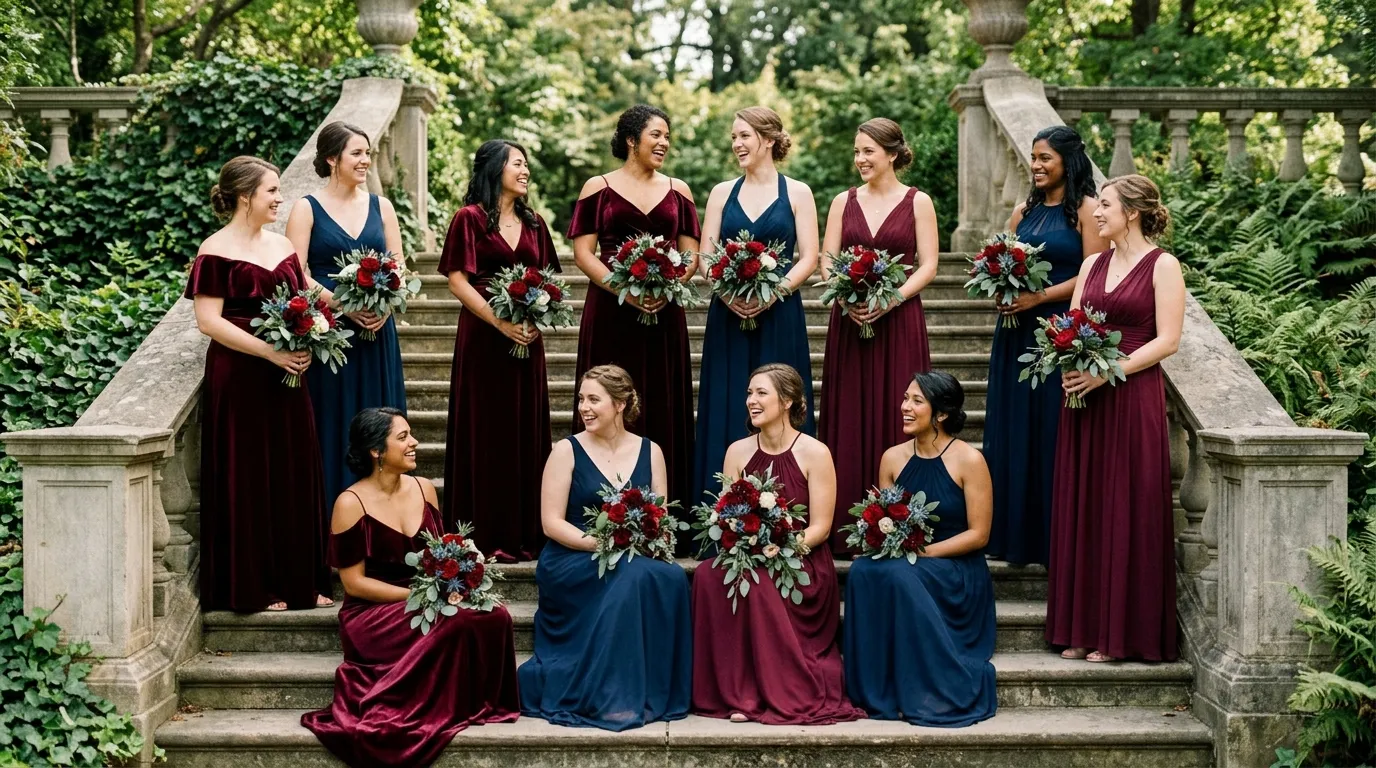
If your answer is spring or summer:
→ Your color direction: pastels, sage greens and champagne neutrals.
◎ WHAT IS YOUR VENUE STYLE?
If your answer is barn, garden or backyard:
→ Your color direction: earth tones and greens that borrow from the landscape.
If your answer is ballroom, hotel or city rooftop:
→ Your color direction: jewel tones, dark shades or champagne.
◎ WHAT MATTERS MORE: SKIN TONE FLATTERY OR PALETTE DRAMA?
If your answer is skin tone flattery:
→ Your color direction: navy, burgundy, dusty rose or dusty blue.
If your answer is palette drama:
→ Your color direction: emerald, forest green, plum or black.
◎ DO YOU WANT ONE COLOR OR A MIXED PALETTE?
If your answer is one color:
→ Your color direction: a single jewel tone or sage green in one fabric.
If your answer is a mixed palette:
→ Your color direction: mismatched bridesmaid dresses within one family, like three neutrals or two deep jewel tones.
Jewel tones are the workhorses of American bridesmaid photography, holding their saturation in dim ballrooms where pastels wash out. They also tend to flatter the widest range of complexions, so I’d start here if your group is mixed.
1. Burgundy: The Jewel Tone Standard
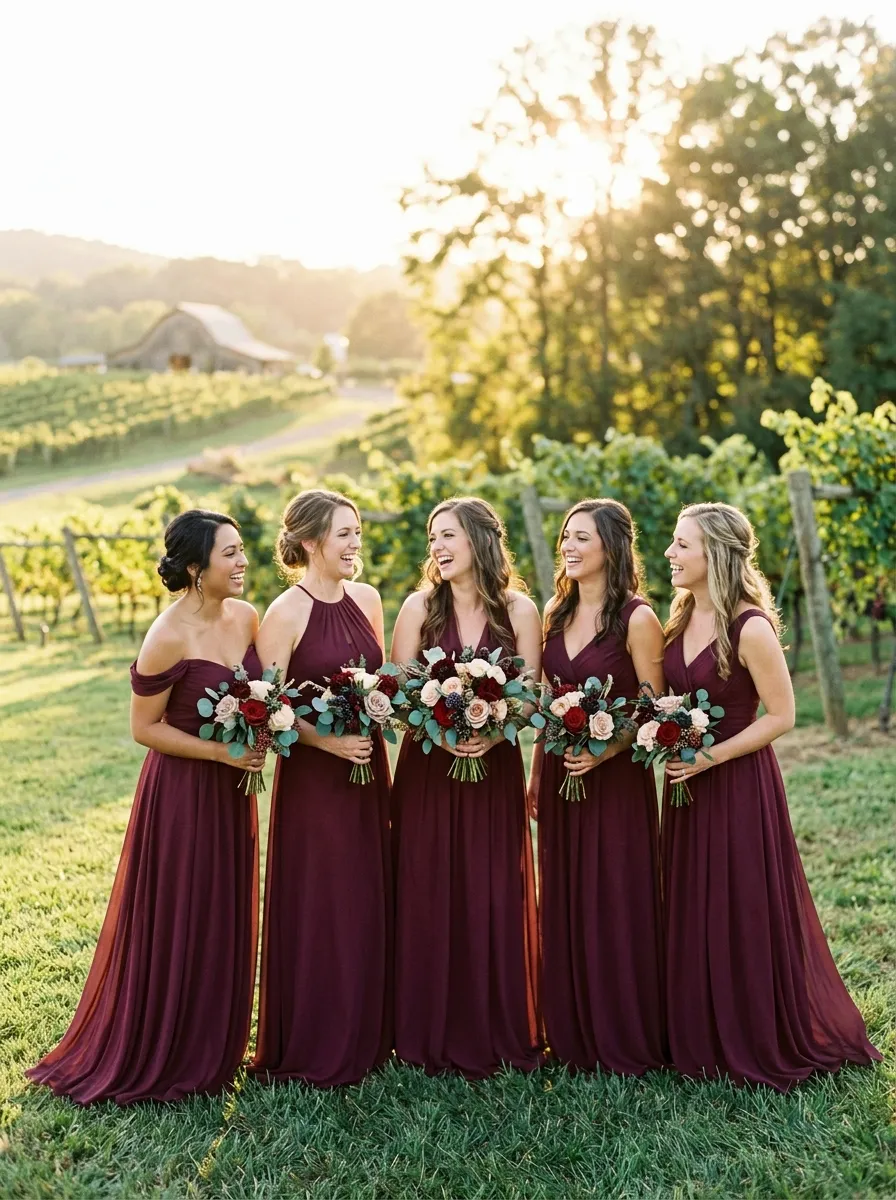
Burgundy sets the standard because it holds its depth in every kind of light and never competes with the bride. It flatters nearly every complexion, with the richest glow on medium to deep skin, while very fair skin does better in a version with a touch of berry. For your wedding, it belongs in fall and winter ceremonies, from Napa vineyards to candlelit barn receptions in Vermont. Burgundy bridesmaid dresses in chiffon or crepe from Azazie or BHLDN are also the most dependable of the dark bridesmaid dress colors for a late-day schedule. My honest note: choose a true wine with blue in it, because brownish burgundy turns muddy under flash.
2. Navy: Always Right, Never Wrong
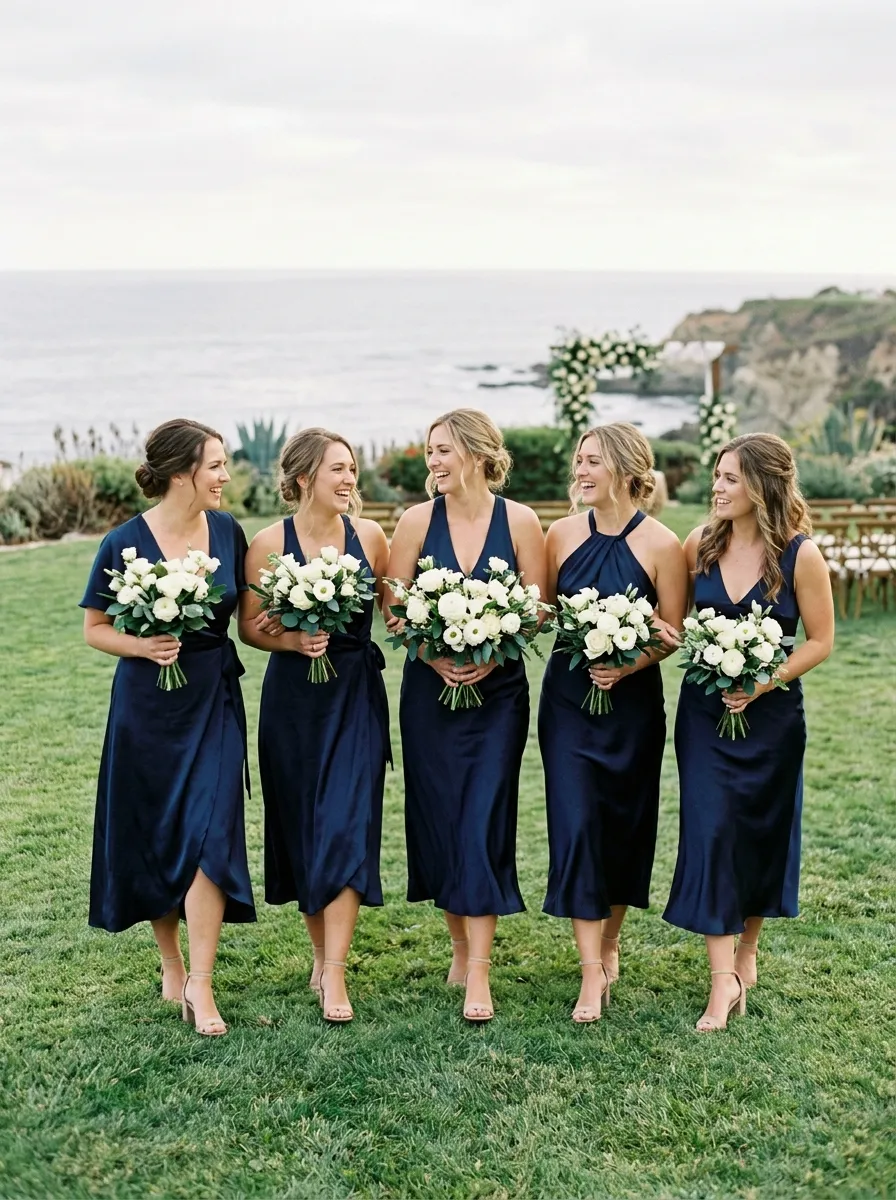
Navy is the color I’d hand to any bride who can’t decide, because it reads polished in a church, a ballroom and on a city rooftop alike. It flatters fair, medium, olive and deep complexions with almost no adjustment, and it makes white bouquets and ivory gowns look crisper. Navy bridesmaid dresses suit your wedding in any season, though they’re strongest from late spring through winter, from California beach ceremonies to Manhattan loft receptions. Satin bridesmaid dress color shows the deepest shine, while matte crepe reads calmer and more modern. The one caution is lighting, since very dark navy can look black in a dim reception.
The Editor’s Color Note: Choose True Navy
✦ Shade to request: true navy or ink navy, never midnight or near-black
✦ Best fabric: matte crepe or satin-back crepe
✦ What kills it: a flat overhead flash in a dim room, especially beside dark suits
✦ Budget option: David’s Bridal navy chiffon in the same true navy, which photographs almost identically
3. Emerald Dresses for Bold Weddings
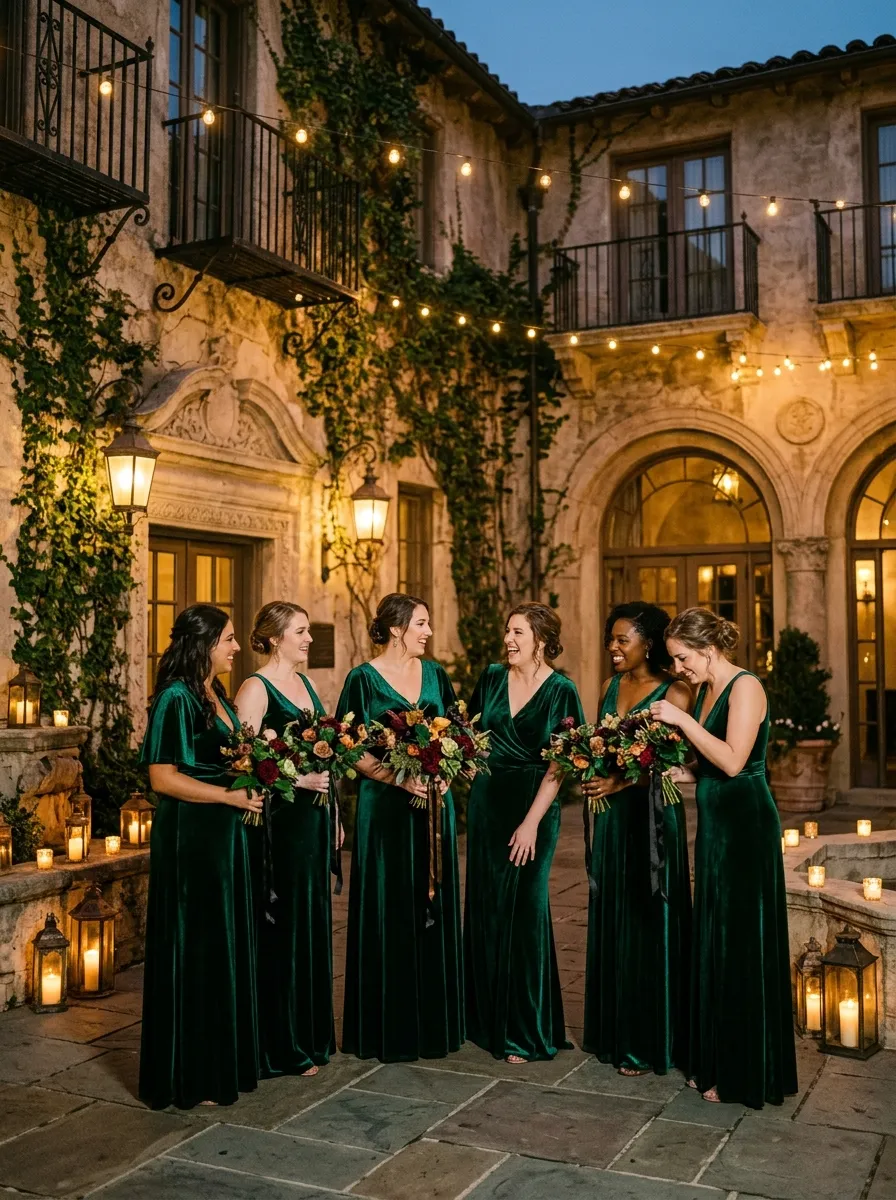
Emerald is the jewel tone for brides who want bridesmaids to look like part of the design instead of a backdrop. It flatters deep, olive and medium skin especially well, and fair skin handles it best in a slightly bluer version. Pair it with winter weddings, historic hotel ballrooms and evening receptions in Charleston or Chicago, where the saturation holds its own against gold and candlelight. In emerald velvet bridesmaid dress color reads richest of all, but the fabric is too heavy for a beach setting. Where emerald goes wrong is a yellow-leaning green that fights your bouquet, so test a swatch beside your flowers.
4. Plum: The Overlooked Jewel Tone
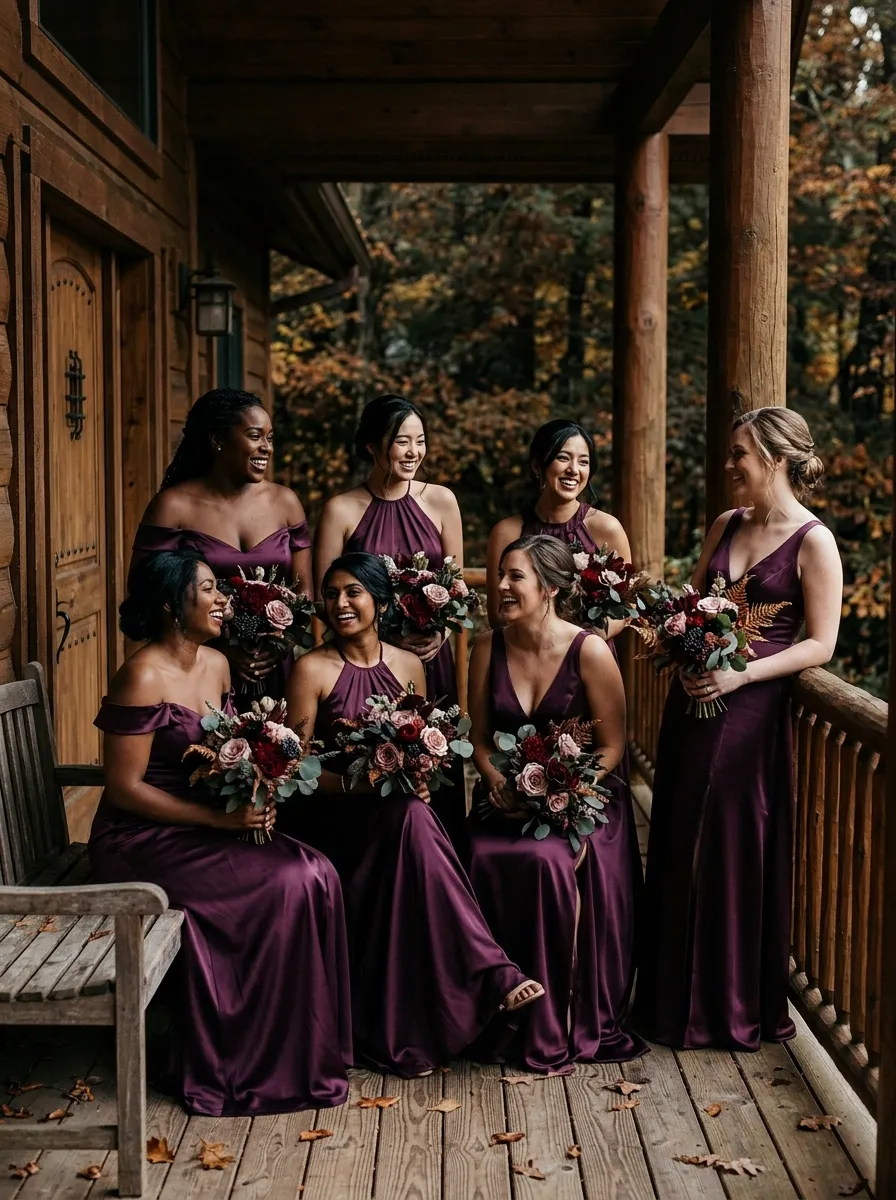
Plum is the jewel tone nobody asks for and everybody compliments, since it sits between burgundy and purple without the heaviness of either. It looks especially good on fair and medium skin, where its cool undertone adds contrast, and on deep skin it reads regal and warm. If your wedding is a fall or winter evening, from a moody Pacific Northwest lodge to a formal city ballroom, plum belongs on the shortlist. Ask for it in satin or velvet, the fabrics that keep jewel tone bridesmaid dresses from looking flat. Skip any plum that leans gray, because it drains under indoor light and photographs as dull purple-brown.
5. Teal Bridesmaid Dresses That Work
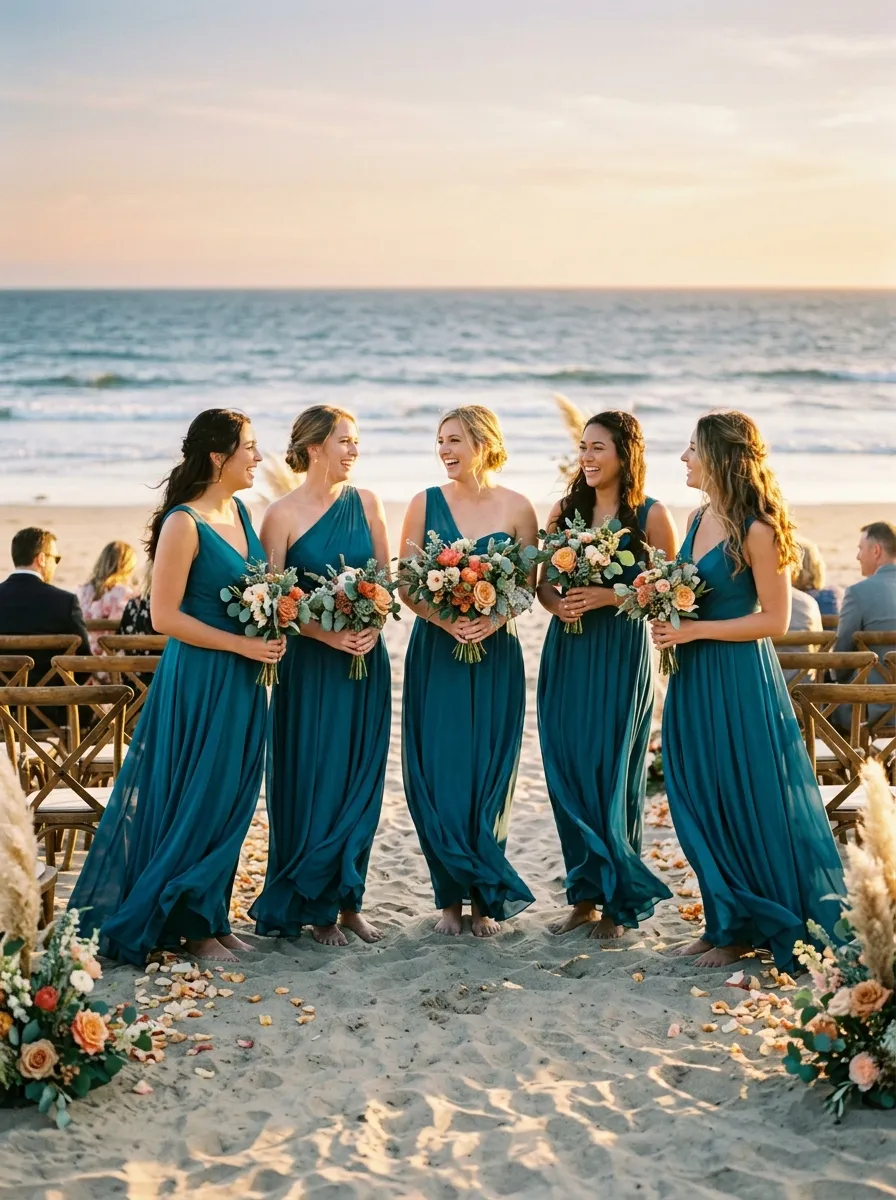
Teal is where the jewel tone family meets the coast, a saturated blue-green that photographs vividly against sand, greenery and stone. It flatters medium, olive and deep complexions most, while very fair skin does better with a softer, slightly grayed teal. California beach ceremonies, lakeside weddings and late spring garden receptions are where teal bridesmaid dresses make the most sense for your wedding. As a bridesmaid color for beach wedding planning, it’s bolder than the usual pastels and stands up to harsh sun. The honest note: avoid teals with a lot of green in them, which drift into scrubs territory in photographs.
6. Mixing Two Jewel Tones Successfully
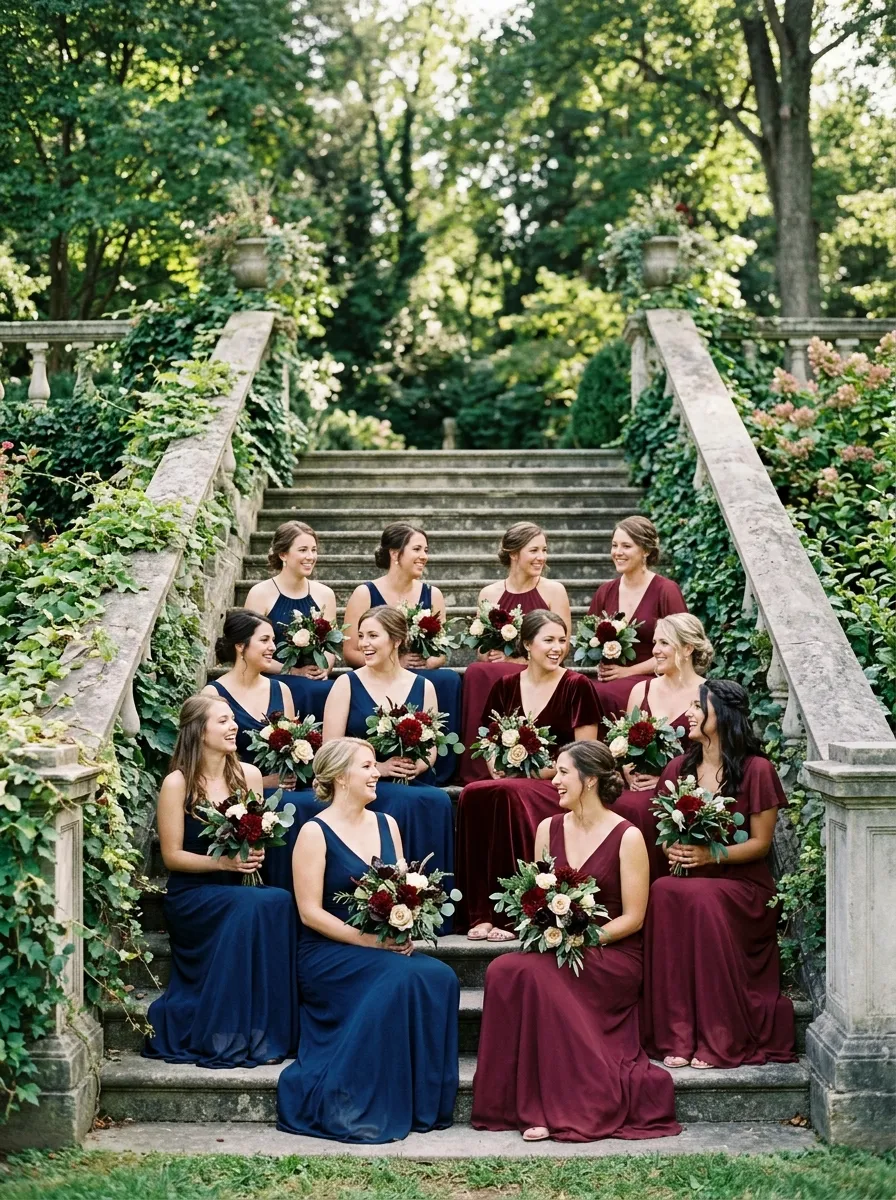
Two jewel tones in one lineup read as a deliberate palette when the depths match and as a mistake when they don’t. Match saturation first, such as burgundy with navy or emerald with plum, and the mix will flatter a wider range of complexions than any single shade could. This suits your wedding if it’s a fall or winter evening, and it lets you choose the shade that suits each bridesmaid’s coloring. Mismatched bridesmaid dresses in two jewel tones work best when one color covers about two thirds of the group. If one shade is brighter than the other, the eye goes straight to it in photographs, so check them side by side in daylight.
💎 Jewel Tones: Which Shade for Which Season
Jewel tone bridesmaid dresses are the easiest of all bridesmaid dress color ideas to match to a season, and the matrix below does the matching for you. Fall weddings call for bridesmaid colors that match the season, and our fall color style guide shows how the same warm autumn palette works across every fashion context.
| COLOR | BEST SEASON | BEST VENUE | AVOID WITH |
|---|---|---|---|
| Burgundy | Fall and winter | Vineyard, barn, ballroom | Bright red florals that blur into the dress |
| Navy | Late spring through winter | Church, coastal, city | Black suits in a dim room |
| Emerald | Winter and early spring | Historic hotel, evening reception | Yellow-green greenery |
| Deep Plum | Fall and winter | Candlelit ballroom, lodge | Navy dresses nearby, since they merge in low light |
| Teal | Late spring and summer | Beach, lakeside, garden | Mint and seafoam accents |
Earth tones read as warm, grounded and quietly expensive in photographs, especially when the light is low and golden. They ask for care with undertones, but they reward it with a palette that feels like the venue instead of sitting on top of it.
7. Dusty Rose: Warm and Camera-Ready
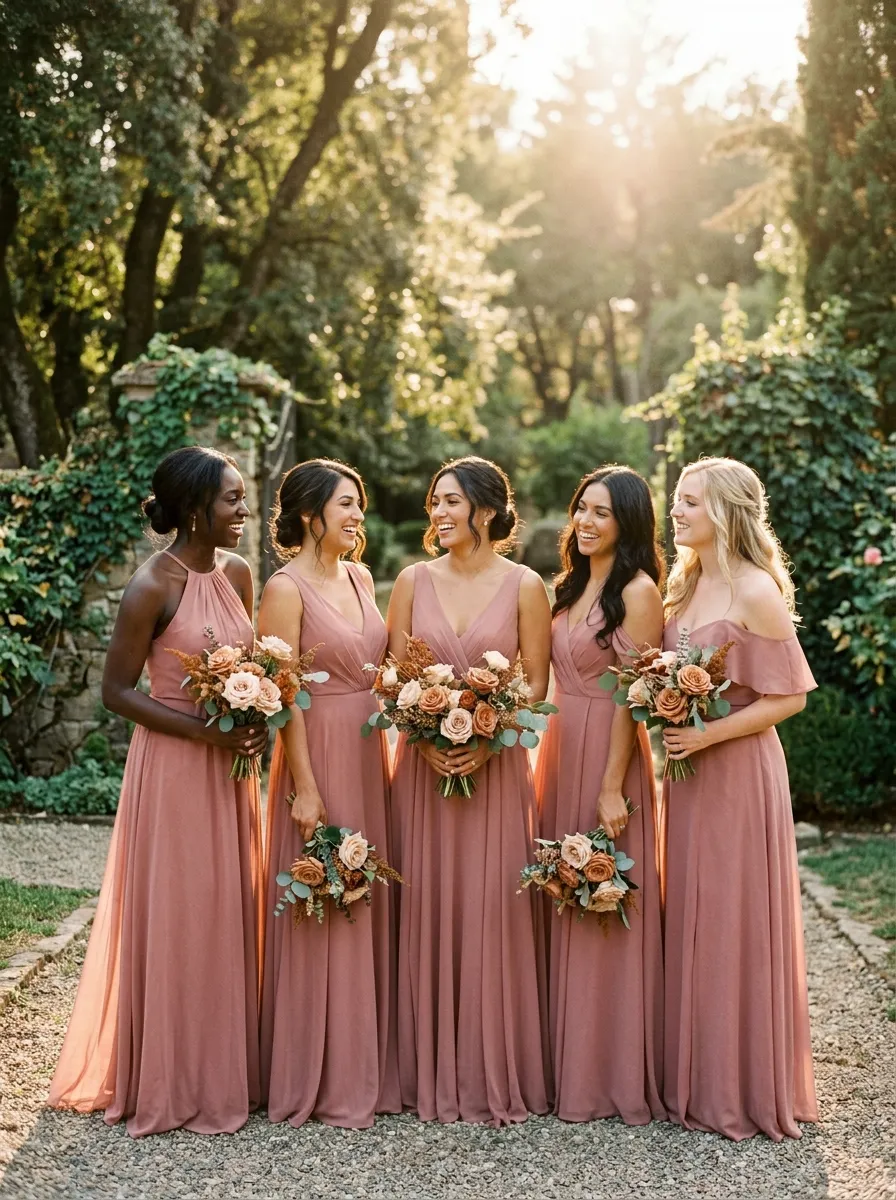
Photographers love dusty rose because it behaves like a warm neutral in pictures, picking up golden light without turning candy pink. It flatters fair, medium and deep skin tones alike, which makes dusty rose bridesmaid dresses a safe choice for a varied group. Garden weddings, spring ceremonies and early fall barn receptions are its natural settings for your wedding, and it pairs well with ivory and cream florals. Anthropologie and BHLDN both stock it in flowy chiffon and satin, and it’s one of the easiest wedding party color ideas to build a mixed-fabric group around. My honest note: it can read gray-brown in dim rooms, so skip it for a ballroom at night.
8. Terracotta for Fall Weddings
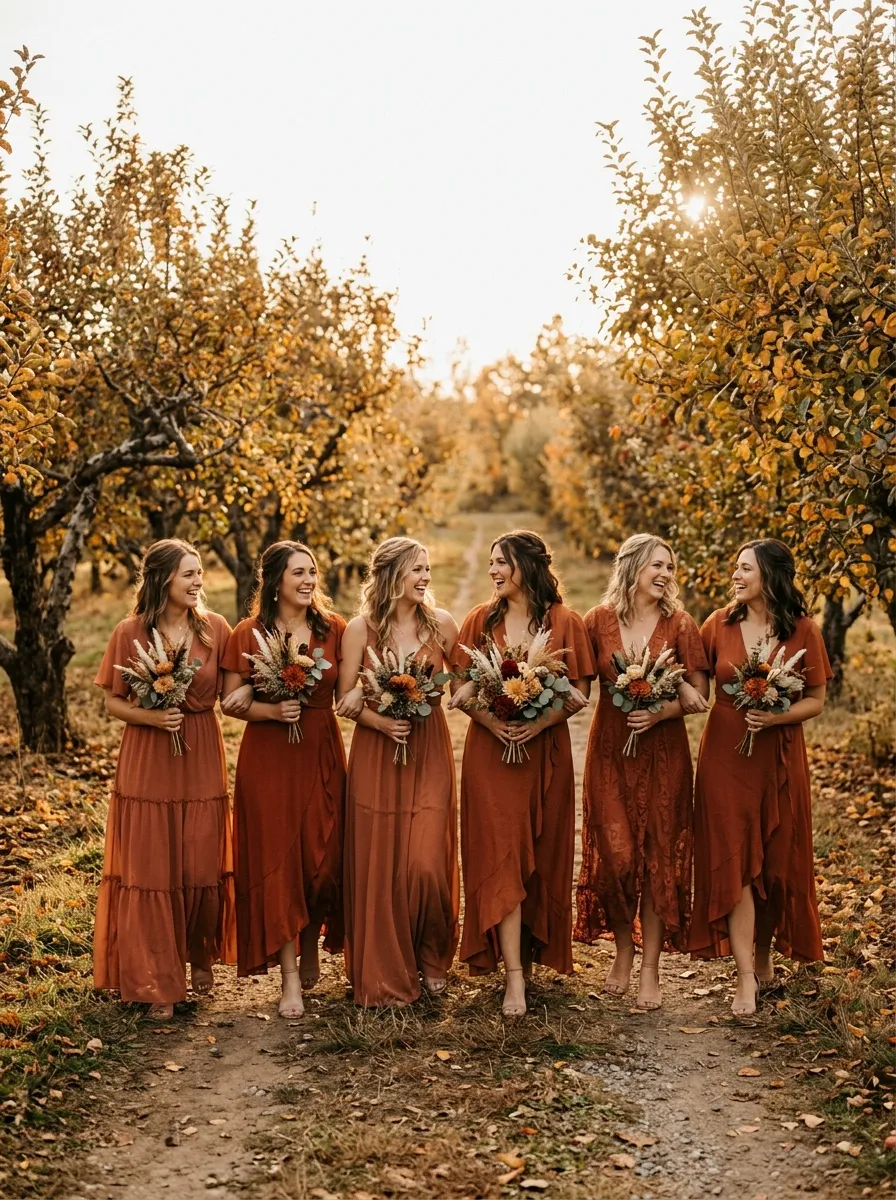
Terracotta makes a fall ceremony look like it belongs to the landscape, with a clay warmth that sits right against turning leaves. It flatters medium, olive and deep skin most, while fair skin needs a lighter, peachier version so the dress doesn’t flatten the complexion. It’s a natural bridesmaid color for fall wedding venues like Hudson Valley orchards, Texas Hill Country ranches and Carolina farm barns, wherever your wedding takes place. Earth tone bridesmaid dresses like these look best in flowy chiffon and crepe, and boho cuts suit them particularly well. The honest note: a terracotta that leans too orange reads as a costume, so keep a muted clay base.
The Editor’s Color Note: Muted Clay Wins
✦ Shade to request: clay or baked terracotta, never orange-terracotta
✦ Best fabric: crepe or matte chiffon
✦ What kills it: neon-bright florals and a harsh overhead flash
✦ Budget option: an Azazie or David’s Bridal terracotta chiffon in a simple A-line cut
9. Rust Dresses for Autumn Ceremonies
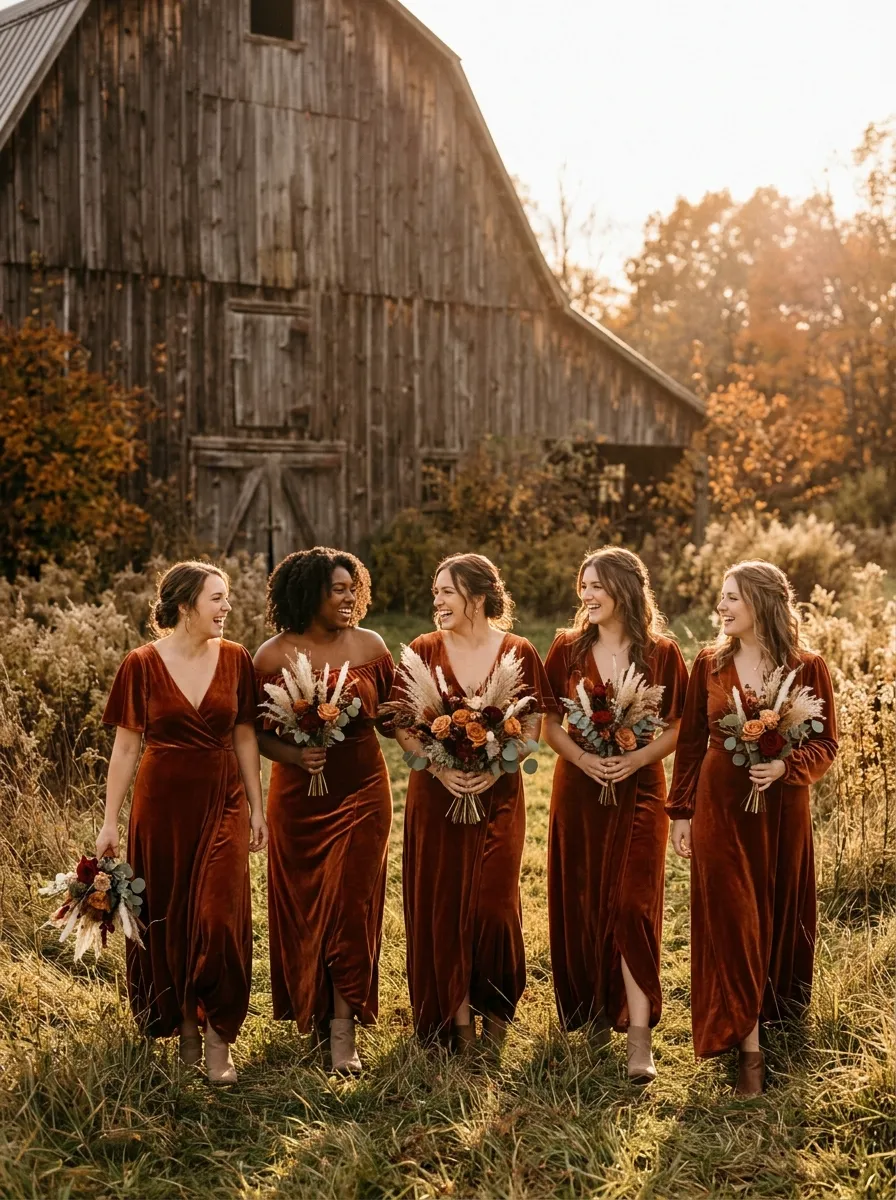
Rust goes deeper than terracotta and reads like autumn itself, with a brown-red depth that photographs richly in low sun. It flatters medium, olive and deep skin tones in particular, and it warms fair complexions if you keep the neckline open and the fabric matte. For your wedding on a farm, in a vineyard or at a lodge in the fall, rust bridesmaid dresses sit well next to dried grasses and burgundy dahlias. A velvet or satin rust gives a more formal evening look, while chiffon keeps it relaxed for an afternoon ceremony. Don’t pair it with a bright orange bouquet, because the colors blur into one warm patch in photos.
10. Burnt Orange: Bold but Grounded
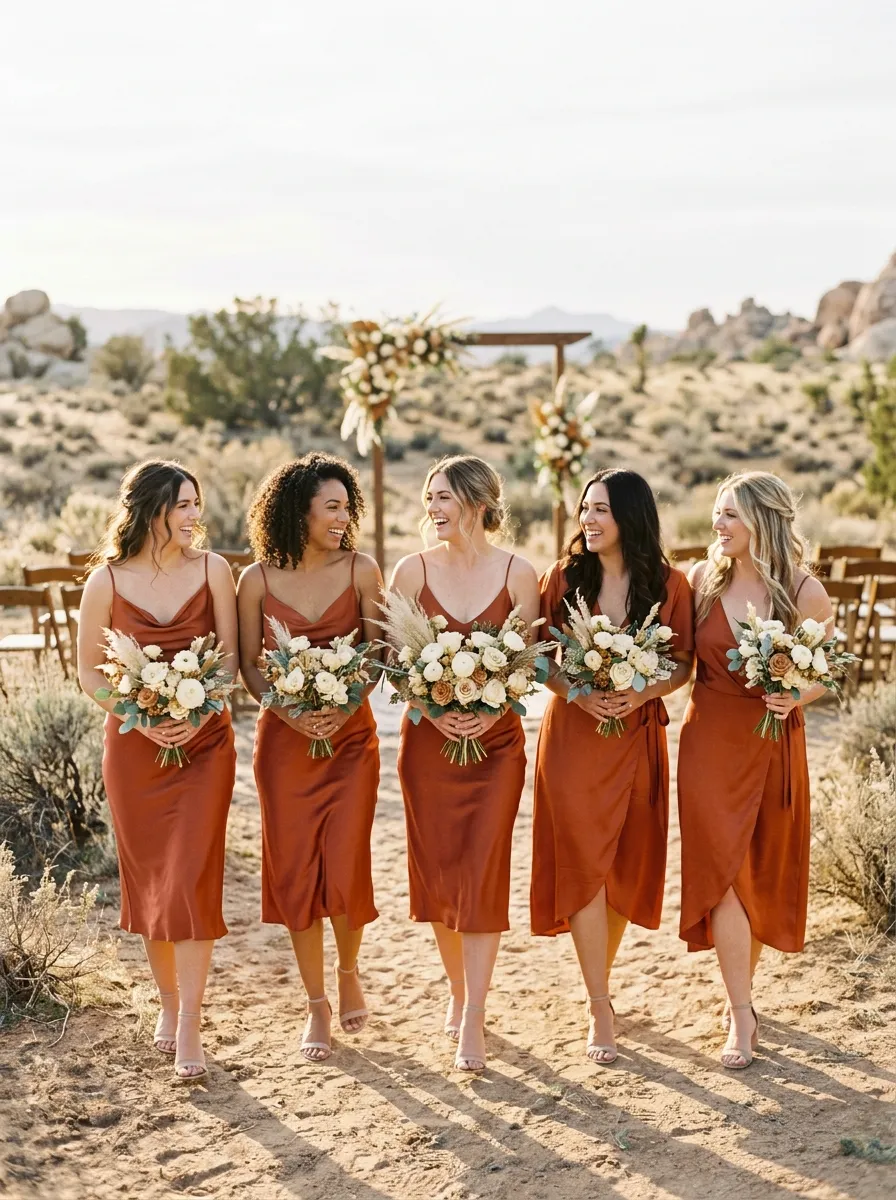
Burnt orange is the boldest of the earth tones, and it only works when you commit to it fully. It looks strongest on medium, olive and deep skin, while fair skin can look flushed unless the shade has some brown in it. Think of fall barn weddings, harvest-style receptions and desert ceremonies where the landscape already carries the same warm palette. For your wedding, a mixed palette with cream and olive keeps it grounded instead of loud, which is an easy way to build bridesmaid palette ideas around seasonal florals. Any orange with too much yellow looks like a safety vest in photos, so go for the deeper, browner version.
11. Mauve: The Subtle Earth Tone
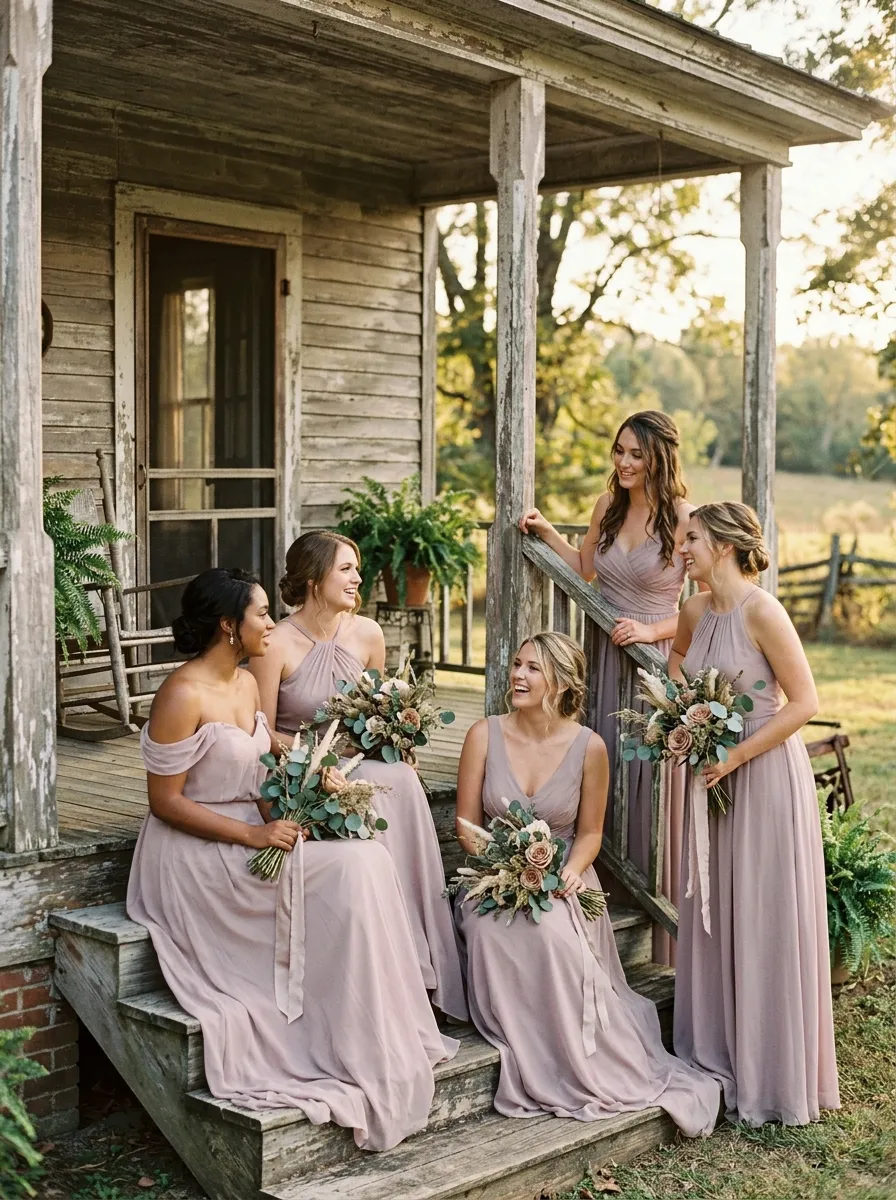
Mauve is the soft in-between where dusty rose meets warm brown, and it photographs as a calm, slightly vintage color. It flatters fair, medium and olive complexions with a quiet warmth, though very deep skin can look chalky if the shade is too pale. Early fall weddings, rustic indoor venues and spring garden ceremonies suit it, and it’s a smart base for floral bridesmaid dresses color schemes at your wedding. It pairs well with champagne and ivory, and it works in satin, chiffon and lace. My honest note: mauve is the shade most likely to look different on a screen than in person, so order swatches before the whole group commits.
12. Warm Brown for Outdoor Weddings
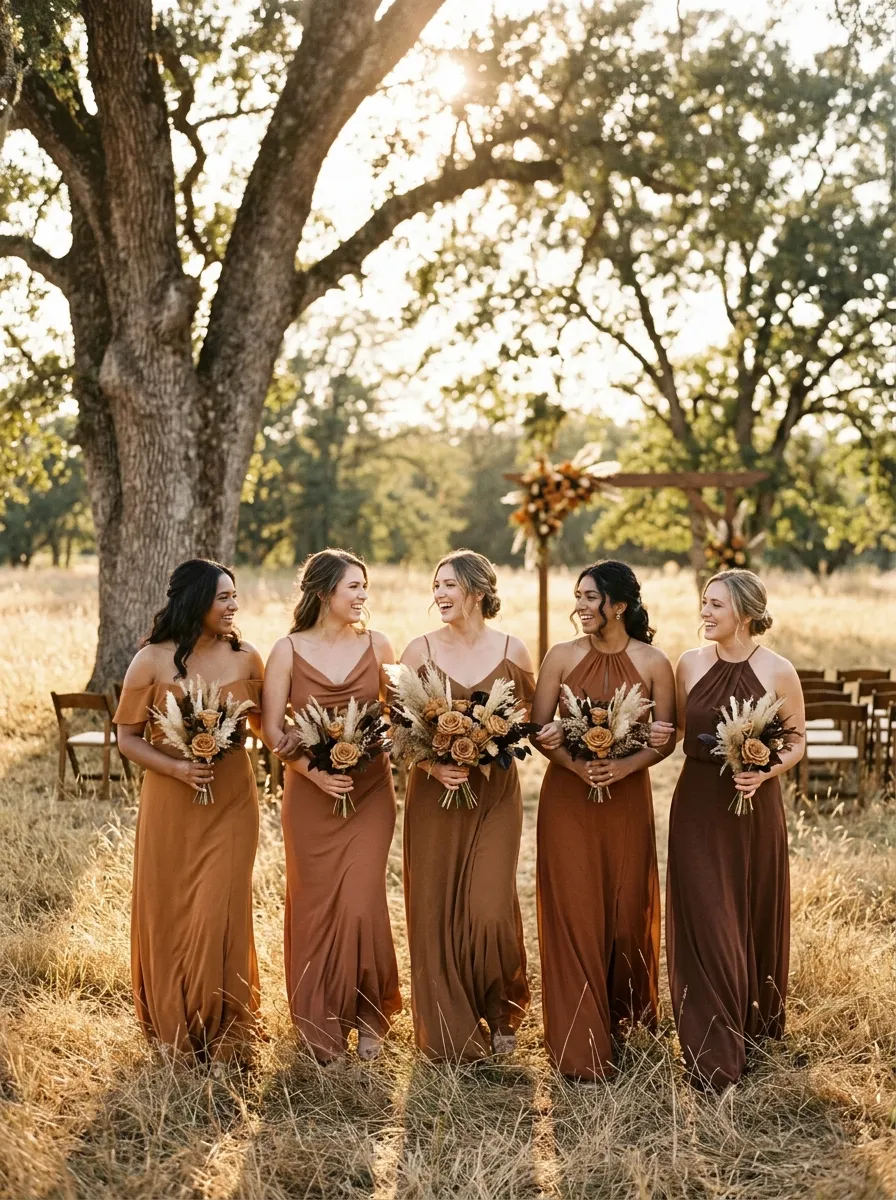
Warm brown looks quietly intentional outdoors, where it reads like bark, wheat and tobacco leaf against a natural backdrop. It flatters medium, olive and deep skin tones best, while fair skin needs a lighter caramel or camel to keep the face from looking washed out. Pair it with barn weddings, Southern garden ceremonies and mountain venues in the fall, when your wedding palette can pull straight from the surroundings. For a quick refresh of earth tone bridesmaid dresses, ask for a taupe-leaning brown in matte satin or crepe. Brown with no warmth looks drab under any light, so keep a reddish or golden base.
🍂 Earth Tones: The Photography Guide
The best bridesmaid dress color ideas in the earth family all behave differently by the hour, so use these bridesmaid dress photography tips to plan your timeline. The right bridesmaid dress color works even harder when it is paired with the right hair color, and our wedding hair color guide shows the specific tones that photograph well alongside every bridesmaid palette.
DUSTY ROSE: MORNING LIGHT: soft and slightly cool, closest to its true color. GOLDEN HOUR: warms toward coral and flatters almost every complexion. INDOOR RECEPTION: can turn muddy under tungsten bulbs, so test it first.
TERRACOTTA: MORNING LIGHT: reads a little flat and clay-like. GOLDEN HOUR: glows and looks richest. INDOOR RECEPTION: holds up well under warm bulbs and candles.
RUST: MORNING LIGHT: reads closer to brown. GOLDEN HOUR: deep, warm and photogenic. INDOOR RECEPTION: stays rich in candlelight but loses detail in very dark rooms.
MAUVE: MORNING LIGHT: dusty pink-gray with a calm feel. GOLDEN HOUR: warms into a soft rose. INDOOR RECEPTION: tends to gray out, so keep lighting warm.
WARM BROWN: MORNING LIGHT: reads neutral and natural. GOLDEN HOUR: turns caramel. INDOOR RECEPTION: darkens quickly, so pair it with lighter florals.
THE FLASH PROBLEM: Direct flash flattens earth tones and pushes warm shades toward orange or gray, so ask your photographer to bounce the light.
Green is the color family brides save most and photograph least well when the shade is chosen carelessly. Pick the right depth and it lets bouquets, lawns and candlelight do half the styling work for you.
13. Sage Green Bridesmaid Dress Color Ideas
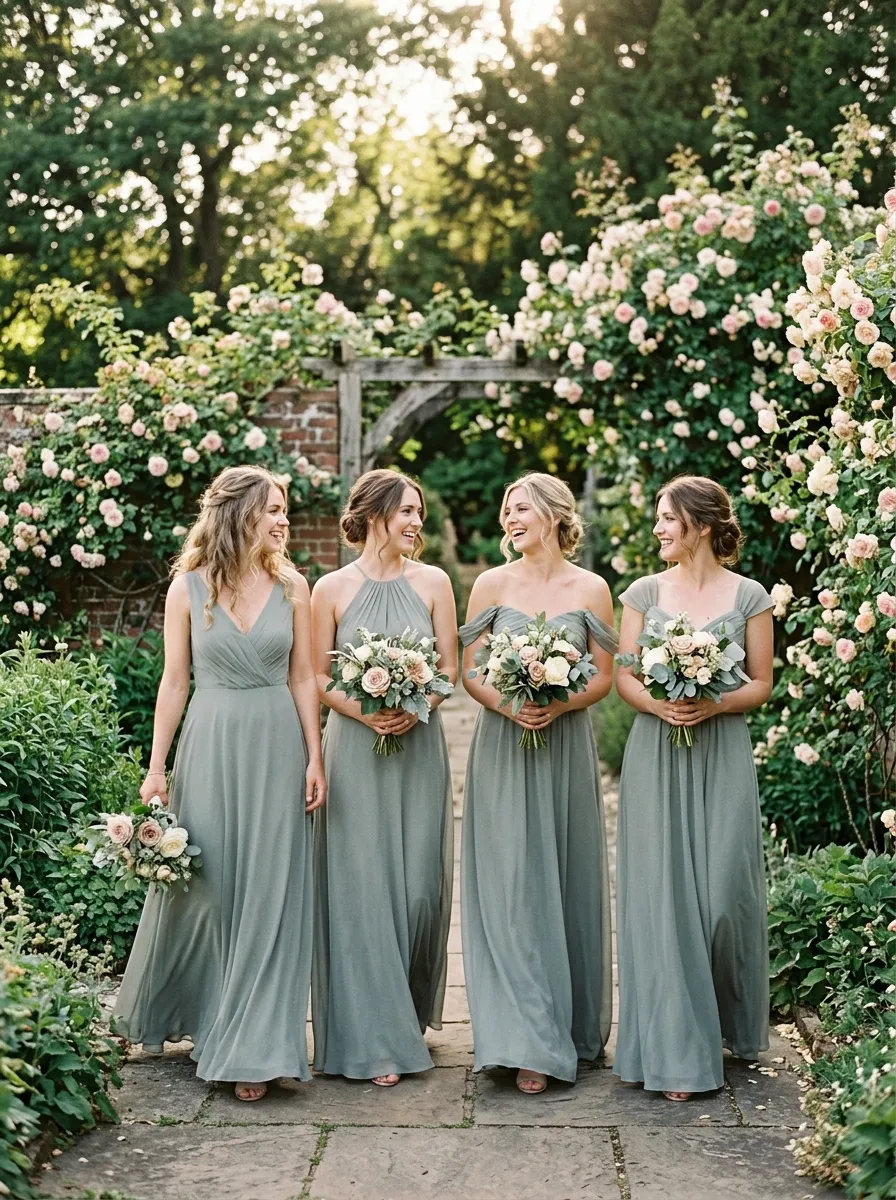
Sage green is the most requested green in bridesmaid dress colors because it acts like a neutral that happens to be a color. It flatters fair, medium and olive complexions with a soft, earthy warmth, while deep skin looks richer in a slightly deeper sage. It suits spring and summer garden weddings, California vineyard ceremonies and outdoor receptions where greenery is part of your wedding backdrop. Sage green bridesmaid dresses from Azazie or BHLDN come in dozens of grayed greens, so match the swatch to your bouquet stems. Pale sage can vanish into a leafy backdrop and wash out fair skin, so go a shade deeper than your Pinterest board.
14. Olive Green for Garden Weddings
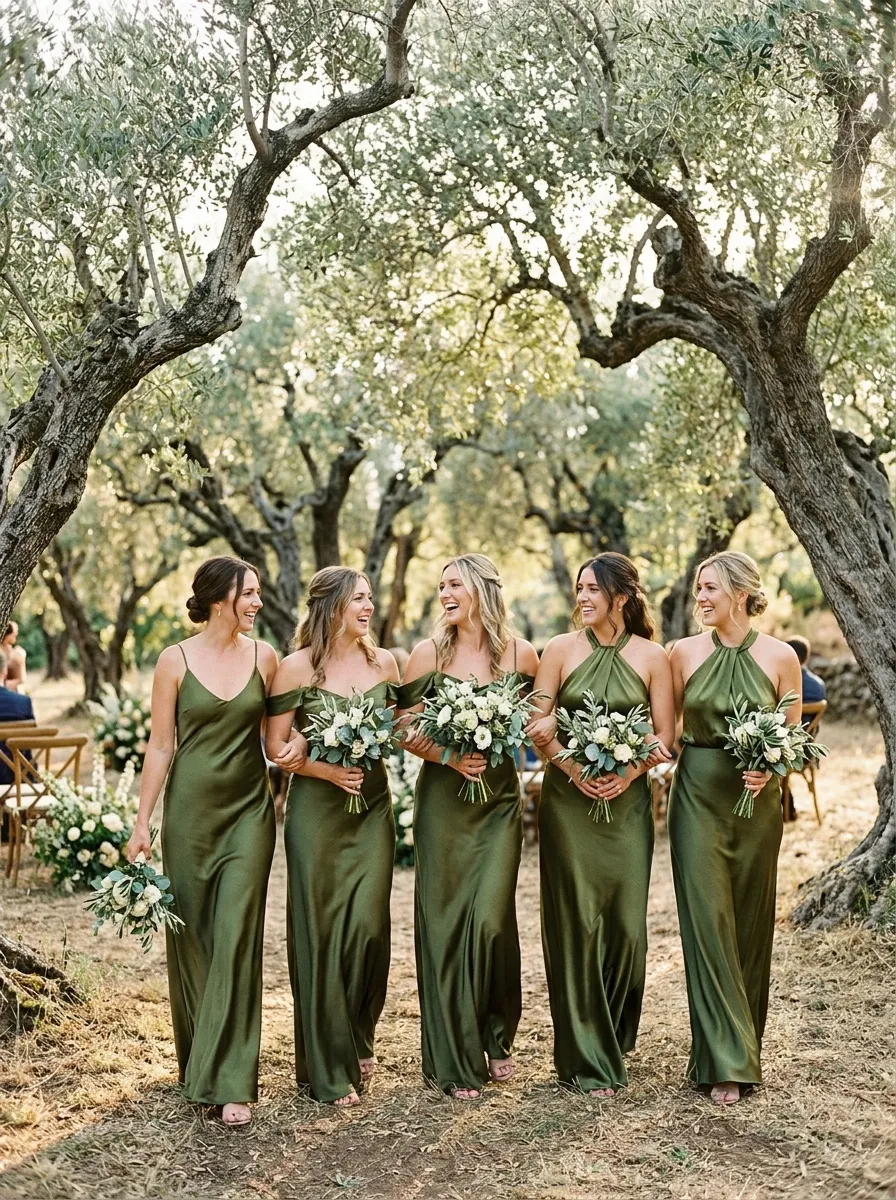
Olive brings the deeper, earthier side of the green family and looks at home among olive trees, tall grass and aged brick. It flatters medium, olive and deep skin best, while fair skin looks lively when there’s a little warmth in the shade. Olive bridesmaid dresses make sense for garden weddings, orchard receptions and early fall ceremonies in Georgia and Northern California, so consider it if your wedding leans rustic. Satin gives it a quiet shine, while chiffon feels softer and more romantic, and both pair with earth tones with ease. Avoid olive with too much yellow, which turns sallow in indoor flash.
15. Blue-Green: The Unexpected Middle Ground
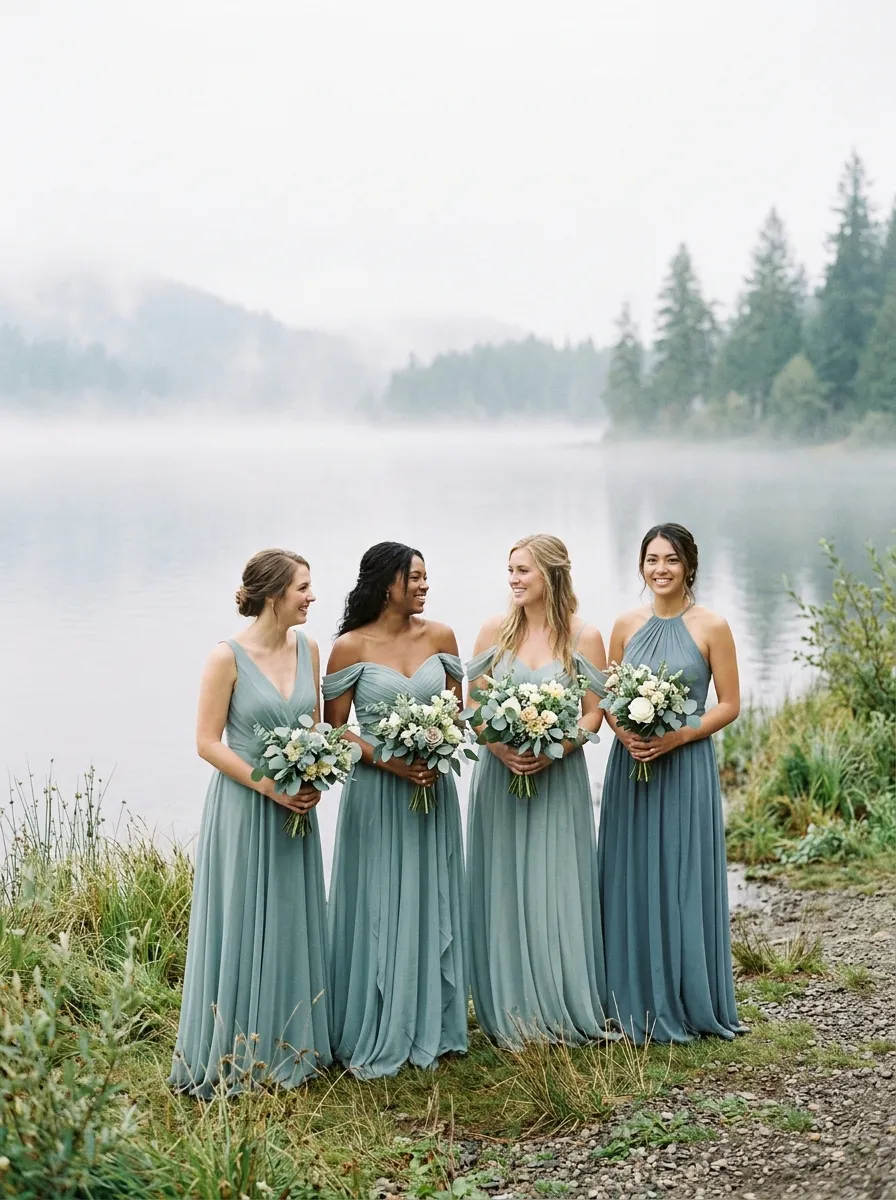
Dusty blue-green lands between sage and dusty blue, and it photographs with a cool, misty calm few other shades manage. It flatters fair, medium and olive skin well, and the cool-leaning shade gives deep skin a clean contrast. Coastal weddings, lakeside ceremonies and spring garden venues use it best, especially when the florals include eucalyptus and white blooms. For your wedding, it’s a smart pick among bridesmaid palette ideas that need to sit between green and blue. It can drift too far toward either color in different light, so check swatches outside at the time of day you’ll marry.
16. Forest Green: Drama Without Darkness
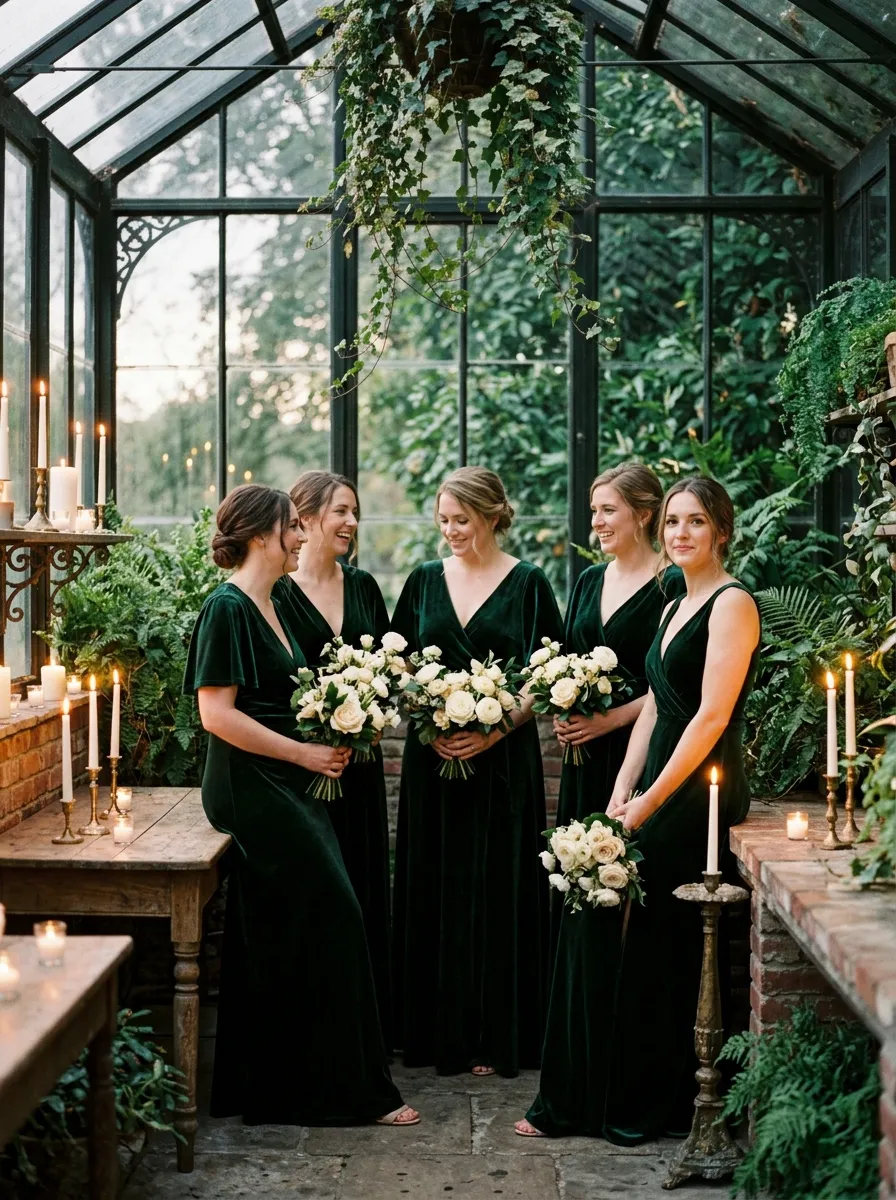
Forest green gives you drama without the heaviness of black, a dark, deliberate green that frames florals well. It flatters fair skin with a clear contrast, and it deepens medium, olive and deep skin with a rich glow. Winter weddings, evening receptions and moody greenhouse venues are its home turf, though it also works at a fall barn wedding. Velvet is the signature fabric, but a matte satin keeps it lighter if your wedding falls outside the cold months. Pair it with warm metallics and cream, because forest green next to black reads as one flat dark mass in photographs.
The Editor’s Color Note: Add Warm Metallics
✦ Shade to request: hunter or deep pine with a hint of blue
✦ Best fabric: velvet for winter, matte satin for the rest of the year
✦ What kills it: dark backdrops with no lighting and black suits that swallow the dresses
✦ Budget option: an Azazie or David’s Bridal forest green chiffon with a satin sash
17. Sage Paired With Warm Neutrals
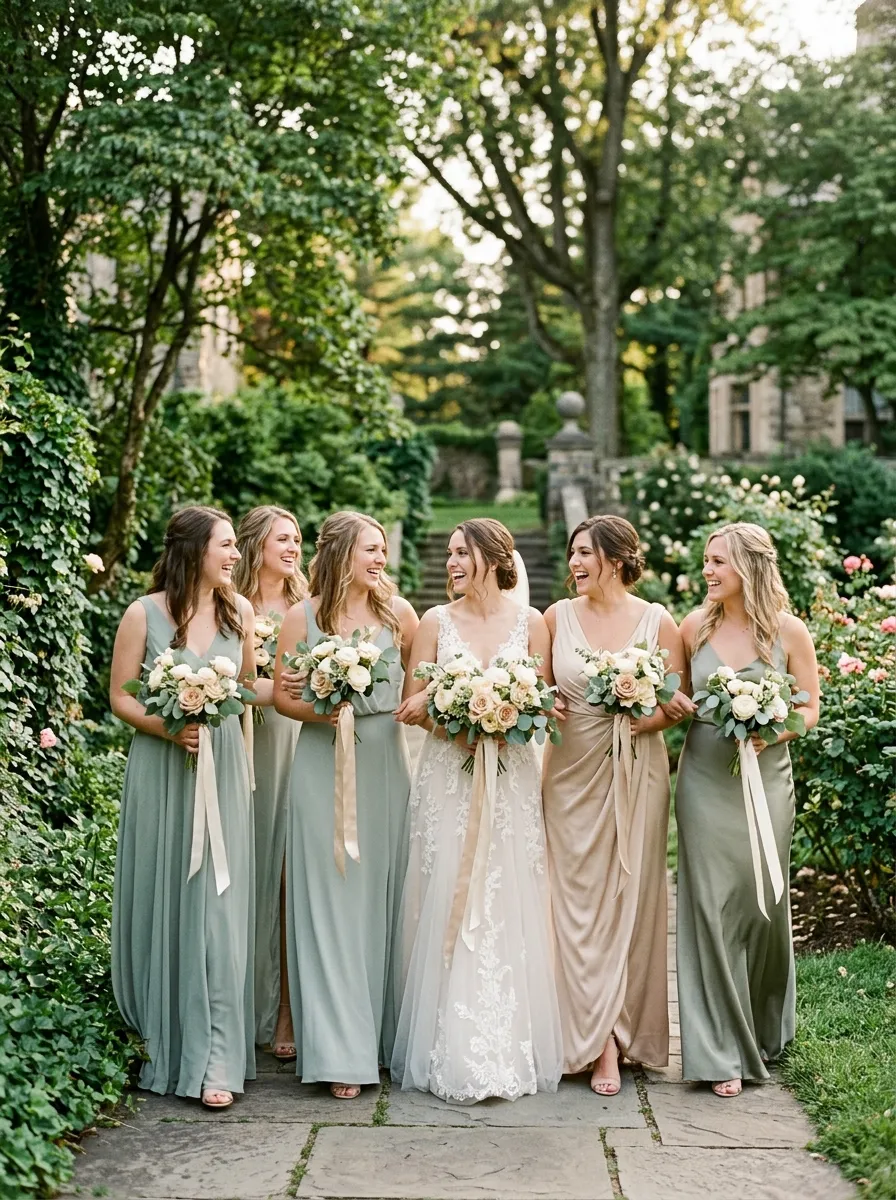
Combining sage with warm neutrals lets you keep the green without putting every bridesmaid in the same dress. Sage next to champagne, ivory and soft tan flatters every skin tone, because the neutrals soften the green’s gray undertone. This works at garden weddings, barn receptions and spring ceremonies where the palette needs to look natural. One approach is to dress the group in sage and give the maid of honor champagne, a trick that sits at the center of neutral bridesmaid dress colors. For your wedding, keep the sage the same depth across the group, or the mix looks accidental.
Pastels are the most honest color family, because they show every lighting mistake and every undertone clash. Get the light and the skin tone pairing right and nothing photographs softer or sweeter.
18. Blush Bridesmaid Dress Color Ideas
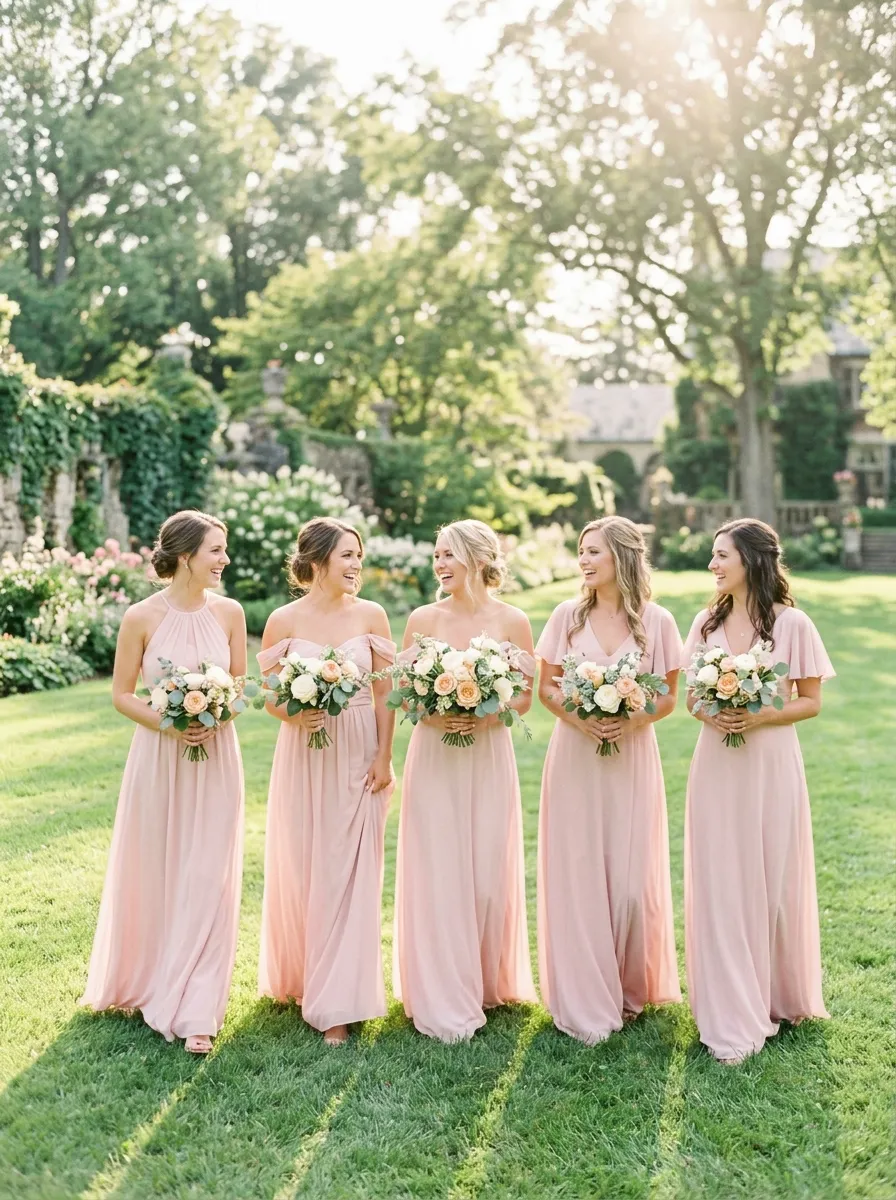
Blush is the soft pink that reads as a warm neutral instead of a pastel, which is why it never seems to date. It flatters fair, medium and olive skin with a gentle glow, while very deep skin looks best in a richer blush with a coral base. Blush bridesmaid dresses suit spring weddings, garden ceremonies and bright ballrooms with white and ivory florals, so they fit your wedding if you want romance without fuss. David’s Bridal and BHLDN carry the widest ranges, from pale chiffon to dusty satin, so pick one fabric family to keep the group even. Pale blush disappears next to a white gown in bright sun, so go a shade deeper than you think you need.
19. Lavender for Spring Garden Weddings
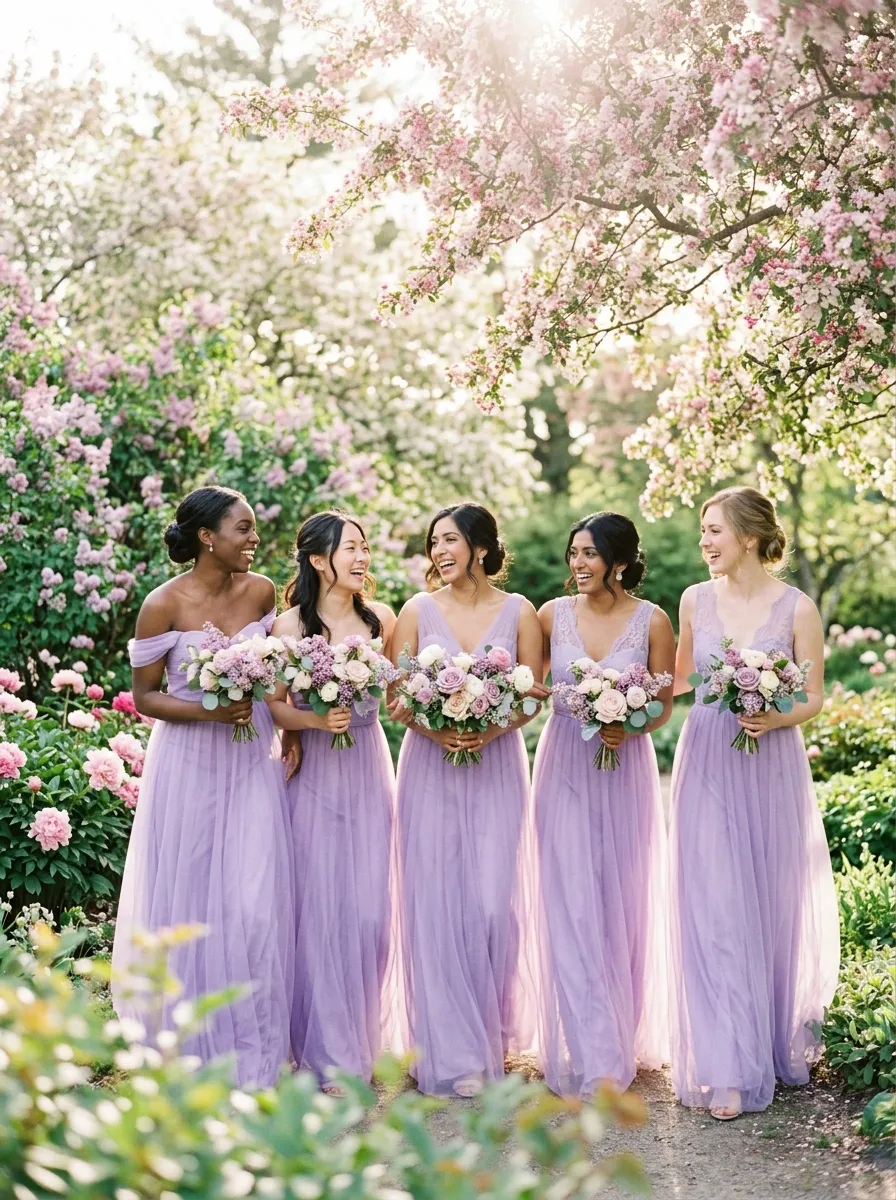
Lavender makes a spring wedding feel like a garden in bloom, a soft purple that sits well against greenery. It flatters fair and medium skin with a cool freshness, and it brings out the warmth in olive and deep complexions. Spring and early summer gardens, backyard receptions and daytime ceremonies suit it best, particularly in Southern gardens in full bloom. Pair it with white and sage florals at your wedding and keep fabrics light, since chiffon and tulle keep the shade airy. Lavender with too much gray turns dull in photographs, so choose a clear, soft violet.
20. Dusty Blue: The Pastel That Performs
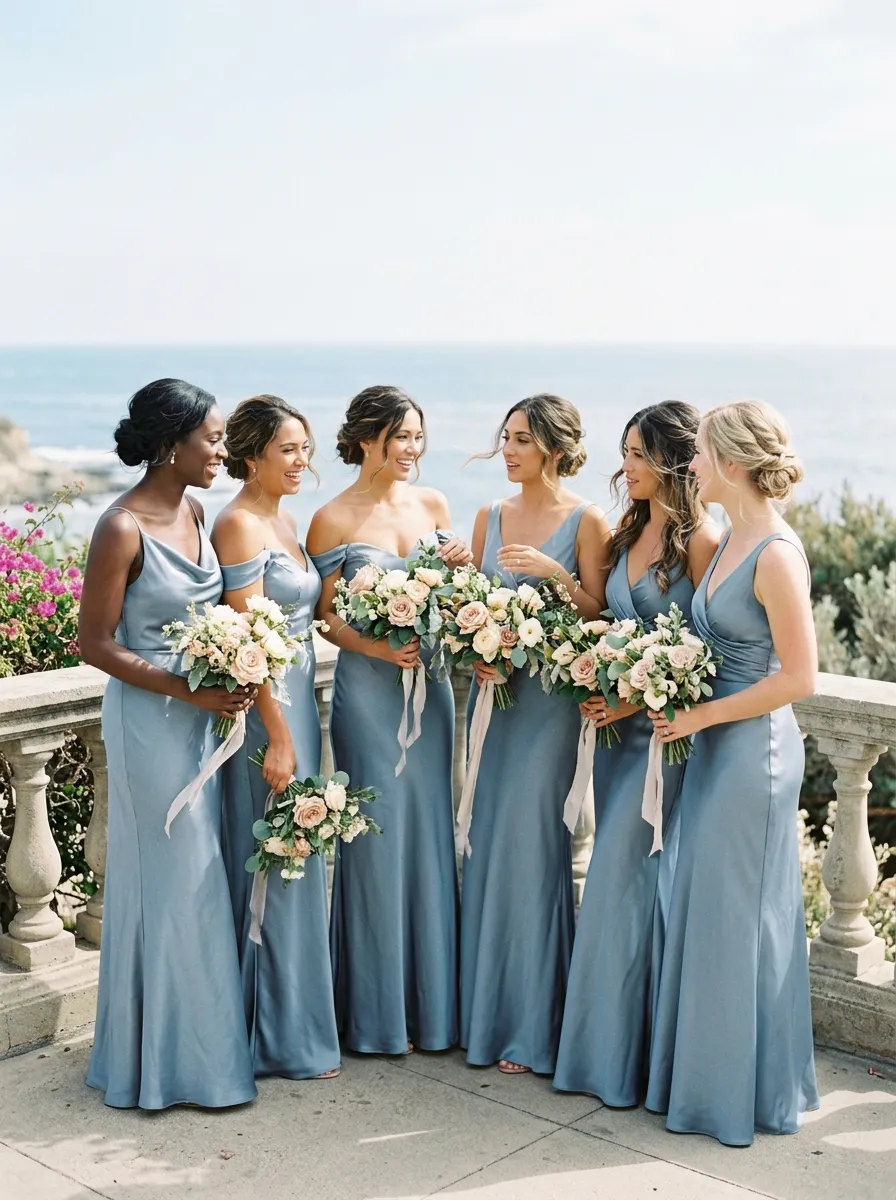
Muted and cool, dusty blue is the pastel that performs in nearly every lighting condition, from bright sun to candlelit tents. It flatters fair, medium, olive and deep skin tones with little adjustment, which makes dusty blue bridesmaid dresses the most reliable pastel for a mixed group. They suit coastal weddings, spring ceremonies and fall barn receptions, and they pair with white, ivory and warm wood details at your wedding. Pastel bridesmaid dresses in satin, chiffon and crepe from Azazie, BHLDN and David’s Bridal let you mix fabrics without breaking the palette. Skip any shade with a gray cast, which looks cold in shade and dim rooms.
21. Pale Yellow for Bright Weddings
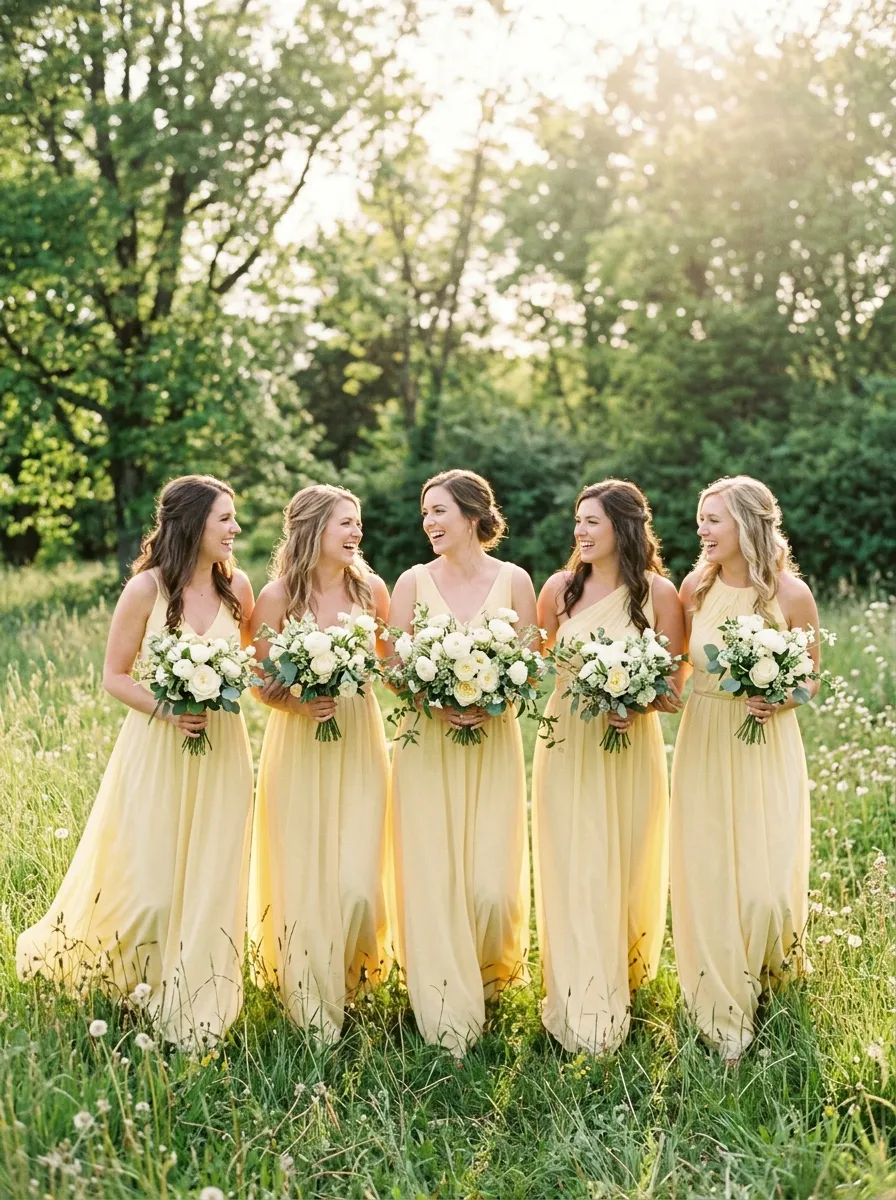
Pale yellow is the warm pastel for weddings that want sunshine in every photo, photographing as soft butter against green and white. It flatters medium, deep and olive skin with a warm glow, while fair skin looks best in a creamier, slightly peachy yellow. Bright outdoor ceremonies, spring garden weddings and daytime beach receptions suit it, and it’s an easy bridesmaid color for spring wedding planning. Pair it with ivory, greenery and white florals at your wedding, and avoid heavy metallics. Yellow with a green cast looks sickly in photos, so choose butter over lemon.
22. Dusty Lilac: Quiet and Considered
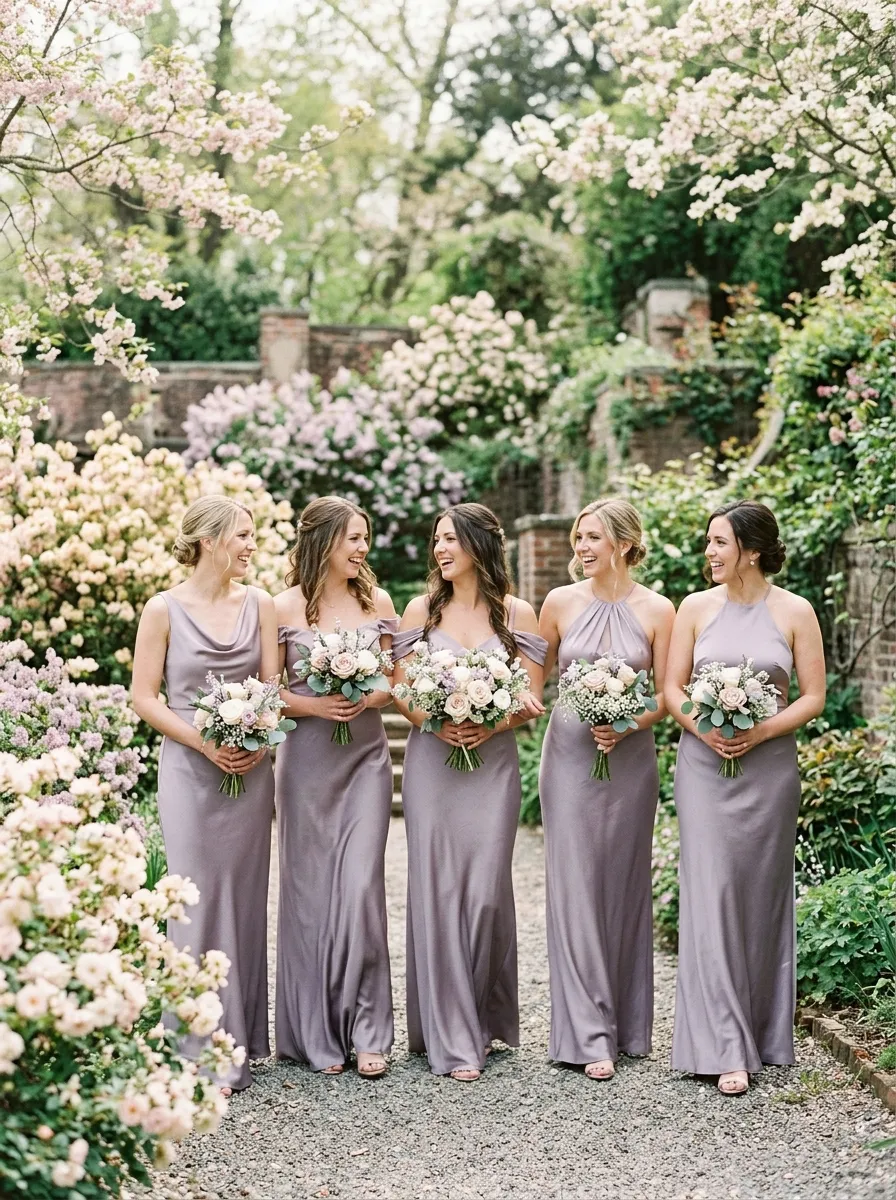
Quiet is the right word for dusty lilac, a softer, grayer purple that reads as restrained instead of sweet. It flatters fair and medium skin with a cool softness, and it gives olive and deep skin tones a clean, understated contrast. Spring garden weddings, bridal luncheons and evening receptions with candles all suit it. For your wedding, it makes a smart base for mixed palettes alongside sage, blush and ivory, and it anchors floral bridesmaid dresses color schemes when the print includes those same shades. Lilac with too much pink looks juvenile, so keep it gray-leaning.
🌸 Pastels: Skin Tone Pairing Guide
Use this bridesmaid dress skin tone guide to narrow the pastel field, because blush bridesmaid dresses and other soft shades behave differently on every complexion.
FAIR SKIN: Dusty blue and dusty lilac. Their cool, slightly muted tones add contrast, so very pale skin doesn’t blend into the fabric.
MEDIUM SKIN: Blush and pale yellow. The warmth in both brings out natural color without looking flat.
OLIVE SKIN: Lavender and warm blush. Lavender cools the undertone, while a peachy blush adds soft warmth.
DEEP SKIN: Pale yellow and lavender. Both contrast cleanly with deep complexions and photograph with a fresh brightness.
THE UNIVERSAL PASTEL: Dusty blue is the one pastel that works across every skin tone I’ve seen photographed.
Pale yellow and warm blush share their color vocabulary with honey and golden hair tones, and our warm tone hair ideas guide shows how that same warmth works across every seasonal aesthetic.
Neutrals are where bridesmaid color gets quiet, and in photographs quiet reads as confident when the fabric is good. The risk is flatness, so texture and undertone do the work that color usually does.
23. Champagne Bridesmaid Dress Color Ideas
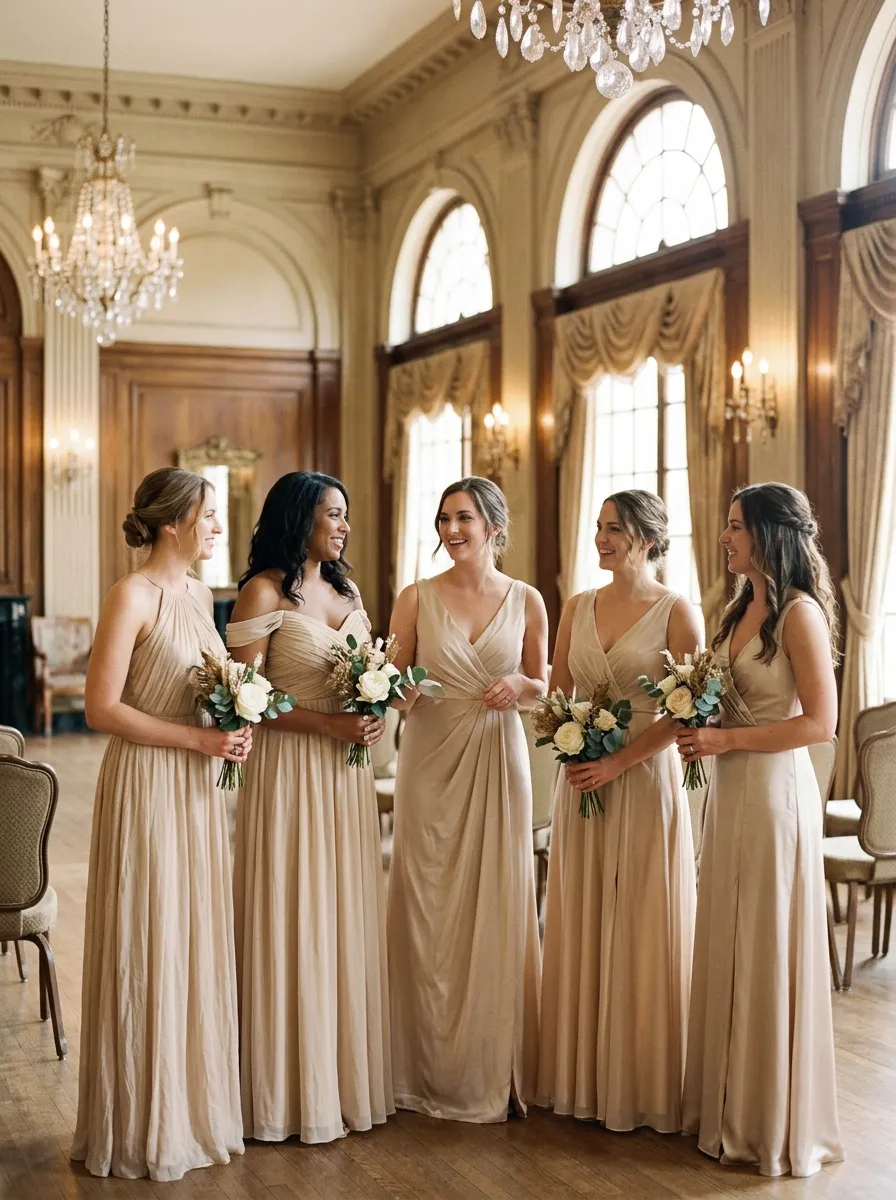
Champagne is the warm neutral with luxury baked in, a pale gold-beige that gives a lineup a glow without competing with the gown. It flatters fair, medium and olive skin with a soft shimmer, while deep skin looks best in a deeper, gold-toned champagne. Champagne bridesmaid dresses suit ballroom weddings, summer garden ceremonies and winter receptions where metallic details carry the palette of your wedding. Sequin and satin versions from BHLDN and Azazie photograph best in warm light. Champagne can disappear next to an ivory gown, so keep it at least two shades deeper.
24. Ivory Bridesmaid Dresses That Work
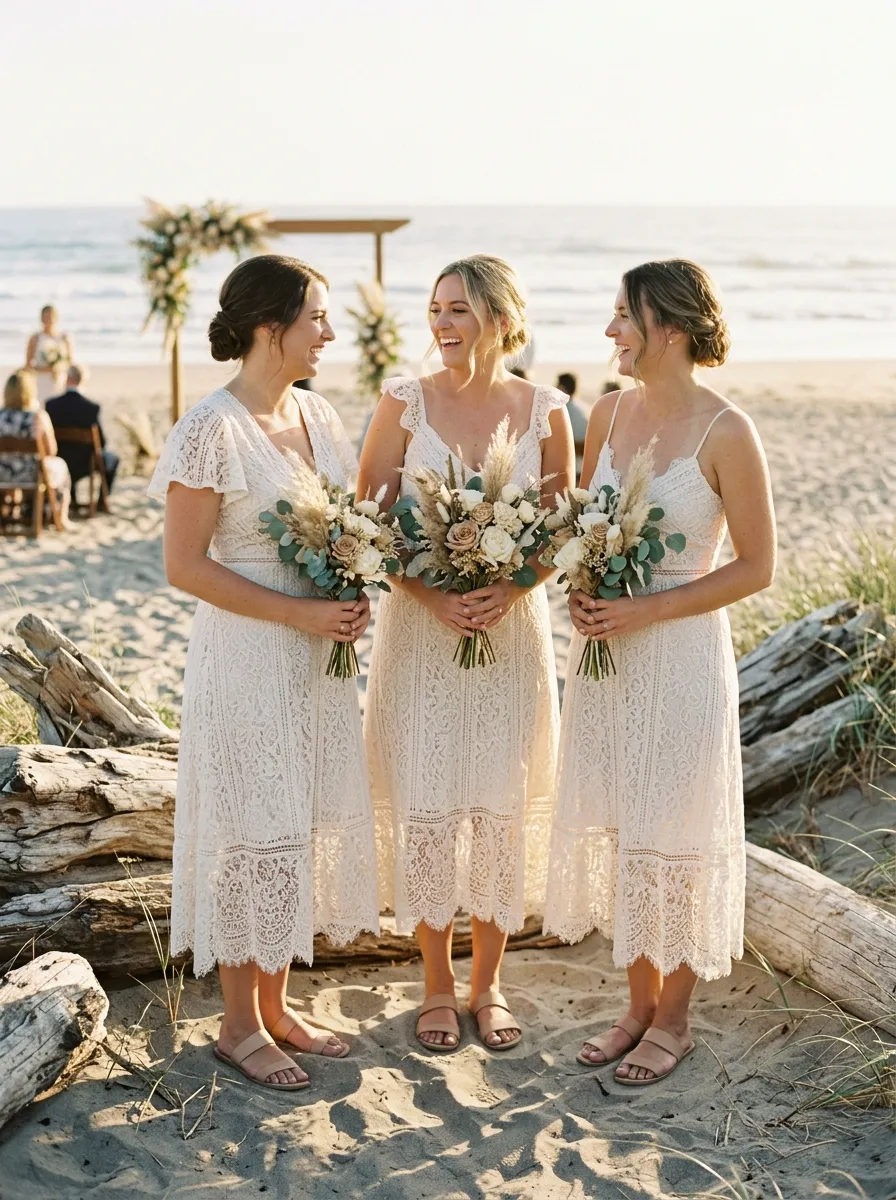
Ivory is the softest neutral you can ask bridesmaids to wear, and it only works when the bride’s gown is clearly a different color. It flatters medium, olive and deep skin as a creamy contrast, while very fair skin can look washed out against it. Ivory bridesmaid dresses suit beach ceremonies, minimalist weddings and boho outdoor receptions, where texture does the work. Lace, crepe and linen keep ivory from looking flat, and a sage or champagne sash adds definition at your wedding. Confirm your gown shade first, because ivory beside a white dress is the one neutral pairing that ends in photo regrets.
The Editor’s Color Note: Texture Over Shine
✦ Shade to request: soft ivory with a warm base, never stark off-white
✦ Best fabric: lace overlay or matte crepe
✦ What kills it: direct sun on flat fabric and any shade that matches the bride’s gown
✦ Budget option: a David’s Bridal ivory chiffon with a lace topper
25. Taupe: The Understated Neutral
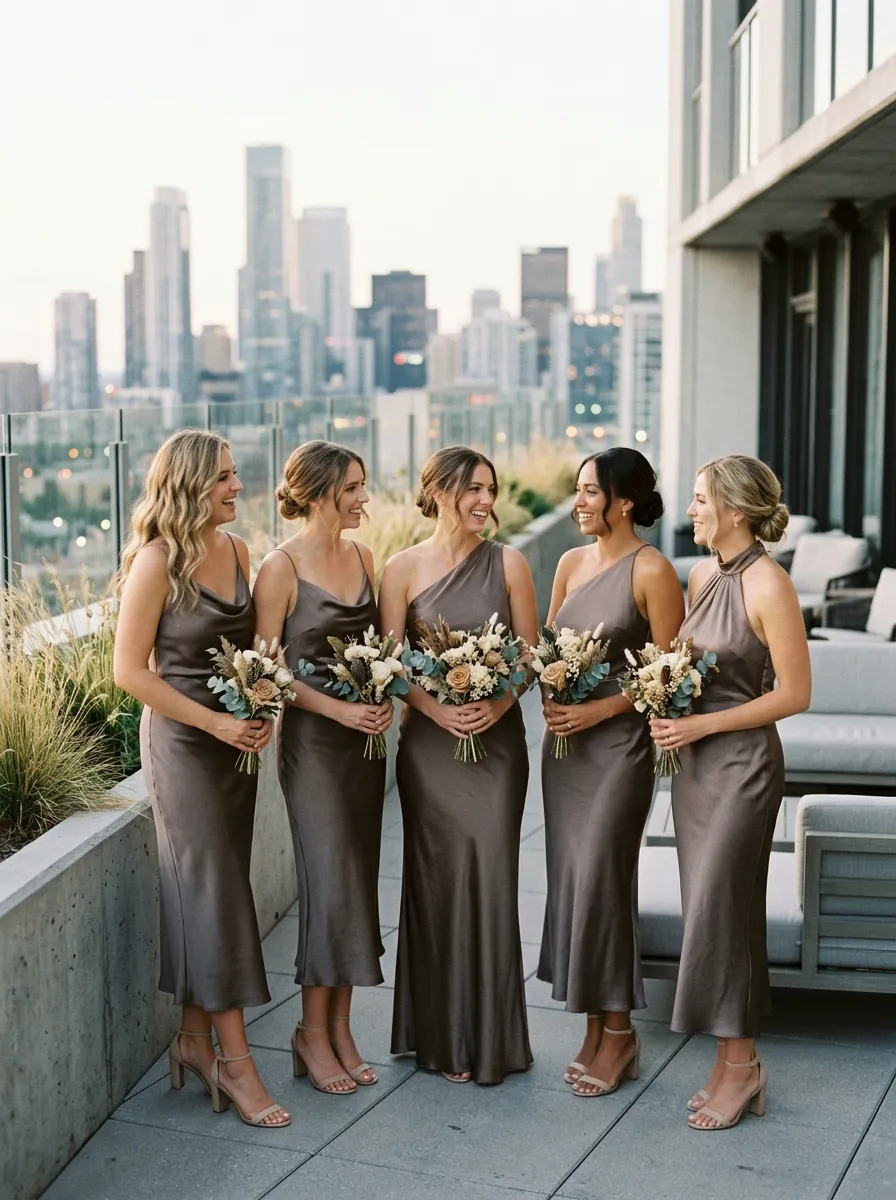
Taupe is the cool-leaning neutral with editorial quality, a gray-brown that reads polished in photographs without trying hard. It flatters medium, olive and deep skin tones with a clean, modern contrast, while fair skin looks best in a taupe with a touch of pink. Taupe bridesmaid dresses suit urban venues, modern receptions and fall or winter weddings where a muted palette fits your wedding setting. Satin and crepe versions look rich, and they pair well with burgundy or forest green accents. A taupe with no warmth can look dull in dim light, so pick a version with a rose or sand undertone.
26. Warm Beige for Minimalist Weddings
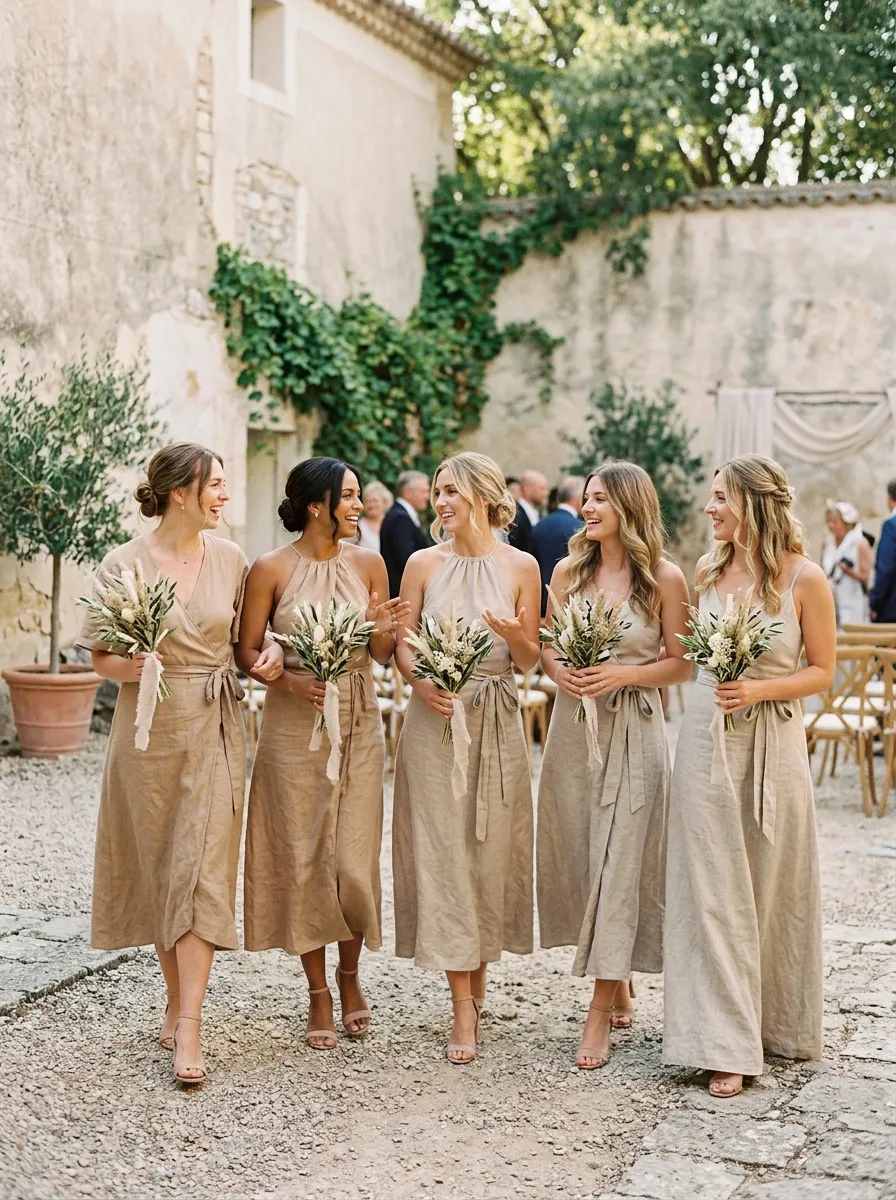
Beige gets dismissed as boring until you see warm beige on a lineup of bridesmaids standing in soft light. It flatters medium, olive and deep skin with an easy glow, and fair skin looks best when the beige has a rosy undertone. Minimalist weddings, courthouse ceremonies and coastal receptions are where it shines, and it pairs with bouquets in white, green and soft pink at your wedding. In linen, satin or crepe, it’s one of the most natural of the neutral bridesmaid dress colors. Beige with a yellow cast turns sallow in indoor flash, so choose rosy sand.
27. Mismatched Neutrals: The Modern Approach
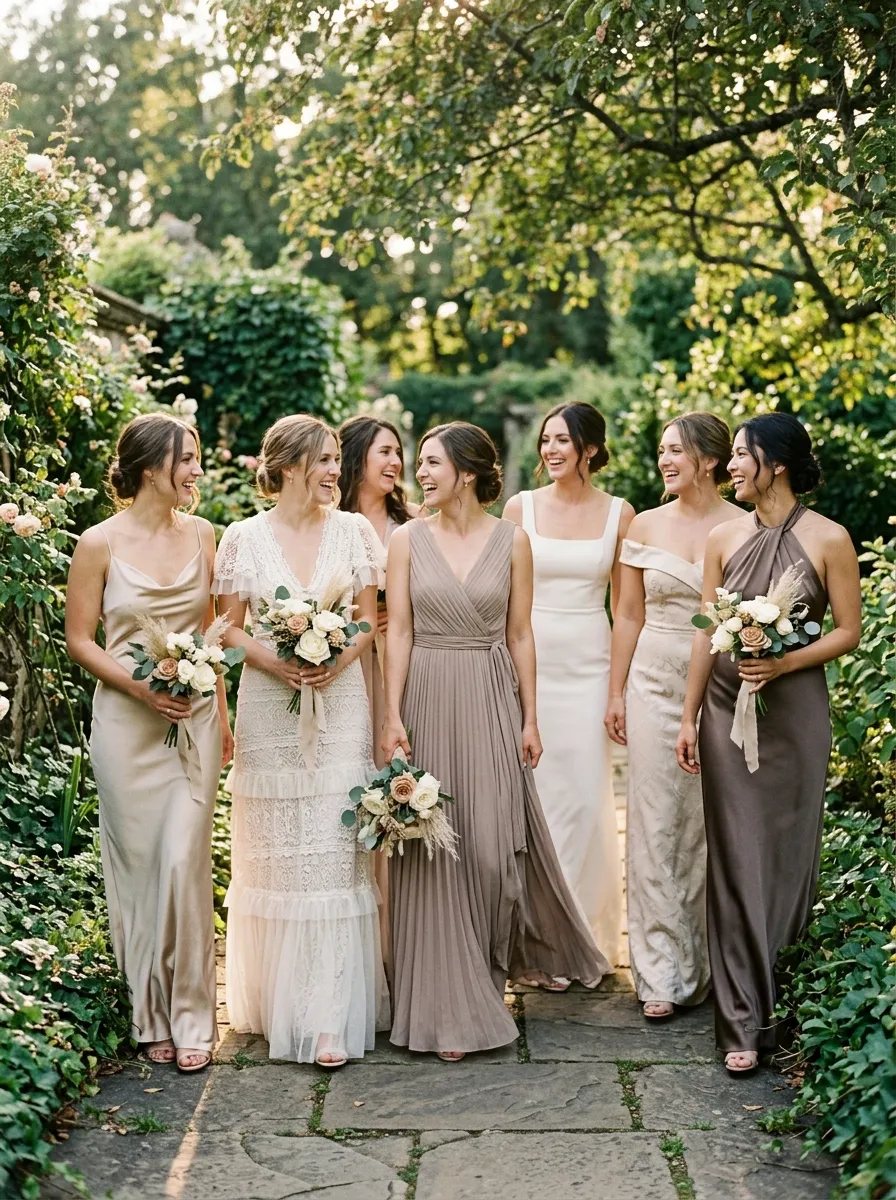
Three neutrals in one lineup look intentional when the undertones match, and they make the most modern group photo on this list. Mismatched bridesmaid dresses in champagne, ivory and taupe flatter every skin tone, because each bridesmaid can choose her best shade. This works at city venues, beach weddings and minimalist garden ceremonies, wherever your wedding calls for a relaxed look. Keep the fabrics and lengths consistent and let the color do the varying, which is the cleanest version of the same color different styles bridesmaid idea. Mixing warm and cool neutrals without a bridge shade is what makes a group look accidental.
🥂 Neutrals: The Mismatched Guide
Mismatched bridesmaid dresses are easiest to get right with neutral bridesmaid dress colors, and this guide shows how to build the group. A bridesmaid dress that works beyond the ceremony is always the best choice, and our layered wedding guest style guide shows how to layer a classic outer piece over any formal dress.
THE ANCHOR NEUTRAL (everyone wears this): Champagne or warm beige in one fabric for most of the group, so the palette has a clear center.
THE SECONDARY NEUTRAL (2-3 bridesmaids): Ivory or soft taupe, chosen to sit one shade lighter or deeper than the anchor.
THE ACCENT NEUTRAL (maid of honor): A deeper taupe or soft mauve-gray that sets her apart without breaking the family.
WHAT UNIFIES MISMATCHED NEUTRALS: A shared undertone, either all warm or all cool, is what holds the palette together. Matching fabric weight and dress length does the rest, so the group reads as one gradient instead of a collision.
WHAT BREAKS IT: Mixing one shiny satin with several matte fabrics, because the eye reads the shine as a different color.
Dark bridesmaid colors are the evening answer, built for candlelit receptions and formal ballrooms where bright shades turn garish after sunset. They photograph with drama as long as there’s some detail or sheen to keep them from collapsing into one dark shape.
28. Black Bridesmaid Dresses: Debate Settled
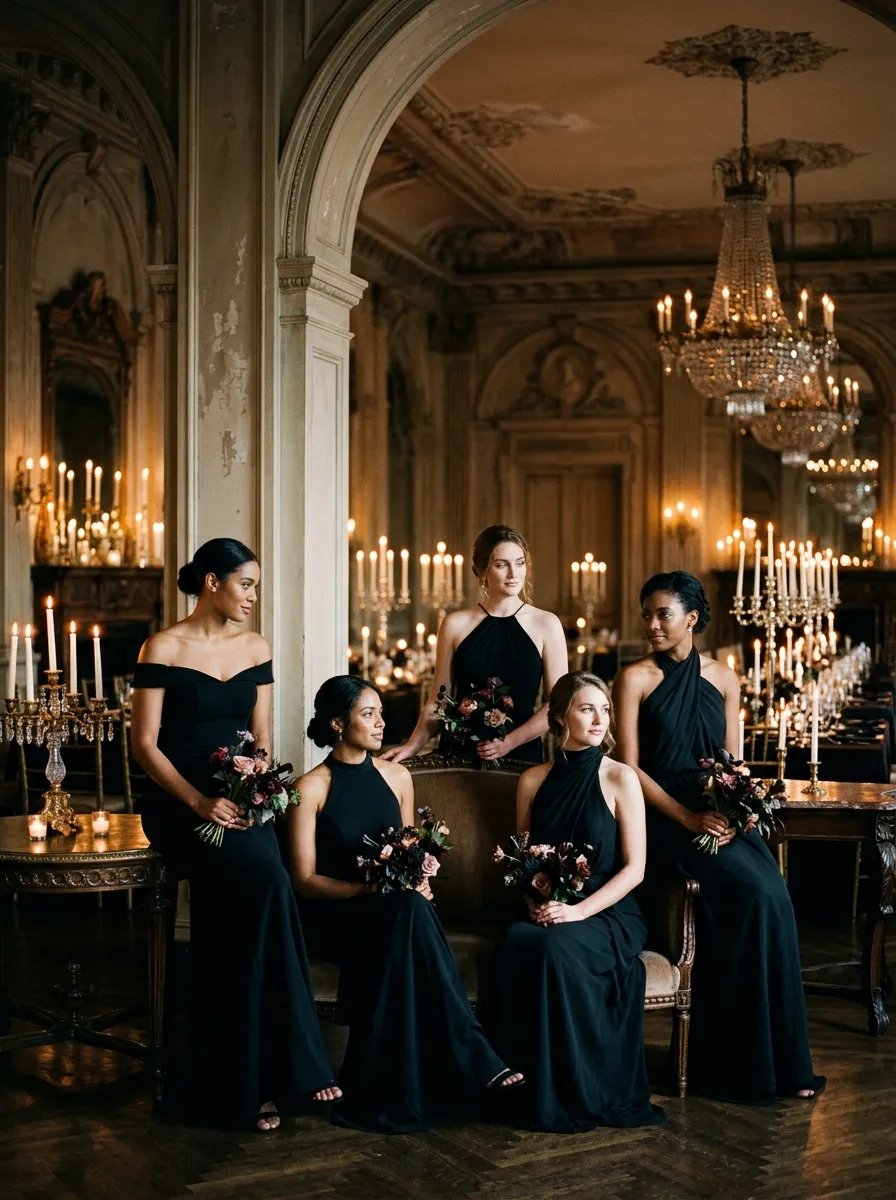
Black is the formal choice that divides opinion, and my verdict is that it works whenever the venue and the dress code support it. It flatters every skin tone in some version, with the best results from matte crepe and satin. Evening ballrooms, city rooftops, winter weddings and black-tie receptions are where black bridesmaid dresses read as chic for your wedding. As one of the dark bridesmaid dress colors, it gains drama from texture, like a halter neckline or a velvet bodice. Black beside a white gown looks sharp, but black on a bright beach looks heavy, so match the setting.
29. Chocolate Brown: Rich, Warm, Unexpected
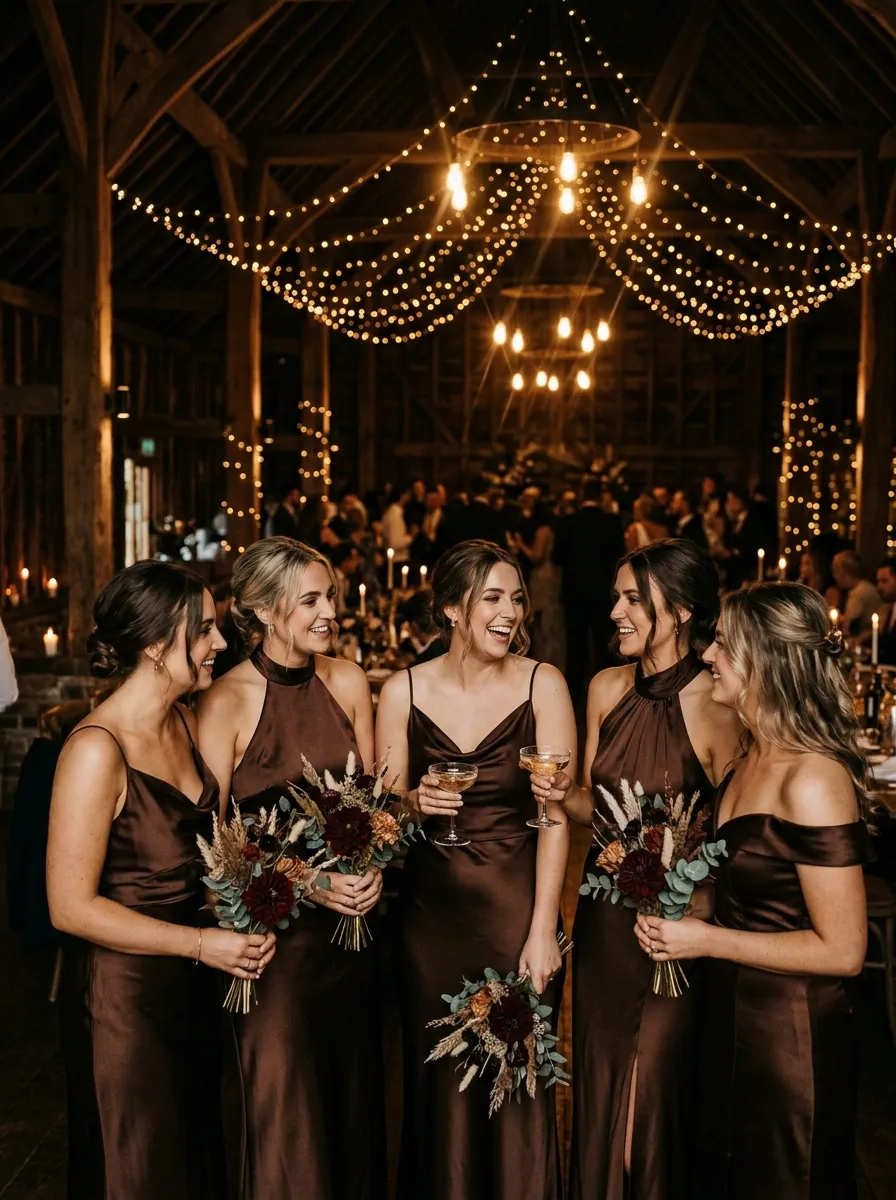
Chocolate brown is the dark option nobody expects, and it photographs as warm and rich instead of heavy. It flatters medium, olive and deep skin tones with a deep glow, and fair skin looks best when the chocolate leans slightly red. Fall and winter weddings, candlelit barn receptions and evening mountain ceremonies suit it best for your wedding. Pair it with cream, gold and burgundy florals, and choose satin or velvet for richness. Chocolate loses detail in dark rooms, so add a lighter bouquet and warm lighting to keep the dresses legible.
30. Two Dark Shades: How to Mix
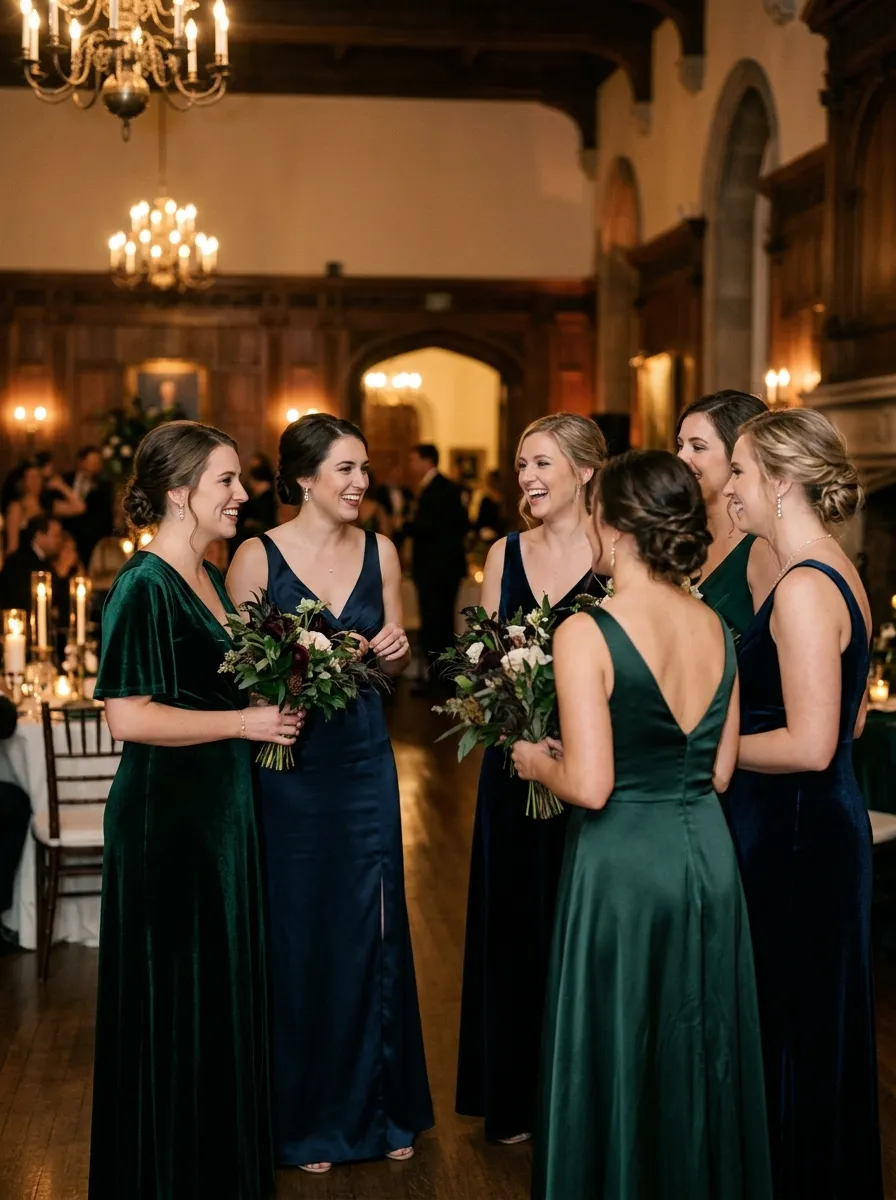
Pairing two dark shades gives a lineup depth that a single dark color can’t, and it’s the best fix for black-tie weddings that feel flat. Try black with burgundy, navy with chocolate or forest green with plum, since each pair shares the same level of depth. It flatters most skin tones when each bridesmaid wears the shade closest to her coloring, and it adds dimension to evening photographs of your wedding. Winter weddings, ballrooms and city venues are the natural settings. The two shades must differ clearly, because navy and black side by side in low light looks like a mistake.
Bridesmaid Color Questions Answered
What is the most popular bridesmaid dress color?
Sage green bridesmaid dresses are the most requested across American weddings, followed closely by dusty blue, burgundy and navy. Among bridesmaid dress color ideas, sage wins because it flatters most skin tones and reads as a neutral in photographs. It also fits garden, barn and beach venues. If your wedding is formal and in the evening, navy and burgundy still hold their place.
What bridesmaid color photographs best?
Colors with depth and a clear undertone photograph best, which means navy, burgundy and dusty blue. Among bridesmaid dress color ideas, mid to deep tones hold their saturation in flash and dim light, while very pale shades can wash out. For bridesmaid dress photography tips, check swatches outdoors and indoors, and ask your photographer to bounce the flash. Matte fabrics photograph more consistently than very shiny satin.
What colors flatter all skin tones for bridesmaids?
Navy, burgundy and dusty blue are the safest bridesmaid color ideas for every complexion. As a quick bridesmaid dress skin tone guide, mid-depth shades with a clear undertone work broadly, while very pale or very neon shades are harder. Fabric matters as much as color, so choose a matte or soft-sheen finish. Order swatches and hold them against each bridesmaid’s face in daylight.
What bridesmaid color works for a fall wedding?
Burgundy, rust, terracotta and forest green are the strongest bridesmaid dress color ideas for autumn. A bridesmaid color for fall wedding planning should echo the landscape, so look at the leaves and the barn wood at your venue. Velvet and satin add richness in cooler weather, and chiffon keeps an afternoon ceremony relaxed. Pair the dresses with warm metallic accents and cream florals.
Can bridesmaids wear different colors of the same shade?
Yes. Mismatched bridesmaid dresses in different depths of one color family are among the easiest bridesmaid palette ideas to pull off, as long as the shades share an undertone. The best wedding weekends flow naturally from the ceremony into more relaxed moments, and our casual wedding season style guide shows how that same warm palette translates into every day of the wedding weekend. Keep the fabric consistent and let the depth vary by one or two steps.
What is the difference between dusty rose and blush?
Dusty rose bridesmaid dresses are grayer and warmer, built on a muted brown-pink base. Blush bridesmaid dresses are lighter, brighter and closer to a soft pastel pink. Dusty rose handles low light and fall settings better, while blush shines in bright spring light. Both work well with ivory florals.
What bridesmaid color works for a beach wedding?
Among bridesmaid color ideas for the coast, dusty blue, teal, champagne and soft coral work best. A bridesmaid color for beach wedding settings should hold up in bright sun and wind, so choose light chiffon in a shade with some depth. Very pale pastels can wash out against sand and sky. Skip heavy velvets and very dark shades, which feel too warm outdoors.
Is burgundy still a popular bridesmaid color?
Yes, burgundy bridesmaid dresses remain a steady favorite for fall and winter weddings because they flatter nearly every complexion. Among bridesmaid dress color ideas, it holds its popularity because it photographs richly in both golden light and candlelight. Pair it with cream, blush or gold florals for contrast. Choose a wine shade with blue in it so it stays rich under flash.
What bouquet colors pair with sage green bridesmaids?
For bridesmaid color and bouquet pairing, sage green bridesmaid dresses work best with ivory, blush, soft peach and white blooms. Burgundy accents add contrast for a fall palette. Avoid bouquets in a similar green, which blends into the dresses in photographs. Eucalyptus and textured greenery add dimension without competing.
Can bridesmaids wear black?
Yes, black works for evening, black-tie and winter weddings, and it can be among the most polished bridesmaid dress color ideas when the fabric has texture. Dark bridesmaid dress colors need warm lighting and lighter florals to keep their detail in photographs. A black dress also flatters nearly every skin tone. On a bright beach or daytime garden wedding, a softer shade usually suits the setting better.
Your Color Report Closes
The best bridesmaid dress color ideas still come down to one test: how the shade looks in the light of your actual venue. The most popular color isn’t automatically the right one. The right one photographs well at the hour your wedding happens, on the complexions standing in your line. Hold a swatch up at the venue at that time of day and trust what you see.
A bridesmaid color decision is one part of a complete wedding aesthetic – The Muse Vale has the wedding, fashion, beauty, and lifestyle guides to help you build every element of that picture.
Come back to The Muse Vale whenever your wedding planning needs a fresh perspective – we will have the bridesmaid color ideas, bridal style guides, and wedding inspiration ready for every decision ahead of you.