

A quick note before we begin: this article is for informational and supportive purposes only, and it isn’t a substitute for professional mental health care. If your anxiety feels severe or keeps coming back, please reach out to a licensed mental health professional who can support you properly. Writing can sit beside that care as a gentle companion, and you deserve both.
Journal prompts for anxiety changed the way I think about a notebook. For years I used mine as a place to pour out every worried thought, and for years I closed it feeling more wound up than when I opened it. The shift came on a quiet morning when I stopped trying to express the anxiety and wrote one steady question that put a little distance between us. That distance was all I needed to think clearly.
Most people who try journaling for anxiety end up amplifying it, because a blank page with no direction invites the spiral to keep going. The right prompts do the opposite. They give your anxiety somewhere specific to land and give your page a job to do. This guide gathers twenty of them, organized by where anxiety actually lives: in the body, in the mind, in the night, and in the future. Start wherever it’s loudest for you today.
Before You Write: Where Is Your Anxiety Living Right Now?
These journal prompts for anxiety work best when you match them to where the feeling is sitting today, so use this check-in as a quick map of anxiety journaling ideas before you pick up a pen.
☽ IN YOUR BODY
What it feels like: A tight chest, a heart running ahead of you, breath that stays high and shallow, and no clear reason why.
What kind of writing helps: A body scan journaling practice that starts with sensation instead of story, so your page follows your body before your mind takes over.
Where to start in this guide: Prompts 1 to 4
☽ IN YOUR THOUGHTS
What it feels like: The same conversation replaying, the worst-case ending on a loop, and a mind that won’t stop drafting what you should have said.
What kind of writing helps: An anxiety spiral writing technique that moves the loop out of your head, gives it edges, and tests it against what’s actually true.
Where to start in this guide: Prompts 5 to 8
☽ IN YOUR CALENDAR
What it feels like: Too much and too soon, with a Sunday evening dread that arrives before the week does.
What kind of writing helps: Lists and boundaries on paper that separate what’s yours to carry from what isn’t.
Where to start in this guide: Prompts 9 to 13
☽ AT 3AM
What it feels like: Wide awake in a silent house, where every unresolved thing suddenly sounds urgent.
What kind of writing helps: Short, unedited writing that moves thoughts from your head to the paper so sleep can have the room back.
Where to start in this guide: Prompts 14 to 17
☽ IN THE BACKGROUND
What it feels like: A low hum you can’t name. Nothing is wrong exactly, but nothing feels settled either.
What kind of writing helps: Slow, repeated entries that build over weeks until the patterns show themselves.
Where to start in this guide: Prompts 18 to 20
PROMPT CHAPTER 01: When Your Body Knows Before Your Mind Does
Anxiety often shows up in the body hours before your thoughts catch up, which is why a prompt that asks about your mind first can feel like a locked door. Starting with physical sensation gives your page something concrete to hold, and concrete is exactly what an anxious mind is missing.
1. The Prompt That Starts With Your Body, Not Your Thoughts

Body-based anxiety often arrives as a physical event first, like a clenched jaw during a Sunday evening scroll or a stomach that drops before you’ve named the worry. This prompt works because describing a sensation engages the observing part of your mind and gives the racing part less to chew on. When you write it, expect small surprises, like noticing your shoulders have been up by your ears since lunch, and let those details sit without explaining them. Think of it as one of the gentlest therapeutic writing prompts you can start with, since there’s no wrong answer when you’re only describing what’s there. Written consistently, it teaches you to catch anxiety at the first physical signal instead of the fifth, and that earlier notice gives you more room to respond.
📝 Your prompt:
“Close your eyes for a moment and notice where your body is holding something right now. Write about that spot as if you were describing it to someone who has never felt it: its size, its temperature, its weight, whether it moves. Don’t explain why it’s there yet. Keep describing until the description feels finished.”
2. Write This When Your Body Feels It Before Your Mind Does

A racing heart or shallow breath can feel like proof that something is wrong, which then feeds the very anxiety it came from. Naming a sensation precisely, and writing slowly enough to breathe while you do it, tends to loosen its grip, because the brain treats a named thing as less threatening than an unnamed one. Expect your handwriting to slow halfway through, and let it. Anxiety journal prompts like this one belong in your rotation on days your body is loud and your thoughts haven’t produced a reason yet. Over several weeks, many people find that physical symptoms start to feel less like emergencies and more like information they’ve already recorded.
📝 Your prompt:
“Write about the last time your chest felt tight or your heart sped up. What were you doing, who were you near, what had you just read or heard? Then write what the sensation seemed to be telling you, even if it sounds irrational. Let each breath mark the start of a new sentence.”
3. What Your Body Is Asking For That Your Anxiety Keeps Ignoring
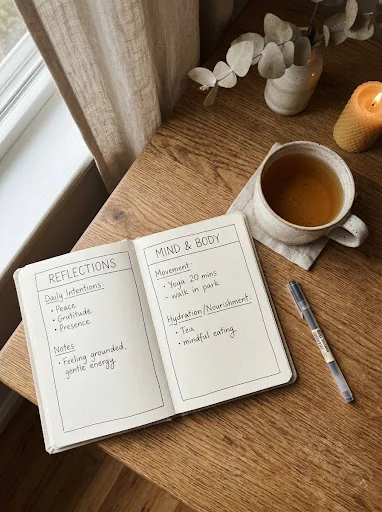
Anxious weeks tend to bury basic needs under a pile of urgent-feeling tasks, and the body keeps quietly sending requests anyway. This prompt works because it asks what you need rather than what you should do, which sidesteps the inner critic and lets simple answers surface. What comes up is often humble: water, a walk around the block, ten minutes of silence, an earlier bedtime. You’ll probably notice that you already knew most of this, which is its own kind of relief. When you write it regularly, your page becomes a record of what your body asks for before it has to shout.
📝 Your prompt:
“If your body could speak plainly for one minute, what would it ask you for today? Write the list without negotiating with it. Then write one thing from that list you could give it before tonight, and what has been getting in the way.”
The Coach’s Note: Small Honest Details
☽ Use concrete words like “heavy,” “buzzing,” or “cold” instead of abstract ones like “bad” or “stressed,” because specific language slows your mind down.
☽ If the prompt brings up more than you expected, put the pen down, take three slow breaths, and return only when your shoulders feel a little lower.
☽ Give this prompt five to eight minutes, and stop when the description feels finished rather than when the page is full.
☽ After writing, do one small thing from your list right away so the page connects to something your body can feel.
4. The Energy Audit Prompt

Some anxiety isn’t about any single worry. It’s the slow drain of too many commitments, too little rest, and a phone that never stops tapping on your shoulder. This prompt works because it turns a vague sense of exhaustion into a list you can actually look at, and seeing the list often reveals a pattern your tired mind couldn’t spot. Expect to be surprised by one or two entries, like an obligation you resent or a person who leaves you steadier than you expected. A dotted notebook is useful here, since you can draw two columns without a ruler. Done every few weeks, the audit becomes a quiet way of noticing when your energy is leaking before it turns into overwhelm.
📝 Your prompt:
“Make two columns on your page. In the first, write everything that has drained you this week, physically or emotionally. In the second, write what has given something back, however small. Look at both lists and write what surprises you most.”
🌿 The Body-First Journaling Approach: Why Starting With Sensation Instead of Thought Works Better for Anxious Minds
THE TRADITIONAL WAY: Most people open a notebook and write about what they’re worried about. That sounds sensible, but it asks an overactive mind to organize itself using the same machinery that’s already running too fast. The result is often a page of loops that sounds more frightening in ink than it did in your head, and the writer closes the notebook more activated than before.
THE BODY-FIRST WAY: The shift is simple: sensation before thought. When you begin with what you feel physically, you’re asking for description rather than interpretation, and description is calmer territory. This is why so many journal prompts for anxiety in this guide open with the body. A body scan journaling practice gives your page a steady anchor, and by the time you reach your thoughts, they have somewhere to land that isn’t a spiral. If you’d like a physical space that supports this, our mindful movement space guide shows how to create a dedicated corner for both movement and stillness.
HOW TO TRANSITION:
- Spend two minutes writing only physical facts: where you feel tension, what your breath is doing, what your hands are doing.
- Write one line that begins “Maybe this feeling is connected to…”, and let it be a guess rather than a conclusion.
- Move into whichever prompt fits, using the sensation notes as your starting point.
WHAT THIS CHANGES: Your thoughts arrive on the page already slowed down, because your body has had its say first. Many people find the writing feels less like confession and more like conversation.
PROMPT CHAPTER 02: The Prompts That Interrupt the Loop Before It Gets Loud
Spirals feed on speed, and the quickest way to slow one down is to give it a container with a clear beginning and end. These prompts ask your thoughts to stand still long enough to be looked at, which is something an anxious mind rarely does on its own.
5. The Question That Turns Worst-Case Thinking Into Something You Can Work With

Worst-case thinking feels productive, but it usually keeps the ending vague, and a vague ending is the most frightening kind. This prompt asks you to write the worst case all the way to its last sentence, because an ending with edges has far less power than a fog you keep circling. Expect your first few lines to sound dramatic, and expect the writing to turn oddly practical around the third paragraph, when you start noticing what you’d actually do. Worst case scenario journaling is one of the oldest tools in a writing coach’s bag, and it works because it moves a fear from feeling into logistics. Used regularly, it teaches your mind that it can think through its own imagination without being swallowed by it.
📝 Your prompt:
“Write down the worst thing you’re afraid might happen, then keep going: and then what? Follow it step by step until you reach the end of the story. Next write who would help you, what you’d do on the first day, and what you’d still have. Leave the ending on the page and close the notebook.”
6. Everything Out of Your Head and Onto the Page

Some anxiety doesn’t have a shape yet. It’s just a crowded head and a feeling that everything is due at once. A brain dump journaling technique works because it asks nothing of you except volume: no sentences, no order, no kindness toward your grammar. Expect the first minute to feel scattered and the second to feel strangely lighter, like emptying a bag onto a table so you can see what’s in it. If you’ve ever tried the morning pages practice, this is its cousin, written for the moments when you can’t wait until tomorrow. Done on busy days, it becomes a reliable reset that keeps small worries from stacking into one large one.
📝 Your prompt:
“Set a timer for five minutes and write everything that’s in your head without lifting your pen. Include the big things, the petty things, the things you’re embarrassed to be thinking about. Don’t reread while you write. When the timer ends, draw a line under it and take one slow breath.”
7. Journal Prompts for Anxiety That Start With What’s Actually True
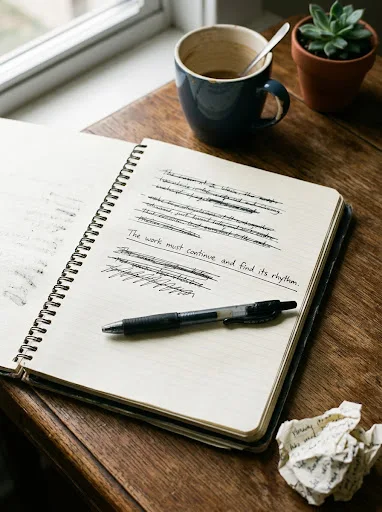
Anxiety narrows attention to what might go wrong, and it does so with such confidence that facts and fears start to feel identical. This prompt works because it asks for three things you can verify right now, which gives your mind a firm floor without requiring you to feel better. What comes up is often modest, like the fact that you have a roof, that someone texted you back, that this feeling has passed before. It’s a short form of cognitive reframing writing, and it’s meant to be believable rather than inspiring. Over time, the habit of separating what’s true from what’s only loud becomes one of the steadiest skills your page can give you.
📝 Your prompt:
“Write three things that are true right now, not hopes and not predictions. They can be small and plain. Then write one sentence beginning with “And I can also notice that…” and finish it with something that sits beside the worry rather than against it.”
8. What Your Anxiety Predicted That Never Happened
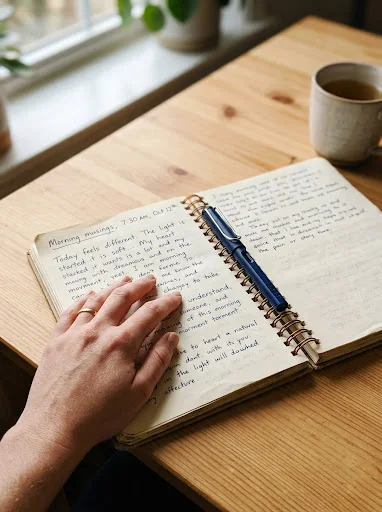
Your anxiety has been making predictions for years, and it has never been asked to show its track record. This prompt works because it treats those predictions like claims that can be checked, which engages a more analytical part of the mind than the one that’s panicking. Expect an uncomfortable honesty here, since some fears did come true and some didn’t, and both belong on the page. The point isn’t to prove your worries wrong but to learn how reliable they actually are. After a few weeks, many people begin to hear the difference between a signal worth acting on and noise that merely sounds urgent.
📝 Your prompt:
“Write down three things your anxiety was certain about in the past year or two. Beside each, write what actually happened. Then write what you’d tell a friend who had been so sure about each one, and what you might want your anxiety to know.”
The Coach’s Note: Honest Not Harsh
☽ Keep your tone curious rather than prosecutorial, because the goal is gathering information, not winning an argument with yourself.
☽ If the prompt reminds you of something that did go badly, write that down too, and let the page hold it without turning it into a verdict.
☽ Give yourself ten minutes, since looking back takes a little longer than looking at today.
☽ After writing, circle the one prediction that surprised you most and read it again tomorrow morning.
🌀 The Anxiety Spiral Writing Protocol: What to Do When the Journal Makes It Worse Instead of Better
SIGN 1 YOU ARE SPIRALING ON THE PAGE: You’re writing the same worry in new words. If the third paragraph says what the first one did, you’re circling rather than processing. Stop and underline the single sentence that feels most true.
SIGN 2: Your handwriting is getting faster, sharper, or harder to read. Speed usually follows activation. Put the pen down, unclench your hand, and take three slow breaths before deciding whether to continue.
SIGN 3: Your sentences are turning into “always” and “never,” and you’re writing conclusions about your whole life. That’s a sign the spiral has taken the pen. Switch to describing only what’s in the room.
THE STOP TECHNIQUE: This anxiety spiral writing technique takes about a minute. First, write the word “stop” on its own line and draw a box around it. Second, write three things you can see, two you can hear, and one you can feel against your skin. Third, close the notebook and move your body for two minutes, even if that’s only walking to the kitchen. Evening spirals respond especially well when this is part of a routine, and our night anxiety wind-down guide shows the specific practices that help an anxious mind prepare for sleep.
WHEN TO CLOSE THE NOTEBOOK: If journaling for anxiety is leaving you more distressed three sessions in a row, that’s useful information, and it’s a good moment to talk with a licensed professional rather than push harder on the page.
PROMPT CHAPTER 03: When the Problem Is Everything That Has Not Happened Yet
Future-focused anxiety is exhausting because it asks you to prepare for a thousand versions of tomorrow at once. These prompts do something quieter: they sort what’s real from what’s imagined and point your effort at the part you can actually touch.
9. Draw the Circle: What You Can Change and What You Can’t
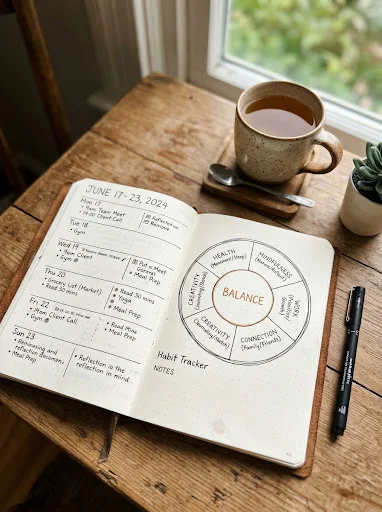
Control sits near the center of most anxiety, and so much energy goes into guarding things that were never ours to guard. This prompt works because it makes the sorting visible: when you see how much of your worry lives outside the circle, the effort starts to look misplaced rather than shameful. Expect to feel a small grief as you write items into the outer ring, like another person’s choices or a result you can’t speed up. Think of it as a mindfulness journaling prompt with a practical edge, since the inner circle often reveals the one action worth taking. With practice, you’ll begin sorting worries in your head before they reach the page.
📝 Your prompt:
“Draw a large circle on your page and a smaller one inside it. In the small circle, write what’s genuinely within your influence this week. Outside it, write what you’ve been worrying about that isn’t. Look at the outer ring and write how it feels to put those things down, even for an hour.”
10. One Realistic Good Version of Tomorrow
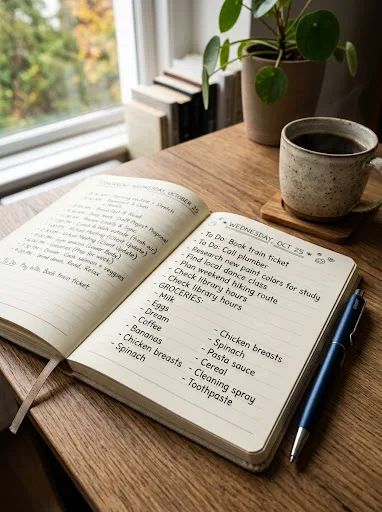
Tomorrow tends to arrive in the anxious mind as a threat, with every possible problem loaded into it. This prompt asks for one plausible, ordinary version of how it could go well, which isn’t the same as forcing optimism and doesn’t ask you to believe anything you can’t. Expect it to feel awkward at first, since an anxious mind is rarely rehearsed in imagining a calm day. The five minute journal format is a familiar American favorite for a reason, and this prompt fits neatly inside it. Over weeks, the habit gives your mind a second script to hold next to the frightening one.
📝 Your prompt:
“Write a realistic version of tomorrow that goes reasonably well. Not perfect, only steady. What time do you wake up, what’s the first thing you handle, who do you talk to, what feels okay by evening? Write it as a quiet scene, in the present tense.”
11. Journal Prompts for Anxiety When the Week Feels Impossible

The Sunday Scaries rarely come from one task. They come from the whole week arriving in your mind at once, with no order and no edges. This prompt works because it replaces the avalanche with a single next step, which is the only unit of work an overwhelmed mind can actually act on. Expect your list to feel longer than you hoped when you write it out, and then expect it to feel shorter once it’s sorted. Write it on paper rather than in your notes app at 2am, since paper keeps the list from slipping away. Practiced weekly, the habit teaches you that the impossible week is usually a handful of manageable days wearing a heavy coat.
📝 Your prompt:
“List everything you feel you have to do this week, without sorting. Then circle the three things that truly matter. Cross out anything that can wait or be asked of someone else. Write the very next physical action for the first circled item, small enough to begin in five minutes.”
12. The Fear Behind the Fear
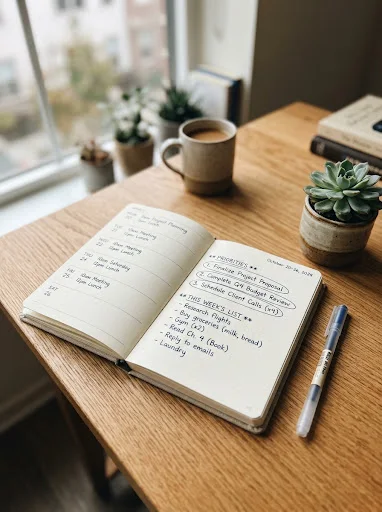
Surface worries are often costumes for something quieter underneath. A fear about a presentation can be a fear about being judged, and a fear about a diagnosis can be a fear about being alone. This prompt works because it keeps asking one gentle question until the writing slows and something plain appears. Expect it to feel tender at the end, and expect a sentence or two that surprise you. Journal prompts for self-reflection like this one are most useful when you treat what surfaces as information rather than a verdict. In time, naming the deeper fear tends to shrink the surface ones, since they’re no longer carrying a secret.
📝 Your prompt:
“Write down the worry that’s loudest today. Then ask: if that happened, what would it mean about me or my life? Write your answer, then ask the question again about that answer. Keep going until you reach something simple and true, and write what you notice.”
13. Write This When Anxiety Strips Everything Else Away

When anxiety is loud, values go quiet, and decisions start to be made by fear instead of by what matters. This prompt works because it reconnects you with a direction that doesn’t depend on how calm you feel today. Expect words like family, honesty, creativity, or rest to come up, and expect some of them to carry a little ache because you haven’t been living near them. It can be useful to write them down on a good day too, so you have them in your own handwriting when you need them. Revisited a few times a year, this page becomes a quiet compass that anxiety has a harder time spinning.
📝 Your prompt:
“Imagine anxiety stepped out of the room for an hour. What would you care about most? Write the three or four things that matter to you, then one small way you could honor each of them this week, even while the worry is still around.”
📋 The Weekly Anxiety Journal Structure: A Simple Format That Takes 10 Minutes and Builds Over Time
MONDAY (INTENTION): Write one sentence beginning “This week I want to feel…” and one action that moves toward it. Spend 2 minutes. This is the lightest of the daily journal prompts anxiety readers can use, and it sets a tone rather than a plan.
WEDNESDAY (CHECK-IN): Write where your anxiety has shown up since Monday: body, thoughts, calendar, or night. Note one thing that helped and one that didn’t. Spend 3 minutes.
FRIDAY (REVIEW): Write what you worried about this week that never arrived, and what you handled better than you expected. Spend 3 minutes.
WEEKEND (REFLECTION): Write one thing you learned about your anxiety and one kindness you’d like to offer yourself next week. Spend 2 minutes. Pairing Monday’s intention with a calm start makes the whole structure stronger, and our morning anxiety routine guide shows how to build a morning that creates mental space before the day makes its demands.
WHAT THIS BUILDS: After four weeks of this journaling routine for mental health, you’ll have a short written record of your own patterns, which is far more useful than a general guess about what sets you off. Many people find the page begins to answer questions they’ve been asking for months.
PROMPT CHAPTER 04: The Prompts Built for the Hours When Everything Feels Louder
Night strips away distraction, and an anxious mind will happily fill the silence with every unfinished thing. These prompts are short and forgiving on purpose, because nobody writes well at 3am and nobody needs to.
14. The 3am Download: Journal Prompts for Anxiety at the Worst Hour

The 3am overthinking loop has a particular cruelty, because everything sounds more urgent when you’re tired and alone with it. This prompt works because it moves the contents of your head onto paper without asking them to be organized, which is often enough to let your body settle. Expect your writing to look rough and a little unhinged, and leave it that way, since nobody is grading it. Stream of consciousness writing is meant for exactly this hour, and a dim lamp or a calming candle can make the ritual feel less like an emergency. Over time, your mind learns that these thoughts have somewhere to go, and the 3am visits often get shorter.
📝 Your prompt:
“Write down everything that’s awake with you right now. Don’t fix, judge, or solve anything. Start each line with “I’m noticing…” and keep going until the list slows down. When it does, write one last line: “None of this has to be handled at this hour.””
The Coach’s Note: Rough And Quick
☽ Keep the lights low and your pen close, and write in whatever handwriting arrives, because 3am pages are meant to be messy.
☽ If the writing stirs up more than you expected, stop and put one hand on your stomach for five slow breaths before deciding to continue.
☽ Spend no more than five minutes, since longer sessions at this hour tend to wake you further.
☽ When you finish, close the notebook and leave it out of reach of the bed so the thoughts stay on the page.
15. A Gratitude Letter to One Specific Moment

Gratitude lists can feel hollow when you’re anxious, as if you’re being asked to feel something you can’t. This prompt works because it narrows gratitude to a single specific moment, which is far easier to believe in than a general list of blessings. Expect it to feel quiet and a little tender, and expect small details like the way a friend laughed or how the light looked in the kitchen. Gratitude journaling for anxiety works best when it’s honest and specific, so choose a moment that actually happened rather than one that sounds impressive. Practiced now and then, it gives your night page a place to rest that doesn’t depend on solving anything.
📝 Your prompt:
“Choose one moment from the last few days that felt even slightly good: a kind word, a warm drink, a stretch of quiet. Write it a short letter. Tell it what you noticed, what it gave you, and what you’d like to remember about it tomorrow.”
16. The Night Plan: Journaling for Sleep Anxiety Before Lights Out

Unfinished tasks have a way of turning into midnight alarms, and your mind will keep them on repeat until it trusts they’ve been recorded somewhere. This prompt works because it hands the job of remembering over to your notebook, so your brain can stop holding it. Expect a list to appear quickly, and expect some items to look much smaller on paper than they did in your head. It’s a gentle form of journaling for sleep anxiety that doesn’t ask you to examine your feelings at all. Done consistently before bed, it becomes a small signal to your body that the day’s work has been put somewhere safe.
📝 Your prompt:
“Write everything that needs to happen tomorrow, in plain short lines. Next to each, write when you’ll do it, or “not tomorrow” if it can wait. Then write one sentence: “It’s written down, and it’s allowed to rest until morning.””
17. What You’d Say to a Friend Feeling Exactly This
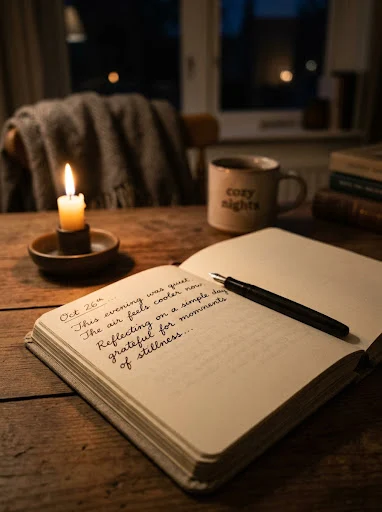
At night the inner voice tends to get sharper, and the words we’d never say to a friend show up in our own heads without a second thought. This prompt works because it borrows the kindness you already have for other people and turns it, with a little awkwardness, back toward yourself. Expect your first draft to sound stiff, and expect the second to sound more like you. Writing from this angle is a form of journaling for emotional regulation, since a softer tone usually calms the body before it calms the thought. Over time, the way you speak on the page becomes the way you speak to yourself in the quiet.
📝 Your prompt:
“Imagine a close friend told you they felt exactly what you feel tonight. Write what you would say to them: your words, your tone, the things you’d want them to know. Then read it back as if it were addressed to you, and write one line in response.”
🌙 The Night Pages Setup: Creating the Right Conditions for Anxiety Journaling Before Sleep
THE SPACE: Choose one place for night writing and keep it consistent: the edge of the bed, a chair near a window, or a small table with a blanket nearby. The goal is to teach your body that this spot means unwinding. Journaling for sleep anxiety tends to work best when the space doesn’t also hold your laptop. Some of the most effective writing happens in the bedroom before sleep, and our peaceful bedroom environment guide shows how to create the kind of calm, considered space that makes quiet reflection feel possible.
THE LIGHT: Use a warm, low lamp or a candle rather than an overhead light or a phone screen. Dim light tells your body that sleep is approaching, and it makes the page feel more private.
THE TIME: Write for five to ten minutes about thirty to sixty minutes before you want to be asleep. That gives your mind time to settle after you’ve set things down. These journal prompts for anxiety are meant to be short at night, so choose one prompt rather than a full session.
THE TOOLS: Keep a small notebook and a pen that writes smoothly beside the bed, such as a Moleskine or a simple notebook from Target or Barnes & Noble. A paper page keeps you away from the screen, and a pen you like makes the ritual easier to repeat.
THE ONE RULE: When you close the notebook, the thinking is done for the night.
PROMPT CHAPTER 05: The Prompts That Build Something Larger Than One Entry
A single entry can steady a hard evening, but patterns only show up across many of them. These last three prompts are meant to be returned to, so your page becomes a record of how you move through anxiety rather than a pile of separate pages.
18. The Weekly Anxiety Review

A low hum of background anxiety is hard to work with because it never presents itself as a clear problem. This prompt works because it looks back across a week instead of inside a single hour, which is where patterns, triggers, and small shifts show themselves. Expect to notice things like which days run tight, which people leave you steadier, and what you did on the better evenings. Reviewing your own pages this way is a simple, private form of writing therapy at home, and it asks nothing but honesty. Many people find that after a month, their triggers have names, and named triggers are much easier to plan around.
📝 Your prompt:
“Look back over the past week. When did your anxiety feel loudest, and what was happening around it? When did it ease, and what had you just done? Write what you’d like to repeat, what you’d like to change, and one thing that’s shifted since you last wrote.”
19. Who You Are Beyond What Your Anxiety Tells You
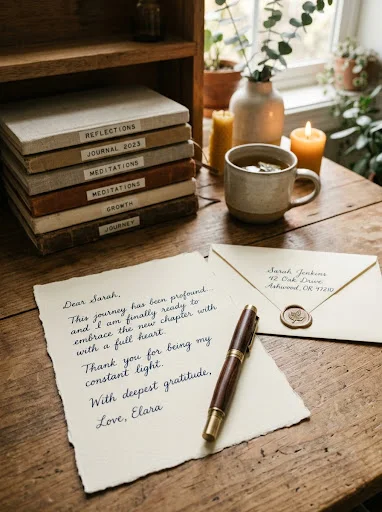
Long stretches of anxiety can start to feel like a personality, as if worry were the main thing about you. This prompt works because it widens the frame, asking what else is true about you that anxiety doesn’t notice. Expect some of your answers to feel almost too ordinary to write, like the way you take care of people or the jokes only you find funny. Those ordinary details are the point, since they’re the parts that remain steady when you’re not. Written occasionally, this prompt reminds you that your anxiety is something you have, and not the sum of who you are.
📝 Your prompt:
“Write a description of yourself that leaves out anything your anxiety has said. What do you love, what are you good at, what do people come to you for? Then write a sentence beginning “Even on my anxious days, I’m still…””
The Coach’s Note: Ordinary Counts Most
☽ Choose plain, specific details over big statements, because “I always remember birthdays” will do more than “I’m a caring person.”
☽ If your mind pushes back with criticism, write the criticism down in one sentence, then return to the prompt without arguing with it.
☽ Give this prompt ten to fifteen minutes, since it tends to open slowly and finish with a few honest lines.
☽ Afterward, share one line of it with someone who knows you well, or tuck it in the front of your notebook for harder days.
20. The Letter From Your Calmer Self to Your Anxious One

There are moments when you’ve felt steadier, even briefly, and that version of you knows something your anxious self has forgotten. This prompt works because it lets that steadier voice speak directly, which isn’t pretending but remembering. Expect the letter to be shorter and kinder than you thought, and expect it to read strangely well when you come back to it on a hard day. A stationery set can help the ritual feel intentional, though any paper will do. Kept in your notebook, these letters become a small collection of reminders in your own handwriting, ready for the next time anxiety gets loud.
📝 Your prompt:
“Write a letter from the calmer version of you to the anxious version who’s reading this tonight. What does the calmer self know? What would she want you to remember, and what would she say about how far you’ve already come? Sign it with a name only you would use.”
Anxiety Journaling Questions, Answered With Honesty and Without the Toxic Positivity
Does journaling actually help with anxiety?
Many people find that it does, though it isn’t a cure and it doesn’t work the same way for everyone. Journaling for anxiety helps by giving your thoughts somewhere to go and creating a little distance between you and the feeling. Journal prompts for anxiety make that distance easier to find, because they give the writing a direction instead of leaving you alone with a blank page. If it helps you feel steadier, keep going, and if it doesn’t, that’s useful information too.
How do I start journaling for anxiety if I have never journaled before?
Begin small. Pick one of the journal prompts for anxiety in this guide, set a timer for five minutes, and write whatever comes without worrying about grammar or neatness. Knowing how to start journaling anxiety is mostly about lowering the bar until it feels almost silly, since a short entry you actually write is worth more than a perfect one you avoid. Any notebook works, whether it’s a Moleskine or a basic pad from Target.
What should I write in my anxiety journal?
Start with what’s real right now: what you feel in your body, what’s on your mind, and what you’re bracing for. Anxiety journal prompts are helpful when you’re stuck, since a good question gives your pen somewhere to begin. The journal prompts for anxiety in this guide move from body to thoughts to night to long-term patterns, so you can choose the one that matches today. You don’t have to write anything beautiful or even coherent.
How long should I journal for anxiety each day?
Five to ten minutes is plenty for most people, and shorter is often better on difficult days. Daily journal prompts anxiety readers use tend to work best when they’re brief enough to repeat without dread. A five minute journal anxiety routine can fit in a morning or before bed, and consistency matters more than length. If you want to write longer on a given day, trust yourself to stop when your shoulders start to drop.
What do I do if journaling makes my anxiety worse?
First, notice that it’s a common experience and not a failure on your part. Journaling for anxiety can sometimes stir things up, particularly when the writing turns into circling the same worry. Try the anxiety spiral writing technique described earlier: write “stop,” ground yourself with what you can see and hear, and close the notebook. If it keeps happening, it’s a good moment to talk with a licensed professional about what’s coming up.
What is the best journal for anxiety?
The best one is whichever you’ll actually open, so choose a notebook that feels pleasant rather than precious. Some people like a guided journal with printed prompts, and guided journal prompts anxiety readers use can make it easier to begin on tired days. Others prefer a plain dotted notebook so they can write freely and use these journal prompts for anxiety as needed. Amazon and Barnes & Noble carry plenty of options, and a smooth pen makes a bigger difference than most people expect.
Should I journal in the morning or at night for anxiety?
Either can work, and which is better depends on when your anxiety is loudest. Morning writing helps you clear your head before the day starts, while night writing is meant to put the day down before sleep. Many people use journal prompts for anxiety at both ends of the day, with a different type of prompt for each, and journaling for sleep anxiety fits naturally into an evening routine. The space also matters, and our calming home rituals guide shows how to build a restorative home environment that makes a consistent practice feel sustainable.
Can journaling replace therapy for anxiety?
No, and it’s important to say that plainly. Journal prompts for mental health are a supportive tool that can sit alongside professional care, but they don’t replace it. Therapeutic writing prompts can help you notice patterns and put words to what you feel, which can make therapy sessions more focused if you’re in them. If your anxiety is severe, persistent, or interfering with daily life, a licensed professional is the right place to start.
What are the best journal prompts for overthinking?
The brain dump, the worst-case scenario prompt, and the three true things prompt are the strongest starting points. Journal prompts for overthinking work by giving your thoughts edges, so they stop looping without end. Together with other journal prompts for anxiety in the spiral stopper chapter, they interrupt the loop before it gets loud. Anxiety often softens when the rest of life feels more structured, and our nourishing weekly routine guide shows how that same principle of intentional preparation extends into the food and rhythm of a calmer week.
How do I make journaling for anxiety a consistent habit?
Attach it to something you already do, like your morning coffee or brushing your teeth, and keep the notebook where you’ll see it. A journaling routine for mental health sticks best when it’s small, so choose one prompt and five minutes instead of an ambitious plan. Keep the journal prompts for anxiety you like best on a sticky note, and don’t punish yourself for missing a day. Coming back counts more than never skipping.
The Page Rests
Journal prompts for anxiety won’t make the worry disappear, and I wouldn’t trust any guide that said they would. What they offer is something smaller and more useful: just enough space between the feeling and your response that a different choice becomes possible. Some days that space is a few minutes of quiet writing, and some days it’s one honest sentence. Either one counts. Professional support is always available and always valuable, and writing can walk beside it.
A journaling practice is one part of a life that supports your mental wellness. The Muse Vale has the self-care, morning routine, and wellness guides to help you build the full picture of a life that genuinely supports you.
Come back to The Muse Vale whenever you need a new prompt, a calmer perspective, or a reminder that what you are feeling is something you can write your way through.