
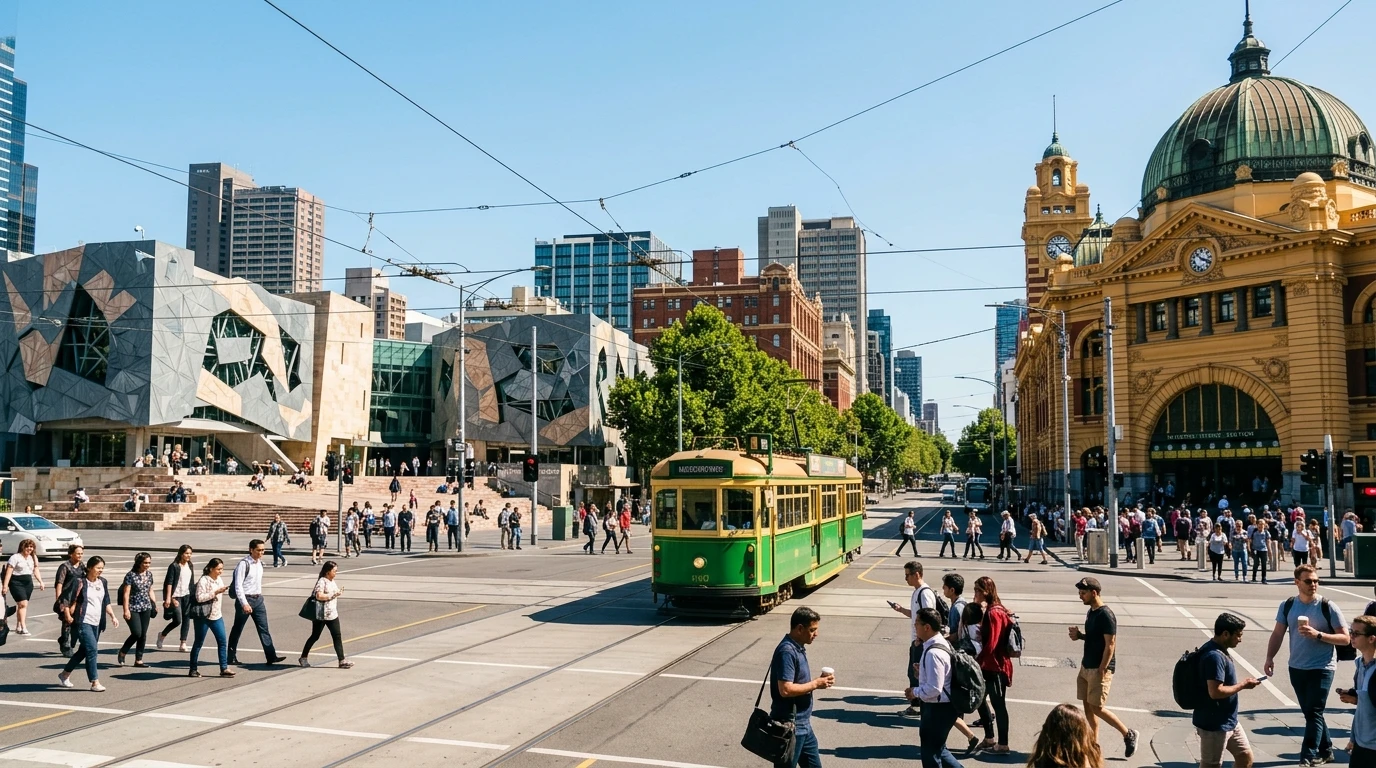
The australia travel aesthetic is the best-kept secret in international travel, and Melbourne is where it lives. I’m sending this first dispatch to every American woman who has scrolled past a Fitzroy laneway photo and assumed the trip belonged to someone else. It doesn’t. Melbourne is the most visually compelling city most Americans have never considered visiting, and by the end of these twenty entries your trip may look very different on paper.
I’ve organized these notes the way I’d write them from a footpath table with a flat white going cold: the visual aesthetic first, then the neighborhoods, the daily experience, and the practical reality of getting here. Along the way you’ll find the laneways, the street art, the tram lines, and the Yarra River Melbourne walk, plus the honest logistics guidebooks skip.
Before You Book: Five Truths
Every good australia travel aesthetic plan starts with a few corrections, and these australia travel tips are the ones I give friends before they book.
✈ THE FLIGHT LENGTH AND WHAT TO DO ABOUT IT
What Americans expect: A long flight, like a bad cross-country trip.
What is actually true: LA is the shortest route, at roughly 15 to 17 hours nonstop, and from New York you’re looking at a connection and well over a day door to door. The Melbourne time zone USA travelers face puts you 17 to 19 hours ahead of the West Coast depending on daylight saving, and you cross the date line.
Why it matters for your trip: Plan a gentle first day and consider a stopover so you arrive intact.
✈ THE WEATHER THAT CHANGES FOUR TIMES A DAY
What Americans expect: Sunshine and beaches.
What is actually true: Melbourne is a temperate city where sun, wind, rain, and a sudden cool change can all show up in one afternoon.
Why it matters for your trip: Your suitcase should be built around layers, not a single outfit.
✈ THE COFFEE CULTURE THAT MAKES AMERICAN COFFEE FEEL LIKE A DIFFERENT DRINK
What Americans expect: Large drip coffee and flavored lattes.
What is actually true: Melbourne runs on espresso, small ceramic cups, and baristas who take milk texture seriously.
Why it matters for your trip: You’ll drink better coffee and need a new vocabulary to order it.
✈ THE CITY THAT LOOKS EUROPEAN BUT OPERATES AUSTRALIAN
What Americans expect: Victorian arcades and trams should mean European habits.
What is actually true: The architecture feels familiar, but it’s a footpath, not a sidewalk, cars drive on the left, and tipping isn’t expected. Australia travel for Americans is full of small differences like these.
Why it matters for your trip: Looking familiar can make you careless, so look both ways twice.
✈ THE COST OF TRAVEL THAT SURPRISES EVERY AMERICAN WHO HAS NOT RESEARCHED IT
What Americans expect: Cheap, because the Australian dollar buys less than the US dollar.
What is actually true: Dining, hotels, and transport are priced like a major American city, and the flight is the largest single cost.
Why it matters for your trip: Price flights on Expedia and stays on Airbnb before you commit, so the budget is honest from day one.
The laneways, the murals, and the light are the reason most people book Melbourne, and they’re also the part photographs can’t fully prepare you for. What surprises American travelers is how ordinary the extraordinary looks here: art on a bin, a café behind a roller door, a lane you’d walk past if nobody pointed.
1. Melbourne Laneways: What to Expect
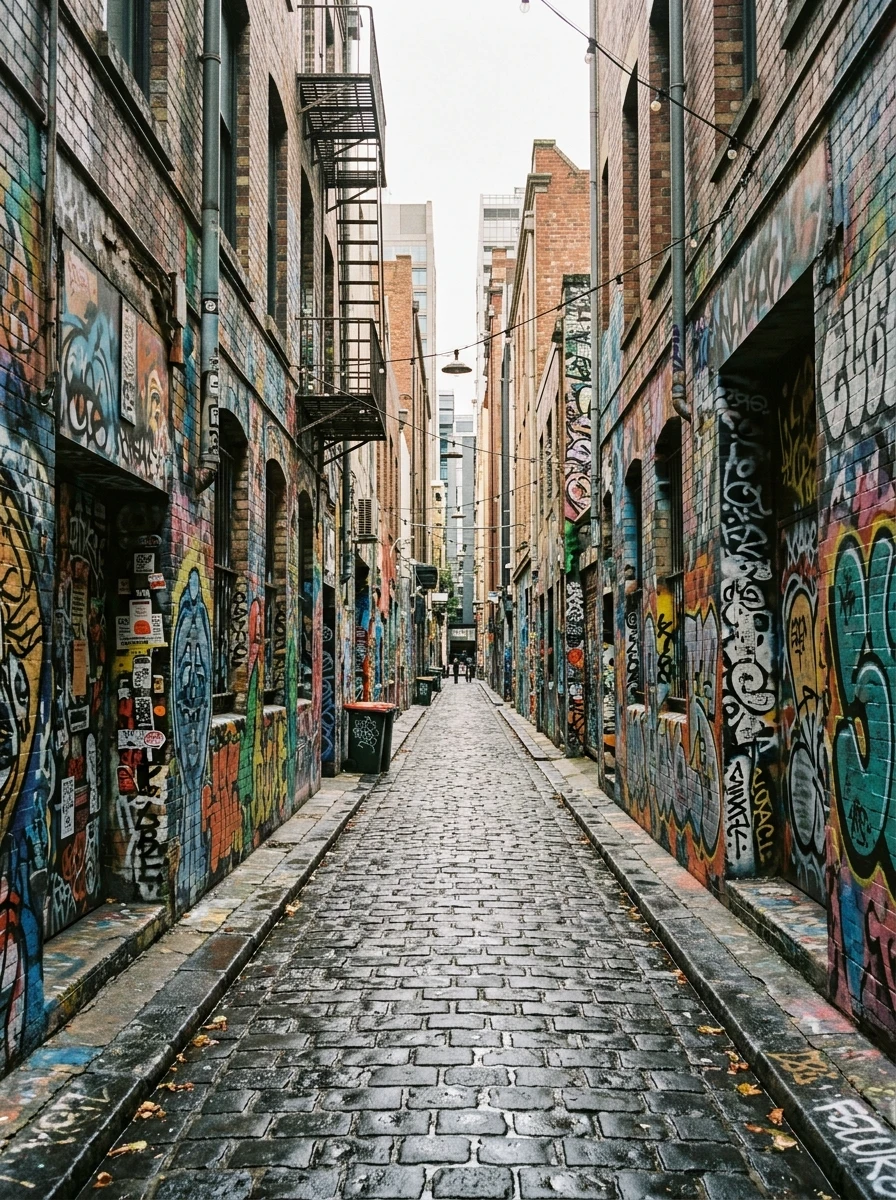
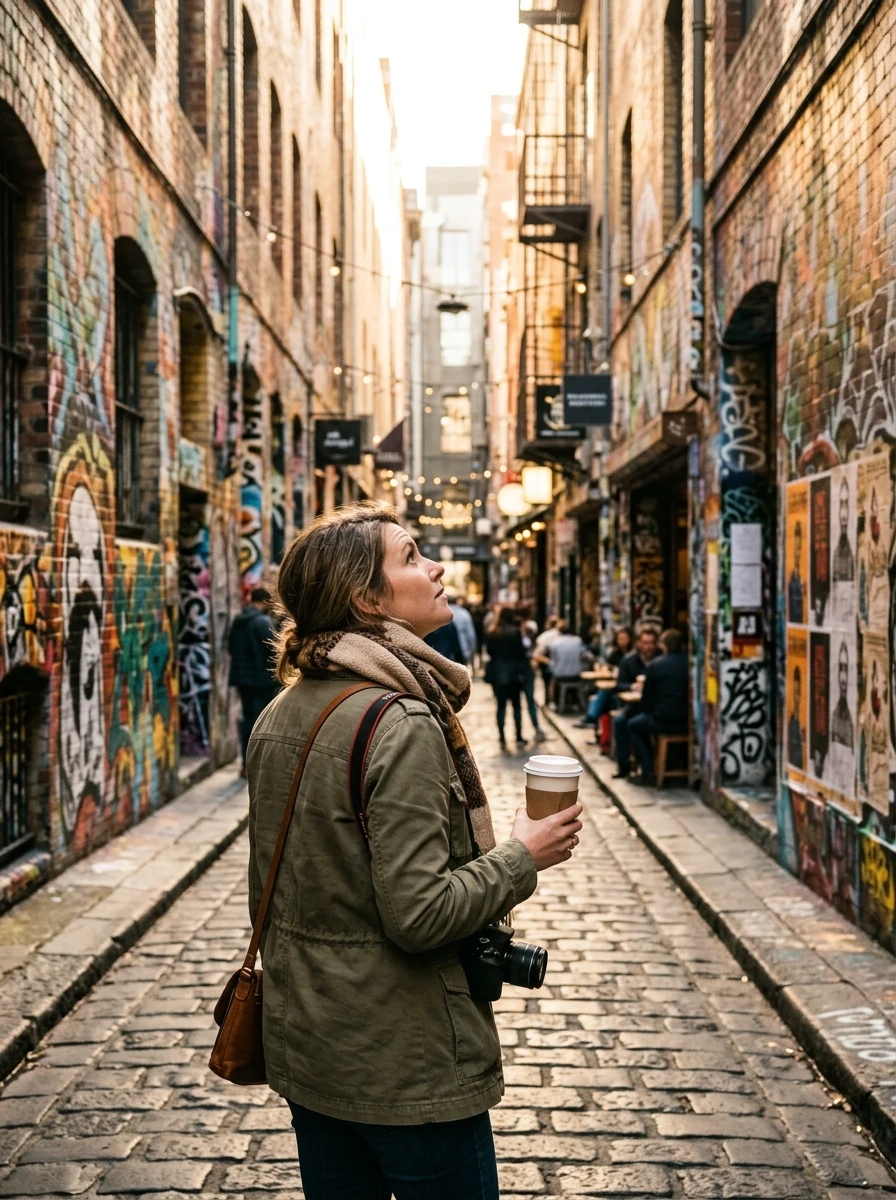
Melbourne laneways look like service alleys until you notice the coffee queue, the stencil art, and the string lights overhead. Most are paved in bluestone, a dark volcanic-grey stone that turns almost silver after rain, and many hide cafés, tiny bars, and bookshops behind unmarked doors. Americans tend to treat them as shortcuts, while locals treat them as the destination and the main streets as the way between. The melbourne laneways aesthetic works best when you let Google Maps hold your hotel pin and simply drift between melbourne hidden laneways. Give a lane two minutes before you decide it’s nothing, because the best ones reveal themselves slowly.
✈ Dispatch note:
Best for: First-time visitors and photographers
Time needed: 2 to 3 hours
Insider tip: Start at Degraves Street and follow the lanes off Flinders Lane before lunch, when the light slants down the walls.
Skip if: You only want the big landmarks and have a single day.
2. Street Art: Australia Travel Aesthetic
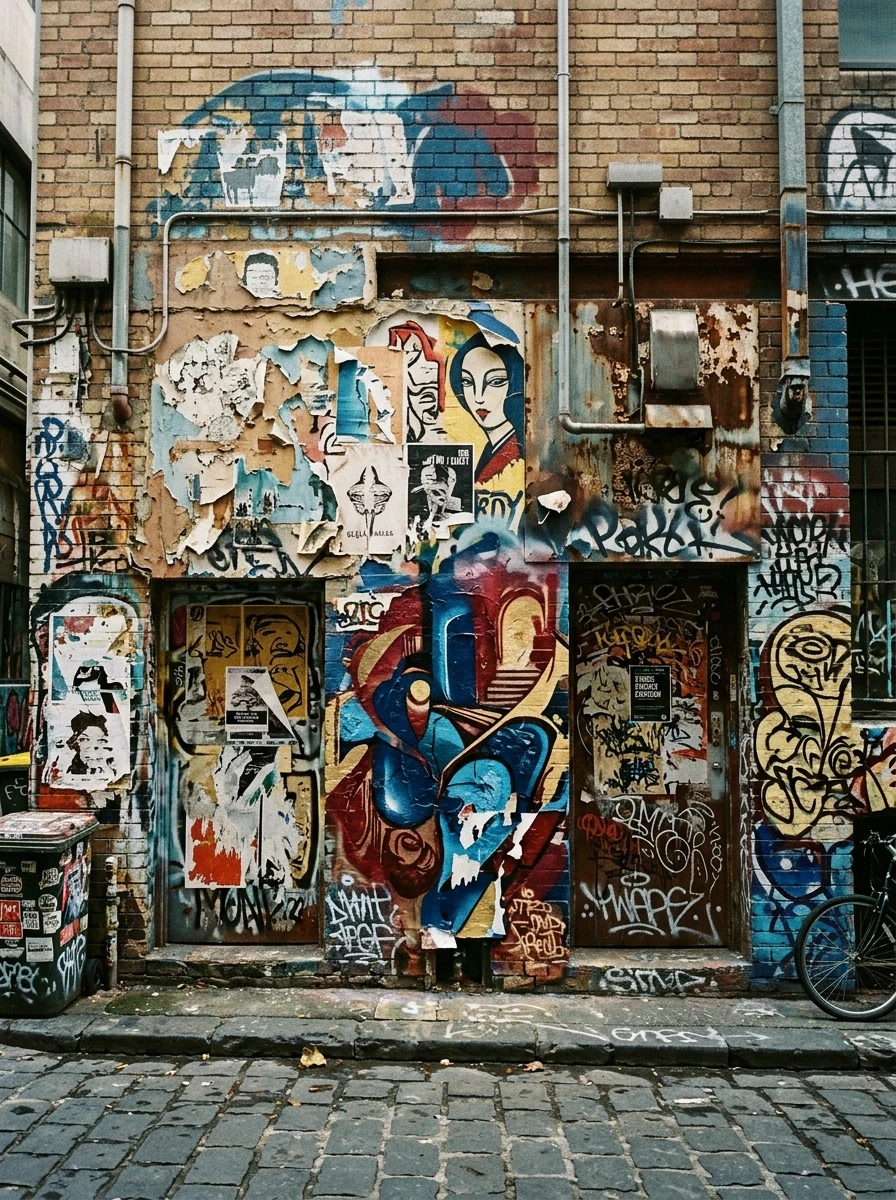
Street art in Melbourne isn’t decoration, it’s a rotating public gallery, and Hosier Lane is the famous front door. The detail guidebooks miss is that the work changes constantly, so the wall in last year’s photo may be buried under something new, which is entirely the point. Americans often expect graffiti to feel unsafe or illegal, but here much of it is permitted, valued, and treated with real respect. Spend time with melbourne street art in the quieter lanes off the main strip, where the pieces are bigger and the crowds thinner. The art and the old brick architecture talk to each other, so skip the selfie queue and look up.
Dispatch Detail: Mural Etiquette Basics
✈ Never touch or lean on a wall; the paint is often fresh and the work is respected.
✈ Most tourists photograph only the first lane they find and miss the larger pieces two streets over.
✈ Shoot straight-on for color, then crouch for the layered, peeling texture at the base.
✈ Street art is free to see, so spend the money you save on a long coffee nearby.
✈ Dispatch note:
Best for: Street art fans and photo-minded travelers
Time needed: 1 to 2 hours
Insider tip: Go on a weekday morning to beat tour groups at Hosier Lane, then wander the quieter lanes nearby.
Skip if: Art isn’t your thing; you’ll still see plenty on the way past.
3. Melbourne Coffee Shop Aesthetic
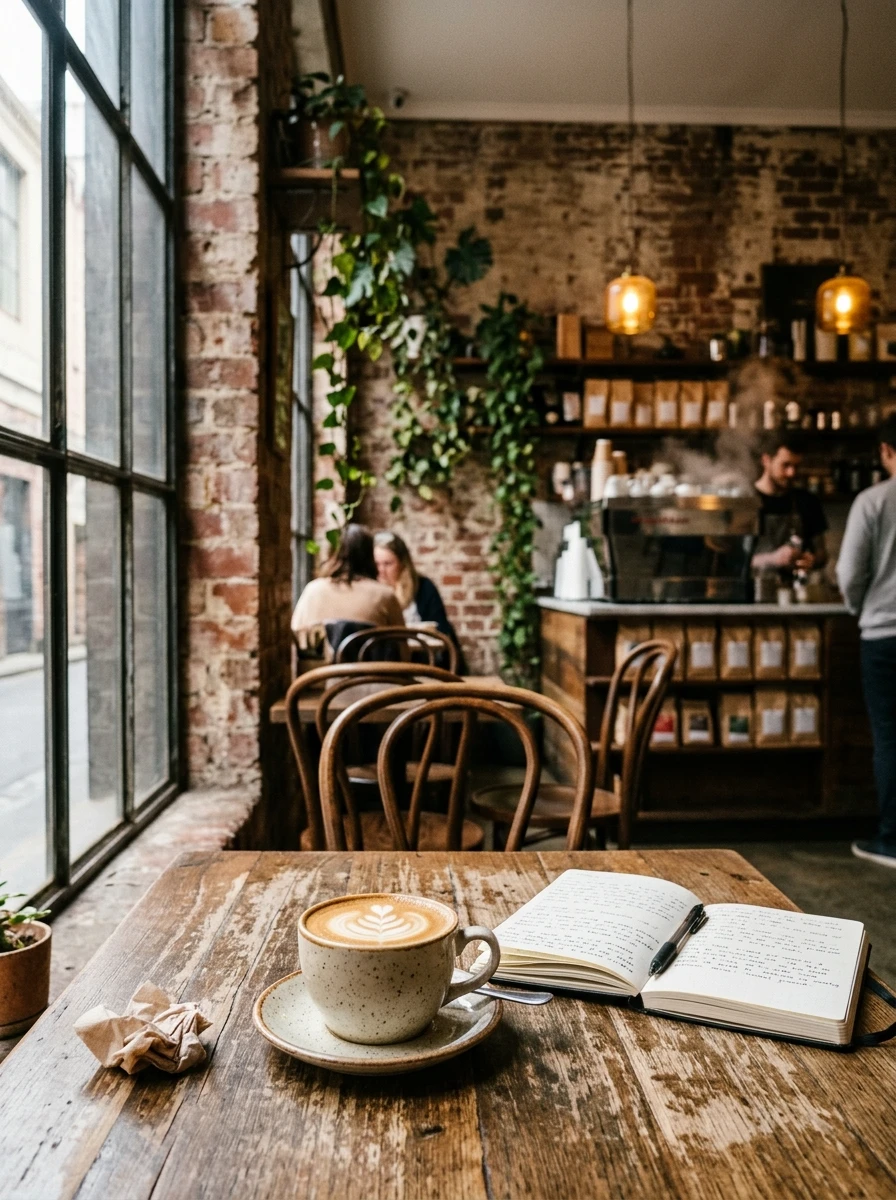
A Melbourne café looks like someone cared about the chair as much as the espresso: exposed brick, raw timber, terrazzo counters, a hand-lettered menu, and light that comes in low. The detail people miss is the corner table by the window, which locals know well, so arrive before the weekend rush. Americans often expect a laptop-and-outlet setup, but many Melbourne spots are designed for conversation and a slower pace. Strong melbourne coffee culture means you can walk into almost any neighborhood and find a room worth photographing, so keep the camera down until your coffee arrives. The best cafés here are the unplanned ones, so choose the place with the queue.
✈ Dispatch note:
Best for: Slow-morning travelers and anyone who loves interiors
Time needed: 45 to 90 minutes per café
Insider tip: Sit by a window on a weekday mid-morning for the softest light and quietest room.
Skip if: You need a laptop-heavy workday spot with plenty of outlets.
4. Golden Hour: Australia Travel Aesthetic
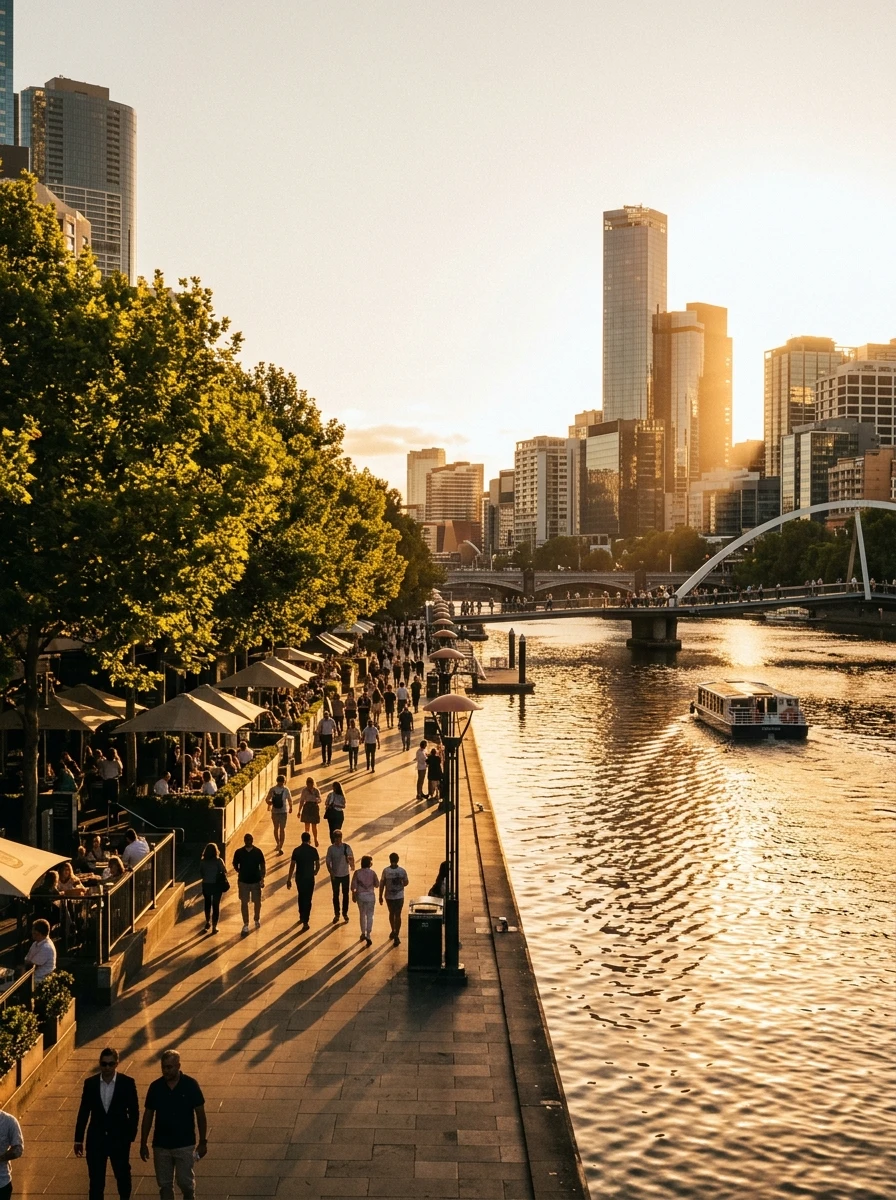
Golden hour in Melbourne arrives sideways, hitting bluestone, brick, and tram windows at an angle that makes ordinary corners look composed. Melbourne light shifts fast, so the warm window can be shorter than you expect, and the Yarra River Melbourne walk near Southbank catches it well. Americans tend to plan golden hour around sunset alone, forgetting that a clearing sky after rain can flood a street with gold earlier than planned. Be in position at the river or the bay before the light arrives, because rushing there means you’ll miss the best ten minutes. Keep a charged phone or camera on you, since you’ll use more battery than you think.
✈ Dispatch note:
Best for: Photographers and sunset chasers
Time needed: 1 to 2 hours
Insider tip: Arrive 30 minutes before the light, not at it, so you can scout an angle.
Skip if: The sky is solid grey and cold, in which case shoot the laneways instead.
5. The Color Palette of Melbourne
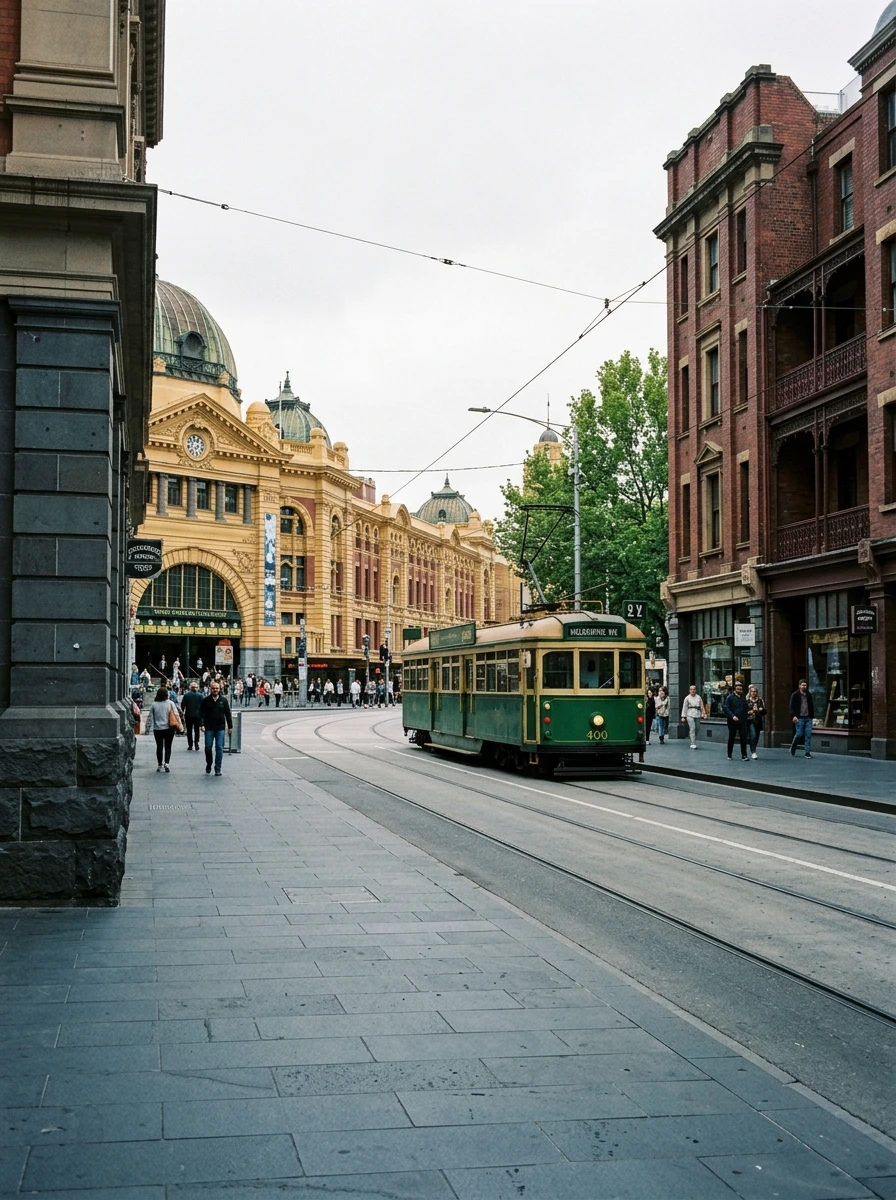
Melbourne’s palette is bluestone grey, oxblood brick, tram green, and the mustard-yellow of Flinders Street Station, all under a sky that moves from pewter to bright blue in an afternoon. Look for Victorian-era terrace houses with lacy iron verandahs, and the colorful bathing boxes at Brighton for contrast. Americans expect Australia to look like a postcard beach and miss the gothic, almost European, slightly moody side of the city. The Melbourne fashion aesthetic follows the same logic, with charcoal, camel, olive, and black. Pack to match the streets and your photos will look edited without any effort.
✈ Dispatch note:
Best for: Designers, stylists, and outfit planners
Time needed: 30 minutes of attentive looking
Insider tip: Look up; the best colors are in the rooflines and verandah ironwork.
Skip if: You’re photographing only people and not the setting.
📸 Melbourne Aesthetic Guide: Where to Find the Best Light at Every Time of Day
EARLY MORNING (6 TO 8AM): The Yarra River bank near Birrarung Marr and the Royal Botanic Gardens, where pale, low light meets quiet paths. Mornings like these are the best use of any day, and our travel morning ritual ideas guide shows how to turn a coffee walk into a practice rather than a rush.
MID MORNING (9 TO 11AM): Degraves Street and Centre Place, where angled light drops down the lane walls and café tables fill.
GOLDEN HOUR (4 TO 6PM): The St Kilda foreshore and pier, where the bay faces west and the sky turns warm behind boats, palms, and silhouettes.
EVENING (7 TO 9PM): The Southbank promenade along the Yarra, with city lights on the water and a slow, social atmosphere.
THE AESTHETIC SECRET: Most photographers chase hard sun, but the australia travel aesthetic really lives in soft, cloudy light, which is exactly what makes a melbourne laneways aesthetic photo glow.
Melbourne is a city of villages, and each neighborhood has its own look, its own pace, and its own idea of a good morning. Americans usually underplan this part, then wish they’d had one more day in at least two of them.
6. Fitzroy: Melbourne’s Best Neighborhood
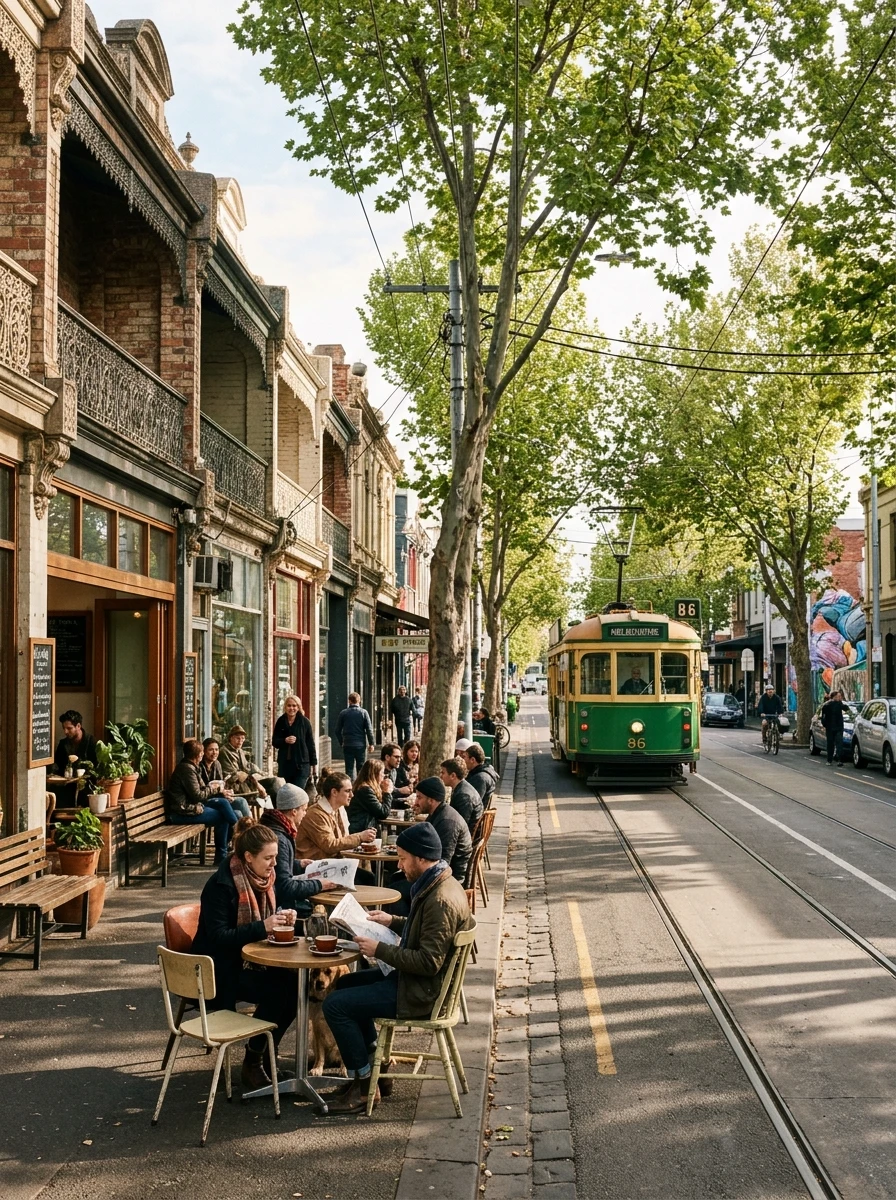
Fitzroy is where the Fitzroy Melbourne aesthetic comes together: vintage shops, wide streets lined with terrace houses, record stores, and cafés where nobody rushes you. Brunswick Street and Gertrude Street are the long-standing spines, and the side streets are where the quiet gets interesting. Americans often treat Fitzroy as a half-day stop, but it rewards a slow wander with time between bites. It’s one of the most walkable entries on any list of melbourne neighborhoods to visit, and the tram stops are close if your feet give up. My honest advice is to stay here or very near, and skip the busiest weekend afternoons if you prefer calm.
Dispatch Detail: Brunswick Street Rhythm
✈ Walk Brunswick Street early, when shops are opening, and loop back along Gertrude Street later.
✈ Most tourists never leave the main strip and miss the quiet residential streets behind it.
✈ Photograph terrace house verandahs and painted shopfronts in side-lit morning light.
✈ Fitzroy is free to wander, so budget for one good meal and many coffees.
✈ Dispatch note:
Best for: Vintage shoppers, café crawlers, and slow wanderers
Time needed: Half a day
Insider tip: Walk Gertrude Street end to end, then cut into the side streets.
Skip if: You only have a couple of hours in the city.
7. St Kilda: Beach and Culture
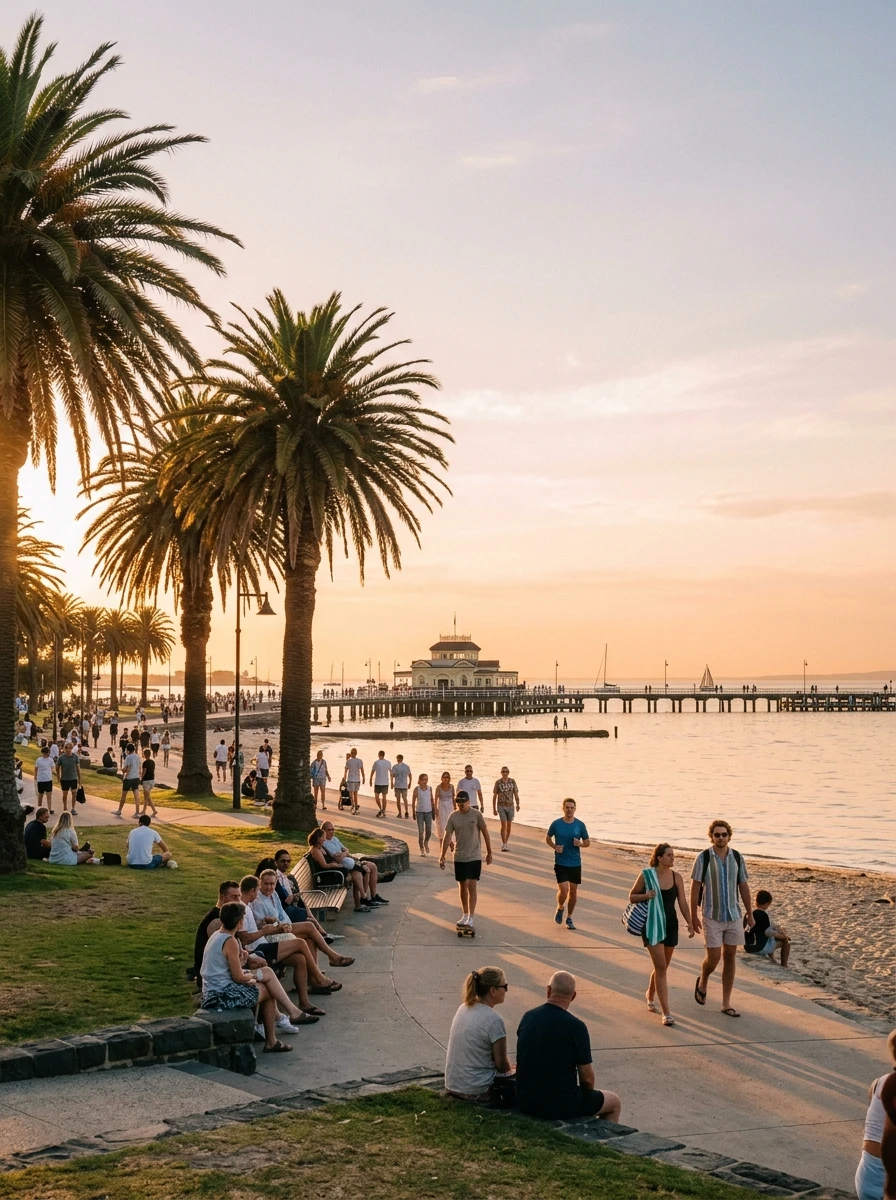
St Kilda is Melbourne’s seaside neighborhood, a mix of wide bay views, a long pier, a heritage amusement park, and cafés along a palm-lined esplanade. Locals come for sunset and the cake shops on Acland Street, and a colony of little penguins lives near the breakwater, sometimes visible at dusk. Americans expect a surf beach, but this is a calm bay, closer to a Mediterranean promenade than a California shoreline. The St Kilda Melbourne beach is for walking, skating, and golden hour, not big waves. Visit late afternoon and plan to stay through sunset.
✈ Dispatch note:
Best for: Sunset walkers and cake lovers
Time needed: 2 to 3 hours
Insider tip: Stay through dusk at the pier for a chance of seeing penguins, and keep your distance.
Skip if: It’s cold and windy and you’re expecting a swim.
8. Australia Travel Aesthetic in Collingwood
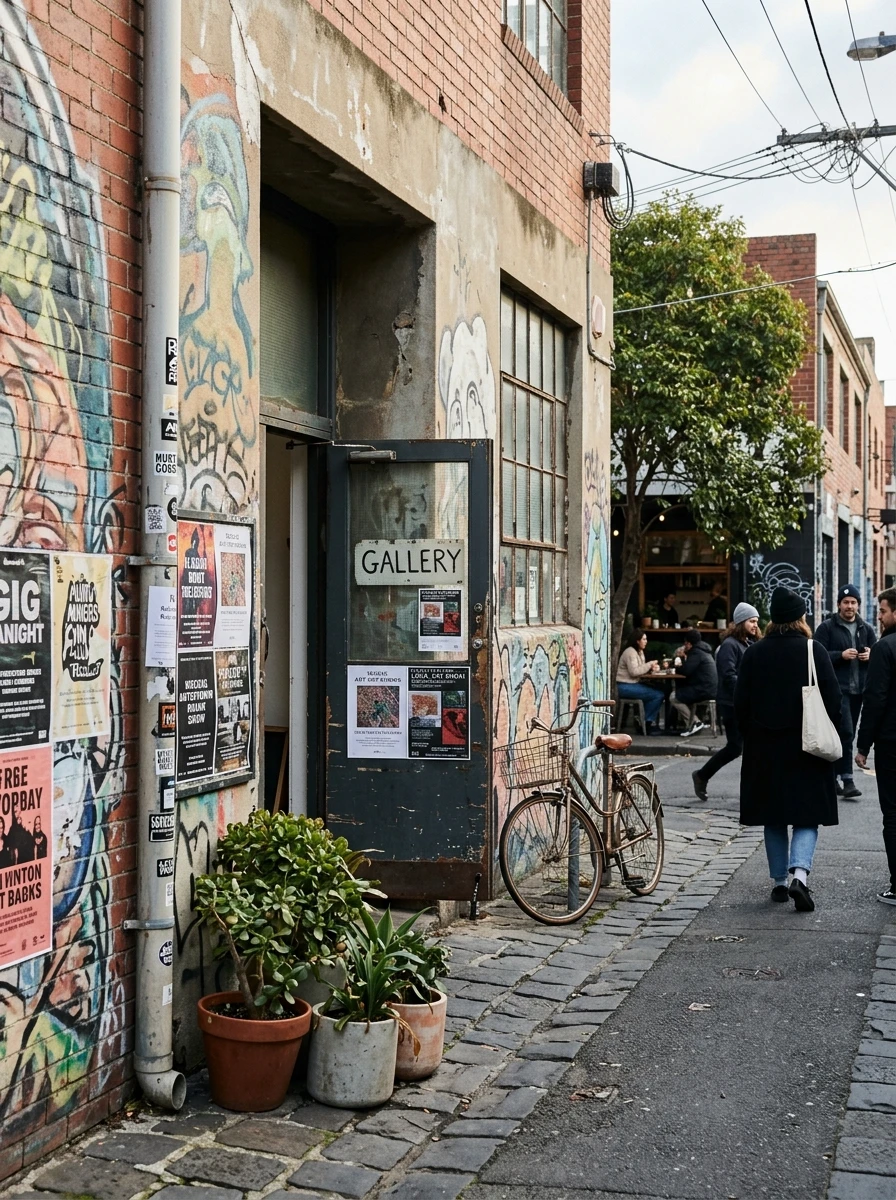
Collingwood is the creative quarter, a former industrial neighborhood of warehouses, galleries, murals, and independent studios that sits right against Fitzroy. Its character comes from converted buildings and big painted walls, and the Collingwood Melbourne cool is quieter and more working-studio than Fitzroy’s polish. Americans often lump it in with Fitzroy and miss that the rough edges are part of the appeal. Smith Street connects the two, so you can drift between them in a single walk. Treat Collingwood as a day of looking, not shopping.
✈ Dispatch note:
Best for: Creative travelers and art-minded wanderers
Time needed: 2 hours
Insider tip: Walk Smith Street between Collingwood and Fitzroy and duck into the side streets.
Skip if: You prefer polished, tidy neighborhoods.
9. The CBD: How to Navigate
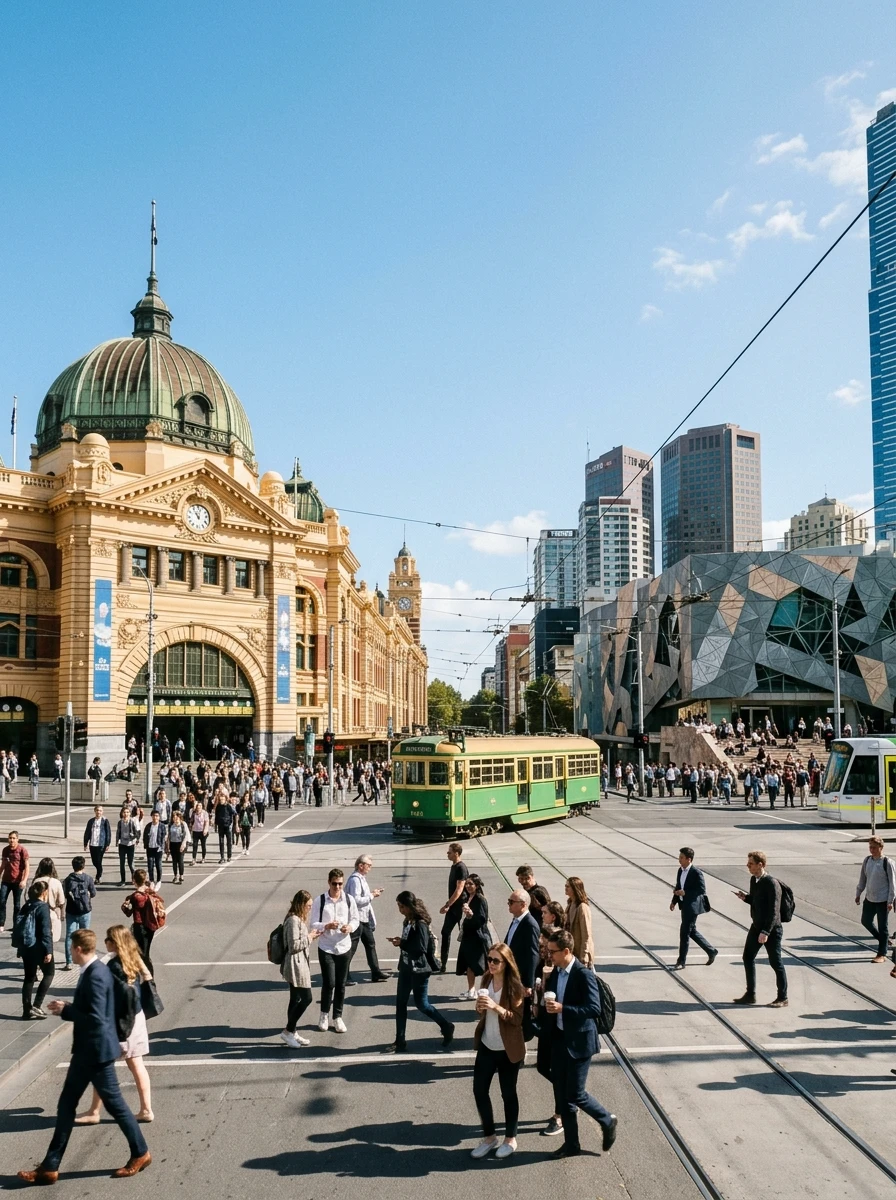
Think of the CBD as a tidy grid of Victorian arcades, grand stations, and laneways, anchored by Federation Square Melbourne and Flinders Street Station. It’s easy to learn, the grid makes Google Maps barely necessary, and the free tram zone covers much of it. Americans tend to book a hotel here and never leave, mistaking the CBD for all of Melbourne. Use it as a base and a launch point, because the best parts of the city sit just beyond the grid. Don’t skip the Block Arcade, with some of the most elegant interiors in Australia.
✈ Dispatch note:
Best for: First-day orientation and architecture lovers
Time needed: 3 hours
Insider tip: Visit the arcades and Federation Square early, before the lunch crowd.
Skip if: You’ve seen big-city downtowns and want neighborhoods instead.
10. Day Trip: Great Ocean Road
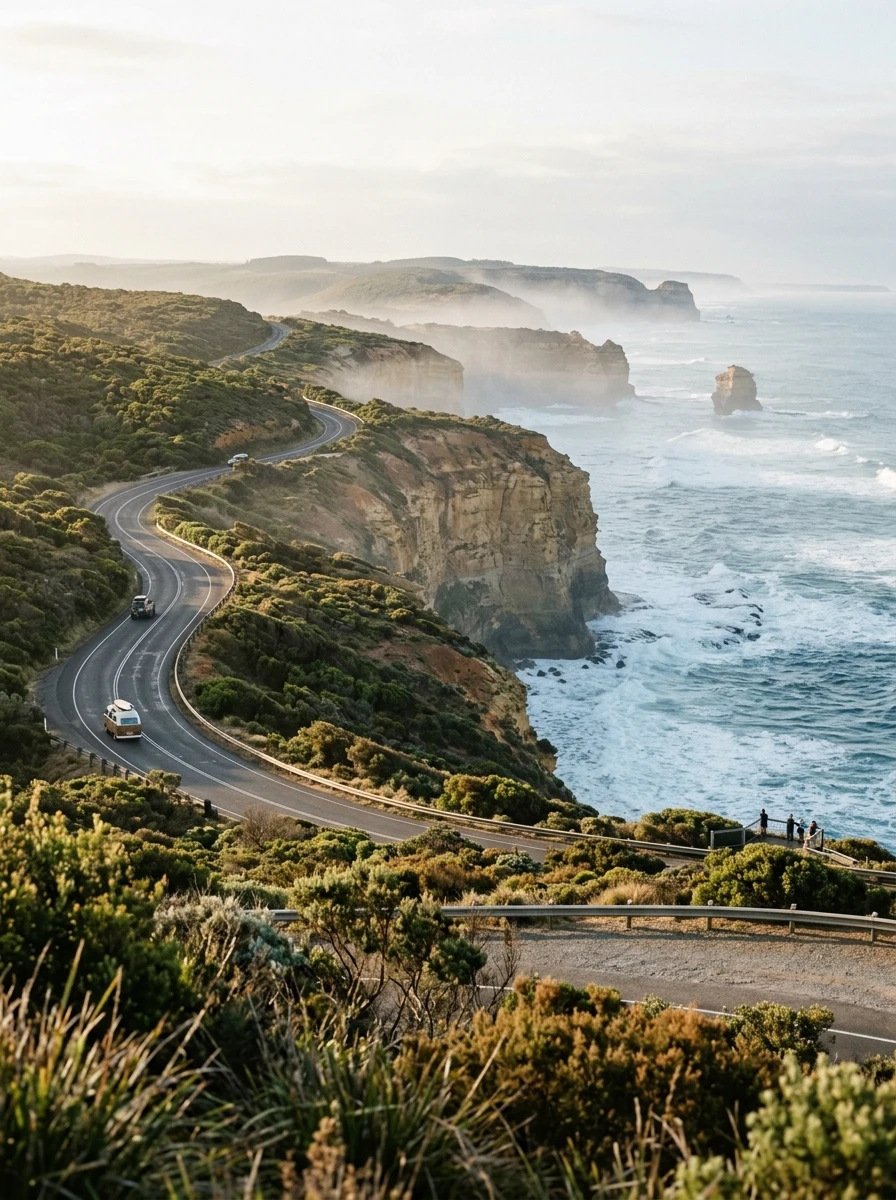
The Great Ocean Road is the classic Melbourne day trip, a coastal drive past surf towns, forest, and limestone stacks. The honest detail is that it’s a long day, since the Twelve Apostles sit roughly four hours from Melbourne by car, so many people overnight. Americans forget Australians drive on the left, which matters if you rent, and many choose a guided tour to avoid it. Among melbourne day trips it’s the one that justifies a very early start, while the Dandenong Ranges Melbourne trip is a gentler alternative. Go for the coastline and quiet stops, and skip it if you only have one full day in the city.
✈ Dispatch note:
Best for: Scenery lovers and road-trippers
Time needed: A full day, 10 to 12 hours
Insider tip: Book a tour or leave very early, and plan stops rather than racing to the end.
Skip if: You only have one day or get carsick on winding roads.
🗺️ Melbourne Neighborhoods: The Honest 30-Second Guide
Choosing melbourne neighborhoods to visit is easier when you match them to your pace, and if you’re going alone, our solo travel planning guide has the pre-trip preparation that makes any solo trip feel manageable. Anyone who wants to visit Melbourne Australia with confidence should read it before booking.
FITZROY: Bohemian, vintage, and café-heavy. Best for browsing and long lunches. Avoid crowded weekend afternoons.
ST KILDA: Seaside, retro, and relaxed. Best for sunset and bay views. Avoid expecting a surf beach.
COLLINGWOOD: Raw, creative, and warehouse-lined. Best for murals and galleries. Avoid it if you want polished shopping.
THE CBD: Gridded, busy, and full of arcades. Best for first-day orientation. Avoid staying only here.
SOUTH YARRA: Polished, fashionable, and leafy. Best for boutiques and the Botanic Gardens nearby. Avoid expecting laneway grit.
THE LOCAL RULE: Locals pick one neighborhood per day and take the tram between them rather than trying to see everything.
This chapter is where Melbourne stops being a place you look at and becomes a place you eat, ride, and queue in. American travelers are consistently surprised by how seriously locals take breakfast and how little they care about being impressed.
11. The Flat White: Melbourne’s Religion
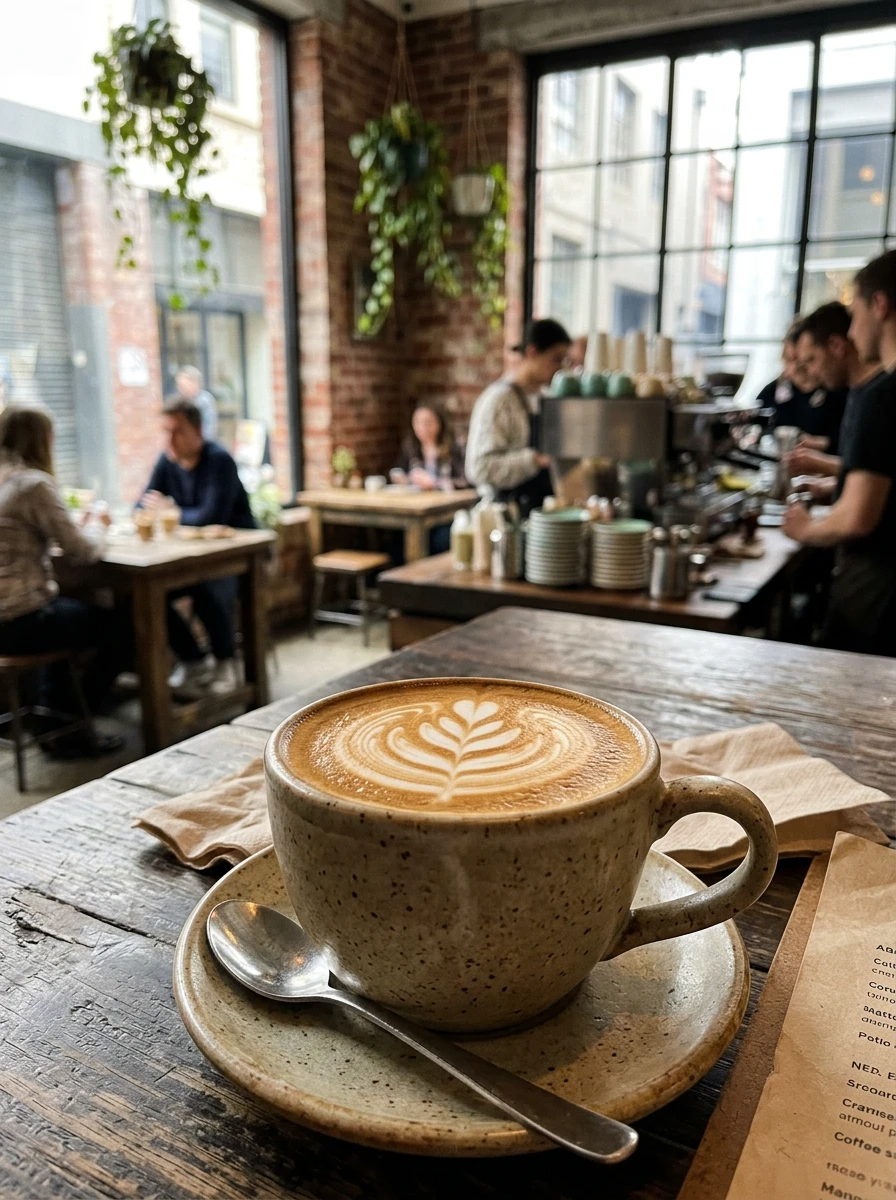
The flat white is the center of Melbourne’s coffee faith: espresso with finely textured steamed milk and a thin layer of microfoam, served in a small ceramic cup. Locals take their barista seriously, so you’ll see regulars with a standing order and a first-name greeting. Americans expect a latte and are surprised by the smaller size and the stronger coffee flavor. The melbourne flat white coffee is the order that earns a nod from the person behind the counter. Make it a daily ritual: order one, sit down, and don’t rush it.
✈ Dispatch note:
Best for: Coffee lovers
Time needed: 20 minutes per cup
Insider tip: Order at the counter and say “flat white,” not “latte.”
Skip if: You don’t drink coffee; ask for tea or a hot chocolate instead.
12. Queen Victoria Market: Go Early
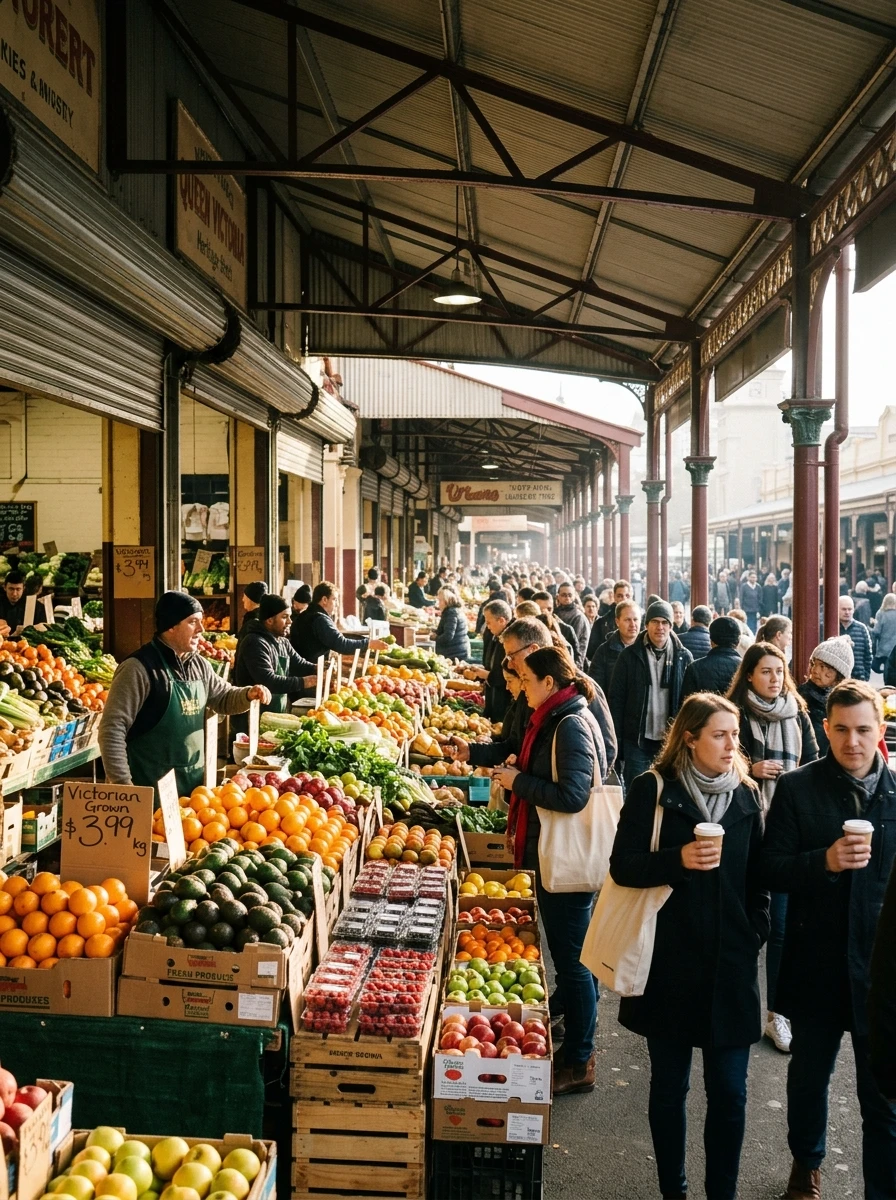
Queen Victoria Market is a sprawling open-air market of produce, delis, and stalls, and early morning is when it’s at its best. It doesn’t open every day, so check hours before you go and plan around them. Americans often arrive midday, when the crowds are thickest, and spend more time in line than looking. The Queen Victoria Market Melbourne experience rewards a slow loop through the deli hall first. Eat something there, buy one small thing to bring home, and skip the souvenir stalls if you don’t need them.
✈ Dispatch note:
Best for: Food lovers and souvenir hunters
Time needed: 2 hours
Insider tip: Check opening days and arrive close to opening for the best produce and shortest lines.
Skip if: Crowds make you anxious.
13. Melbourne Tram: Free in CBD
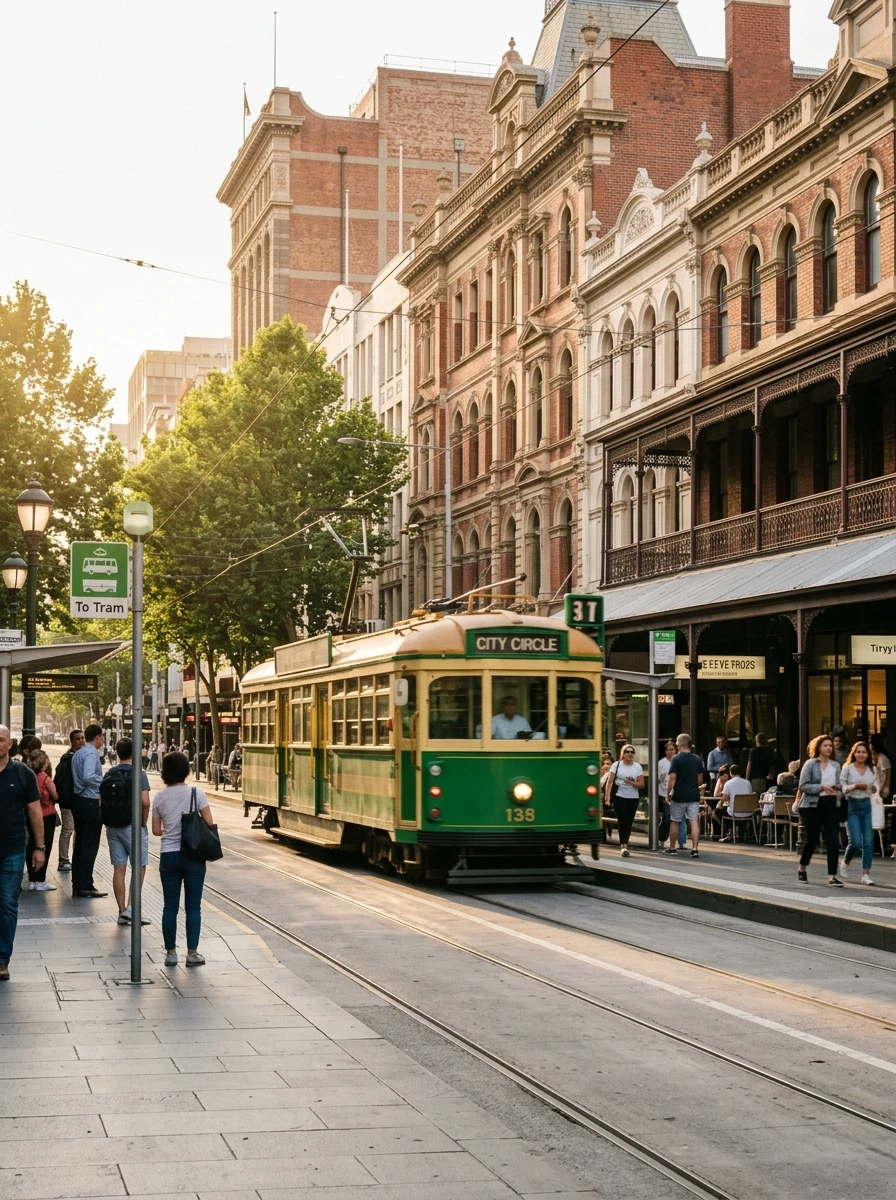
The Melbourne tram network is one of the largest in the world, and the green trams are as much a part of the city’s look as its transport. Within the central Free Tram Zone, rides cost nothing, and outside it you’ll need a myki card, so check the current boundaries and options when you arrive. Americans think trams are quaint, then discover they’re the fastest way to reach Fitzroy and St Kilda. A single line can show you three neighborhoods for the price of one ticket, if you’re paying at all. Sit by a window and treat the ride as a sightseeing tour.
✈ Dispatch note:
Best for: Car-free travelers
Time needed: 10 to 30 minutes per ride
Insider tip: Check the Free Tram Zone boundaries before you tap on.
Skip if: You’re heading far outside the network, where trains work better.
14. Melbourne Brunch: The Real Deal
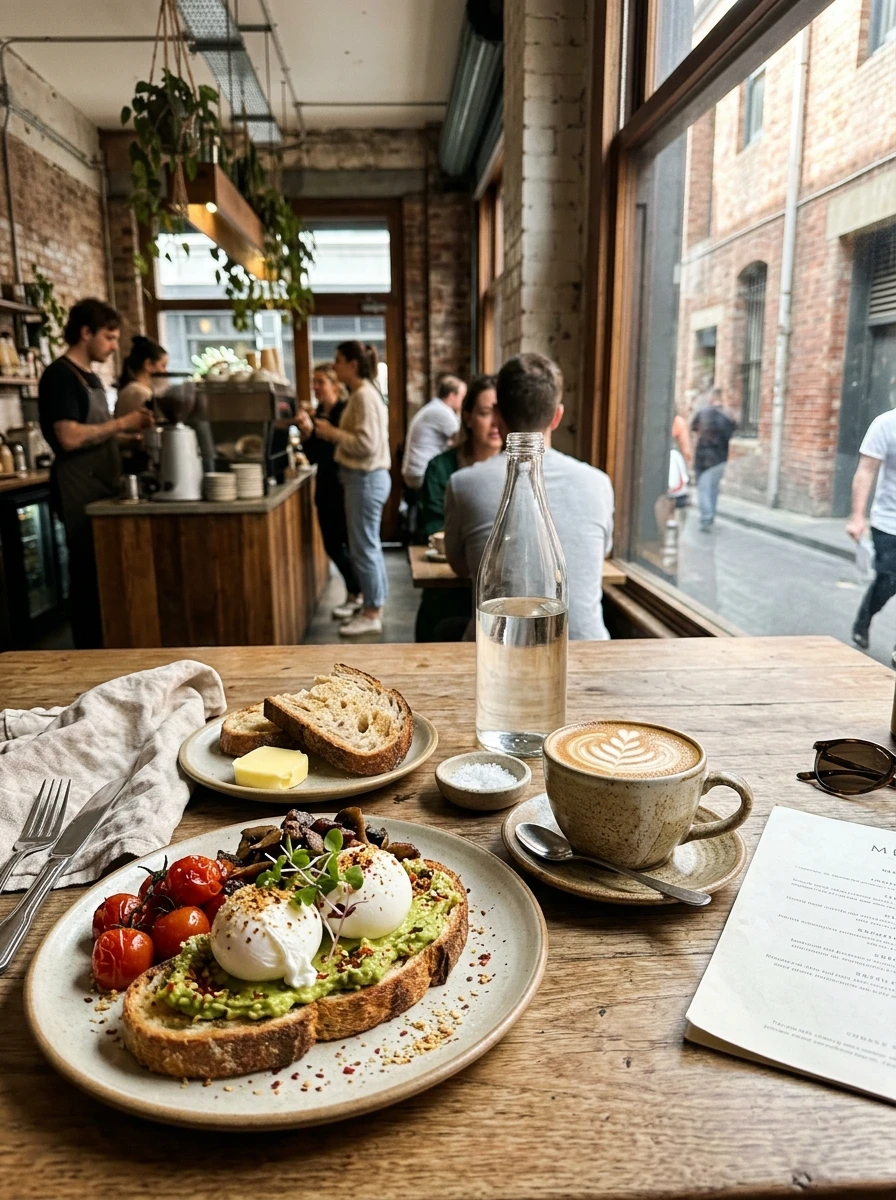
Brunch in Melbourne is a daily habit rather than a weekend event, with menus of smashed avocado, eggs, ricotta hotcakes, and seasonal produce plated with care. Locals queue patiently and often book ahead. Americans expect a mimosa and a diner menu, then find a flat white, a composed plate, and no tipping expected. The Melbourne brunch culture is the best window into the melbourne food scene and how seriously the city takes it. Go on a weekday for shorter lines and calmer rooms.
✈ Dispatch note:
Best for: Leisurely mornings
Time needed: 1 to 1.5 hours
Insider tip: A weekday brunch beats a weekend queue every time.
Skip if: You’re a lunch-only eater.
☕ Melbourne Coffee Guide: What to Order and What Not to Ask For
For American women who have explored domestic travel deeply, our American travel inspiration guide covers the best USA fall destinations, and Melbourne coffee culture is the first thing that will remind you this trip isn’t in America.
ORDER THIS:
Flat white: espresso with silky steamed milk and a thin layer of foam, in a small cup.
Long black: a double shot poured over hot water, closer to an Americano but with the crema kept intact.
Short black: a straight espresso, small and strong.
Magic: a Melbourne favorite, a double ristretto with steamed milk, smaller and stronger than a flat white.
NEVER ORDER THIS:
A venti caramel macchiato. It will get you a polite smile and a confused barista.
An “iced coffee” expecting cold brew. In Australia it’s often a sweet, milky dessert drink with ice cream.
THE FLAT WHITE EXPLANATION: Think of a latte with less milk and more coffee, silkier on top, in a smaller cup, with the espresso doing most of the talking.
THE CAFE CULTURE RULE: Melbourne cafés are built for sitting and talking, while American coffee shops are often built for grabbing and going.
The practical reality is where an Australia dream becomes a plan, and it’s where honest preparation matters most. American travelers are consistently surprised by how much a good first two days depends on the flight, not the itinerary.
15. Flight From USA: Honest Breakdown
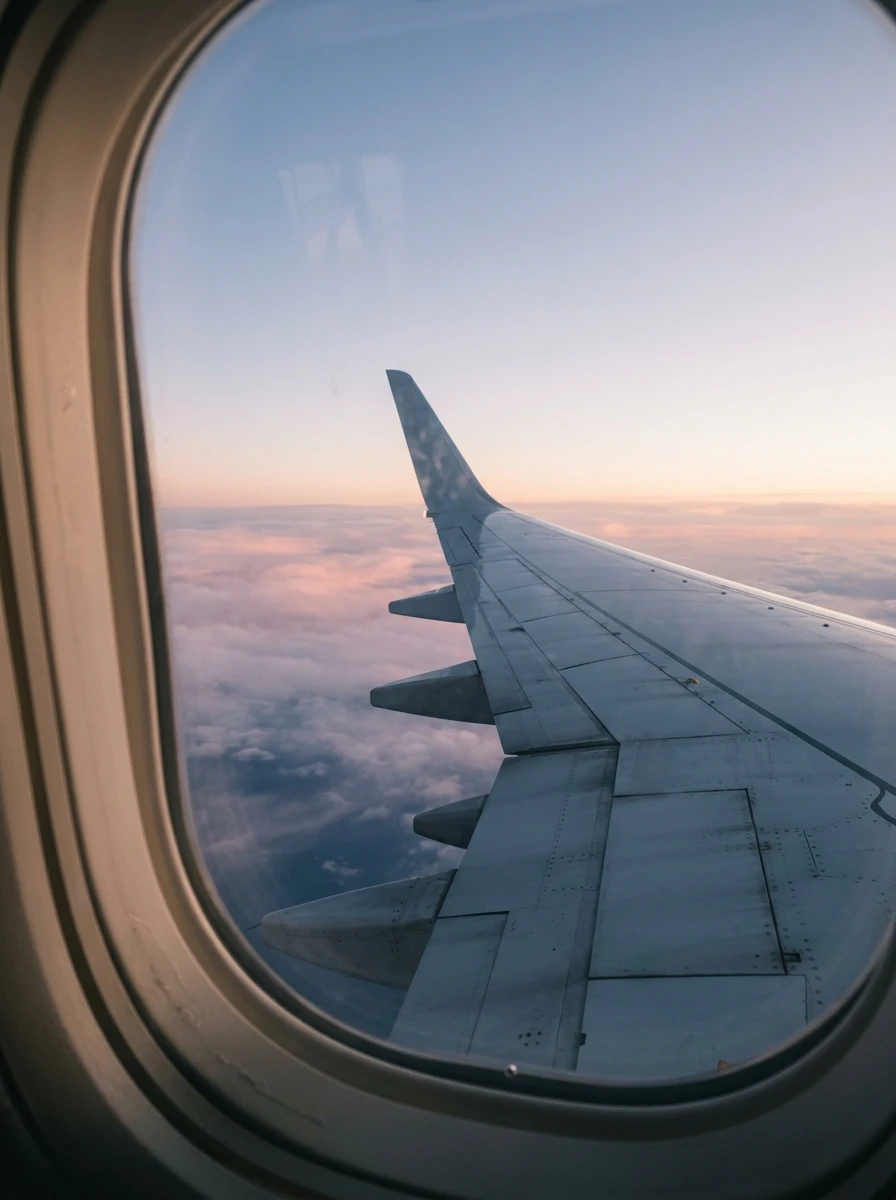
The flight from the USA to Melbourne is the biggest cost of this trip, and it’s long: the LA to Melbourne flight runs roughly 15 to 17 hours nonstop on the direct route, with connections from San Francisco or New York adding hours and layovers. Many travelers add a stopover in Sydney, Auckland, or somewhere in the Pacific to break it up. Americans consistently underestimate the effect on their body, treating it like a longer cross-country flight. Check Expedia and Google Flights for the cheapest dates, then price a stopover against a straight run. Choose an aisle seat and book your first night in an Airbnb or hotel that lets you arrive without a rush.
Dispatch Detail: Long Haul Logistics
✈ Download entertainment and offline Google Maps before you leave, since airport Wi-Fi is unreliable.
✈ Most travelers forget you cross the date line and lose a calendar day on the way over.
✈ Photograph the window at dawn on arrival, when the first light hits the coast.
✈ Compare nonstop and stopover prices; a stopover can lower the fare and ease the body clock.
✈ Dispatch note:
Best for: Anyone planning a first trip
Time needed: 20 to 30 hours door to door
Insider tip: Book an arrival that gives you a full buffer night, not a tight same-day check-in.
Skip if: You already have a stopover mapped out.
16. Jet Lag: What Actually Helps
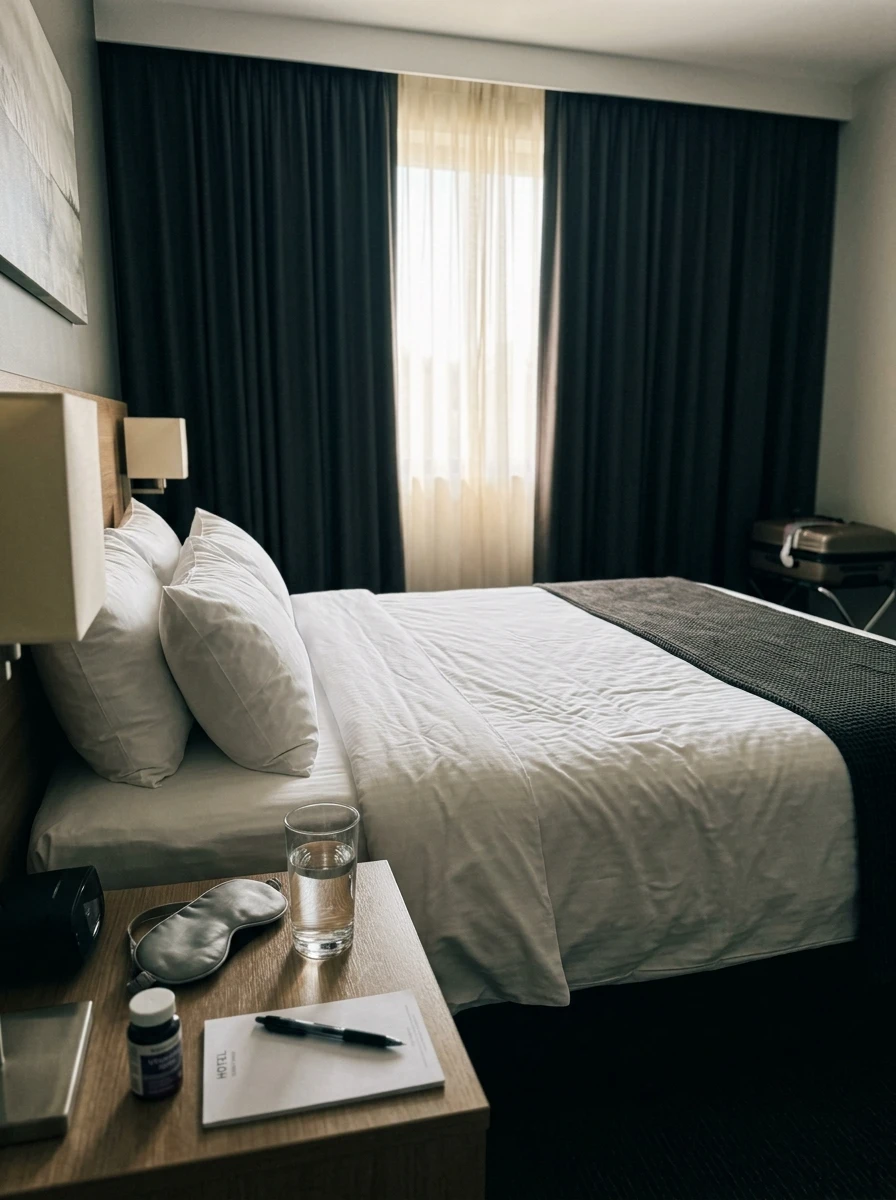
Melbourne sits roughly 17 to 19 hours ahead of Los Angeles depending on daylight saving, so you land into a day you never experienced. Morning light does more for your body clock than caffeine, so a walk along the Yarra River Melbourne path on day one helps more than a nap. Americans often crash for hours in the afternoon, then wake wide awake at three in the morning. Melbourne jet lag recovery is faster if you stay up until local evening and keep your first day light. Drink water, eat on local time, and let your first dinner be early and simple.
✈ Dispatch note:
Best for: First-time long-haul travelers
Time needed: 2 to 3 days to adjust fully
Insider tip: Get outside in daylight as soon as you arrive, even if you’re exhausted.
Skip if: You’ve booked a stopover and arrive already adjusted.
17. What to Pack for Melbourne
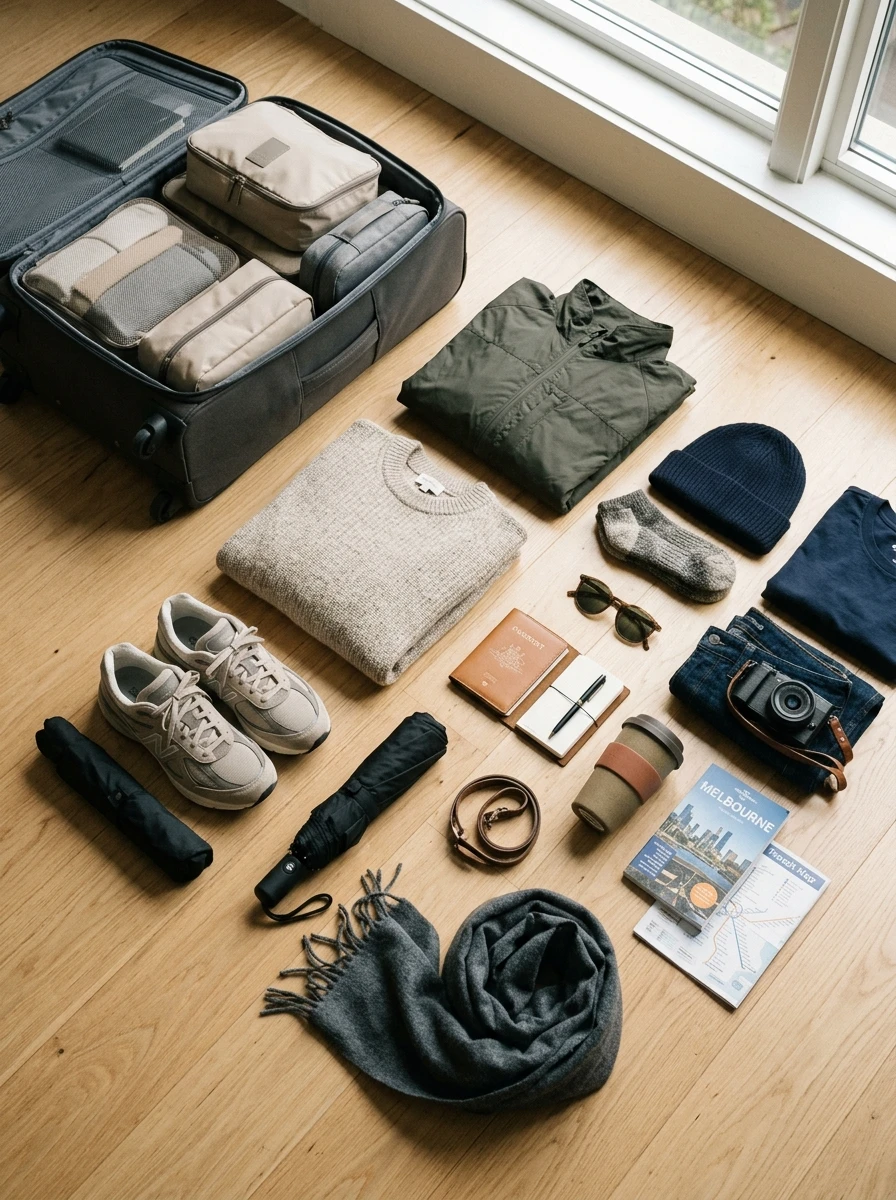
Packing for Melbourne means planning for four weather moments in one day: sun, wind, rain, and a sudden cool change. Melburnians layer almost year-round, wearing black or neutral pieces they can strip off between café and tram. Americans pack for a beach country and forget Melbourne can feel cool even on a bright day. For melbourne weather packing, bring layers that pack small and mix together. Keep your palette neutral so your photos look cohesive, and skip anything you can’t wear at least twice.
🧳 Melbourne Packing Guide: What the Weather Actually Demands
THE WEATHER REALITY: Melbourne’s four-seasons-in-one-day reputation is earned, with a bright morning, cold wind by noon, a shower by mid-afternoon, and clear skies by dinner. These australia travel packing tips and melbourne weather packing rules apply in every season.
ALWAYS PACK:
A packable rain jacket, because showers arrive fast and leave faster.
Comfortable walking shoes, because laneways are cobbled and distances add up.
Sunscreen and sunglasses, because the UV is strong even on cool days.
A Type I power adapter, because Australian plugs differ from American ones.
A light scarf or extra layer, because evenings cool quickly.
LEAVE HOME:
A bulky umbrella, because the wind will win.
A US hair dryer, because voltage and plugs won’t match.
A stack of US cash, because Melbourne runs on cards and phones.
THE LAYER SYSTEM: Start with a breathable base like a simple tee, add a knit or cardigan in the middle, and finish with a packable shell or light coat. Our travel outfit inspiration guide has the layering pieces that pack light and perform across every Melbourne weather moment.
✈ Dispatch note:
Best for: Planning your suitcase before you fly
Time needed: 1 hour to pack well
Insider tip: Pack in cubes sorted by layer so you can reach your jacket without unpacking.
Skip if: You already travel with a tested layering kit.
18. Melbourne Safety: Honest Assessment
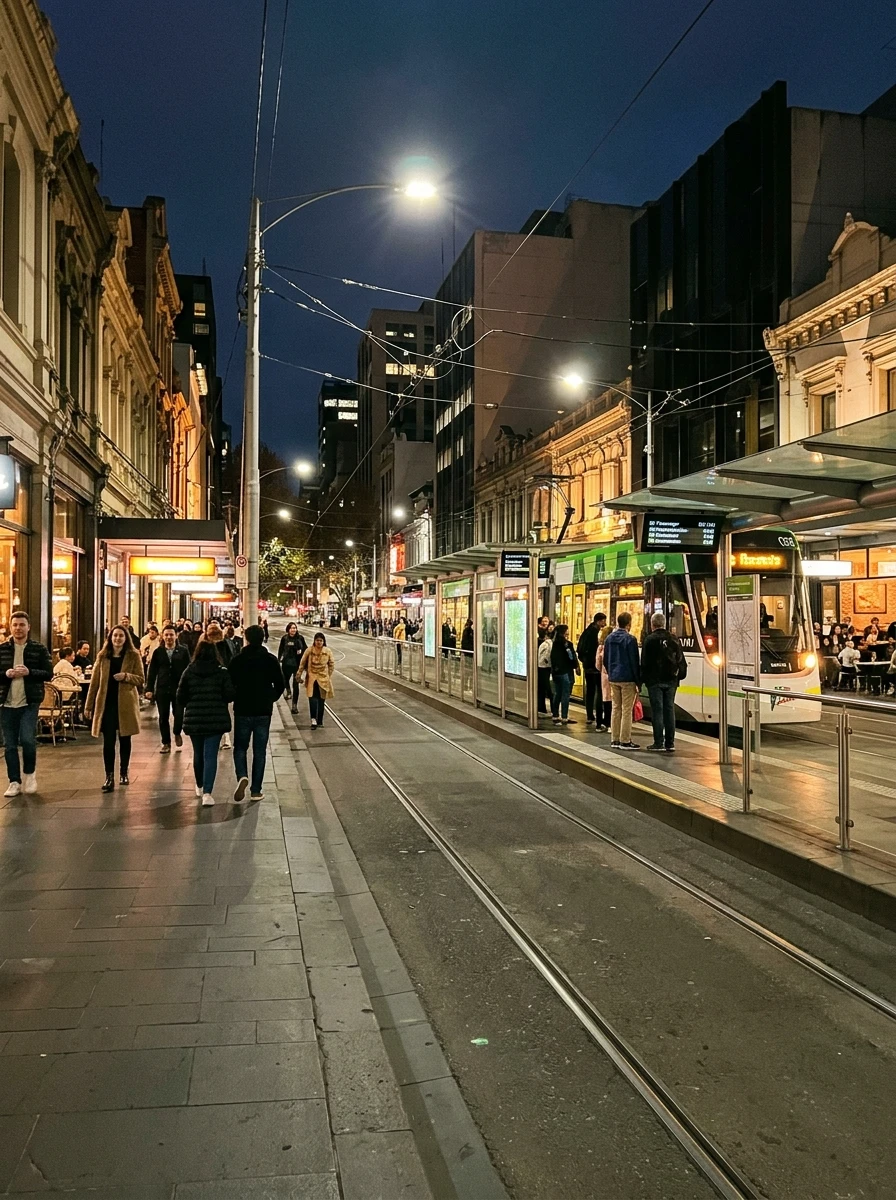
Melbourne is generally a safe, well-lit, walkable city, and women travel there alone regularly without trouble. Petty theft does happen around crowded tourist areas and on public transport at night, so keep your phone and bag close. Americans, used to avoiding certain neighborhoods, often relax too far in a place that feels friendly. Use the same city awareness you’d use at home: stay on busy streets late at night and plan your ride back. It’s one of the easier international cities for a first solo trip, but don’t skip travel insurance.
Dispatch Detail: After Dark Basics
✈ Share your live location with someone at home when you’re out in the evening.
✈ Most travelers leave late-night transport to chance; check your last tram or ride before dinner.
✈ Photograph the laneways at dusk, when the lights come on and the foot traffic is still steady.
✈ Budget for a rideshare back to your stay rather than a long late walk.
✈ Dispatch note:
Best for: Solo travelers and first-time visitors
Time needed: Ongoing awareness, not extra hours
Insider tip: Stick to busy, lit streets after dark and trust your instincts.
Skip if: You’re traveling with a group and already have a plan.
By now you’ve seen Melbourne’s streets, cafés, and logistics, so this last chapter is about where the trip fits in your life. It tends to surprise American travelers that the answer is usually that it deserves more time than they planned.
19. Australia Beyond Melbourne: What Next
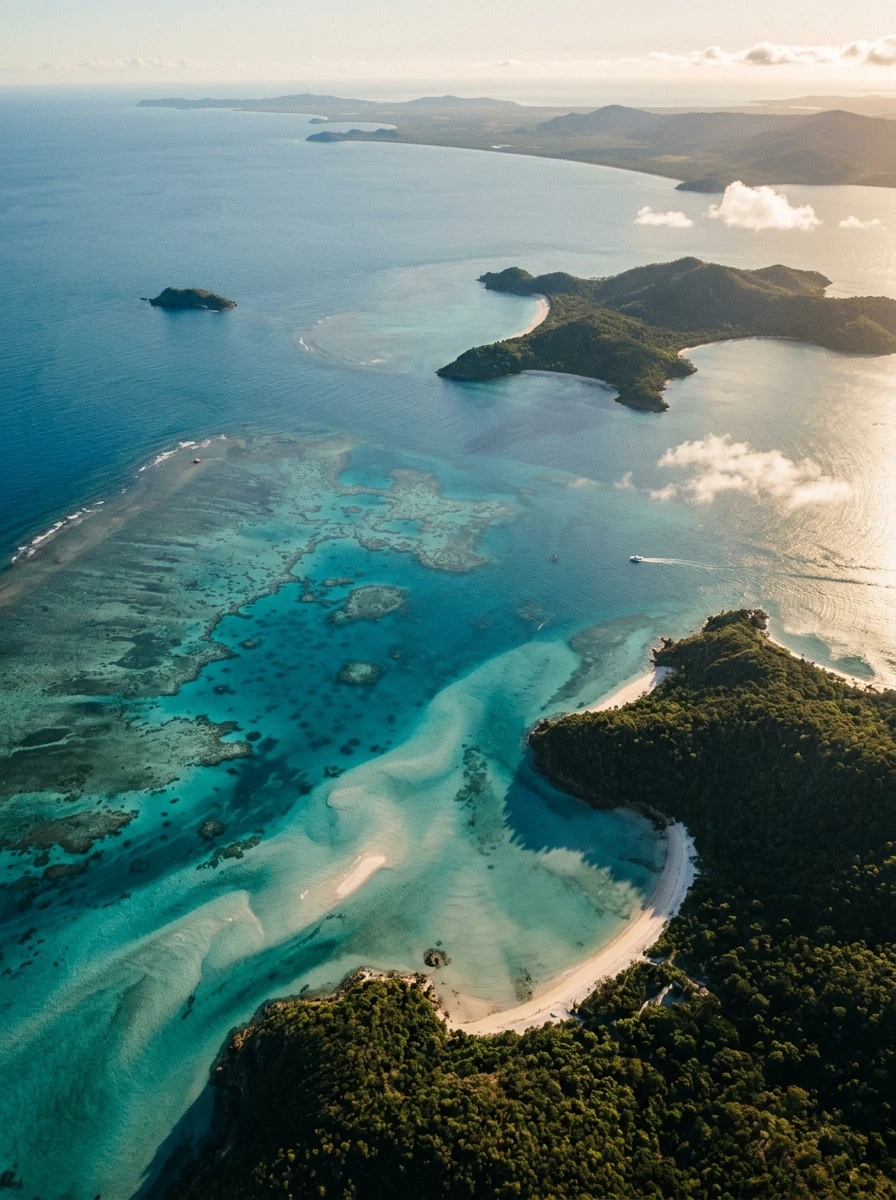
Once you’ve done Melbourne, the rest of your australia travel bucket list opens up: Sydney’s harbor, the Great Barrier Reef, Tasmania, and the red center. Australia is enormous and domestic flights are the norm, so each region needs its own plan. Americans often squeeze four cities into ten days and spend the trip in airports. The australia travel aesthetic changes dramatically with the landscape, from city laneways to reef blues, which is why australia travel ideas work best in small, focused clusters. Treat Melbourne as your anchor, add one more destination, and leave margin.
✈ Dispatch note:
Best for: Second-trip planners and long-stay travelers
Time needed: 5 to 10 extra days
Insider tip: Fly between regions and compare fares on Expedia early.
Skip if: It’s your first trip and your time is short.
20. Is Melbourne Worth the Flight?
Yes, if you want a city that surprises you with its look, its food, and its pace. Melbourne isn’t a compromise trip, it’s the kind of destination where the flight pays you back with laneways, coffee, and a culture of taking things slowly. Americans who go often say they should have stayed longer. The australia travel aesthetic is only half the reason; the other half is how easy the city makes it to be a traveler instead of a tourist. If you only have a few days, give it at least five.
✈ Dispatch note:
Best for: Undecided travelers
Time needed: 5 to 7 days
Insider tip: Build in a buffer day so you don’t spend the trip catching up.
Skip if: You need a beach resort to relax.
Melbourne Dispatch: Travel Questions Answered
Is Melbourne worth visiting for American travelers?
Yes. The australia travel aesthetic is rare among major cities, with laneways, murals, and light you won’t find at home. Among melbourne must see places, the laneways, Fitzroy, and St Kilda are the ones that reward the long flight. Most Americans say they wish they’d gone sooner.
How long is the flight from the USA to Melbourne?
The LA to Melbourne flight is roughly 15 to 17 hours nonstop, with connections from the East Coast or San Francisco adding time. Good australia travel tips include a stopover and an arrival day with no plans. Expect to cross the date line and lose a calendar day on the way over.
When is the best time to visit Melbourne?
Spring and autumn are the most comfortable seasons to visit Melbourne Australia, with mild days and softer light. Summer is warm and busy, and winter is cool and quiet, so remember the seasons are opposite to the US. These are good australia travel ideas for matching the city to your preferred pace.
What neighborhoods should I visit in Melbourne?
Start with Fitzroy, Collingwood, St Kilda, and the CBD. These melbourne neighborhoods to visit give you the best mix of melbourne aesthetic places, from creative streets to seaside walks. Add South Yarra if you want boutiques and green space.
Is Melbourne safe for solo female travelers?
Melbourne is generally one of the easier international cities for solo women. My honest assessment of Melbourne safety is that normal city awareness is enough: keep your bag close, stay on busy streets at night, and plan your ride home. These australia travel tips apply to any big city, but Melbourne feels friendlier than most.
What is the coffee culture like in Melbourne?
Melbourne coffee culture is serious, small-cup, and espresso-focused, and it’s part of the australia travel aesthetic as much as the architecture. Order a flat white, sit down, and don’t rush. A good coffee also helps after the flight, and our long-haul travel recovery guide has the wind-down practices that help any traveler adjust to a new time zone without losing the first two days.
What should I pack for a trip to Melbourne?
Pack layers, a rain jacket, comfortable walking shoes, sunscreen, and a Type I adapter. These australia travel packing tips matter because melbourne weather packing means preparing for sun, wind, and rain in one day. Keep colors neutral and pieces mixable.
Do Americans need a visa for Australia?
Most US citizens need an Electronic Travel Authority before flying, which is usually applied for online or through the official government app. Check the Australian Department of Home Affairs for the current requirements before you book, because rules for australia travel for Americans can change. Good australia travel tips include applying early and keeping a digital copy.
What day trips are worth doing from Melbourne?
The Great Ocean Road and the Dandenong Ranges are the best melbourne day trips. The australia travel aesthetic shifts from city to coast to forest on these outings, so dress in layers, and our Melbourne outfit layering guide shows the outer layer that suits both the climate and the cultural dress code. Start early, especially for the coast.
How do I get around Melbourne without a car?
The Melbourne tram network is the easiest way to move around, and the central Free Tram Zone makes the CBD effortless. Use trains for farther suburbs and a rideshare late at night. You can easily visit Melbourne Australia without ever renting a car.
The Dispatch Ends
The australia travel aesthetic isn’t a compromise on the way to somewhere more famous. Melbourne is a first-choice destination that most Americans haven’t discovered yet, with laneways, coffee, and light that reward every hour you give them. I wrote this dispatch so you’d have what I wanted before my own long flight. Book the flight, charge the camera, and leave room for a long coffee.
An Australia trip is one part of a travel life that is genuinely expansive – The Muse Vale has the travel, wellness, and lifestyle guides to help you plan every part of a trip this far and this worth it.
Come back to The Muse Vale whenever your travel list needs a new destination – we will have the australia travel aesthetic guides, destination inspiration, and travel planning ideas ready for wherever you are going next.