
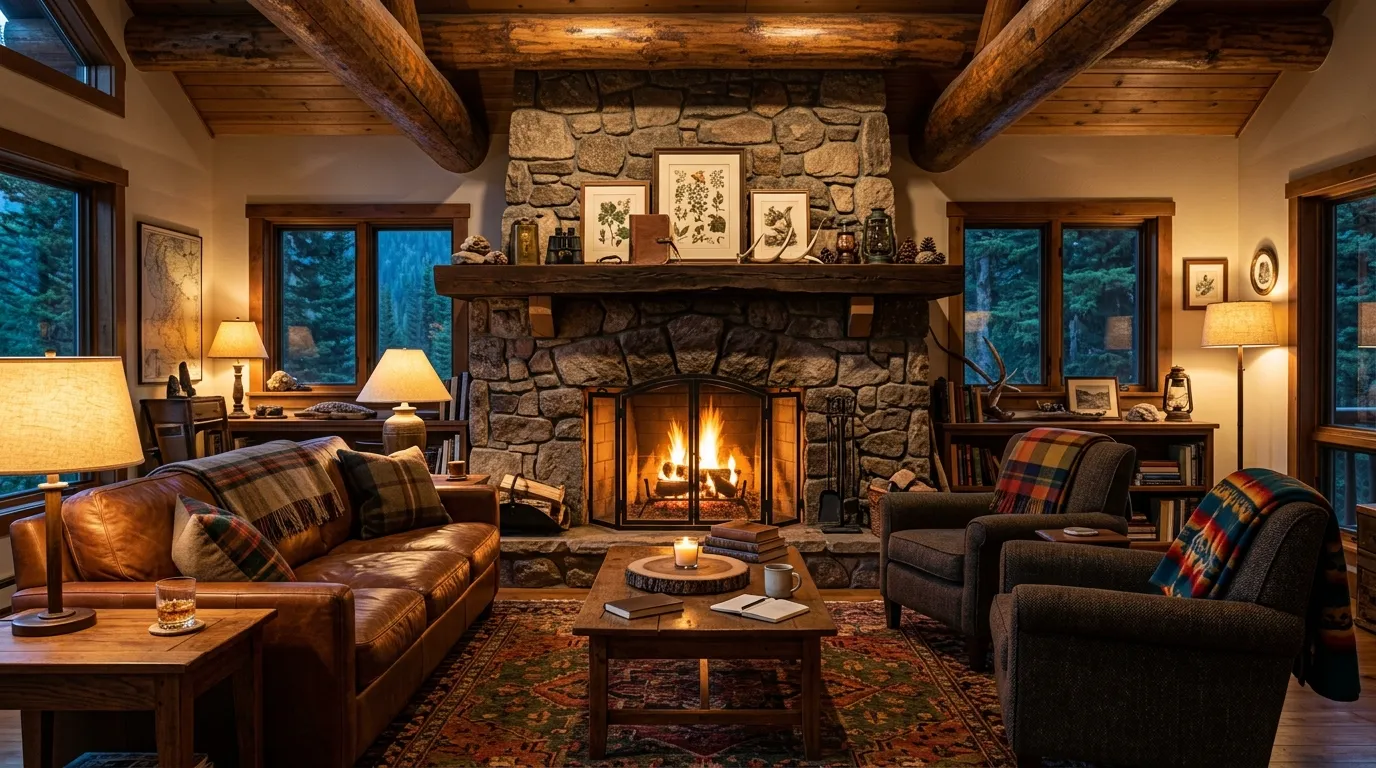
The best cabin living room ideas I’ve ever collected didn’t come from a showroom. They came from a Colorado ski chalet where somebody’s boots were steaming by the hearth, and from an Adirondack camp where the sofa had clearly hosted a hundred card games. Neither room was decorated the way Pinterest means it. Both had been accumulated, one Pendleton blanket and one good chair at a time, until the space smelled faintly of woodsmoke and held eight people without effort. That’s the quality this guide maps. Across 22 field notes, I’ll walk through the stone fireplace, the log beam ceiling, the textiles, the objects, and the lighting that make a mountain room feel earned. Whether you’re working with a log cabin in the Smokies, a cedar home in the Pacific Northwest, or a lake house that fills up every summer weekend, these notes will help your cabin feel gathered rather than themed. Take them one at a time, and let your mountain room fill in slowly.
Which Mountain House Are You Actually Decorating? Find Your Cabin Style First
Before any of the 22 notes below, it helps to know which mountain house you’re working with, because the best cabin living room ideas shift with the architecture. Pick the entry closest to your space, then borrow freely from the rest. Every cabin style living room has a version of this vocabulary, but the dialect changes from Vermont to Colorado.
⛰️ THE CLASSIC LOG CABIN (ADIRONDACK OR APPALACHIAN)
The feel: Dark, close, and gathered, like a room that has kept people warm for a hundred winters.
Key material: Hand-hewn logs with visible chinking and a heavy stone hearth.
Avoid: Anything glossy or shiny, which makes log cabin living room ideas feel like a theme restaurant.
⛰️ THE COLORADO SKI CHALET (MODERN MEETS MOUNTAIN)
The feel: Tall glass, warm wood, and a fire that anchors the room after a day on the slopes.
Key material: Wide-plank timber with blackened steel accents.
Avoid: Cold white minimalism that ignores the lodge style living room ideas that make a chalet feel hospitable.
⛰️ THE PACIFIC NORTHWEST CEDAR HOME (NATURAL AND MINIMAL)
The feel: Quiet, airy, and tuned to the sound of rain on a roof.
Key material: Clear vertical-grain cedar, left to silver naturally.
Avoid: Heavy plaid layers that crowd a room built on restraint.
⛰️ THE TENNESSEE MOUNTAIN RETREAT (WARM AND GATHERED)
The feel: A porch-adjacent room built for long rental weekends and crowded sofas.
Key material: Knotty pine and river rock.
Avoid: Anything too delicate for a house that sleeps twelve.
⛰️ THE LAKE HOUSE CAMP (NAUTICAL MEETS WOODSY)
The feel: Sandy feet, wet towels, and a screen door that never quite closes.
Key material: Whitewashed or weathered boards paired with rope and canvas.
Avoid: Matching anchors-and-lighthouse sets that read as a catalog.
The first thing I notice in any cabin is what the room is made of before anybody puts anything in it. When the bones are right, the furniture only has to be comfortable.
1. Cabin Living Room Ideas Start at the Stone Fireplace That Earns Every Chair
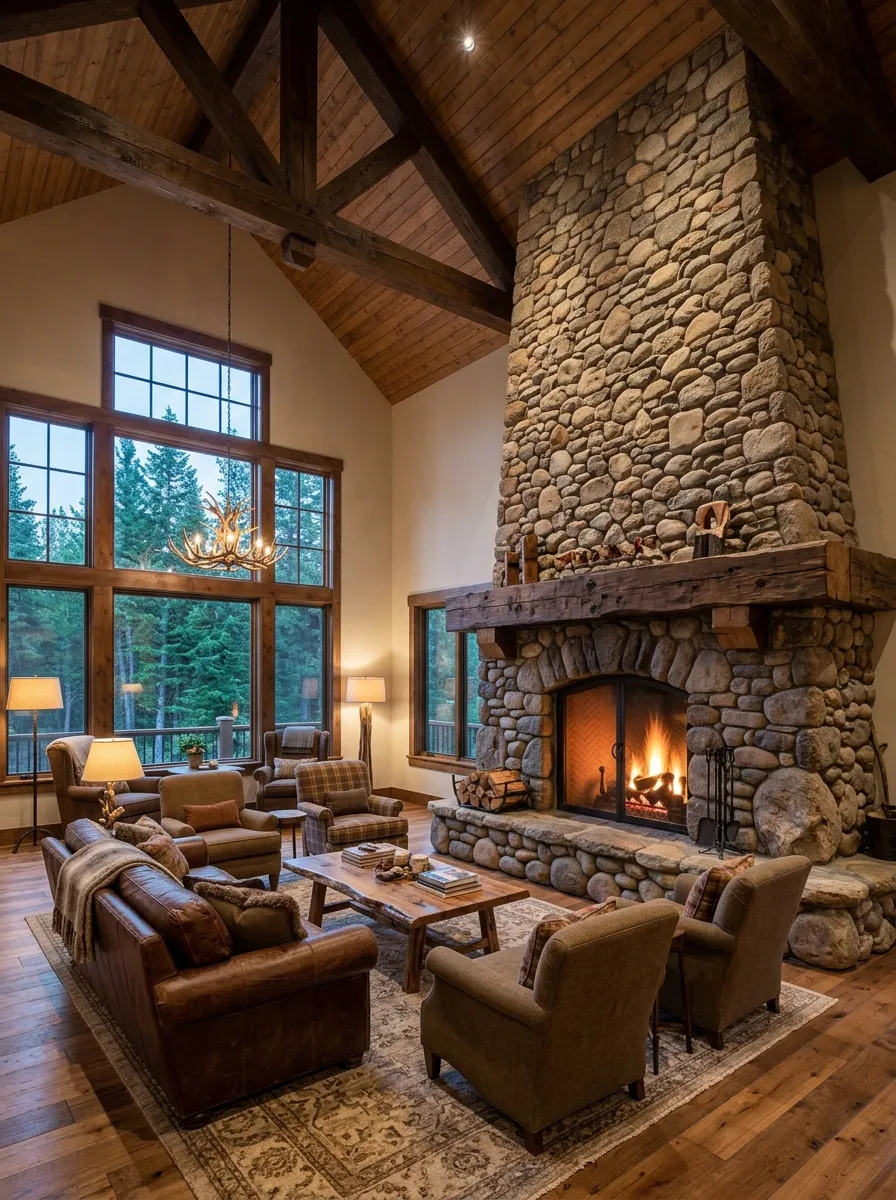
In the most compelling cabin living rooms I’ve walked into, the stone fireplace isn’t a feature on a wall. It’s the reason every piece of furniture sits where it does. Choose stacked river rock, fieldstone, or ledgerstone with real depth, and carry the stone up to the ceiling so the chimney reads as structure. The common mistake is a thin veneer on a half-height surround, which turns the hearth into wallpaper and leaves the seating with nothing to face. A true stone fireplace cabin living room also needs a raised hearth deep enough to sit on, and a good iron log holder keeps wood within reach. The one that made me stop and take notes was a Vermont ski lodge hearth worn smooth on the front edge by decades of cold hands.
Field Note Detail: Hearth Depth Matters
⛰ Choose fieldstone or river rock with varied depth, since flat cut veneer reads as cladding.
⛰ Build the raised hearth at least 16 inches deep and 14 to 18 inches high so it doubles as a seat.
⛰ Don’t mount the television over the firebox, because heat, height, and neck strain all work against you.
⛰ On a budget, use real thin stone veneer with a chunky reclaimed beam as the mantel, which reads as authentic from across the room.
2. The Log Beam Ceiling That Changes How the Entire Room Sounds
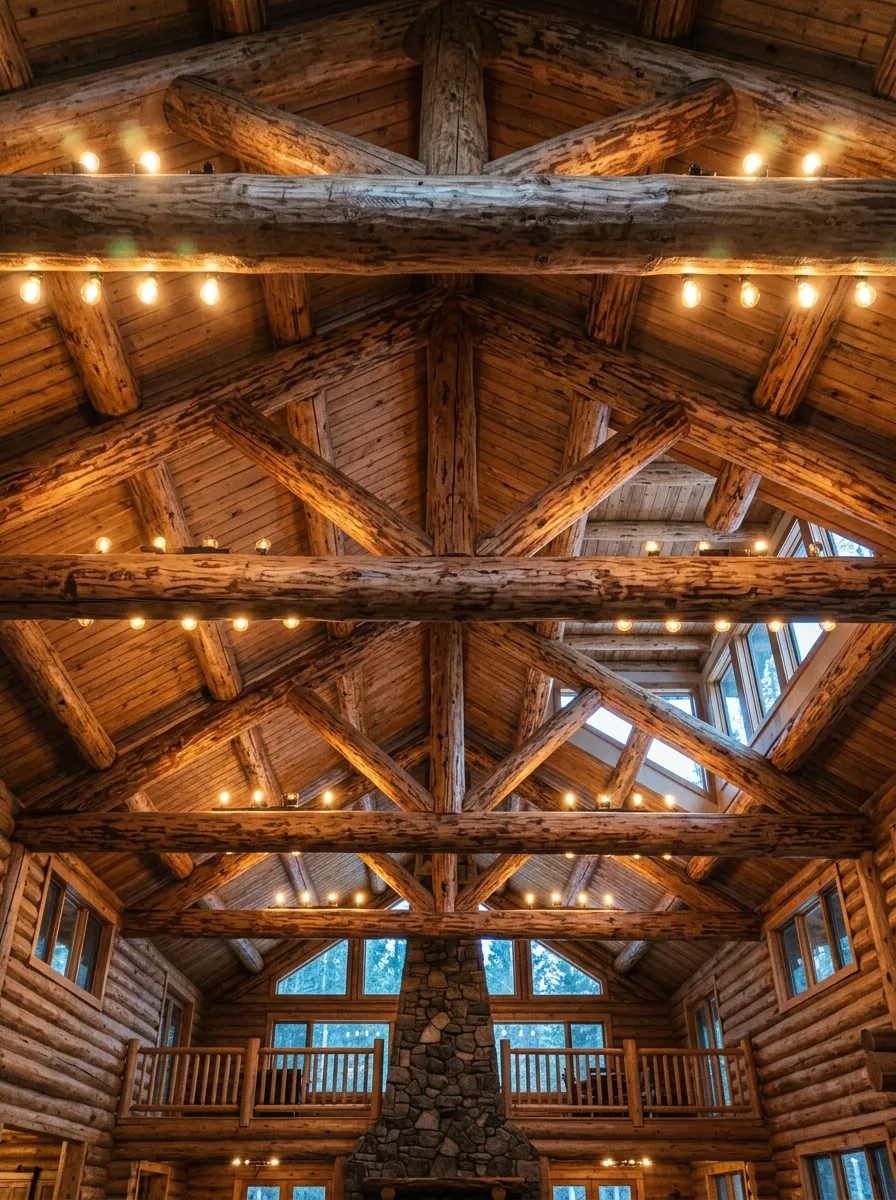
The first thing I register in a great mountain room is the sound, and a log beam ceiling is why. Timber breaks up echo and lowers the visual ceiling so a big room feels held rather than hollow. If your ceiling is flat drywall, hollow box beams in reclaimed or hand-hewn finishes can give the same rhythm, spaced evenly and stained to match the walls. The mistake I see most is beams painted a flat brown that looks plastic under overhead light. Pair a log beam ceiling cabin room with warm bulbs and the grain starts to glow, especially when the sun drops behind the ridge. I once sat under a ceiling of peeled spruce in a lake camp and could hear the rain on the roof and a card game in the next room at the same time.
3. Wood Panel Walls: Which Finishes Age Well in a Cabin Living Room
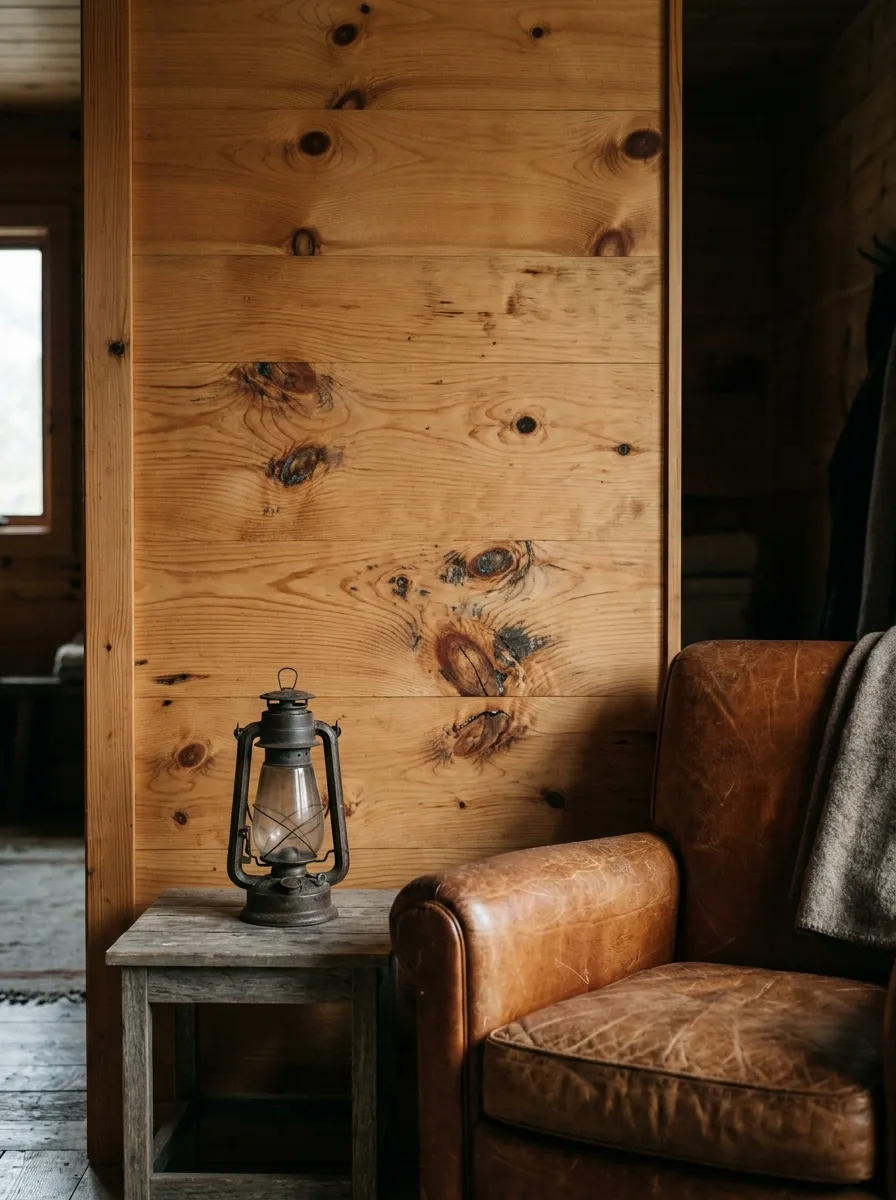
Honest assessment: wood panel walls either deepen with age or sour, and the finish decides which. Knotty pine with a matte oil finish, tongue-and-groove cedar, and wide horizontal planks all gain depth as they darken. Avoid high-gloss polyurethane, which yellows unevenly and flattens the grain into something that looks like a rec room. Wood panel wall cabin room finishes should vary slightly in tone, because a perfectly uniform wall is the surest sign of a recent purchase. In Tennessee rentals I’ve seen tired pine paneling saved with nothing more than a good cleaning and fresh oil. The wall that earned a note in my book was a Smoky Mountain den where decades of woodsmoke had turned the boards the color of tea.
4. What to Put Underfoot When Wet Ski Boots Come Through the Door
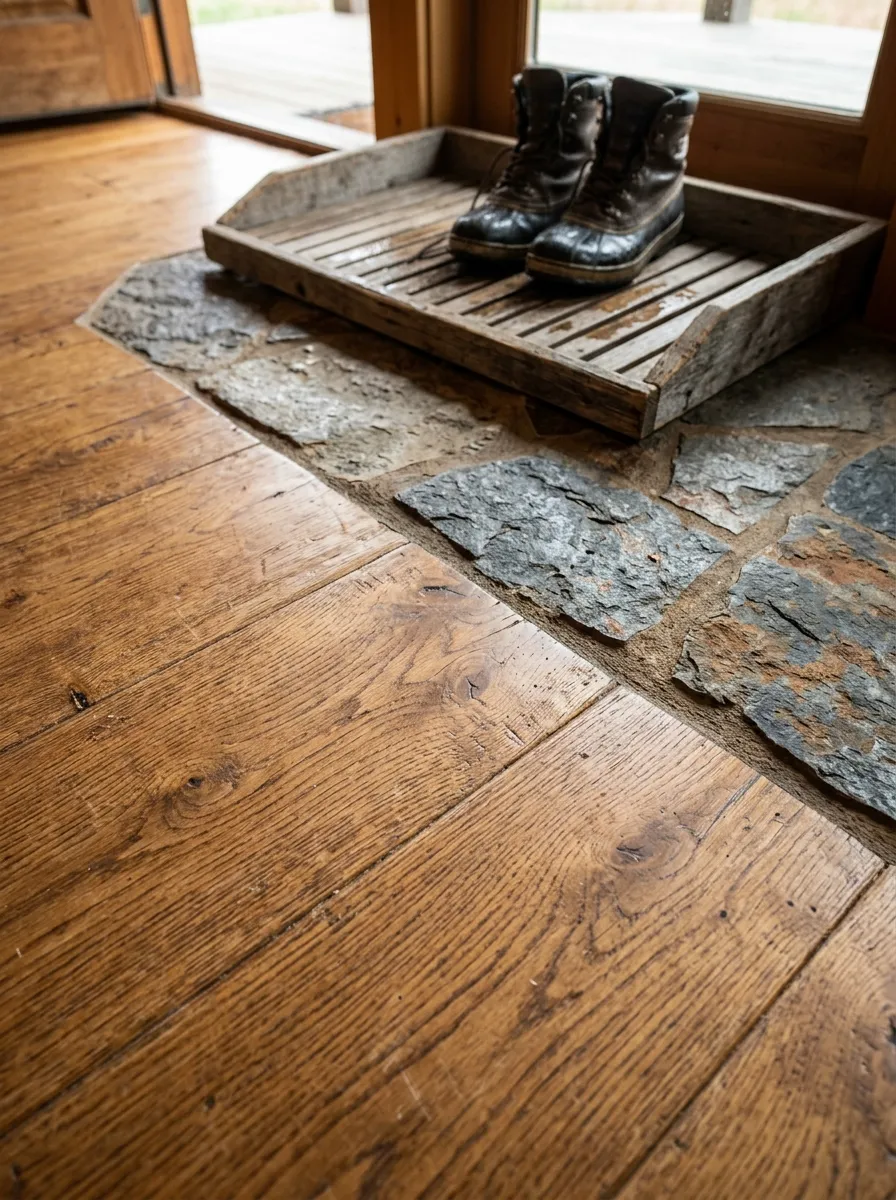
Every cabin living room has a floor problem, and it begins at the door. Wide-plank oak or hickory, hand-scraped hardwood, and flagstone all survive wet boots, dropped logs, and dogs that have been in the creek. Plan a boot zone where the entry meets the living room, with a slatted tray and a stone or slate threshold so water stops there. The usual mistake is installing glossy engineered flooring, which scratches visibly and shows every puddle. A cabin floor should look better with a few scars, which is why seasoned owners choose a matte finish in a mid-tone wood. I still remember a Colorado chalet where the flagstone hearth apron ran straight into the hardwood, and the first thing guests did was take off their boots there without being asked.
5. Why Windows Face the View, and What Your Cabin Living Room Ideas Need When They Don’t
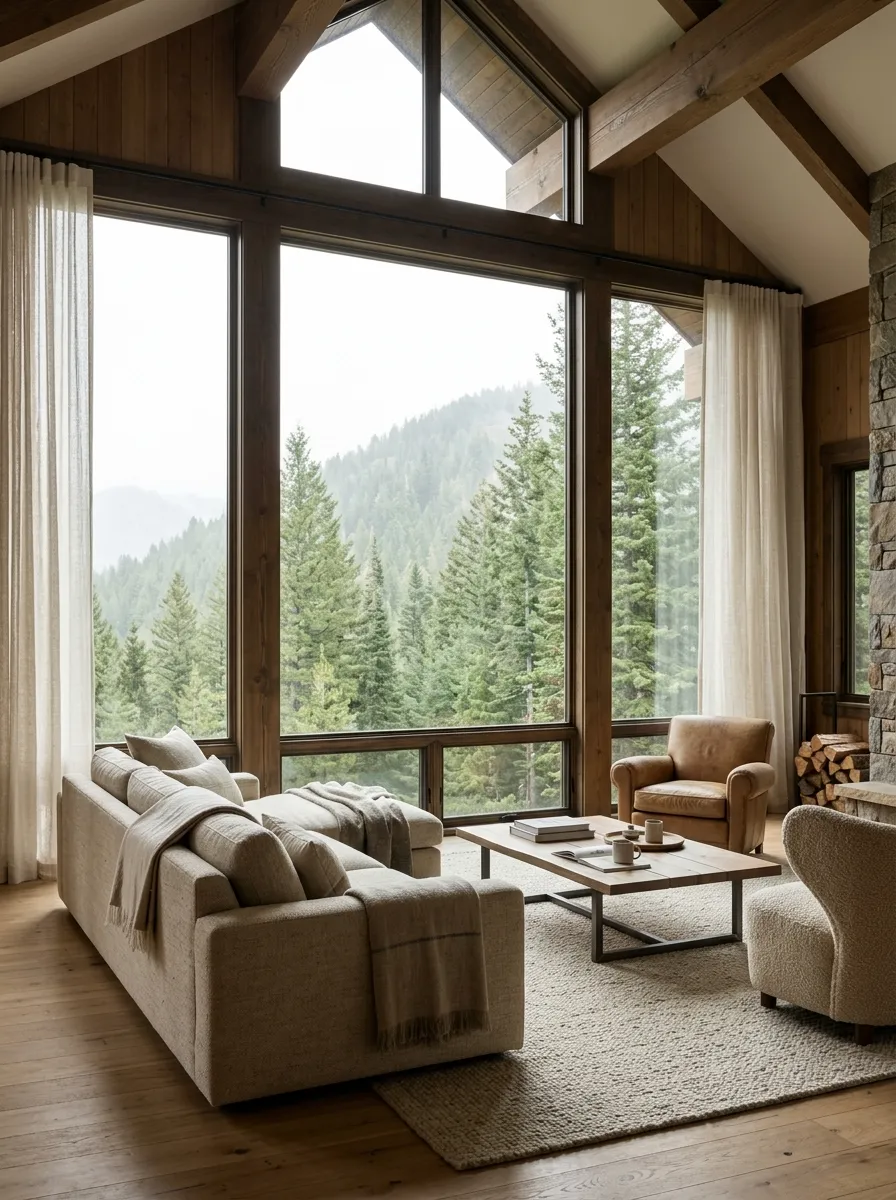
The best cabin living rooms point their windows at something worth looking at, and they keep the sightline clean. Put the seating where the glass is, and let the fireplace and the view share the room instead of competing. If your cabin sits in dense woods or the windows face a neighbor, bring in cabin living room natural light with pale linen sheers, a mirror opposite the strongest window, and warm wood tones on the walls. The common mistake is heavy drapery over a small window, which blocks the little daylight you have. Keep the glass uncovered during the day and let a lantern or two carry the evening. The room that made me put down my coffee was a Pacific Northwest cedar living room with floor-to-ceiling glass and not one decorative object blocking the firs outside.
🪵 The Cabin Living Room Materials Guide: What Belongs in a Mountain House and What Makes It Look Like a Cabin Theme Park
Every one of the best cabin living room ideas I’ve collected rests on materials that look better with age, and the same few turn up in every room.
ALWAYS AUTHENTIC:
- Stone: it’s the oldest mountain material and it holds heat from the fire.
- Hand-hewn or peeled logs: the grain and tool marks can’t be faked well.
- Wool: it insulates, dries fast, and has clothed mountain homes for generations.
- Leather: it softens and darkens with use, which is exactly the point.
- Iron: forged hardware looks right with timber and doesn’t date.
USE CAREFULLY:
- Faux fur: fine as a single throw, but a whole sofa of it tips toward lodge costume.
- Reclaimed barn wood: wonderful in small doses, but covering every wall feels like a restaurant.
- Stained glass or tinted lamp shades: one warm piece can sing, but a set feels like a gift shop.
AVOID IN A CABIN LIVING ROOM:
- High-gloss polyurethane on wood: it flattens the grain and looks plastic.
- Chrome or polished nickel fixtures: the cold reflection fights the warm timber.
- Vinyl plank flooring printed to look like wood: it repeats the pattern and reads fake from the door.
- Fake stone made of molded foam: the seams and lightness give it away.
THE AUTHENTICITY TEST: If a material would look better after a decade of use, it belongs in your cabin; if it would only look worse, it’s purchased mountain rather than the real thing. The enduring principles behind this test are the same ones our classic mountain room style guide traces through every room of the house, and they pair naturally with a mountain cabin color palette of earth, bark, and stone.
Furniture in a mountain room does the daily work, and it either carries the aesthetic or fights it. I look for pieces that have clearly been sat on.
6. The Cabin Living Room Sofa Has Two Honest Answers: Performance Fabric or Leather
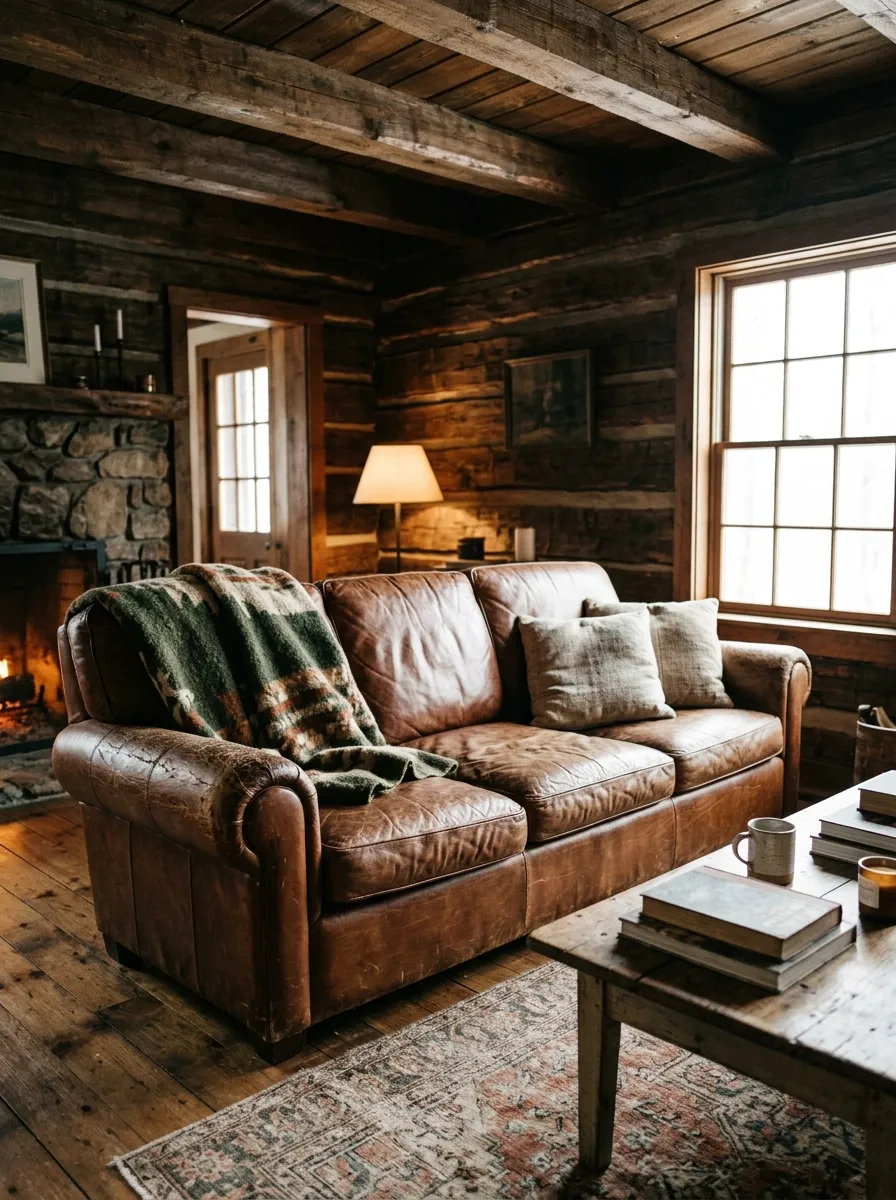
Every cabin sofa I’ve loved was either leather or a tightly woven performance fabric, and I’ve stopped looking for a third answer. A cognac or tobacco leather sofa cabin living room anchor develops a patina that improves with every ski weekend, and a performance fabric in oatmeal or charcoal laughs at wet dogs. Choose deep seats of 22 to 24 inches and a frame that’s kiln-dried hardwood, since this piece will be slept on, sat on, and jumped on. The classic mistake is a delicate linen or velvet sofa in a room where somebody will always come in from the snow. RH and Pottery Barn both carry sturdy, deep-seated options, and Amazon has decent performance-fabric slipcovers if you want to refresh what you own. The sofa that earned a note was a cognac leather sectional in a Smoky Mountain rental, cracked at the arms and obviously beloved.
7. One Leather Club Chair, Placed Where the Fire Can Reach It
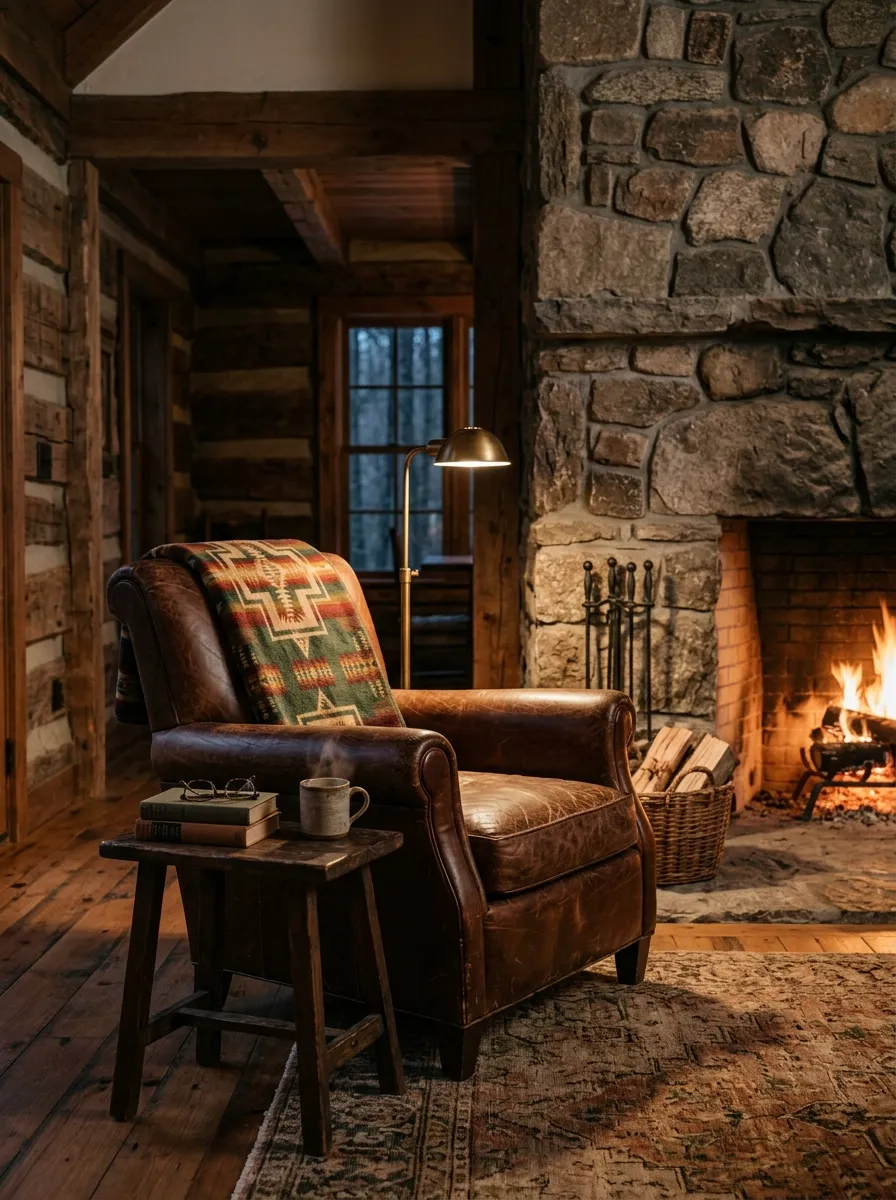
If I could add one piece to any mountain room, it would be a leather club chair facing the fire at a slight angle. It gives one person the best seat in the house, which is a small luxury that every cabin earns. Choose a roomy chair with a rolled arm in saddle or chestnut leather, and place it about five feet from the hearth so it gets the warmth without the sparks. The usual mistake is pairing two identical chairs in a stiff pair, which reads as a furniture showroom. A single weathered chair with a wool throw over one arm looks like it has a history. In a Vermont ski lodge I once watched a grandfather claim a battered club chair every evening, and nobody ever argued.
8. The Coffee Table That Has to Serve Eight People and One Set of Boots
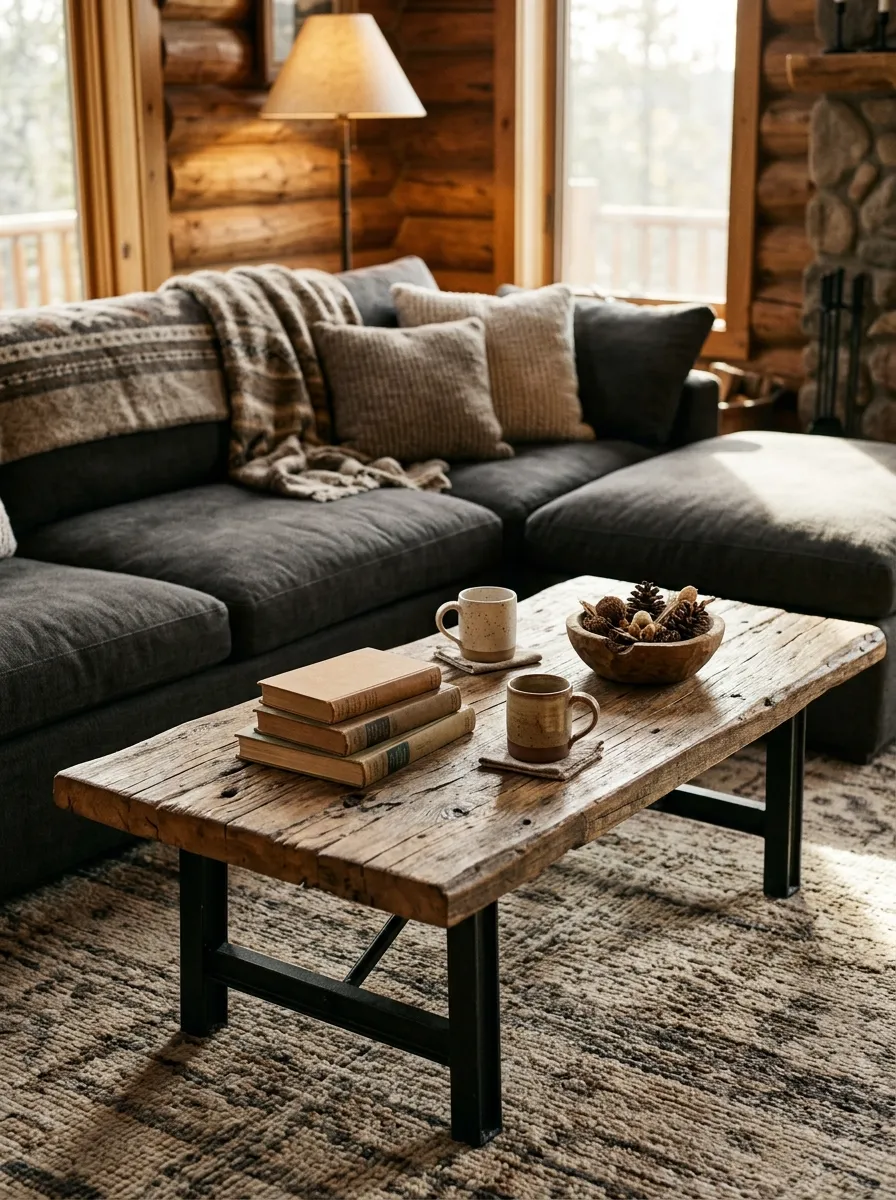
A cabin coffee table works harder than any other surface in the house, holding mugs, board games, and somebody’s feet by midnight. Look for reclaimed wood with iron legs, a thick slab top, and an edge that can survive a dropped log. Keep the height within two inches of the sofa seat and the width at roughly two-thirds the sofa’s length, so eight people can reach it. The mistake I see most is a small glass table that disappears under a crowd and fogs with every drink. Surface styling should stay simple, with a wood bowl, a few pine cones, and a stack of books, because the table needs room to be used. I once saw a Tennessee cabin table with ring stains from a decade of rentals, and the owner said every mark was a story.
9. Layering a Woven Rug in a Mountain Living Room Without Making It Look Staged
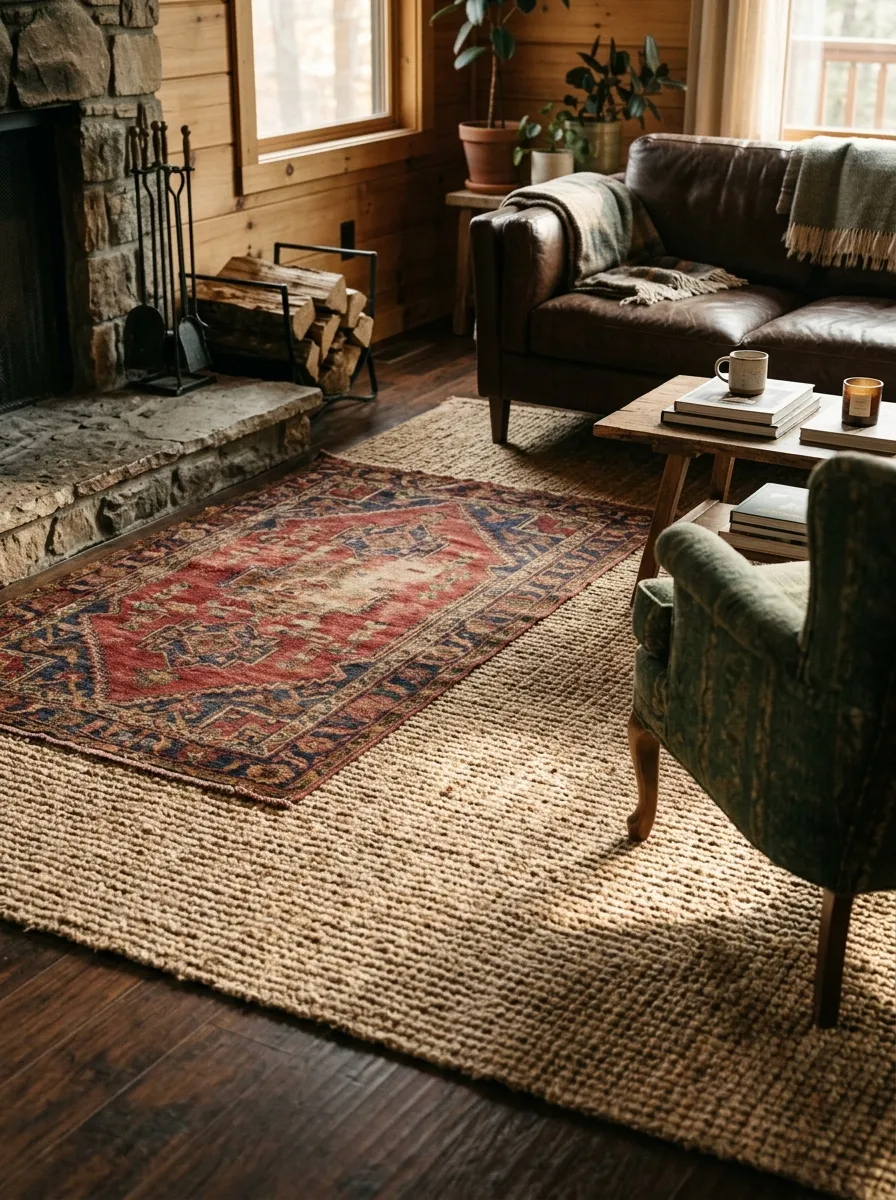
The rugs I admire most in mountain rooms are woven, textured, and large enough to anchor all the seating at once. Start with a big jute or wool flatweave, then layer a smaller hide or kilim at an angle near the hearth for warmth and pattern. Make sure the front legs of every seat sit on the rug, otherwise the furniture floats and the room feels unsettled. The common mistake is a rug that’s too small, which leaves a floor island with furniture orbiting it. A natural woven rug cabin living room base handles mud and melted snow better than anything with a high pile. The layered setup that made me stop was a Colorado den with a jute foundation and a worn Persian runner crossing in front of the fire.
Field Note Detail: Layer Without Fuss
⛰ Choose jute, sisal, or flat-woven wool for the base, since all three tolerate wet boots.
⛰ Size the base rug at 9 by 12 feet for a standard seating group, with at least 18 inches of floor showing around it.
⛰ Don’t use a high-pile shag as the base layer, because it traps snow melt and takes days to dry.
⛰ On a budget, buy a large jute rug from Amazon or HomeGoods and add a vintage-style runner for the layered look.
10. The Antler Chandelier: When It’s Right and When It’s the Obvious Choice
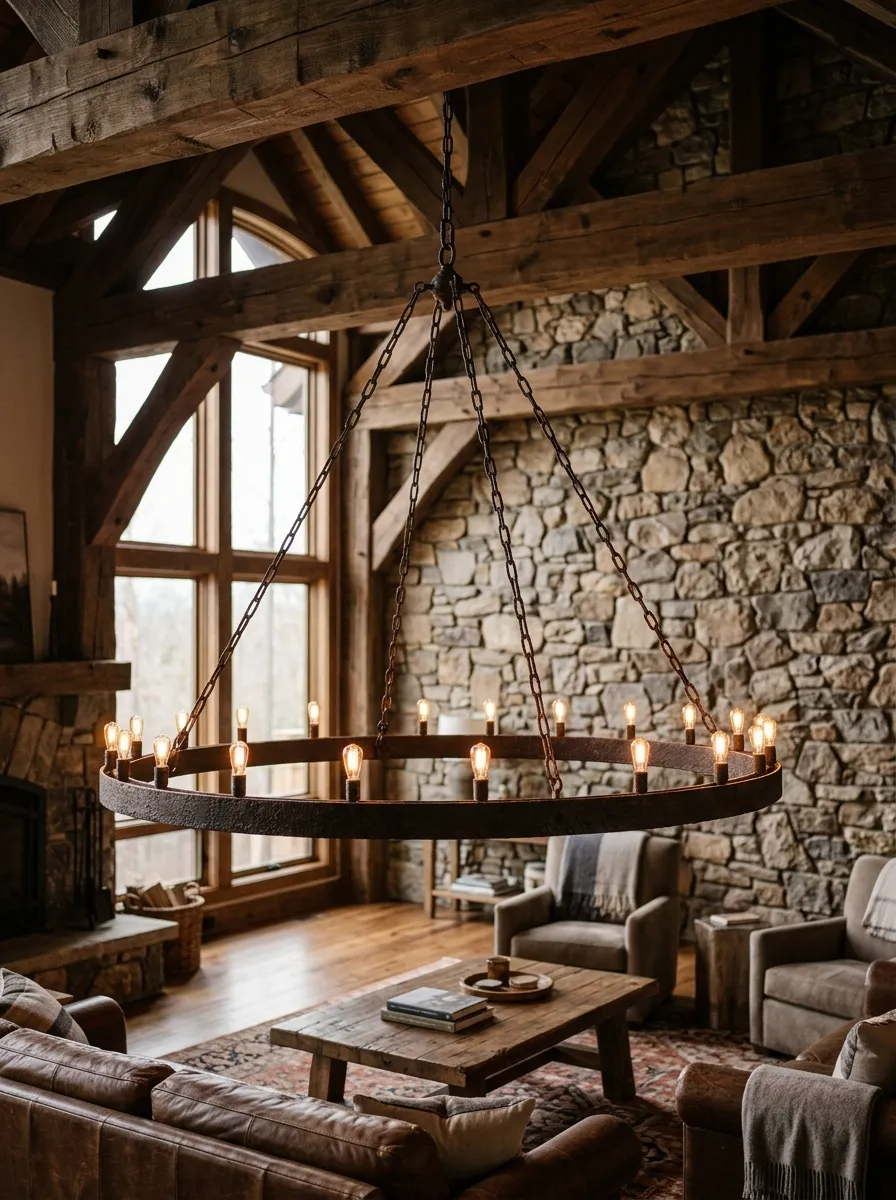
I have strong opinions about antler chandeliers, and the main one is that scale and restraint decide everything. In a great room with vaulted timber, a substantial antler or forged iron pendant fills the volume and gives the eye something to land on. In a smaller space it becomes a joke, a cartoon of mountain life hanging over the sofa. Choose one with warm, dimmable bulbs and a finish that matches your other metals, and hang it so the bottom sits at least 7 feet from the floor. The mistake is buying the most literal version, with fake candle sleeves and plastic antlers, which breaks the spell. An antler chandelier cabin living room moment works best when the rest of the room stays quiet around it. The one that stayed with me was a simple iron ring pendant in a Montana log home, with no antlers at all.
🛋️ The Cabin Living Room Furniture Scale Guide: Why Mountain Rooms Need Bigger Furniture Than You Think
THE RULE: Cabin rooms have tall ceilings, heavy timber, and wide stone, so furniture sized for a standard apartment gets swallowed.
SOFA: Choose 90 to 96 inches or a sectional, because a bigger frame balances the volume of the room and seats a crowd. Our cabin sofa selection guide shows the styles and fabrics that hold up to mountain use.
COFFEE TABLE: Aim for 48 to 54 inches long and 28 to 32 inches wide, which gives eight people reach without crowding the walkway.
CHAIR: Choose a deep, oversized club or lounge chair around 36 inches wide, since it’s the piece that has to hold its own next to the fireplace.
RUG: Go 9 by 12 or 10 by 14 feet so the whole seating group sits on it, which is the same logic behind the best cabin living room furniture ideas I’ve seen.
THE CONSEQUENCE OF GOING TOO SMALL: Undersized furniture floats in the volume of a mountain room and leaves the timber and stone looking oversized and unfinished. It also fails the first test of any log cabin living room, which is whether everyone can actually sit down together.
Textiles are where a mountain room gets warm, and where I can tell within a minute whether somebody has lived there.
11. How Much Plaid Is Enough in a Cabin Living Room?
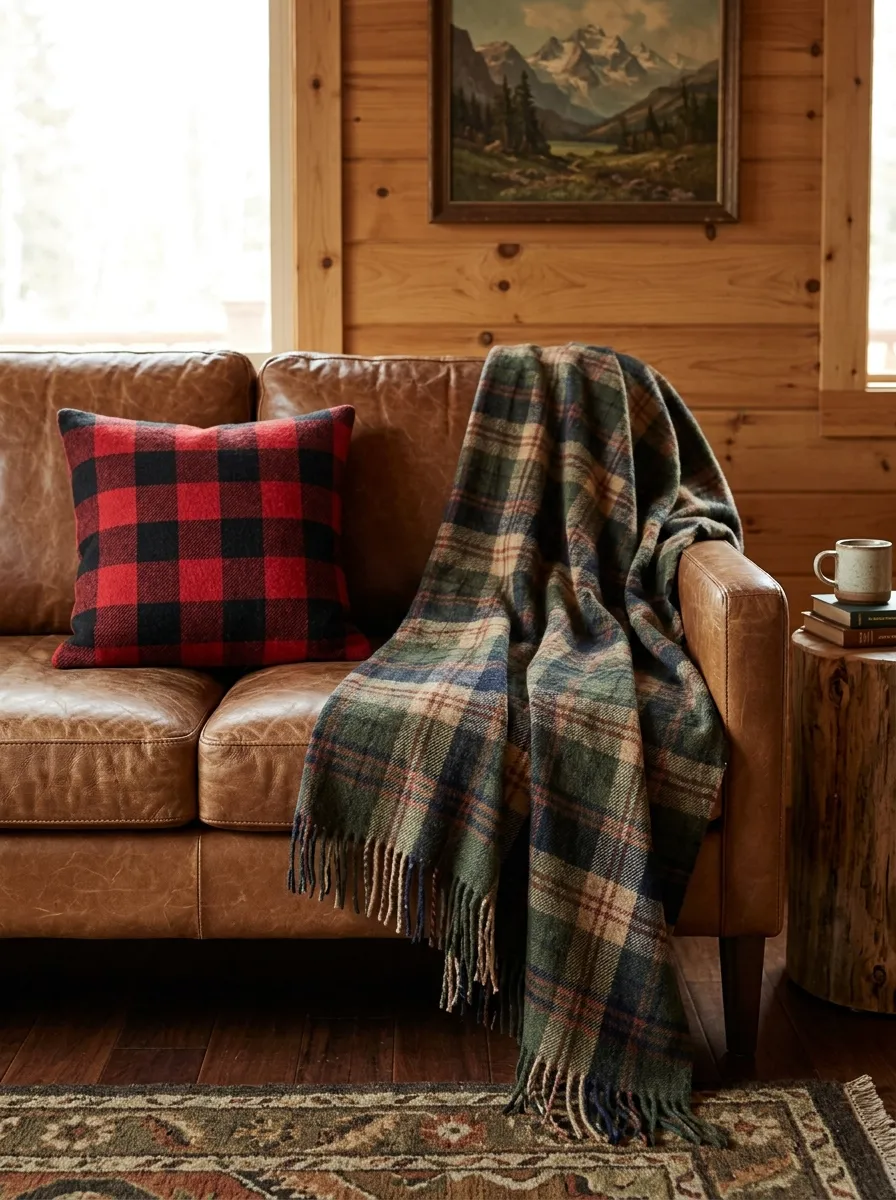
Plaid is the mountain house’s native language, and the question is how much of it to speak. In the best rooms I’ve visited, there’s one dominant check, usually buffalo check or a muted tartan, with the rest of the textiles in solids and natural fibers. A plaid throw cabin living room moment works best on a leather sofa, where the pattern offsets the smooth surface. The mistake is matching everything, from curtains to pillows to rug, until the room becomes a lumberjack uniform. Pick one scale of plaid and let a second, smaller pattern play a supporting role at most. The Adirondack camp that taught me this had red buffalo check on a single armchair, and nothing else in the room dared compete.
12. Why This Mountain Living Room Has Three Throws, None Matching, All Perfect
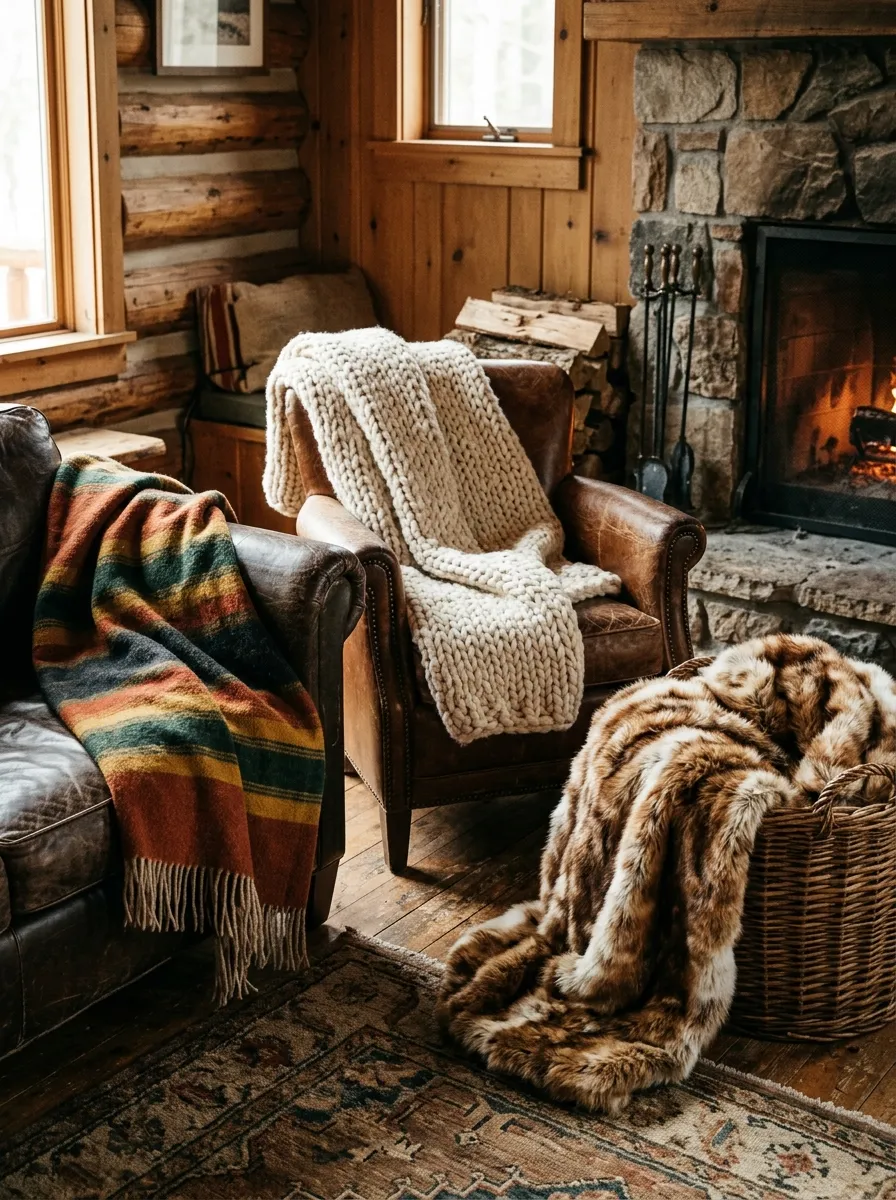
I counted three throws in a Colorado chalet once, and not one of them matched, and the room was the best I’ve sat in. A Pendleton blanket cabin decor staple, a chunky knit, and a faux fur layer all share a warm palette without sharing a pattern. Drape one over the sofa arm, fold another over the back of the club chair, and leave a third in a basket by the hearth, so nothing looks arranged for a photograph. The usual mistake is folding every blanket into a perfect rectangle, which tells guests not to touch. Pendleton and L.L.Bean Home both make wool throws that wear well for years. The note I wrote on that first visit was simply: nobody here is afraid of the blankets.
13. The Pillow Formula: Leather, Plaid, and One Natural Fiber
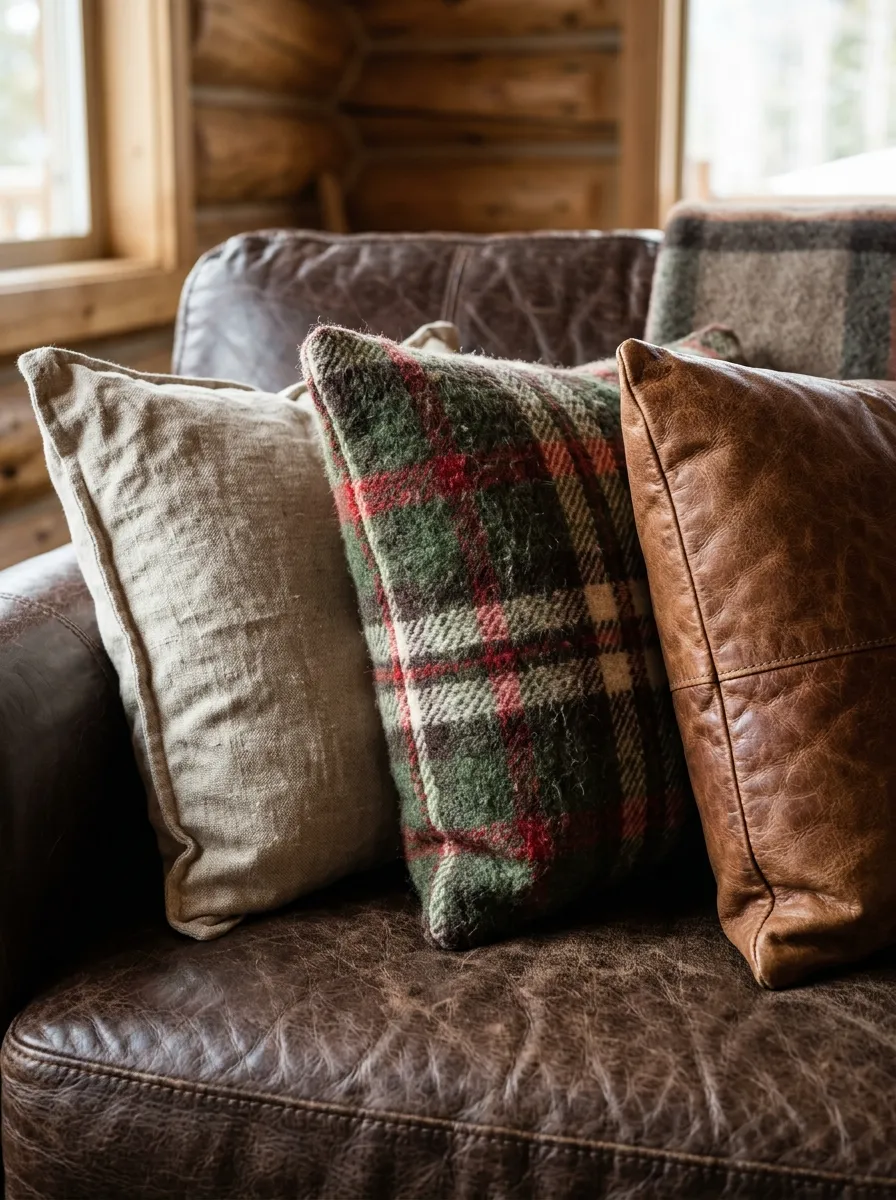
Pillows follow a formula in the rooms that look best, and it’s simple enough to repeat anywhere. Combine one leather or suede pillow, one plaid or check, and one in a natural fiber like linen, wool, or cotton canvas, in sizes from 18 to 24 inches. Limit the sofa to three or four, since anything more starts to look like a display. The common mistake is a pile of seasonal novelty pillows with sayings or pine trees, which flattens the mood. Cabin living room textile layering works because the textures contrast, so let the smooth leather sit next to the nubby wool. The sofa that earned my note was in a Smoky Mountain cabin with just three pillows, each a different weight and each slightly flattened by use.
14. Curtains in a Cabin Living Room: When the View Makes Them Unnecessary
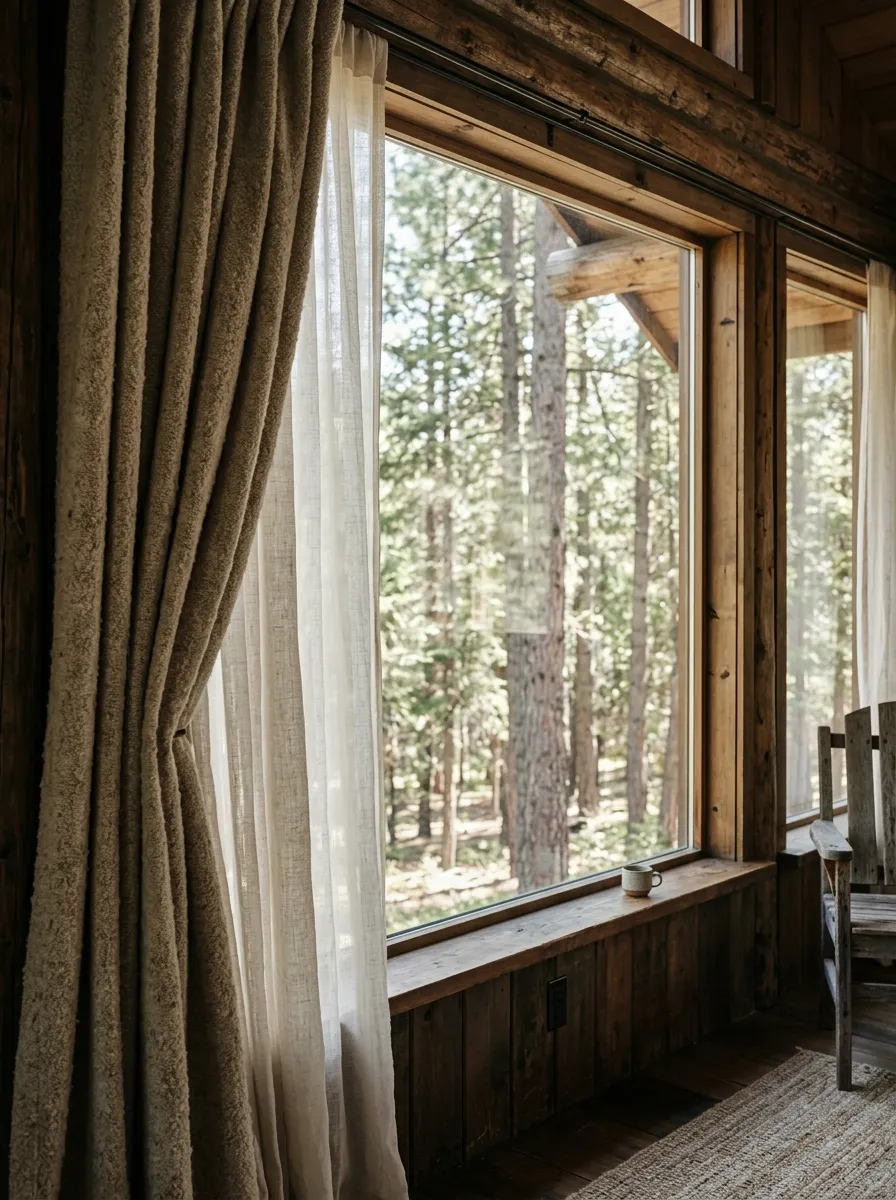
The honest answer about cabin curtains is that the view usually argues against them. If your windows face a ridge, a lake, or tall pines, leave the glass bare during the day and use a heavy lined drape only for cold nights and privacy. Mount rods wide of the frame so the fabric stacks off the window, and choose wool, linen, or heavy cotton in a natural shade. The mistake is a fussy valance or a patterned drape that competes with the scenery outside. If you want softness, layer linen sheers under a thicker panel you can pull closed at dusk. In a Pacific Northwest cedar home I once saw no curtains at all, and the effect was a room that felt open to the forest.
15. The Warm Earthy Tones That Belong in Any Mountain House
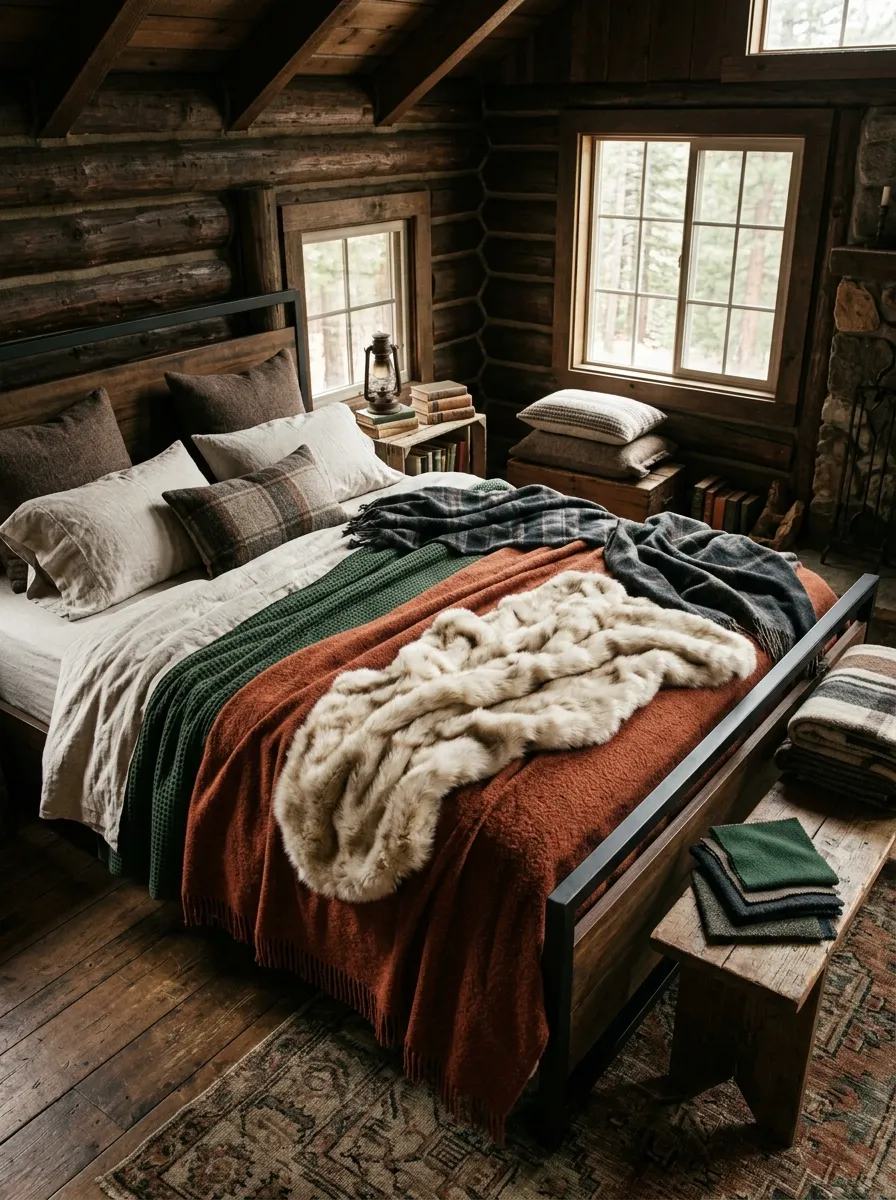
The textile palette in the most resolved cabins comes straight from the landscape: oatmeal, rust, forest, charcoal, and the brown of bark. Use these as your base and let one deeper tone, like burgundy or navy, appear in a single throw or pillow. The mistake is introducing a cool gray or a bright white that fights the timber and makes the room feel like a rental flip. A faux fur throw in cream or taupe adds softness without introducing a new color. Stay inside this family and everything you add later will fit, whether it’s a Pendleton blanket from last year or a HomeGoods find from last week. The palette that made me stop was a Vermont lodge in rust, moss, and wool white, where nothing fought for attention.
🎨 The Cabin Living Room Color Palette Guide: The Earthy Mountain Tones That Always Work and the Ones That Miss the Mark
A reliable cabin living room color palette begins in the woods and works outward, and the same handful of tones keep earning their place in mountain living room ideas.
THE CORE PALETTE:
- Benjamin Moore Chestertown Buff (HC-8): a soft tan that warms walls the way old timber does.
- Sherwin-Williams Cavern Clay (SW 7701): a muted terracotta that echoes stone and hearth.
- Sherwin-Williams Dard Hunter Green: a deep forest tone that sits comfortably beside pine.
- Benjamin Moore Kendall Charcoal (HC-166): a woodstove charcoal that grounds trim and built-ins.
- Benjamin Moore Revere Pewter (HC-172): a warm greige that bridges wood, stone, and wool.
THE ACCENT LAYER:
- Mustard: introduce it in a single throw or pillow to echo autumn aspens.
- Deep navy: use it in a rug or chair for a lake house or ski lodge feel.
- Brick or burgundy: bring it in through a plaid or a leather cushion.
AVOID IN A CABIN:
- Cool gray: it drains the warmth from timber and makes the room feel like a showroom.
- Bright white: it’s harsh against logs and shows every mark from a mountain weekend.
- Teal or turquoise: it reads as coastal and fights the earthy palette.
THE PALETTE RULE: Let the wood and stone set the temperature and choose everything else to match it. The same logic works seasonally, and our fall cabin living room guide shows how to layer autumn color onto a mountain space that was already built for it.
The objects in a cabin are where I can tell whether a room was assembled in an afternoon or in twenty years.
16. The Cabin Living Room Mantel: Collected or Purchased?
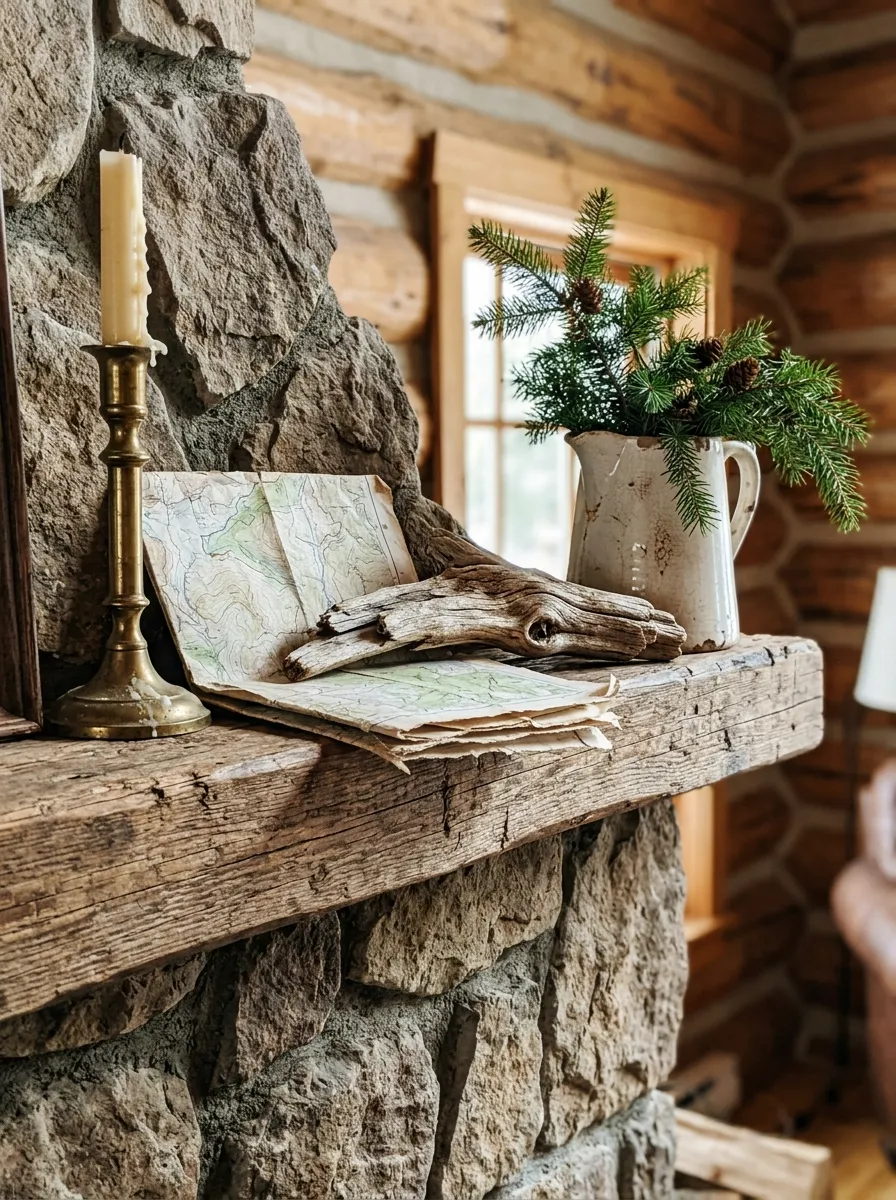
A mantel is the first thing I read in any mountain room, because it tells me how long the owners have lived there. The best ones hold a mix of things that mean something, like a worn brass candlestick, a trail map, a piece of driftwood, and a framed photograph from a summer long ago. Vary the heights, leave bare wood showing, and lean one larger piece against the stone rather than hanging it. The mistake is a symmetrical row of matching lanterns and candles bought in one trip, which looks bought rather than gathered. A single iron lantern or two is fine when everything else around it has a history. Our fireplace room styling approach to a hearth is something I’ll cover in the FAQ below. The mantel that made me stop was a Vermont ski lodge shelf holding a chipped pitcher, a pair of old goggles, and a single sprig of spruce.
Field Note Detail: Gathered Mantels
⛰ Mix at least three materials, such as iron, wood, and glass, so the mantel reads as accumulated.
⛰ Keep the tallest object about one-third the height from mantel to ceiling, and leave a third of the shelf empty.
⛰ Don’t line up objects in a symmetrical row, since it reads as a store display.
⛰ On a budget, shop flea markets, estate sales, and your own garage before you buy anything new.
17. Books, Maps, and Pine Cones: The System Behind Shelves That Feel Real
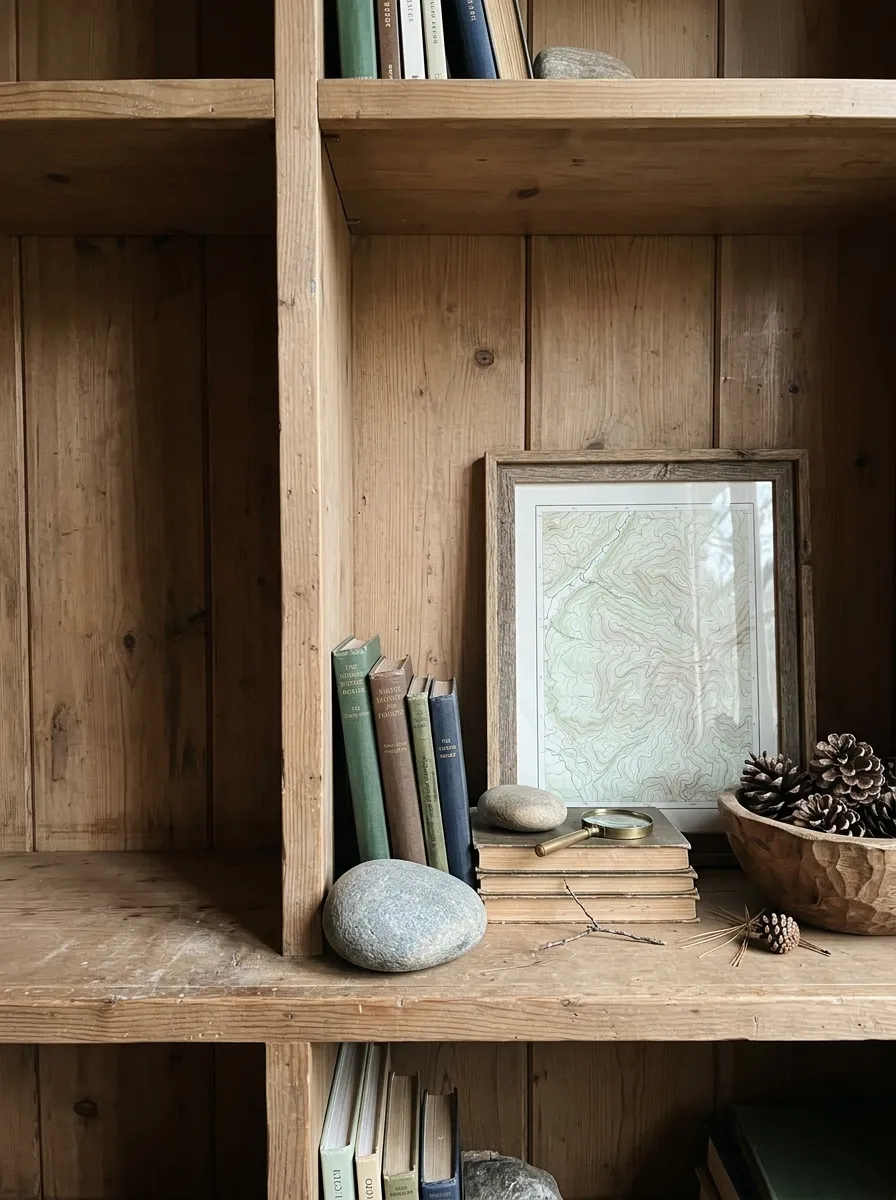
Cabin shelves that feel real follow a loose system that I’ve seen repeated from Colorado to Maine. Mix horizontal and vertical book stacks, add a framed topographic map of the nearby mountains, and place a few natural objects like pine cones, a bird’s nest, or a smooth river stone. A cabin living room bookshelf styling approach works best when about a third of the shelf stays empty, so the books and objects have room to breathe. The mistake is arranging books by color or wrapping them in matching covers, which reads as an interior designer’s afternoon rather than a reader’s life. Pine cone cabin decor looks right in a wooden bowl or loose on a shelf, never glued to a wreath that hangs year-round. I once pulled a worn field guide to local birds from a Tennessee cabin shelf and realized the whole room was built around the people who read it.
18. Wildlife Art in Cabin Decor: Where the Narrative Ends and the Theme Begins
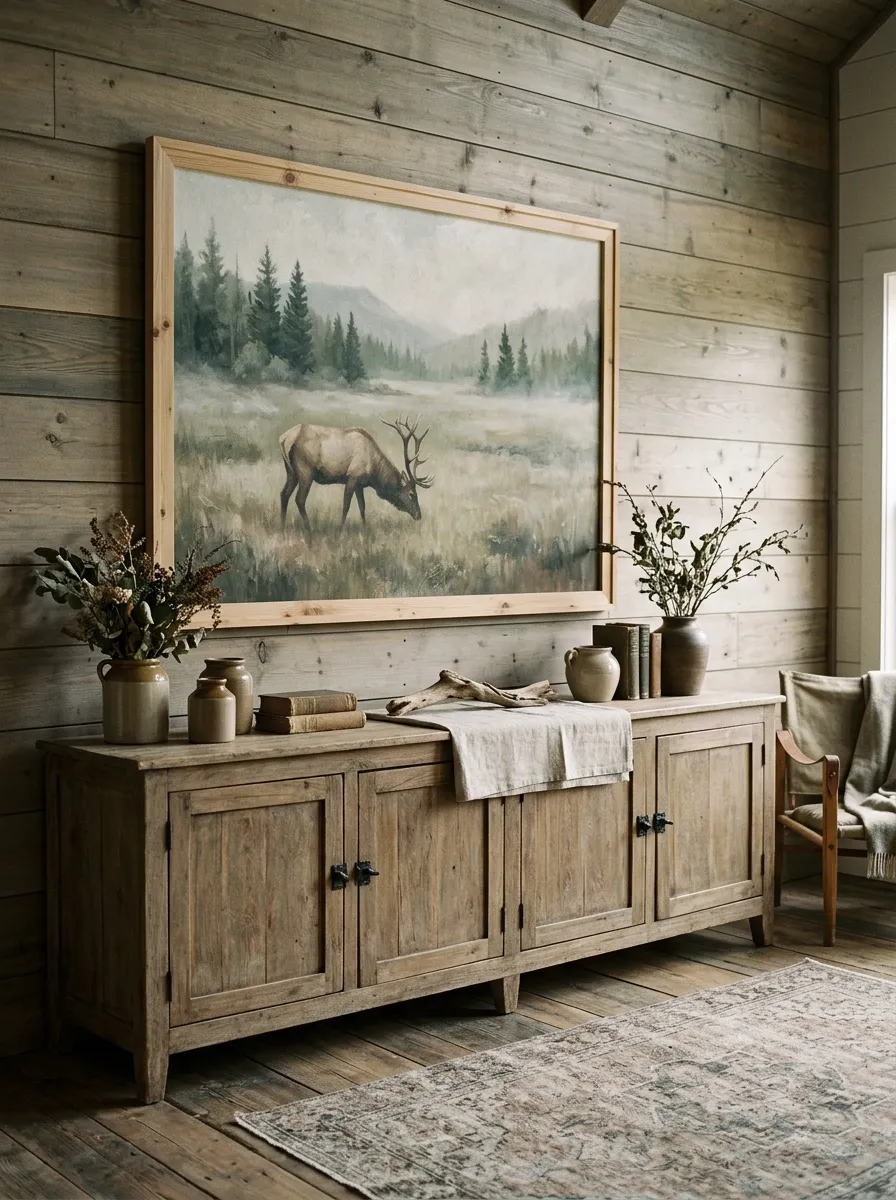
Wildlife art can anchor a mountain room or tip it into costume, and the difference is usually restraint. One large, well-framed painting of an elk meadow or a moose in a lake is a narrative, while five bears of five different sizes is a theme. Hang it where the light is soft, choose a muted palette that matches your walls, and let it stand alone with plenty of space around it. The mistake is buying a matching set of mass-produced silhouettes that make every wall feel like a gift shop. If your cabin has a story, like a family of anglers or a grandfather who hunted, let the art reflect it honestly. The piece that made me stop was a single black-and-white photograph of a trout stream in an Adirondack camp, framed in plain pine.
19. The One Cabin Living Room Plant That Survives Dry Mountain Heat
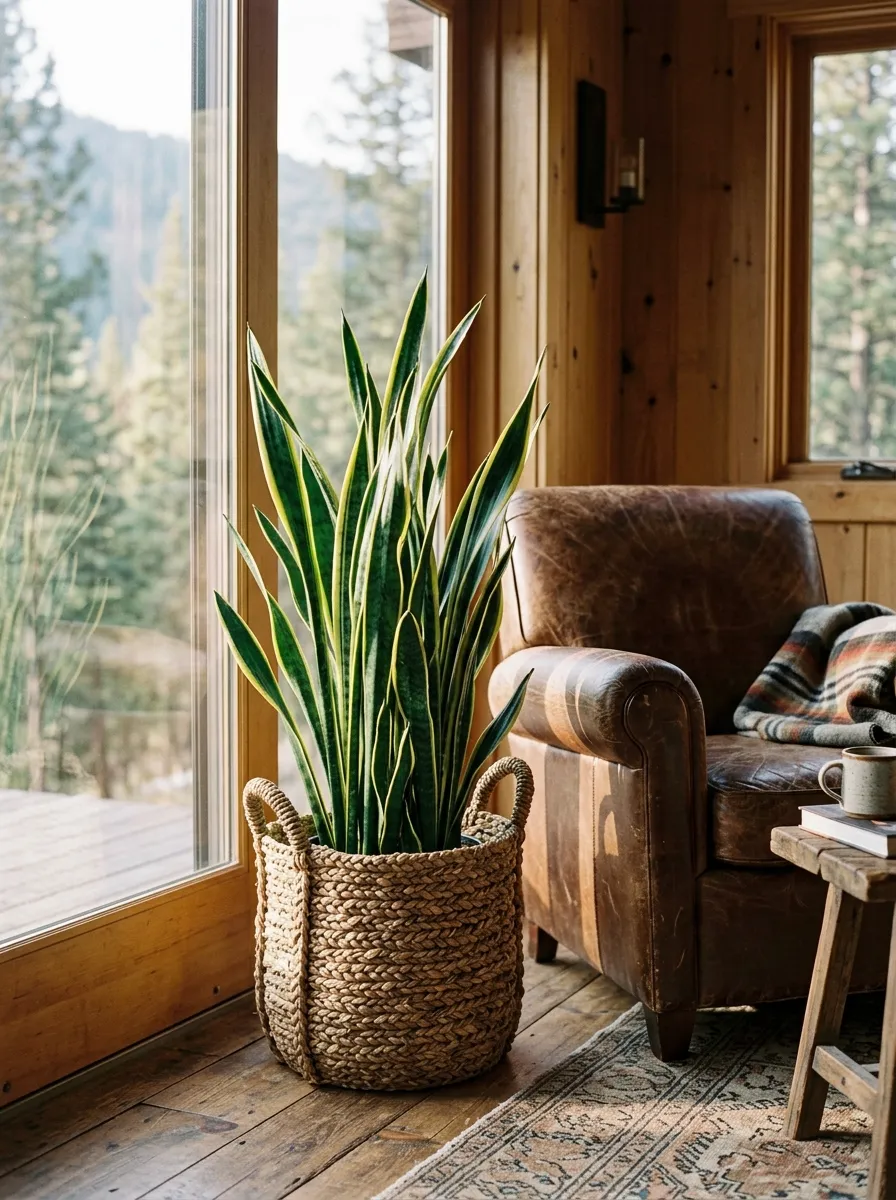
Mountain houses are tough on plants, with dry wood heat, low winter light, and long stretches when nobody’s home. The ones that work are snake plants, ZZ plants, and pothos, which tolerate neglect and look good in a woven basket or an old crock. Place them near a window but out of direct stove heat, and water only when the soil is dry to the second knuckle. The mistake is a fiddle-leaf fig or a delicate fern that browns in a week and leaves the corner looking sad. A cabin living room plant ideas rule I follow is one large plant per room, not a jungle. The plant I noted was a tall snake plant in a hand-woven basket beside a leather chair in a Pacific Northwest cabin, upright and utterly unbothered.
🦌 The Cabin Object Authenticity Guide: What to Display, What to Store, and What Never to Buy
Objects are where a cabin gets its voice, and the principles of bear and wildlife cabin decor and hunting and fishing cabin decor are the same: let the real thing speak.
DISPLAY WITH CONFIDENCE:
- A worn wooden canoe paddle: it comes from real use on a real lake.
- Antique snowshoes: they carry the history of winter travel.
- A cast iron skillet or kettle: it belongs by the hearth and in the kitchen.
- Vintage fishing creels or tackle boxes: they’re honest hunting and fishing cabin decor with patina.
- Hand-stitched quilts: they bring the maker’s hours into the room.
APPROACH WITH CAUTION:
- Taxidermy: one mounted head can anchor a lodge, but several turns the room into a trophy case.
- Carved wooden bears: a single handmade piece can charm, but a collection becomes bear and wildlife cabin decor in its worst form.
- Antler accessories: use them sparingly, because too many turn the room into a theme.
NEVER BUY FOR A CABIN:
- Mass-produced “Lake Life” signs: they tell guests nothing and replace actual character with a slogan.
- Resin bear statues: they’re glossy, lightweight, and obviously made in bulk.
- Printed faux log wall hangings: they imitate a material the room should already have, and a cabin with real wood needs no pretend wood.
THE COLLECTION RULE: Accumulated objects have a story and purchased ones have a receipt. The warm tones in your objects can carry into other rooms too, and our warm mountain palette guide shows how the same terracotta and earthy colors work in a bedroom with equal warmth.
The last layer is light, and it’s the one that decides whether a room feels like a cabin or a hotel lobby.
20. Cabin Living Room Lighting That Works With the Fire, Not Against It
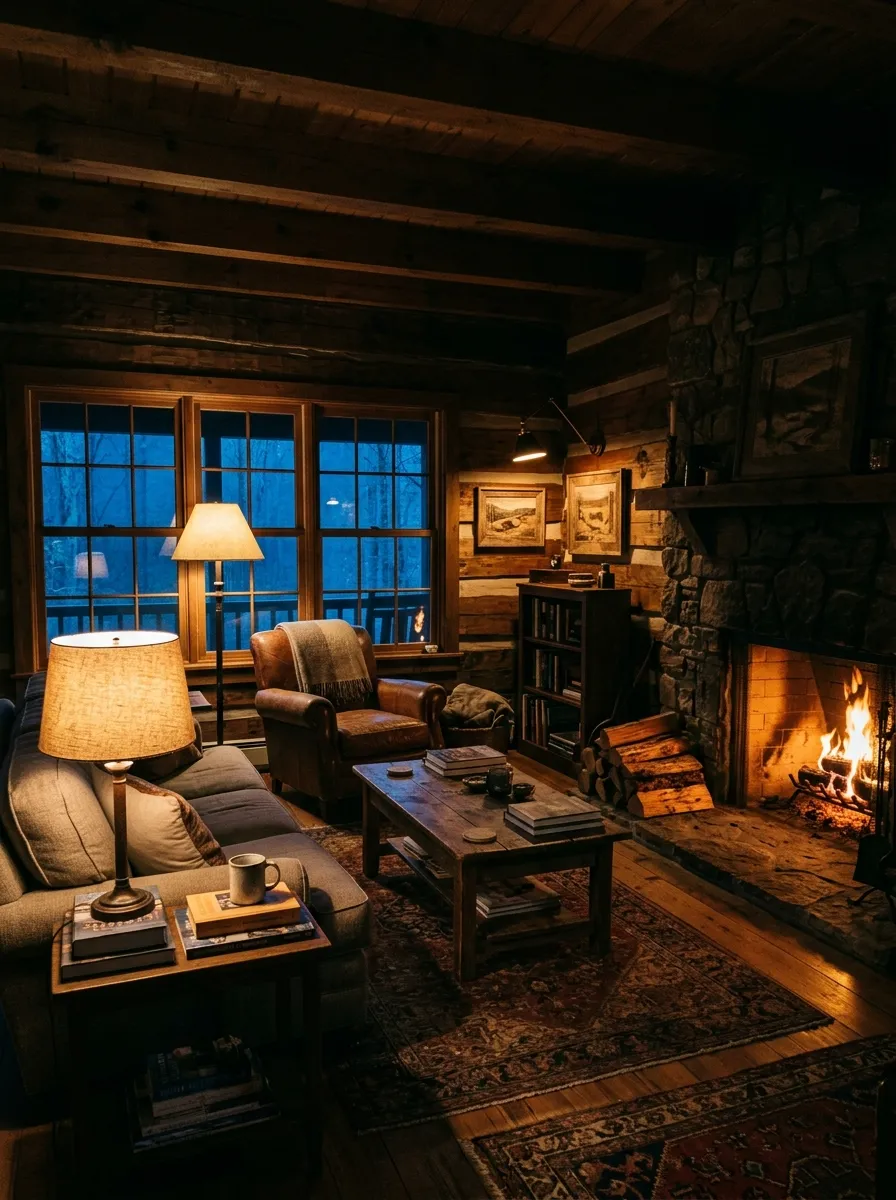
The best cabin lighting I’ve experienced is low, warm, and layered so the fire is always the brightest thing in the room. Use floor lamps and table lamps with warm bulbs around 2200 to 2700 Kelvin, add swing-arm sconces beside the sofa for reading, and put everything on dimmers. Skip recessed overhead lights unless they’re on a separate dimmer, because a bright ceiling kills the firelight. The mistake is a single overhead fixture that washes the whole room in flat, even light and erases the shadows that make a cabin feel deep. Good cabin living room lighting ideas always include at least three light sources at different heights. The room that earned a note was a Colorado chalet at dusk with two lamps, one sconce, and the fire, and nobody wanted to turn anything else on.
21. The Modern Cabin Living Room: Contemporary Touches That Respect the Mountain Vocabulary
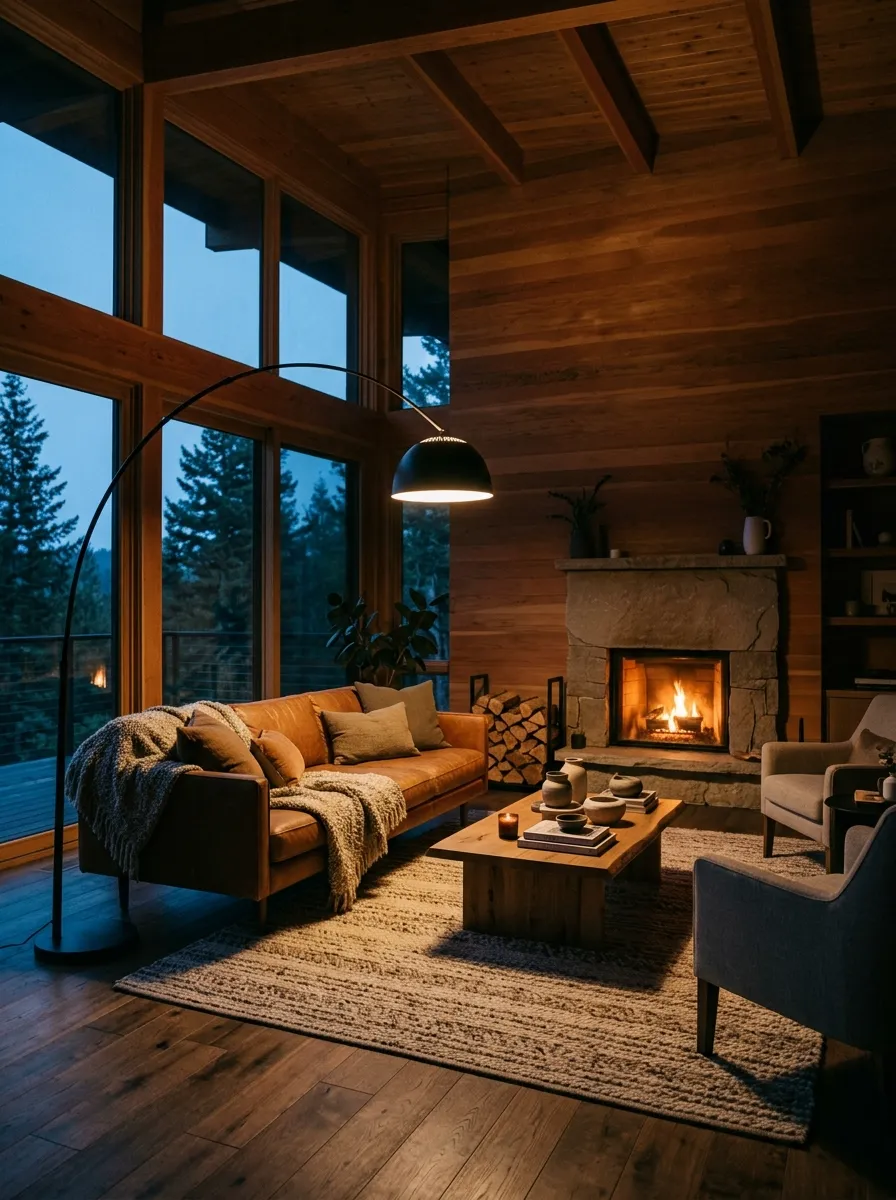
A modern cabin works when contemporary touches borrow from the mountain palette rather than fight it. Think clean-lined sofas in leather or boucle, blackened steel lamps, and a simple stone fireplace without a fussy mantel, all set against warm timber. Keep the lines simple, limit the number of patterns, and let the view and the wood do the decorating. The mistake is importing a stark white minimalist look that ignores the warmth and texture a cabin is built on. Modern cabin living room ideas succeed when every sleek piece still has a natural counterpart, like a steel lamp beside a hewn beam. The most convincing example I’ve seen was a Pacific Northwest cedar home with a low leather sofa, a black iron arc lamp, and nothing else on the walls.
Field Note Detail: Modern Without Chill
⛰ Pair one modern material, like blackened steel, with two natural ones, like wood and wool.
⛰ Keep the sofa low, around 30 inches in total height, and the lines straight and unfussy.
⛰ Don’t use cold white walls or glossy lacquer, because they clash with the timber and show every smudge.
⛰ On a budget, buy a simple black arc lamp from Amazon and pair it with a secondhand wool rug.
22. The Complete Cabin Living Room Ideas, Every Field Note in One Mountain Room
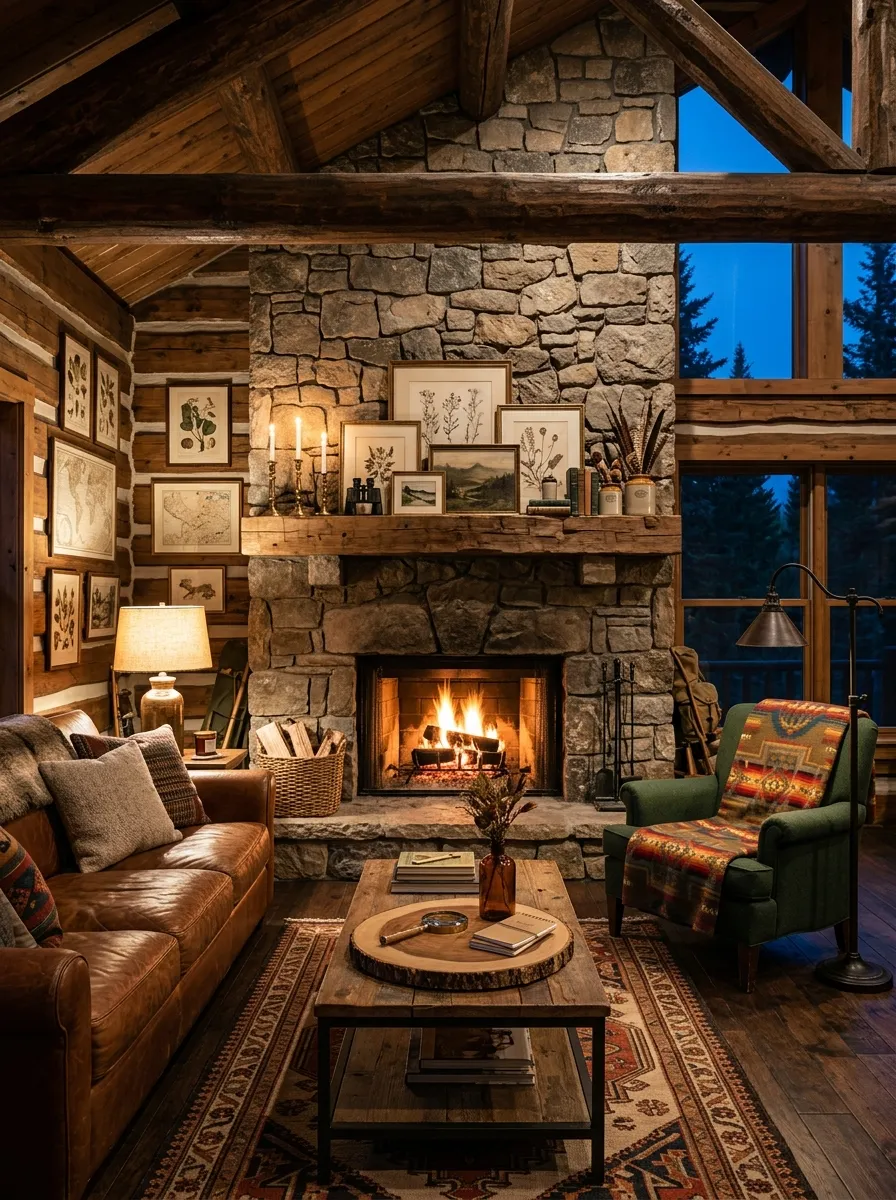
Here’s the room I’d build if I could use everything I’ve written down. A stone fireplace anchors one wall, with a log beam ceiling overhead and wide-plank flooring underfoot, and a deep cognac leather sofa faces a single club chair with a Pendleton throw over the arm. A big woven rug ties the seating together, the coffee table is reclaimed wood sized for eight, and the lighting is low and layered so the fire does most of the talking. On the mantel sit a few things that mean something, and on the shelves a map, a handful of books, and a pine cone or two. The common mistake is trying to include everything at once, so build the room slowly and let each piece earn its place. A simple wood slice tray on the coffee table, holding a candle and a mug, is the last small detail that makes the whole thing look lived in.
Cabin Living Room Questions, From the Mountain House Notes
How do I decorate a cabin living room?
Start with the bones: a stone fireplace, timber ceiling, and warm wood walls, then add deep leather or performance-fabric seating and layered wool textiles. The best cabin living room ideas build slowly, with objects gathered over time rather than bought in one afternoon. A rustic cabin living room should feel warm and slightly worn, never staged. Keep the color palette earthy and let natural materials do most of the work.
What furniture works best in a cabin living room?
Choose oversized, durable pieces: a deep leather sofa, a roomy club chair, and a reclaimed wood coffee table with iron legs. The best cabin living room furniture ideas favor sturdy frames and materials that improve with age. Size everything generously, since mountain rooms swallow small furniture. For log cabin living room ideas, avoid delicate pieces that can’t survive wet boots and card games.
What colors work in a cabin living room?
Stay with oatmeal, rust, forest green, charcoal, and the brown of bark. A reliable cabin living room color palette follows the landscape, with a single deeper accent like burgundy or navy. Mountain living room ideas that work best avoid cool grays and bright whites, which fight the timber. Let the wood set the temperature and match everything else to it.
How do I make a cabin living room feel authentic rather than themed?
Choose real materials and a few meaningful objects instead of a catalog of mountain-themed decor. A cabin style living room feels authentic when each piece has a use or a story, so skip the slogan signs and resin bears. Among all the cabin living room ideas I’ve collected, the genuine rooms always have a few worn, mismatched, loved pieces. Accumulate slowly and let the room age with you.
What is the best sofa for a cabin living room?
A deep leather sofa or a performance-fabric one in a warm neutral is the best choice for a rustic cabin living room. Leather develops a patina and performance fabric shrugs off dogs and snow, and both belong among the best cabin living room furniture ideas. Choose a frame of at least 90 inches with 22 to 24 inch seat depth for real comfort. Place it facing the hearth, following the arrangement principles in our fireplace room styling guide.
What rugs work in a cabin living room?
Large woven rugs in jute, sisal, or flat-weave wool work best. Among cabin living room ideas, a woven rug cabin living room base layered with a smaller vintage-style piece is the most reliable combination. Size it at 9 by 12 feet or larger so every seat sits on it. Avoid high-pile shag, which traps melted snow and mud.
How do I add warmth to a cabin living room?
Layer wool throws, leather pillows, and a faux fur blanket, and keep the lighting warm and low. Cozy cabin living room decor comes from texture rather than quantity, so add one of each fiber rather than ten of one. For more cabin living room ideas on surface warmth, our mountain table styling guide shows how to dress a coffee table with natural objects. A burning fire does the rest.
What lighting works best in a cabin living room?
Use layered lighting at three heights: floor lamps, table lamps, and wall sconces, all with warm bulbs on dimmers. The best cabin living room lighting ideas let the fire stay the brightest source in the room. Skip a bright overhead fixture, which flattens the shadows. Cabin living room ideas that work in the evening always include at least one lamp near the reading chair.
How do I create a modern cabin living room?
Pair clean-lined furniture with natural materials like timber, stone, and wool. Modern cabin living room ideas work best with a limited palette, blackened steel accents, and simple shapes. Among all cabin living room ideas, the modern version relies most on proportion, so it helps to review the basics in our living room layout guide. Keep the warmth and skip stark white.
What is a ski lodge living room style?
A ski lodge style is a big, timber-framed room built around a stone fireplace, deep seating, and plenty of wool, leather, and plaid. The best lodge style living room ideas make a room that can hold a crowd in wet boots and still feel warm. It shares much with the cabin living room ideas above, but on a larger scale. Think Vermont ski lodge or Colorado chalet, with generous furniture and a hearth you can sit on.
The Notes Close
These cabin living room ideas all point to one truth: the best room isn’t the one that’s most perfectly decorated, but the one that makes everyone in it forget how long they’ve been sitting there. Stone, timber, wool, and firelight do most of the work, and the rest is patience and a few things you actually love.
A cabin living room is the heart of a mountain home that knows how to hold people. The Muse Vale has the living room, home decor, and interior guides to help you build every warm space from the first beam to the last fire.
Come back to The Muse Vale whenever your cabin needs a new idea or your mountain home needs a fresh perspective. We will have the cabin living room ideas, mountain style guides, and interior inspiration ready for every retreat you are building.