
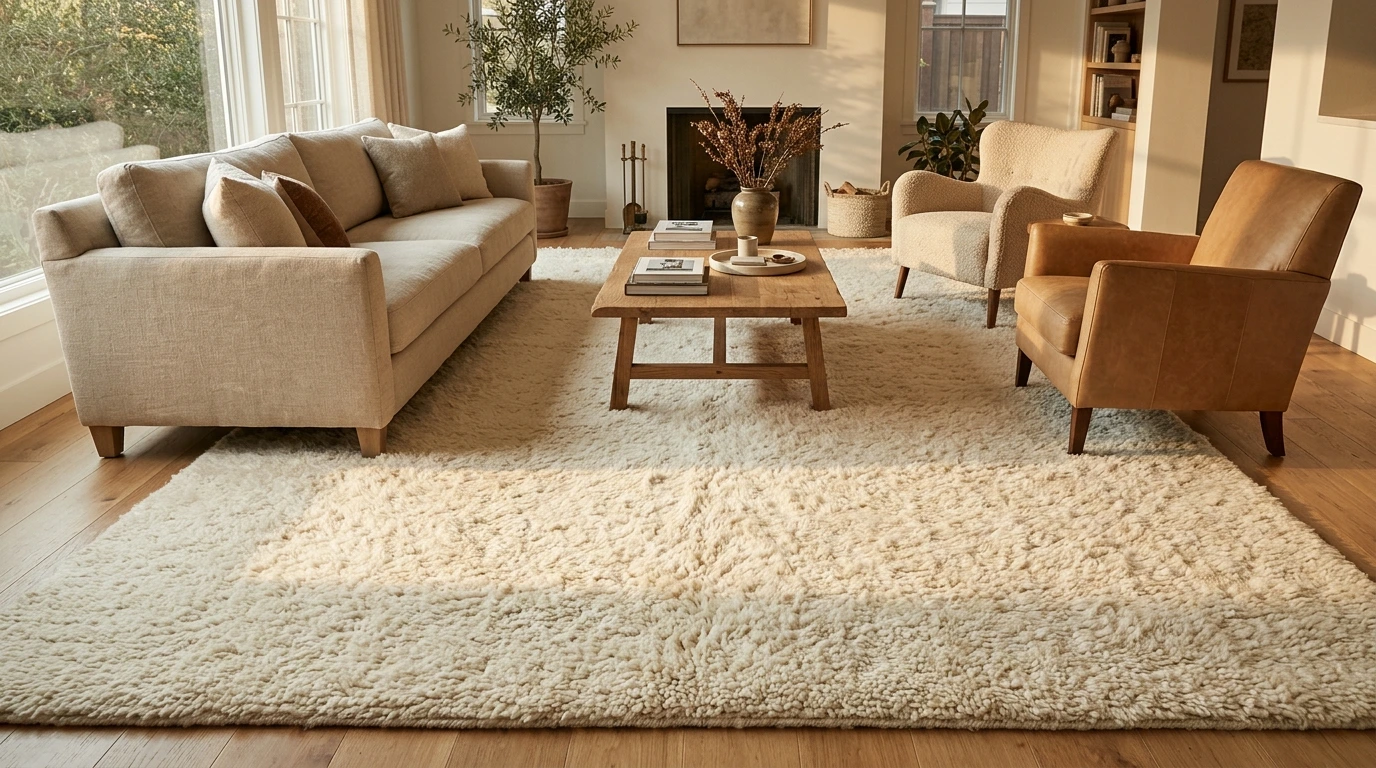
The best cozy living room decor ideas rarely involve buying a new sofa. I can usually tell in thirty seconds what your living room needs: the furniture is good, the palette is inoffensive, the layout is sensible, and yet nobody ever lingers there after dinner. Warmth isn’t a style choice. It’s a series of small, specific decisions, and most American living rooms are missing three or four of them, whether it’s the family room that gets used every evening, the apartment living room that has to do everything, or the open-plan space that never quite feels warm. This edit walks through 24 of those decisions, from the throw blanket fold to the lamp you haven’t added yet, and from the area rug under your coffee table to the way a woven basket changes a corner. Some are free, some cost a Target run, and a few are worth a trip to Pottery Barn. All of them are about how the room feels once you sit down, not how it photographs.
The Living Room Warmth Test: Why Does Your Room Look Good But Not Feel Right?
If you’ve scrolled through cozy living room decor ideas and still can’t say why your room falls flat, these five barriers explain most of it, and each one has a warm living room decor fix that takes an afternoon or less.
◎ THE ROOM THAT IS BEAUTIFUL IN PHOTOS AND COLD IN PERSON
What it looks like: Every surface is clear and styled, the room photographs well, and yet people perch on the edge of the sofa instead of sinking in.
What is actually causing it: The styling was done for a camera angle, so nothing sits within arm’s reach and there’s no soft furnishing warm living room layer at seat height.
The edit that fixes it: Put a throw and two cushions exactly where people sit, and let them look used.
◎ THE LIGHTING THAT MAKES EVERYTHING LOOK INSTITUTIONAL
What it looks like: Flat white light from the ceiling, faces without shadow, and the television as the only softer glow.
What is actually causing it: A single cool overhead source and no warm lighting living room layers at lower heights.
The edit that fixes it: Turn the ceiling fixture off after 5pm and add two lamps at different heights with 2700K bulbs.
◎ THE SOFA THAT NOBODY WANTS TO SIT IN FOR LONG
What it looks like: A tidy, upright sofa that stays empty while someone takes the floor or the one armchair.
What is actually causing it: A firm, shallow seat and a hard back with no texture to soften the angle.
The edit that fixes it: Add a full lumbar cushion and one heavy throw so the sofa invites you to lean back.
◎ THE PALETTE THAT IS TECHNICALLY NEUTRAL BUT FEELS STERILE
What it looks like: Gray walls, gray sofa, white trim, and nothing you could point to as wrong.
What is actually causing it: Cool undertones everywhere with no warm material to balance them.
The edit that fixes it: Bring in warm wood, cream and oatmeal fabrics, and one rust or ochre note.
◎ THE ROOM THAT HAS EVERYTHING BUT LACKS A REASON TO STAY
What it looks like: All the furniture faces the television and there’s no corner to settle into.
What is actually causing it: The room has one destination, the screen, and nothing that rewards sitting still.
The edit that fixes it: Build a lit chair with a table and a book within reach.
Every living room I walk into has a textile gap, usually at the exact height where people sit, lean, and put their feet up. American rooms tend to be furnished with a sofa and a rug and then stop, as though the soft layers were optional.
1. Cozy Living Room Decor Ideas Begin With the Throw Blanket You Are Folding Wrong
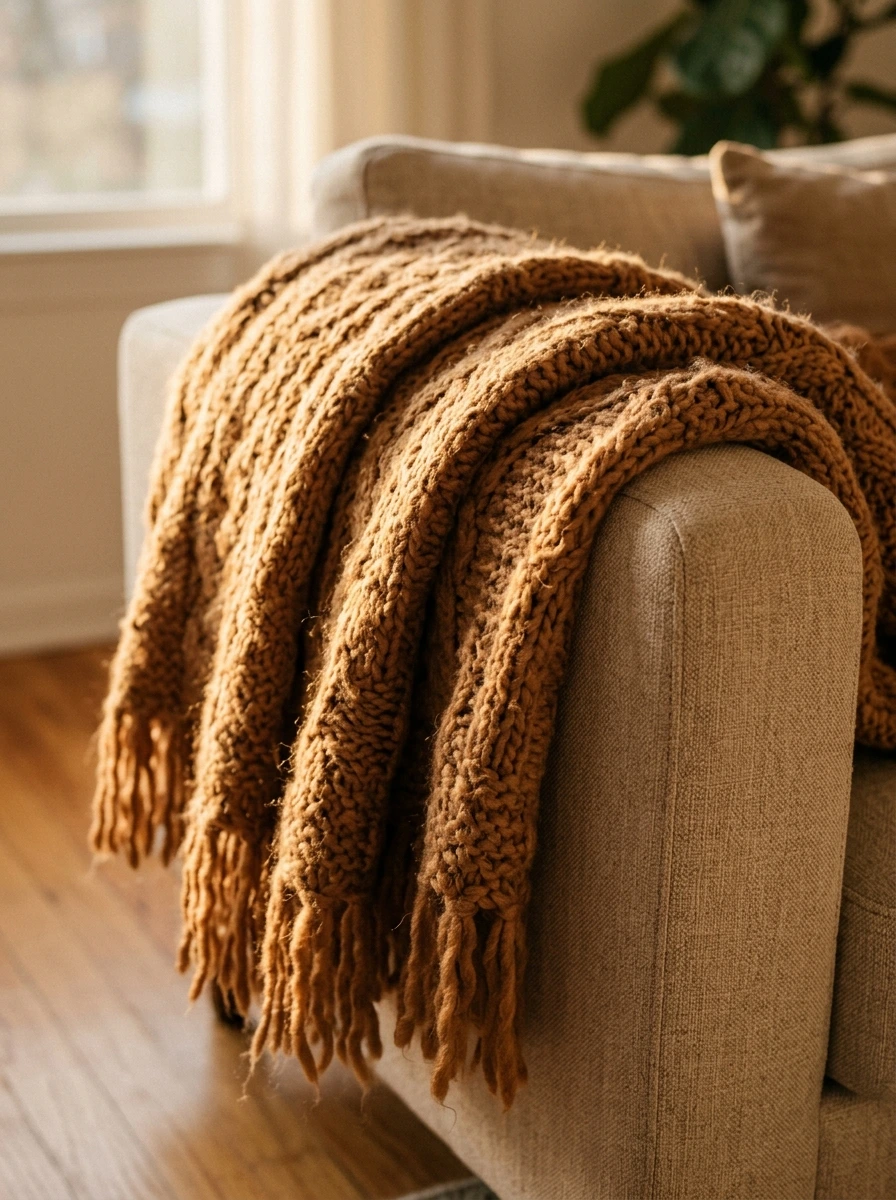
A throw blanket does more for your living room than any piece of art, because it tells people the room is meant to be used. Drape one oversized throw loosely over the arm of the sofa, folded once lengthwise with the fringe or cuff showing, and keep a lighter second throw on the ottoman or a chair. What kills the effect is the blanket folded into a perfect square on the sofa back, which reads as display and never invites anyone to pull it over their legs. Good throw blanket living room styling also means choosing weight over pattern, so wool, chenille, or chunky knit from Pottery Barn or Target will always feel warmer than thin acrylic. If you change one thing today, make it a throw you’d want over your own lap, then leave it slightly unfolded.
2. Why Odd Numbers of Cushions Feel Inviting in a Warm Living Room and Pairs Feel Like a Showroom
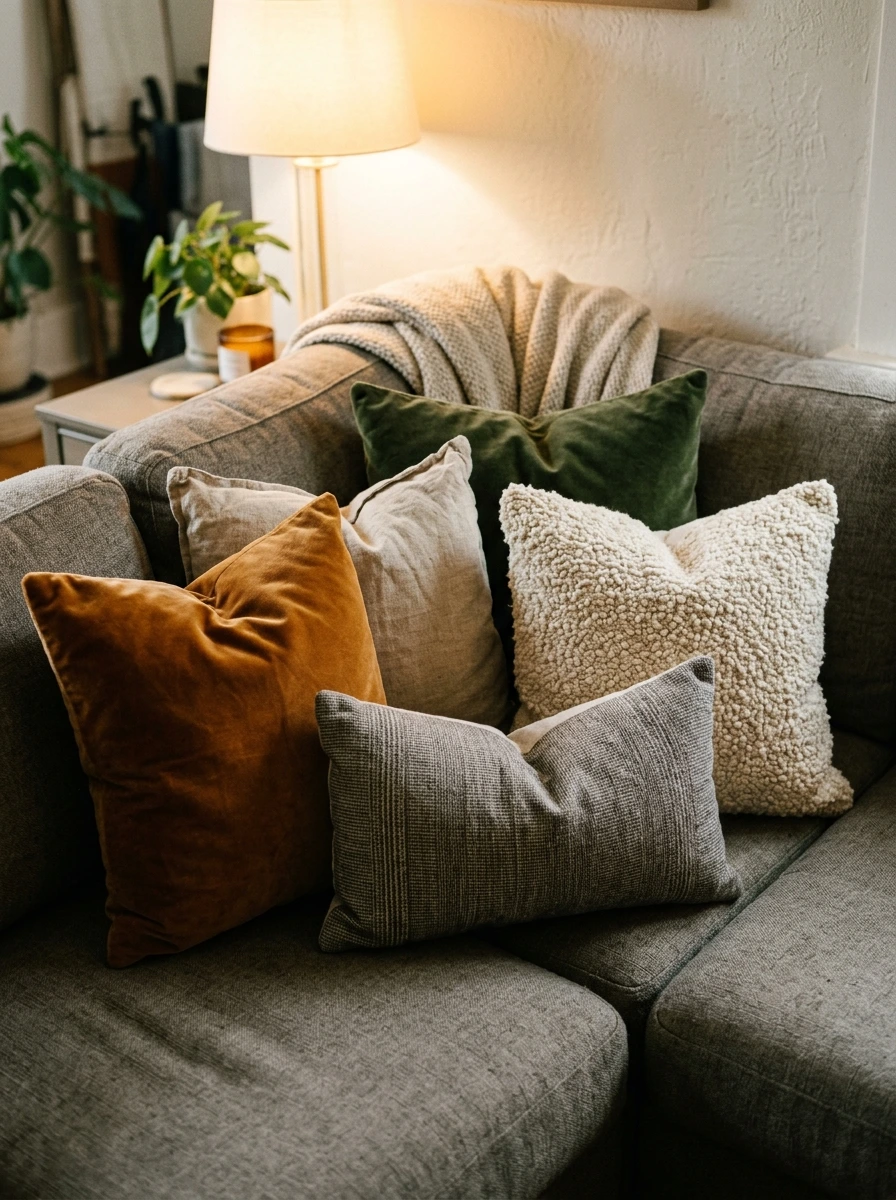
Cushion layering is how a sofa goes from furniture to a place, and the right mix gives a warm living room its first real softness. Use three on a standard sofa and five on a sectional, mixing one solid velvet, one linen, and one textured or patterned cushion, with the largest at the back and a smaller lumbar in front. What kills it is a matched pair of identical pillows lined up at each end, which looks like a showroom and gets shoved aside the moment someone sits. That layered cushion living room rule works because varied sizes and fabrics create shadow and depth, and the eye reads depth as comfort. The single biggest upgrade is replacing thin, stiff inserts with full ones so the cushions slump a little.
The Warmth Edit Detail: Slump, Mix, Count
◎ Choose covers in velvet, linen, and wool bouclé from West Elm or HomeGoods, sized one inch smaller than the insert so they look full.
◎ Use three cushions on a standard sofa and five on a sectional, with the lumbar always in front.
◎ Avoid matching pairs with a sharp crease down the center, which looks staged rather than lived in.
◎ Budget alternative: buy plain IKEA inserts and dress them in secondhand or HomeGoods covers.
3. The Rug Is the Warm Living Room’s Foundation, and Yours Is Probably Too Small
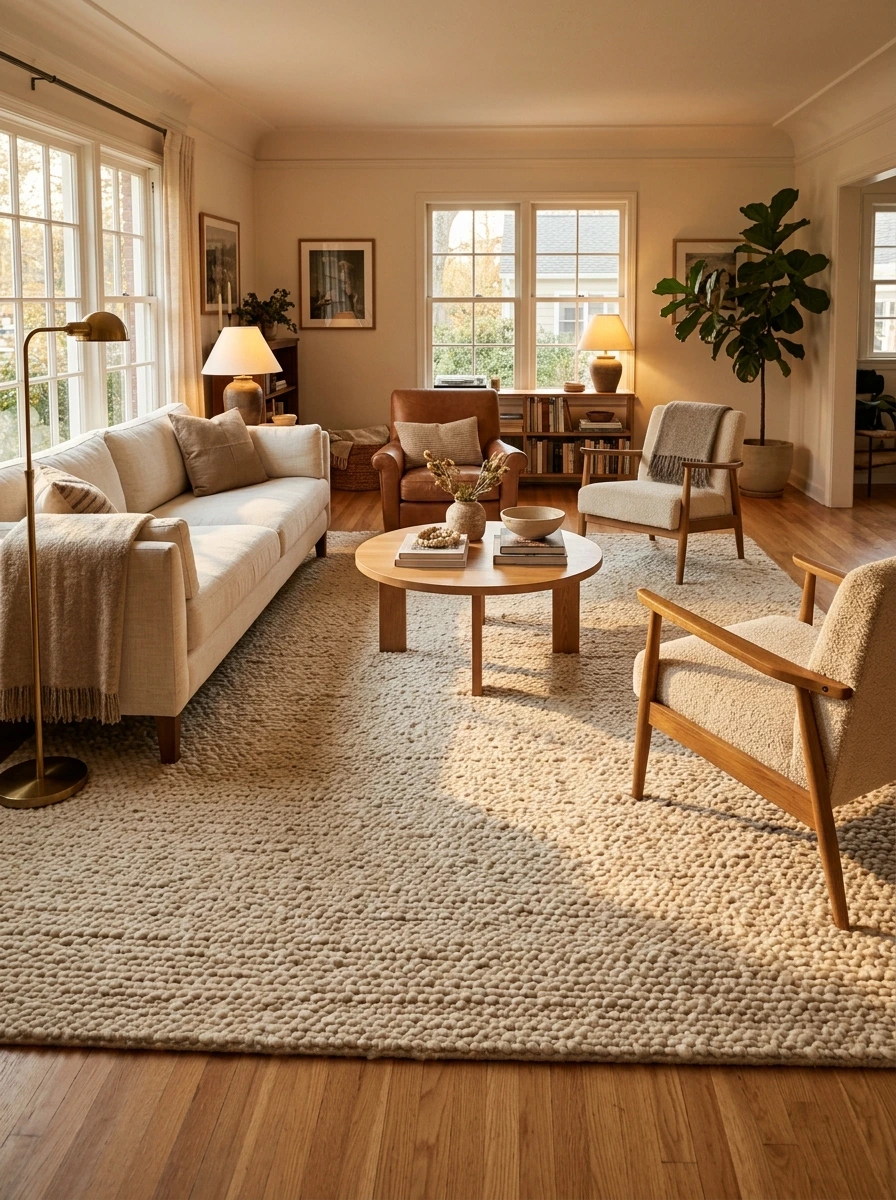
The area rug is the foundation every other warmth layer sits on, and it’s the first thing I check in a living room that feels cold underfoot. Choose a wool or wool-blend rug in warm ivory, oat, or rust, sized so at least the front legs of every seating piece rest on it, which usually means 8×10 or larger in an average family room. A rug that floats in the middle like a postage stamp breaks the room into islands and leaves bare floor chilling the edges. An area rug in a cozy living room should have enough pile to feel soft barefoot while staying low enough that chairs and the coffee table don’t wobble. If you can only upgrade one thing, go bigger, because a larger plain rug warms a room more than a smaller expensive one.
4. Curtains Hung Too Short Are the Quiet Reason Your Living Room Feels Unfinished
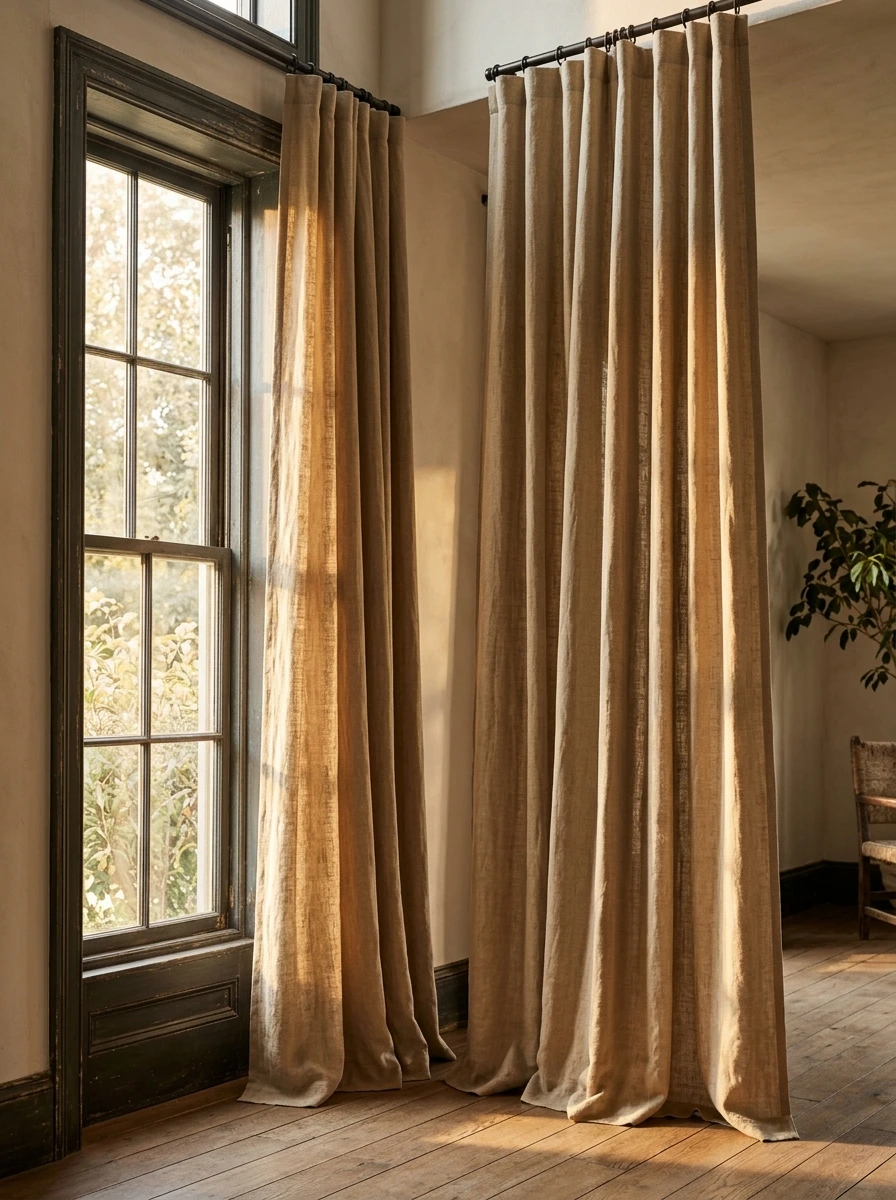
Curtain weight and length decide whether a window frames your room or just sits in it, and most living rooms hang them wrong. Mount the rod four to six inches above the window frame, let lined linen or cotton in warm sand, oatmeal, or soft clay graze the floor, and buy panels with enough fullness to look generous when drawn. Short, sheer, or builder-white panels hung right at the top of the frame make the ceiling feel lower and let cold light flood the room. Good curtain warmth living room design also muffles echo, which is why heavier fabric helps open-plan spaces feel gathered. The best swap is going from 84 to 96 inch panels on a higher rod, because that alone makes the room look intentional.
5. Where Velvet Earns Its Place in a Warm Living Room and Where It Starts Competing
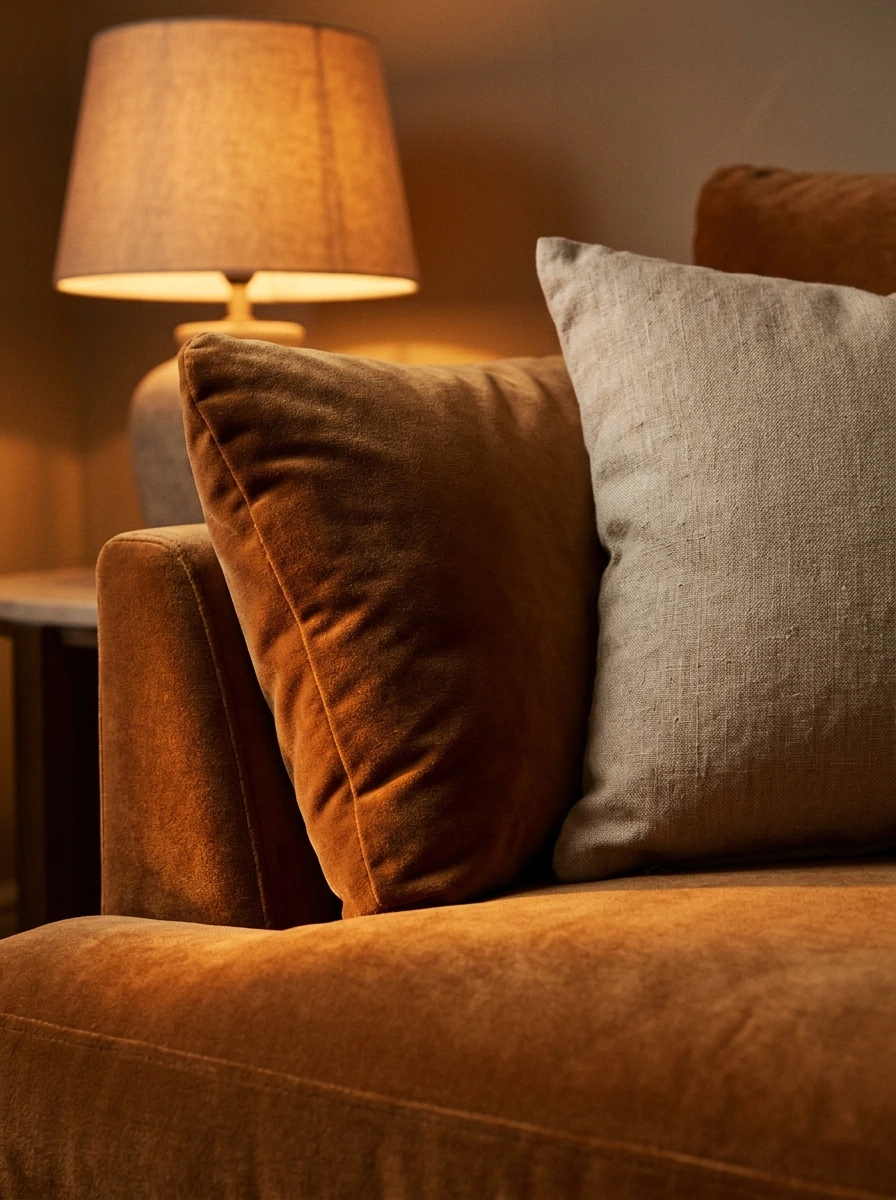
Velvet adds a depth and glow that flat fabrics can’t, but only when it’s the main event and not one of five. Put it on one large piece, such as a sofa or accent chair, in caramel, rust, deep olive, or warm mushroom, and keep everything else matte, linen, or wool. Velvet in a cool jewel tone, or in a high-sheen finish beside leather and metal, competes for attention and reads formal, even cold. A velvet sofa in a cozy living room works because the pile catches lamplight and turns it amber, so keep it near a lamp. My honest note: if you aren’t ready for a velvet sofa, two velvet cushions in rust do a surprising amount of the same work.
6. The Layered Textile Approach: When Textures Work Together and When They Fight
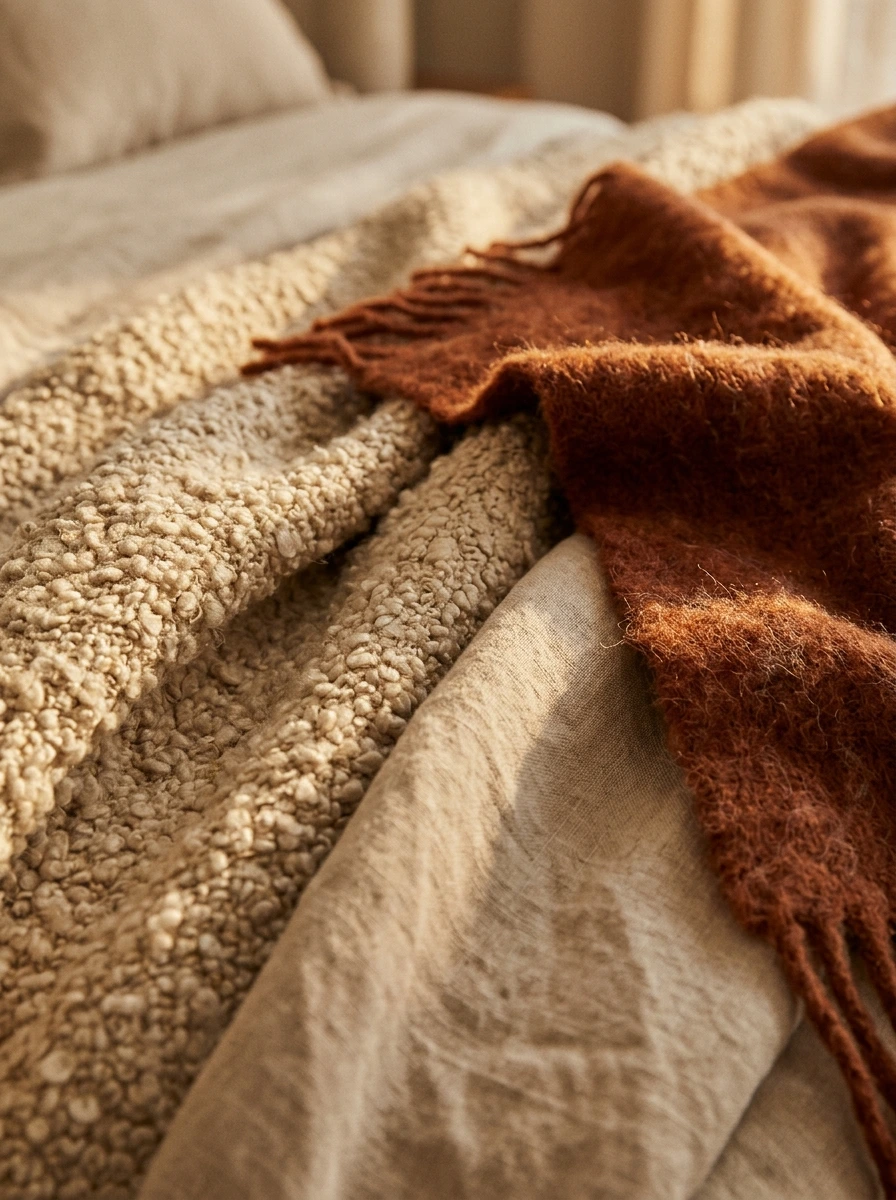
Layering textiles works the way layering clothing does: each piece should add something the others lack. Pair one smooth surface with one nubby one and one soft one, such as a linen sofa, a bouclé cushion, and a wool throw, and keep the color family within two or three warm tones. When every texture is equally chunky, or shiny satin sits next to scratchy wool, the room feels busy instead of enveloping. This is where cozy living room textiles either come together or compete, so squint at your sofa and ask which texture is shouting. The quickest fix is to remove one competing piece and let the rest breathe.
🧶 The Living Room Textile Warmth Formula: What to Layer, How Many, and in What Order
The best cozy living room decor ideas treat textiles as a system, and these cozy living room textiles go on in a specific order.
FOUNDATION TEXTILE (the rug): A wool or wool-blend rug in ivory, oat, or rust, large enough to hold the front legs of all seating. This is the layer your feet and your eyes feel first, so don’t economize on size.
ANCHOR TEXTILE (the sofa upholstery): Choose a tight-weave performance fabric, bouclé, or velvet in caramel, oat, or olive. Our sofa warmth selection guide shows the specific styles, fabrics, and colors that build warmth rather than work against it.
LAYERING TEXTILE (throw blankets): Two throws, one oversized wool or chunky knit draped over an arm and one lighter folded on a chair or ottoman, both in the same warm color family.
ACCENT TEXTILE (cushions): Three on a sofa, five on a sectional, mixing velvet, linen, and one textured piece, with the largest at the back and a lumbar in front.
THE WARMTH MULTIPLIER: A wool rug, a linen or bouclé sofa, one rust velvet cushion, and a chunky throw within arm’s reach, all sitting under a lamp.
THE WARMTH KILLER: A stack of matching gray polyester pillows on a gray microfiber sofa over a thin flatweave rug. It looks coordinated and feels like a waiting room.
Lighting is the warmth chapter people skip because it doesn’t feel like decorating, and it changes a room more than anything else here. I find the same pattern in nearly every American living room: one bright overhead fixture, one lamp that’s rarely lit, and a television doing the rest.
7. The Overhead Light That Stays On Is Why Your Living Room Warmth Disappears After Dark
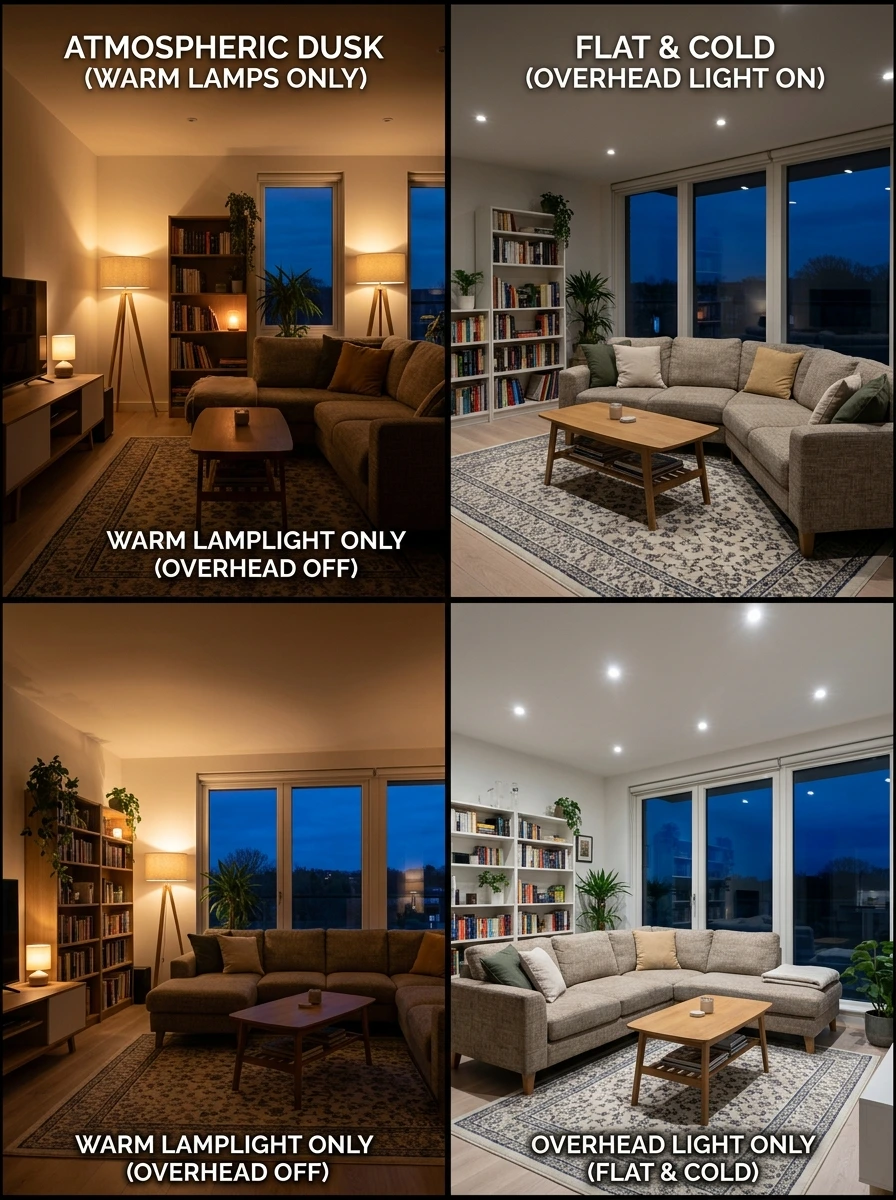
The overhead light is the biggest enemy of evening warmth, and in most homes it’s on every night out of habit. Leave the ceiling fixture off after 5pm, or swap its bulbs for 2700K warm white on a dimmer, so the lamps carry the room. A 4000K or 5000K bulb overhead flattens every texture you’ve added, casts shadows under your eyes, and makes even a good sofa look like a waiting room. Among all living room warmth ideas, the cheapest is removing the one layer that flattens the others. If you do nothing else this week, switch it off for three evenings and notice who sits where.
8. The Floor Lamp Edit: Placement, Shade, and the Glow That Changes the Room After 5pm
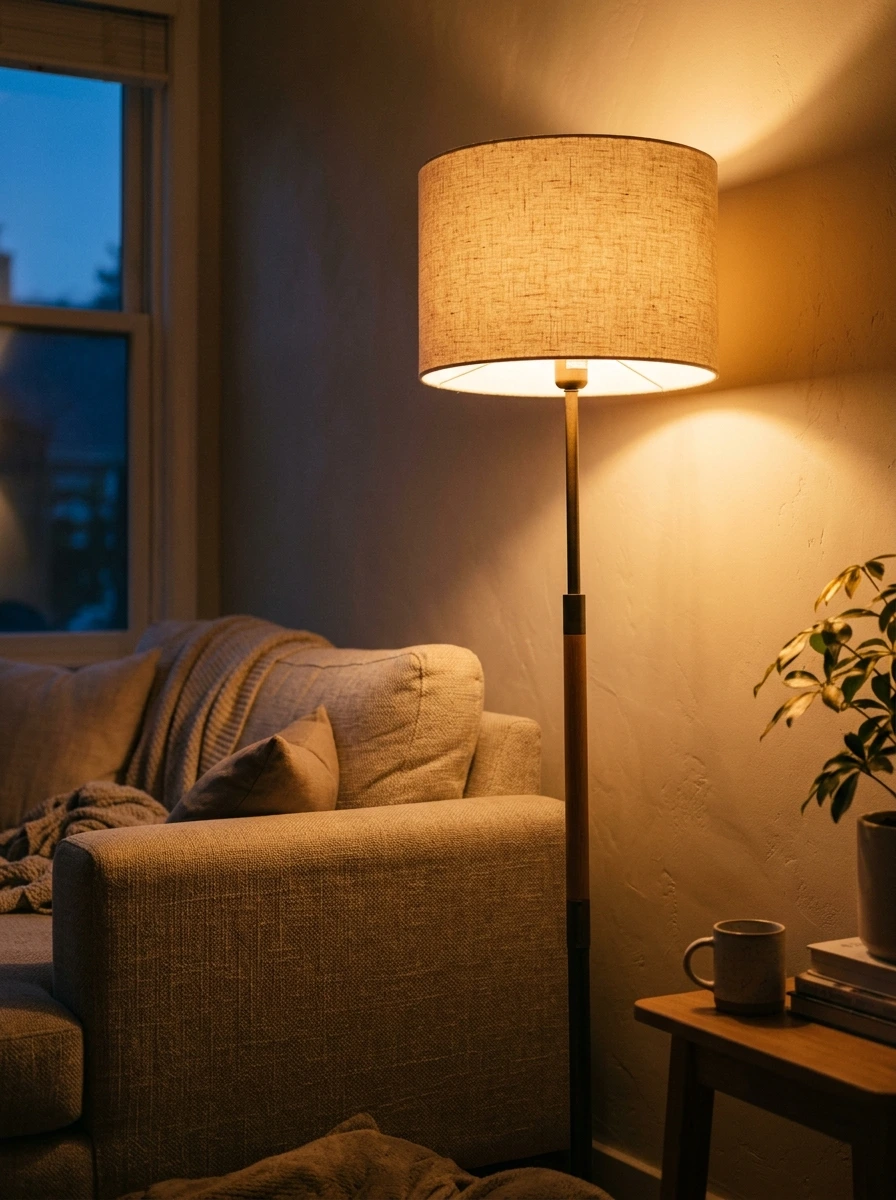
A floor lamp lifts light to head height, which is the level where a room starts to feel enveloping. Place one beside the sofa or in the darkest corner, choose a fabric or linen shade in cream or warm white, and use a 2700K bulb of about 800 lumens. A metal or glass shade that throws light straight up and down, or a lamp pushed against a wall where it spills nothing, produces spotlights instead of a glow. Warm lighting living room layers start at this height, because a fabric shade turns the bulb into a soft wash. The honest edit: move the lamp two feet closer to where people actually sit, and the whole corner changes.
The Warmth Edit Detail: Shade, Height, Glow
◎ Choose a linen or paper-lantern shade in warm white or oatmeal with a 2700K bulb of roughly 800 lumens, from Target, IKEA, or Pottery Barn.
◎ Place the lamp at shoulder height beside seating, angled so light falls across the seat and not into eyes, and aim for at least two lamps per room.
◎ Avoid black metal drum shades with exposed bulbs and daylight-white LEDs, which look current and feel clinical.
◎ Budget alternative: a basic IKEA or Amazon paper-and-wood floor lamp with a warm bulb gives the same glow at a fraction of designer prices.
9. The Lamp You Haven’t Added Yet Is the Reason the Room Doesn’t Feel Right After Dark
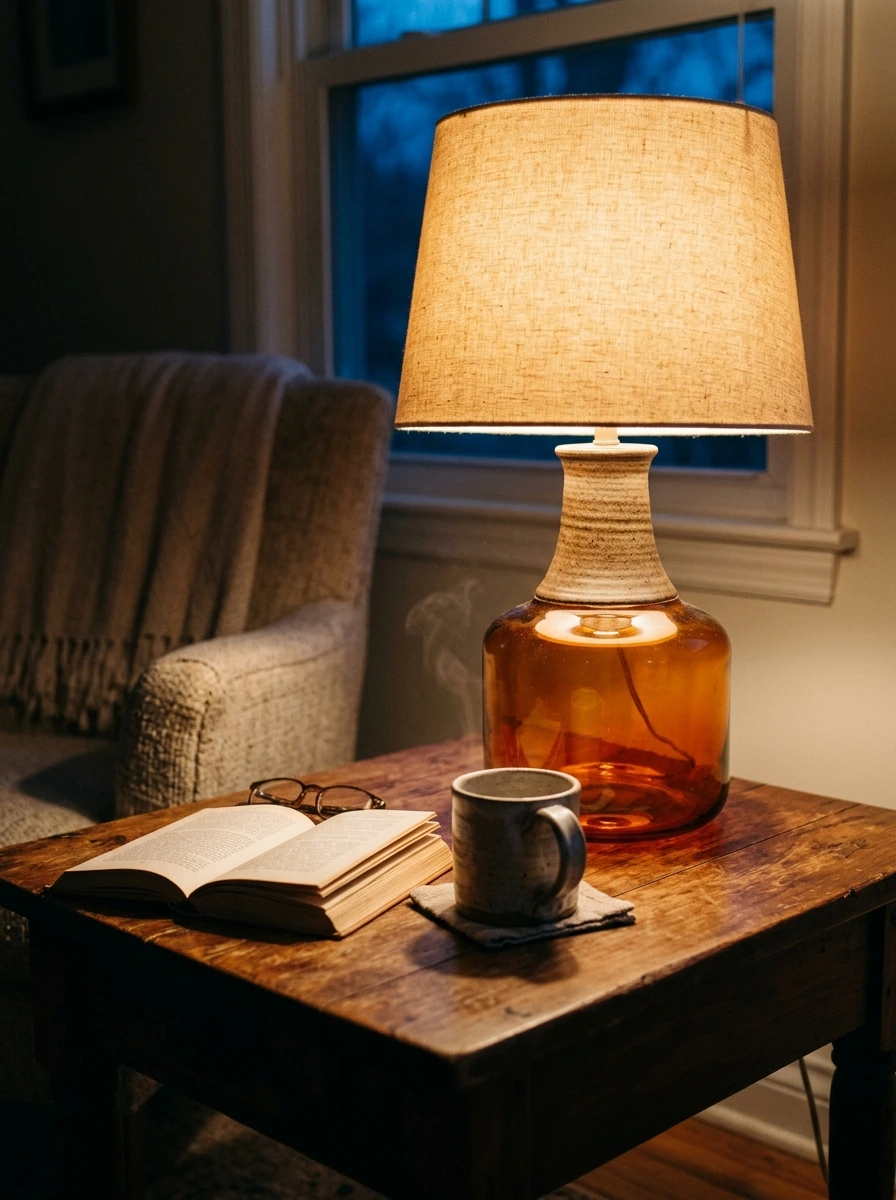
Table lamps are the quiet workhorses of warmth, because they bring light down to the level of hands, books, and faces. Choose a base in ceramic, amber glass, or aged brass, top it with a drum or empire shade in linen or cotton, and pair it with a 2200K to 2700K bulb for a true amber tone. White plastic shades and clear-glass bulbs put the brightest part of the bulb right in your eye and wash the lamp’s color out. A pair of lamps on a console or side tables adds the soft, gathered symmetry that makes amber lighting living room schemes feel settled. My honest note: if your room has only one lamp, add a second at a different height before you buy any decor.
10. The Candle Arrangement That Gives a Warm Living Room Its Evening Mood
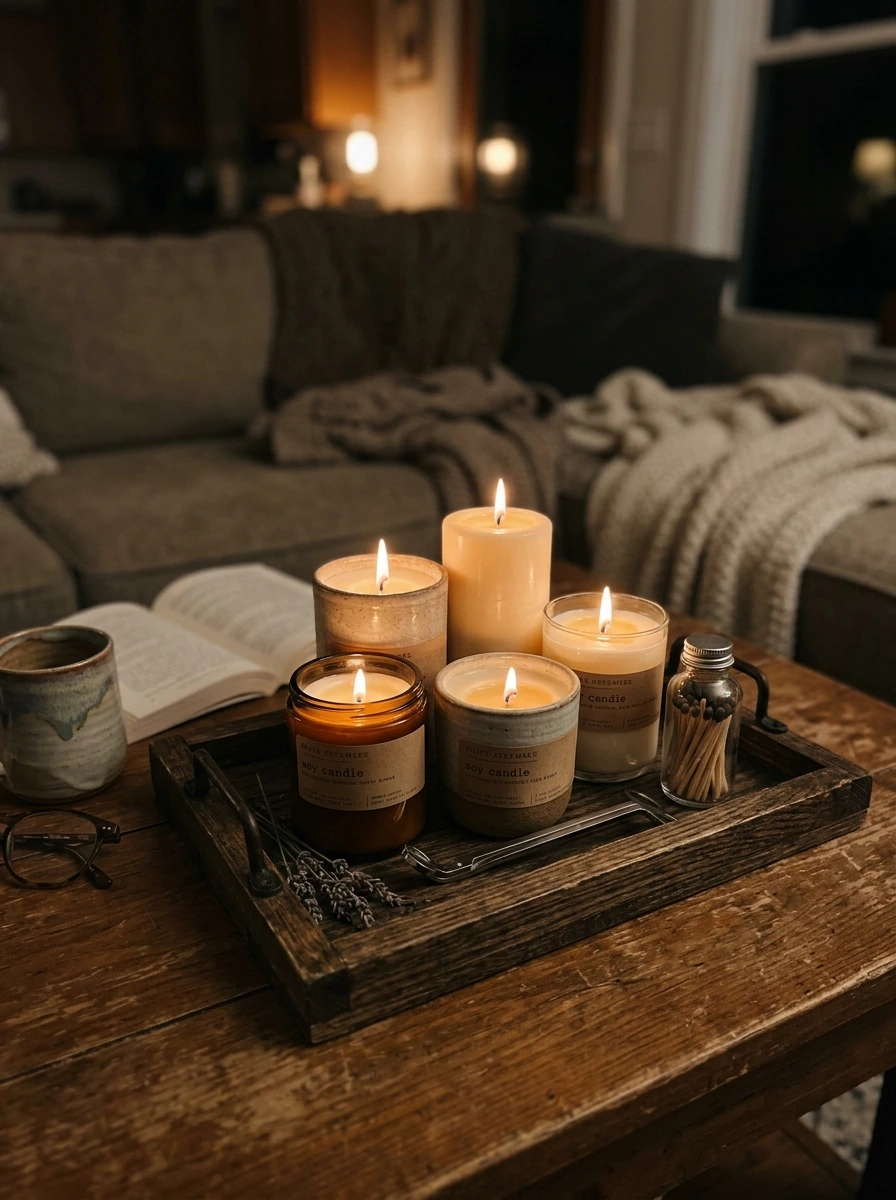
Candles add a flickering, low light that no bulb quite matches, and they signal that the evening has started. Cluster three to five in varied heights on a tray on the coffee table, put one pair on the mantel or console, and set a single votive on a bookshelf, using unscented or lightly scented soy or beeswax. A lone candle in the middle of a bare table, or heavily perfumed ones that fight with dinner, tend to feel like a spa lobby. A good candle arrangement living room system also repeats the same wax color, so the flames feel gathered rather than random. Light them every evening, not just for guests, because the habit is what makes the room feel lived in.
11. The Dimmer Switch Is Worth More Than Any Decorative Purchase You’ll Make
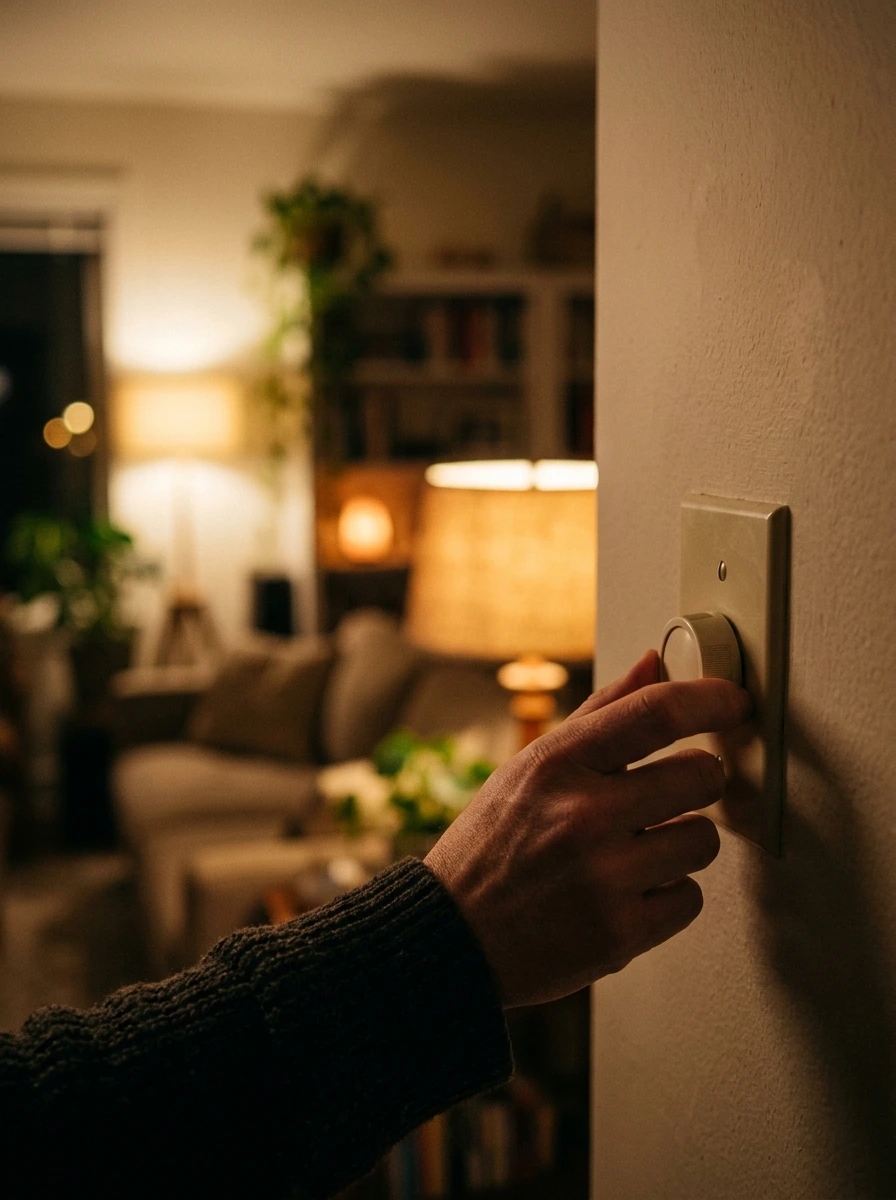
A dimmer lets one fixture do four jobs: bright for cleaning, medium for dinner, low for television, and glowing for the last hour of the day. Install a slide or rotary dimmer rated for LED, pair it with dimmable 2700K bulbs, and set the evening default at roughly a third of full brightness. Many people buy lovely lamps and leave the overhead at full, or install a dimmer without compatible bulbs and get flicker and buzz. Used with warm lighting living room layers, it’s the lever that ties every other lamp together. If you rent, a plug-in dimmer on a lamp or smart bulbs with brightness presets give a similar effect without touching the wiring.
💡 The Living Room Lighting Warmth Guide: What to Turn Off, What to Add, and What to Change
Cozy living room lighting ideas all come down to the same trade: fewer bright sources, more low ones, and a lot of amber lighting living room glow at seat height.
TURN OFF FIRST: The ceiling fixture. Leave it off after 5pm, and use it only for cleaning or hunting for something you dropped.
ADD THESE: A floor lamp beside the sofa for head-height glow. A table lamp on a side table or console for hands-and-book light. A candle cluster on the coffee table for flicker. A small accent lamp or picture light on a bookshelf or mantel. If you have a fireplace, treat it as the primary light source, and our fireplace warmth guide covers every hearth decision from mantel to furniture arrangement.
CHANGE THESE: Every bulb to 2700K, or 2200K in lamps where you want a true amber tone, and put the overhead circuit on a dimmer rated for LED.
THE WARMTH FORMULA: AMBIENT + TASK + ACCENT = a room that glows in soft pools at several heights, with no single bright source and nothing flat.
THE ONE SWITCH: Replace your overhead switch with a dimmer and your evenings will change by tonight.
Color is where a living room most often looks warm on a swatch and feels cold on the wall, because paint behaves differently under your windows and your bulbs. The mistake I see most in American homes is a safe gray-and-white scheme that’s technically neutral and emotionally flat.
12. The Undertone Test That Decides Whether Your Warm Living Room Palette Works
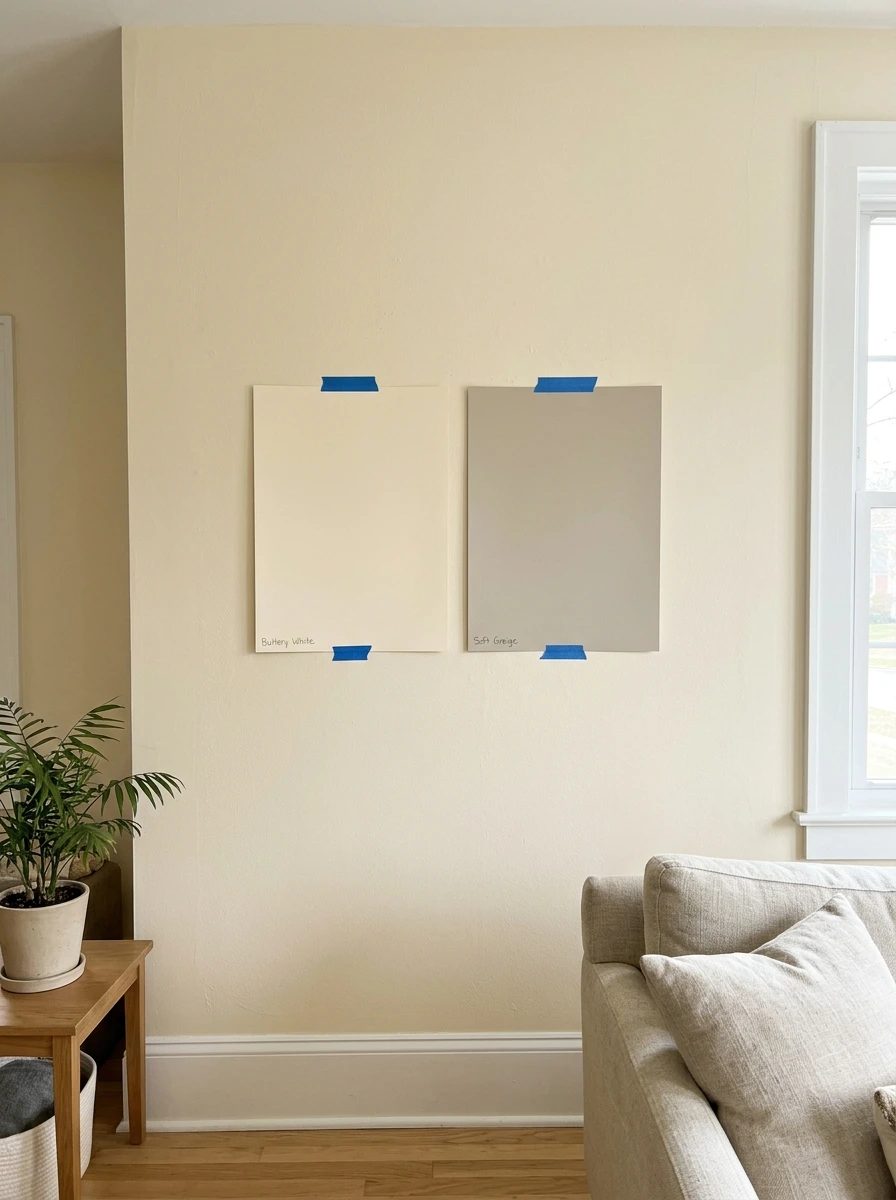
Undertone is what separates a warm neutral from a flat one, and it’s invisible until it’s on your wall. Look for creams, buttery whites, soft greige, and oatmeal with a yellow, red, or brown base, and hold each sample next to white paper to see which way it leans. Gray with a blue or green base, stark builder white, and anything labeled cool will pull the room toward a clinical mood the moment the sun dips. A warm neutral living room palette works because the colors share an undertone, so wood, fabric, and paint all feel related. My note: test two large swatches on different walls and look at them morning and evening before you commit.
13. The Warm Wood Tones That Always Work in a Living Room, and the Ones That Don’t
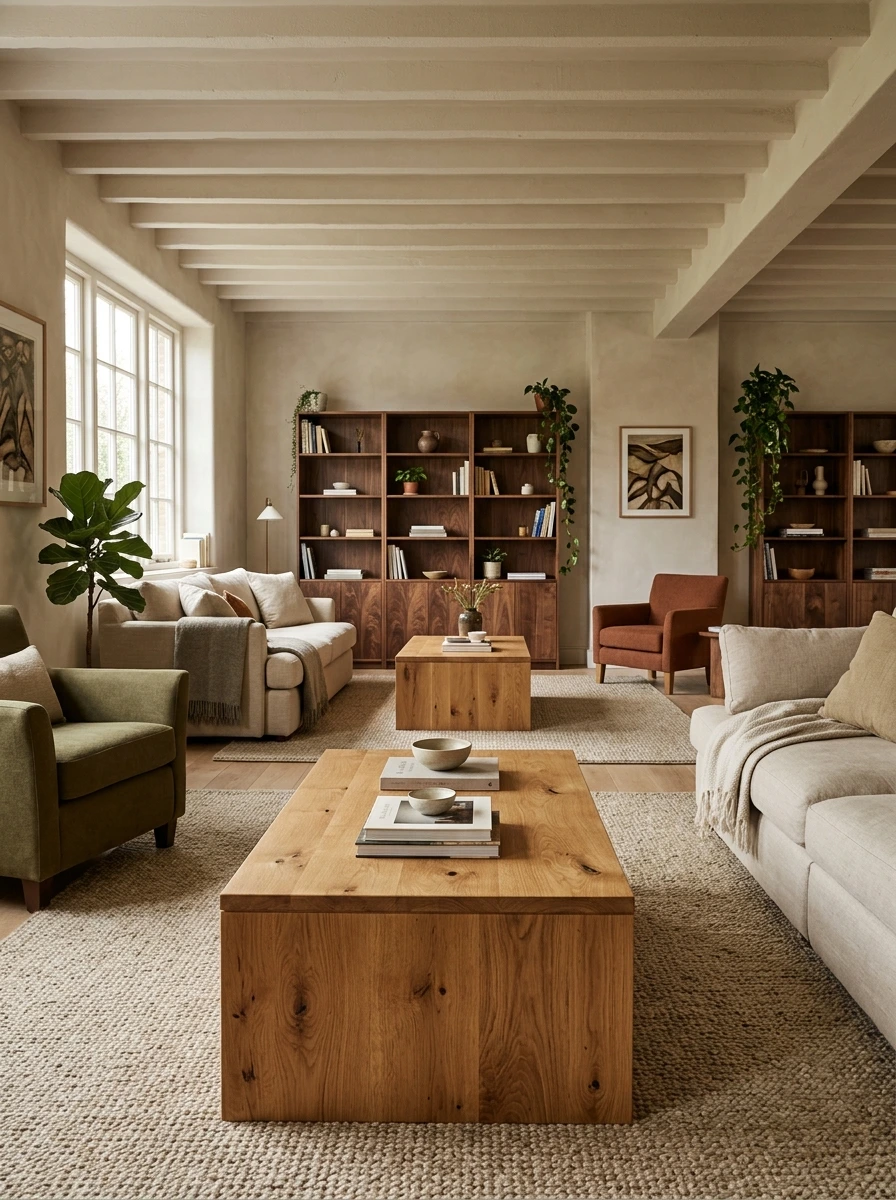
Wood is the living room’s oldest warmth material, and the right tones add depth that paint can’t. Choose mid-tone oak, walnut, or honey-finished pine for the coffee table, side tables, or shelving, and repeat the tone in at least three places so the room reads as intentional. Very pale, gray-washed, or orange-stained wood fights a warm room, while a single dark espresso piece can read heavy among lighter tones. Warm wood tones living room design comes down to repetition, because one wood piece looks lonely and three look planned. The best low-cost edit is swapping a cold metal or glass side table for a wooden one from West Elm, IKEA, or a thrift shop.
The Warmth Edit Detail: Mid-Tone, Matte, Repeated
◎ Choose solid or veneered oak or walnut in a satin or matte finish, a range Pottery Barn and West Elm both carry.
◎ Repeat the wood tone in at least three places, such as a coffee table, a shelf, and a lamp base or frame.
◎ Avoid gray-washed or high-gloss orange-toned finishes that fight warm neutrals.
◎ Budget alternative: oil or restain a thrifted wood table in a warm tone for a fraction of the new price.
14. The One Accent Color That Earns Its Place in a Warm Living Room
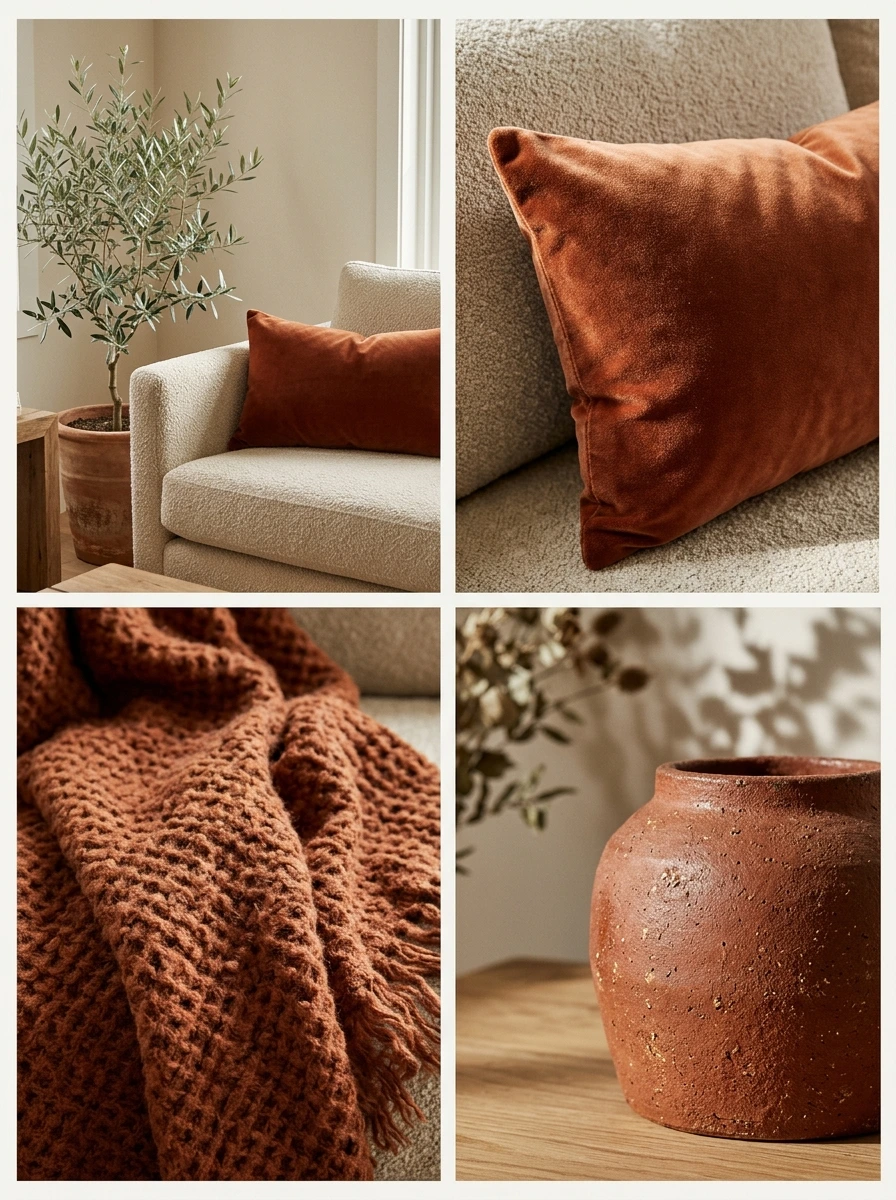
An accent color should feel like a warm note in a chord, not a new instrument, and in a warm living room it needs to earn its spot. Pick one from rust, deep olive, burnt ochre, or terracotta, then repeat it in three small items such as a pillow, a vase, and a book spine, in different textures. Bright primaries or cool teal and lavender shift the mood away from warmth and make the palette feel unplanned. A warm living room color palette stays warm when the accent shares an undertone with the neutrals, so test it against your walls first. My honest note: if you can’t repeat it three times, it isn’t an accent yet.
15. Cozy Living Room Decor Ideas on a Budget: The Palette Changes That Cost Almost Nothing
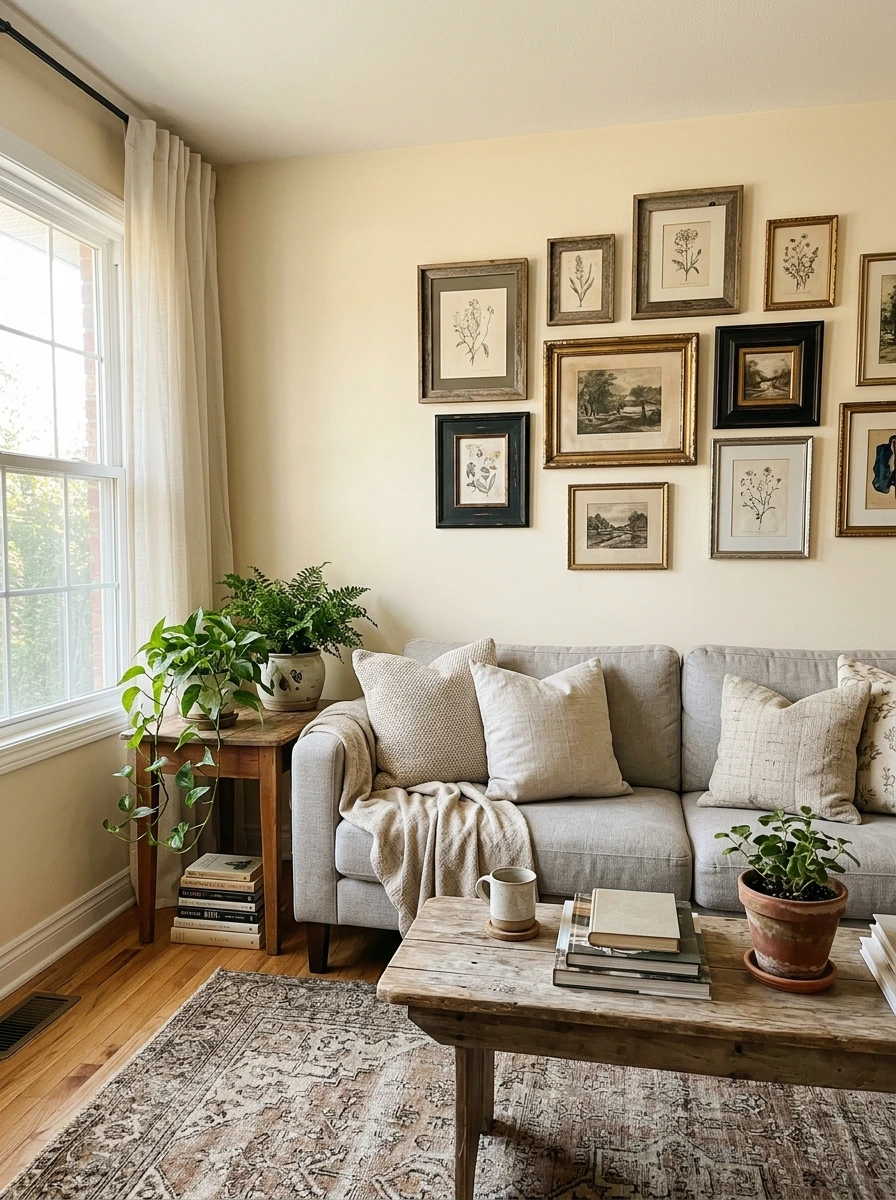
Warmth isn’t a spending decision, and some of the biggest palette shifts cost less than a restaurant dinner. Paint one wall or the back of a bookshelf in warm cream or soft clay, swap white cushion covers for oatmeal and rust at HomeGoods or Target, and trade a cool-toned print for a warm one in a thrifted frame. Spending on a new sofa before fixing wall color and textiles is the classic mistake, because the room still reads cold afterward. A cozy living room on a budget starts with the two or three colors you already own, so edit toward those before you add anything. The best dollar-for-dollar change is a quart of warm cream on the wall behind the sofa.
16. The Cold Living Room Rescue: What to Change First When the Palette Works Against You
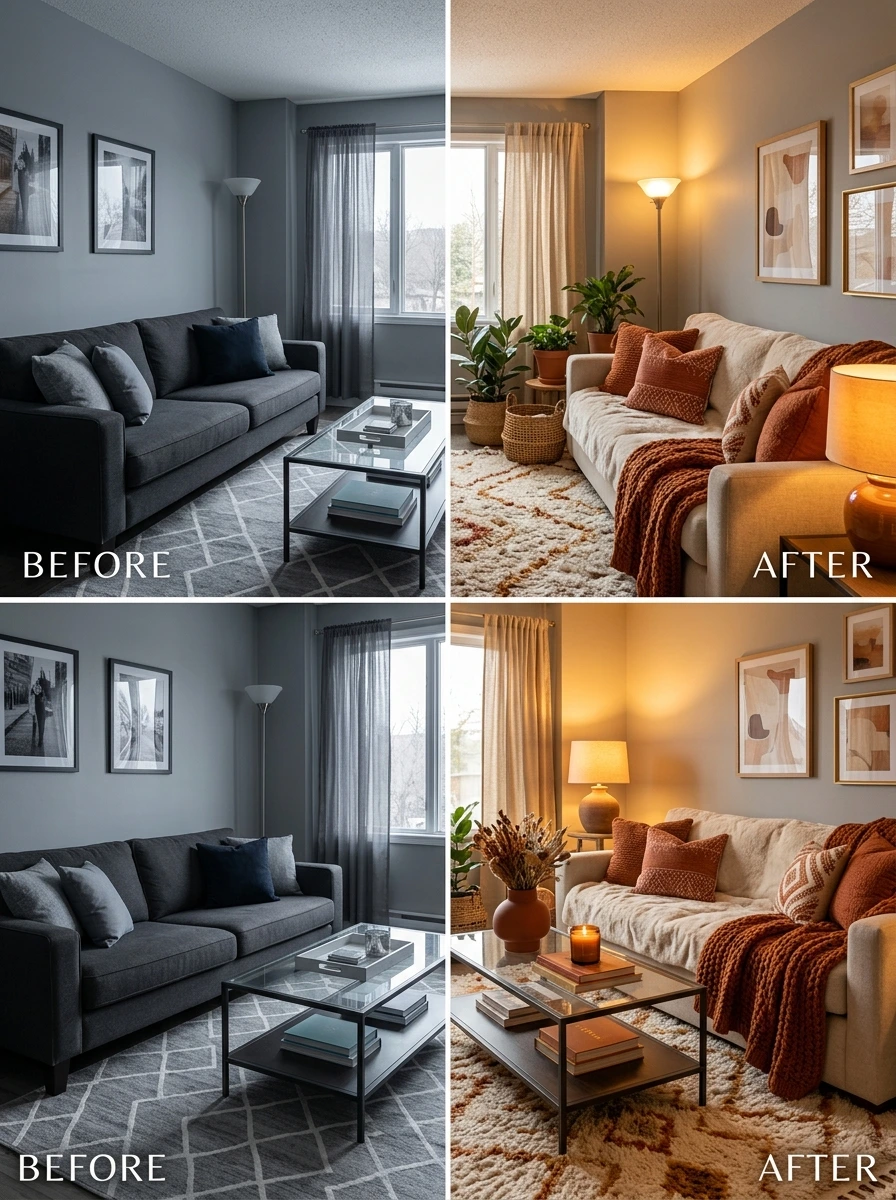
When a room’s bones are cool, you don’t need to repaint everything, you need to change what the eye lands on first. Start with textiles, then lighting, then wood, and finally one painted wall, adding warm cream, oatmeal, rust, and brass to balance the gray or white. Fighting a gray room with more gray pillows, or hiding it with stark white, only makes the chill more obvious. Cozy living room color ideas start with the existing floor, because its tone decides which warm shade will sit well. My honest note: warm up the lowest third of the room first with a rug, a throw, and a lamp, because that’s where people feel the temperature.
🎨 The Warm Living Room Color Guide: Undertones, Palettes and the Specific Shades That Actually Feel Warm
A warm living room color palette begins with undertone, and a warm neutral living room palette is built on a classic foundation, which our classic warm living room guide explores through the traditional elements that create genuine warmth in any American home.
WARM UNDERTONE NEUTRALS:
Benjamin Moore White Dove (OC-17): a soft, creamy white that stays gentle in north light.
Sherwin-Williams Alabaster (SW 7008): a quiet off-white with a buttery base that glows in lamplight.
Sherwin-Williams Accessible Beige (SW 7036): a balanced greige that reads warm without turning yellow.
Benjamin Moore Edgecomb Gray (HC-173): a warm gray that leans beige and works in rooms that insist on gray.
COOL NEUTRALS TO AVOID:
Blue-based concrete grays, which turn icy in evening light. Stark, bright builder white, which flattens wood and fabric. Silver or violet-leaning taupes, which look warm on a chip and cold on a wall.
THE WARM ACCENT:
Rust: use it on cushions and a throw for the most reliable warm note. Deep olive: use it in a plant pot, a chair, or a book cover to add depth without heat. Burnt ochre: use it in a lamp base, a vase, or a framed print as a small, glowing detail.
THE WARMTH TEST: Paint a two-foot square on two different walls and look at it at 8am, at noon, and again after the lamps are on. If it turns gray, pink, or flat at any point, reject it.
The decisions in this chapter cost nothing, which is why they’re the ones people skip. Most American living rooms are arranged for the television rather than for conversation, and that’s the first thing I’d change.
17. Why Moving the Sofa Three Feet Can Give Your Living Room Warmth You Can’t Buy
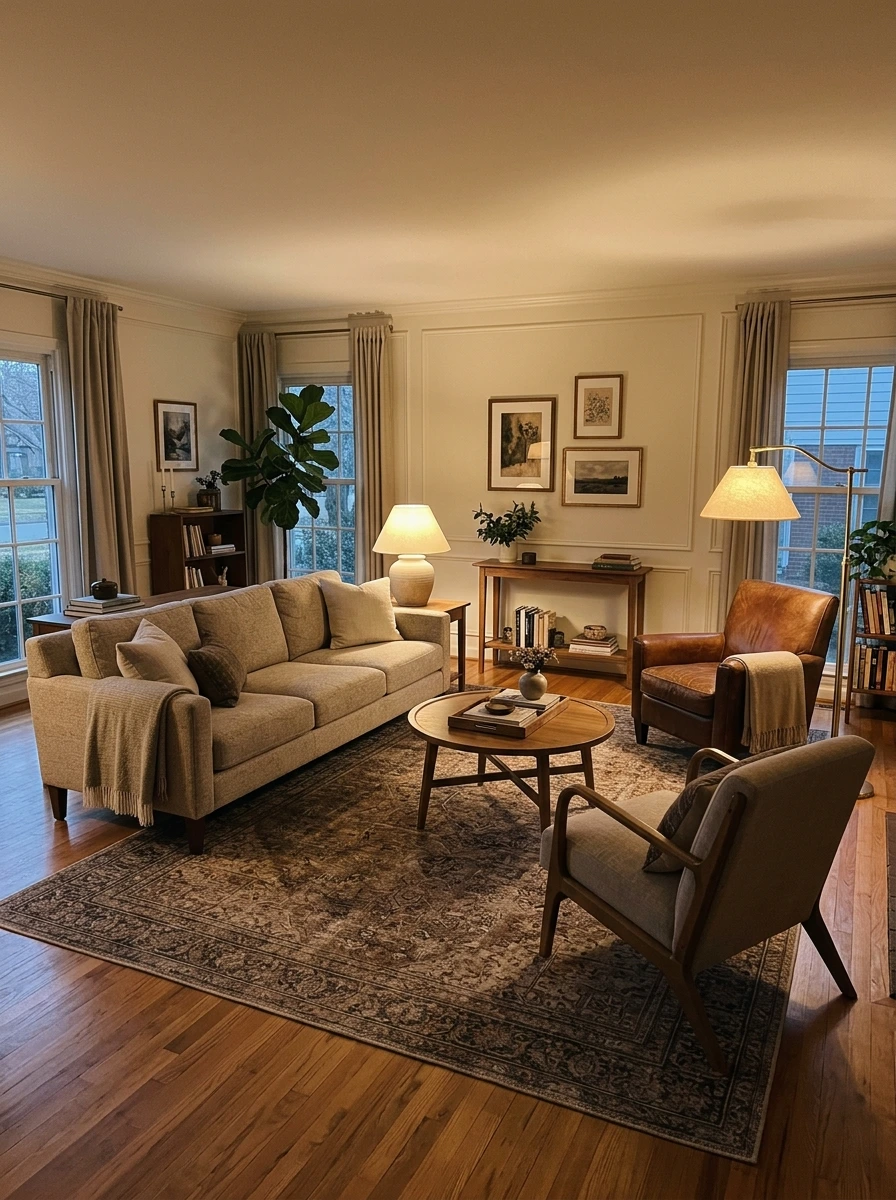
Furniture arrangement decides whether people face each other or the screen, and conversation distance is what makes a room feel warm. Pull the sofa away from the wall, angle two chairs toward it, and keep seating within eight to ten feet so nobody has to raise their voice. Pushing everything against the walls leaves a dead center and makes even a large room feel like a waiting area. In an open plan, a rug and a sofa with its back to the dining area carve out a warm living room open plan zone that wouldn’t otherwise exist. Try the new layout for a week, and put a lamp where the old gap was.
18. The Coffee Table Vignette That Makes a Surface Look Lived In
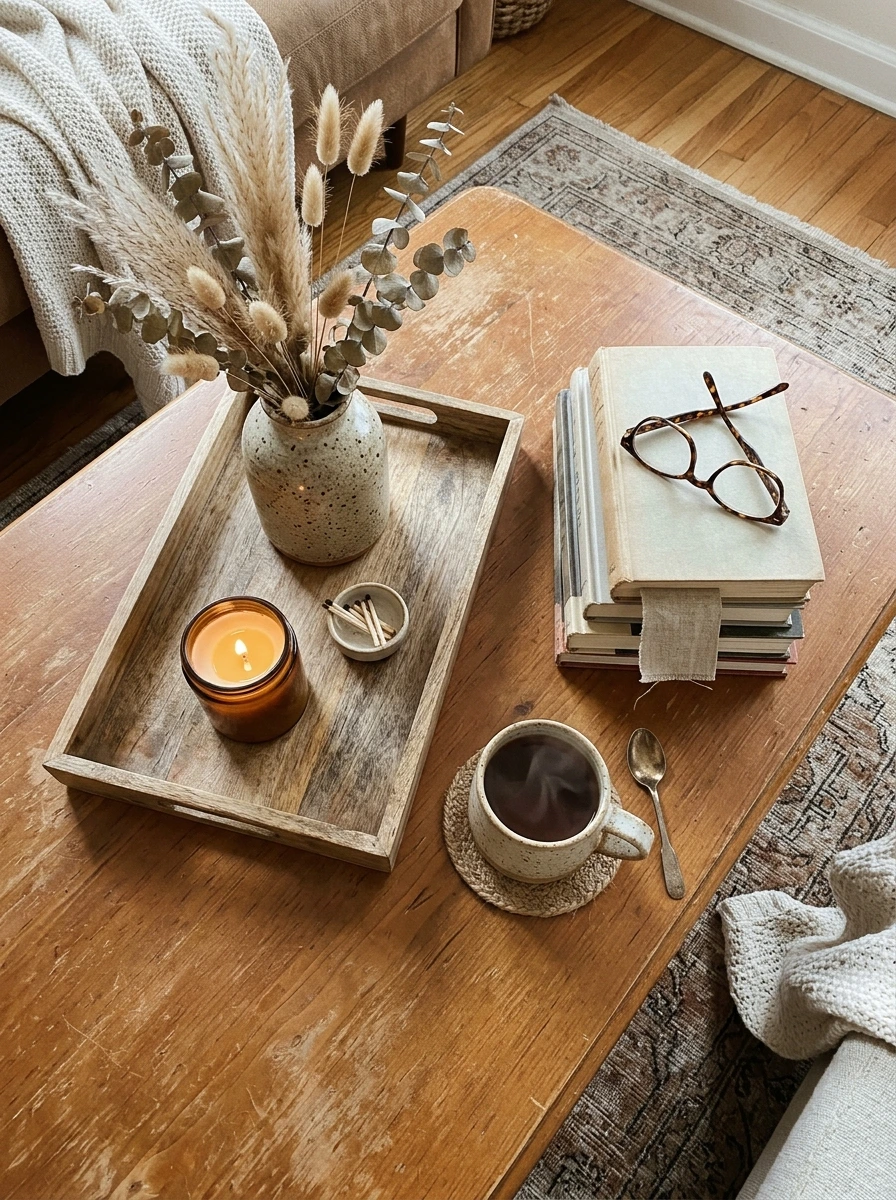
A coffee table is the most visible surface in the room, and its styling decides whether the whole space feels inhabited or staged. Anchor it with a tray, then add a stack of two or three books, a small vase of fresh or dried stems, and one tactile object such as a wooden bowl or candle, leaving half the surface clear for a mug. A table loaded with identical decorative objects, or left bare with only a remote, looks like a showroom or an afterthought. Every coffee table vignette that feels warm includes something with height, something with texture, and something alive. My honest note: leave room for a drink, because a table that can’t hold a mug will never be used.
19. The Bookshelf Mix That Makes a Warm Living Room Look Lived In
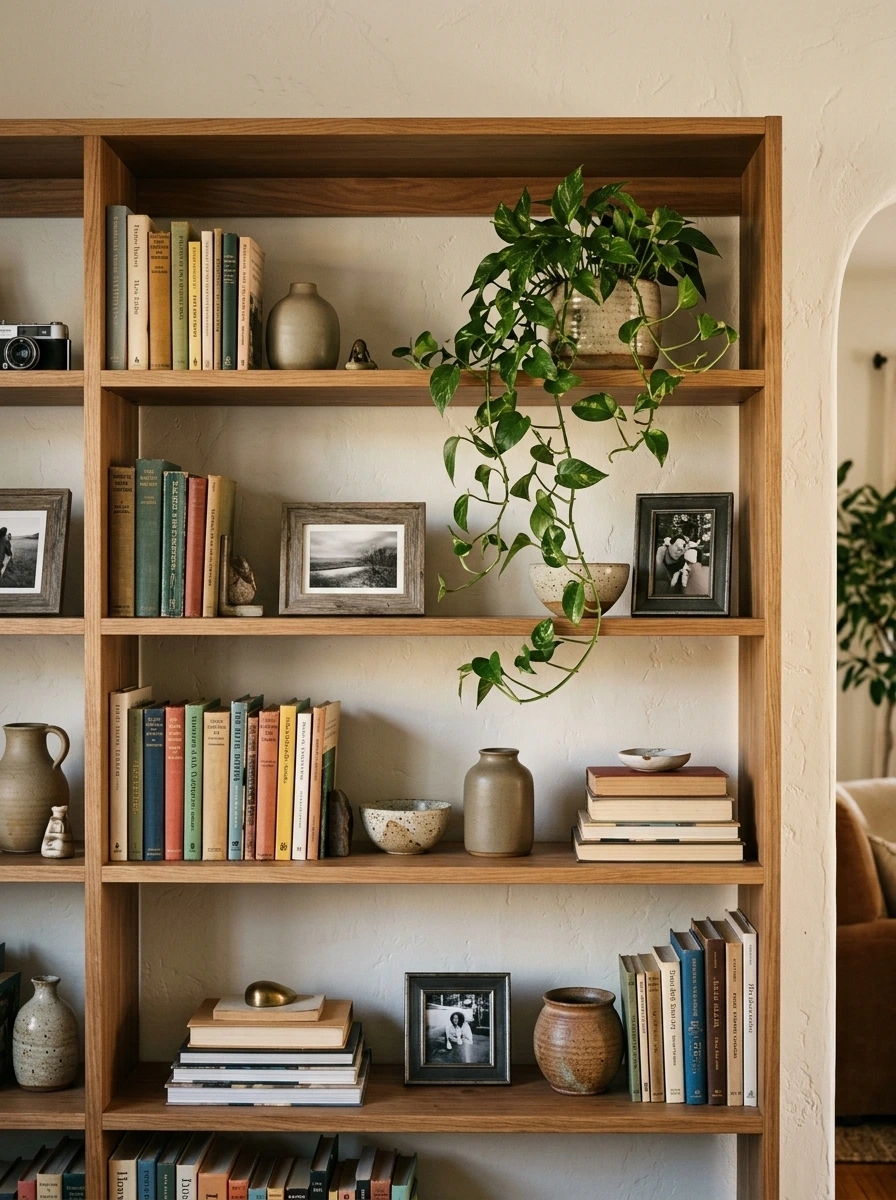
Bookshelves are a warmth surface, and the best ones read as a collection rather than a display. Mix books stacked horizontally and vertically with ceramics, framed photos, a candle, and a trailing plant, leaving about a third of each shelf as breathing room. Shelves arranged strictly by color, with every spine facing out and nothing else on them, look like a library showroom. A bookshelf in a cozy living room gets its character from personal objects, so use things you actually own, even small ones. The change that matters most is removing anything you bought only to fill space.
20. Plants Do More for a Living Room Than Most Decor, If You Place Them Well
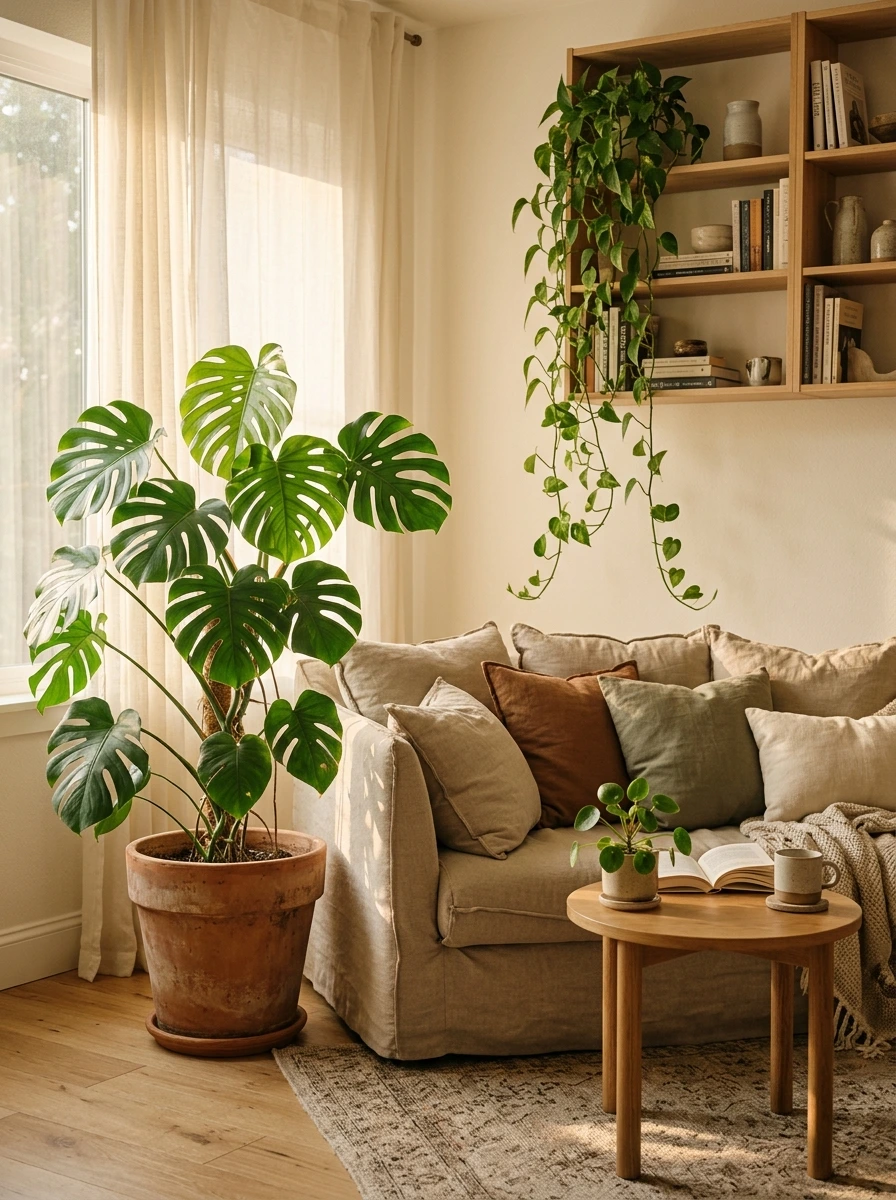
Plants bring life, softness, and a hint of the outdoors that nothing else replicates, and they warm a room without adding clutter. Group a large floor plant, a medium plant at seat level, and a small trailing one on a shelf, in terracotta or matte ceramic pots, and place them near a window or lamp. Plastic pots, dusty faux plants, or a single sad plant in a dark corner look neglected and push the mood toward cold. The best plants for a warm living room, such as pothos, rubber plant, and snake plant, tolerate low light and forgive you for forgetting them. If you only add one, make it a tall plant in a warm clay pot beside the sofa.
21. The Woven Basket and Natural Object System: Warmth Through Organic Materials
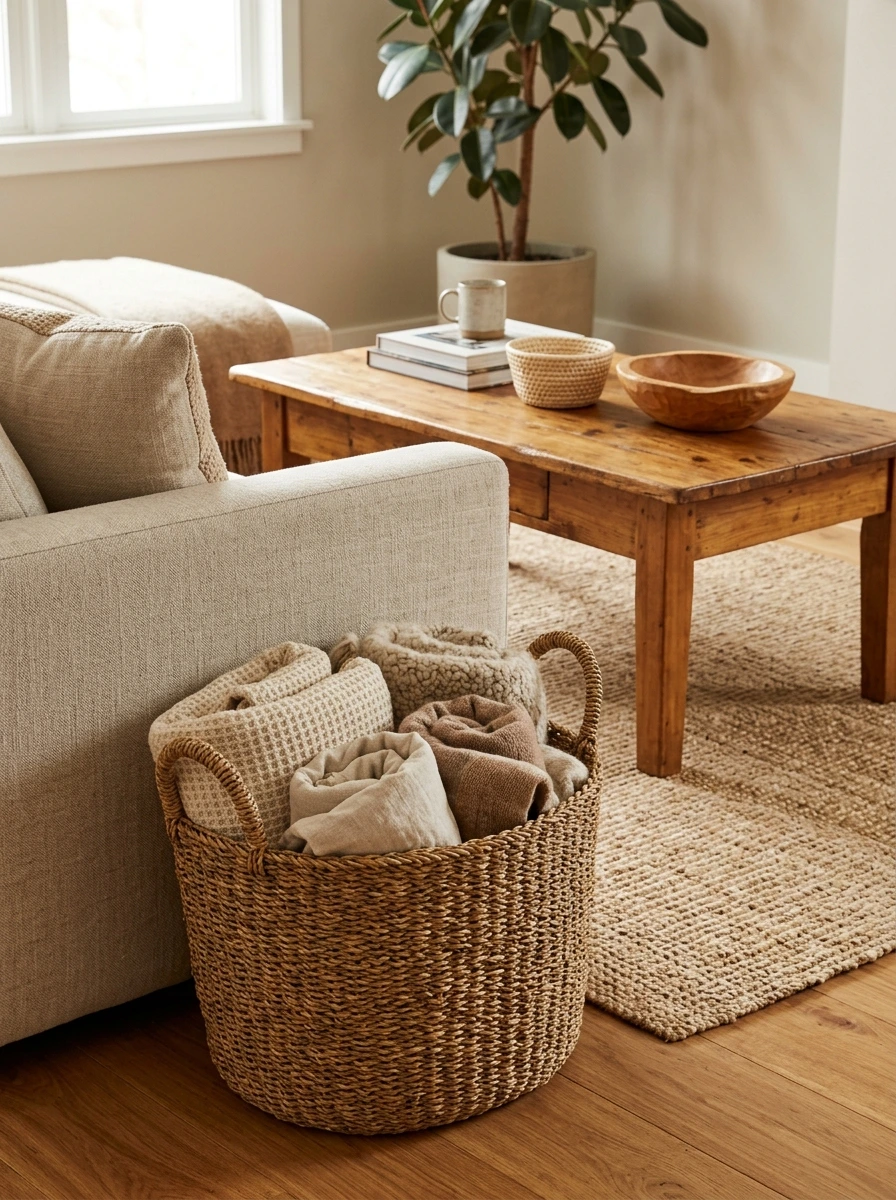
Organic materials such as rattan, seagrass, jute, and wood add warmth through texture, and baskets are the easiest way to bring them in. Use one large basket for throws beside the sofa, a medium one for magazines or remotes, and a small tray or bowl on the coffee table, all in the same honey or natural tone from IKEA, Target, or HomeGoods. Mixing too many weaves and finishes, or choosing plastic imitations, makes the effect look cheap and cluttered. A woven basket living room decor approach also hides everyday clutter, which keeps the warmth from turning into mess. The one change that matters most is a big basket for blankets, because it makes the throw feel intentional.
The Warmth Edit Detail: Natural, Repeated, Hidden
◎ Choose seagrass, jute, or rattan in a honey tone with sturdy handles.
◎ Use three baskets in different sizes: one on the floor, one on a table, one on a shelf.
◎ Avoid plastic wicker and glossy dyed finishes that look like an afterthought.
◎ Budget alternative: thrifted baskets or IKEA seagrass options give the same organic warmth.
🏡 The Living Room Warmth Audit: 10 Changes Ranked From Most Impactful to Least (Do Them in Order)
These are the cozy living room decor ideas I’d do in this order, and each one is one of the living room warmth ideas with the best return for its effort.
WARMTH IMPACT RANK 1 (do this first): Turn off the overhead light and add two lamps with 2700K bulbs. Light changes how every other thing in the room reads, so nothing else has a higher return.
RANK 2: Put the remaining lights on a dimmer or use smart bulbs. It gives you control over the mood for almost no money.
RANK 3: Upgrade to a larger wool rug. It anchors the seating and warms the floor, where most of the room’s chill lives.
RANK 4: Add two throws and three or five layered cushions at seat height. This is the fastest way to make the sofa invite people.
RANK 5: Rearrange the seating into a conversation group. It costs nothing and changes how the room is used.
RANKS 6 TO 10:
Hang curtains high and long: it makes the ceiling and windows feel generous.
Repeat warm wood in three places: it adds depth and unity.
Light a candle cluster every evening: it adds flicker and ritual.
Place plants at three heights: they add life and softness.
Style the coffee table with a tray, books, and something alive: it makes the surface feel inhabited.
Once those are in place, the room is ready to follow the seasons, and our fall living room warmth guide shows exactly how to layer seasonal warmth into a space that is already built for comfort.
By now every layer has a job, and this last chapter is about making them work as one room rather than a list of fixes. The rooms that pull it off aren’t the most decorated, they simply have a destination, a scale that fits, and no leftover cold spots.
22. The Reading Nook That Makes an Inviting Living Room Feel Like More Than One Space
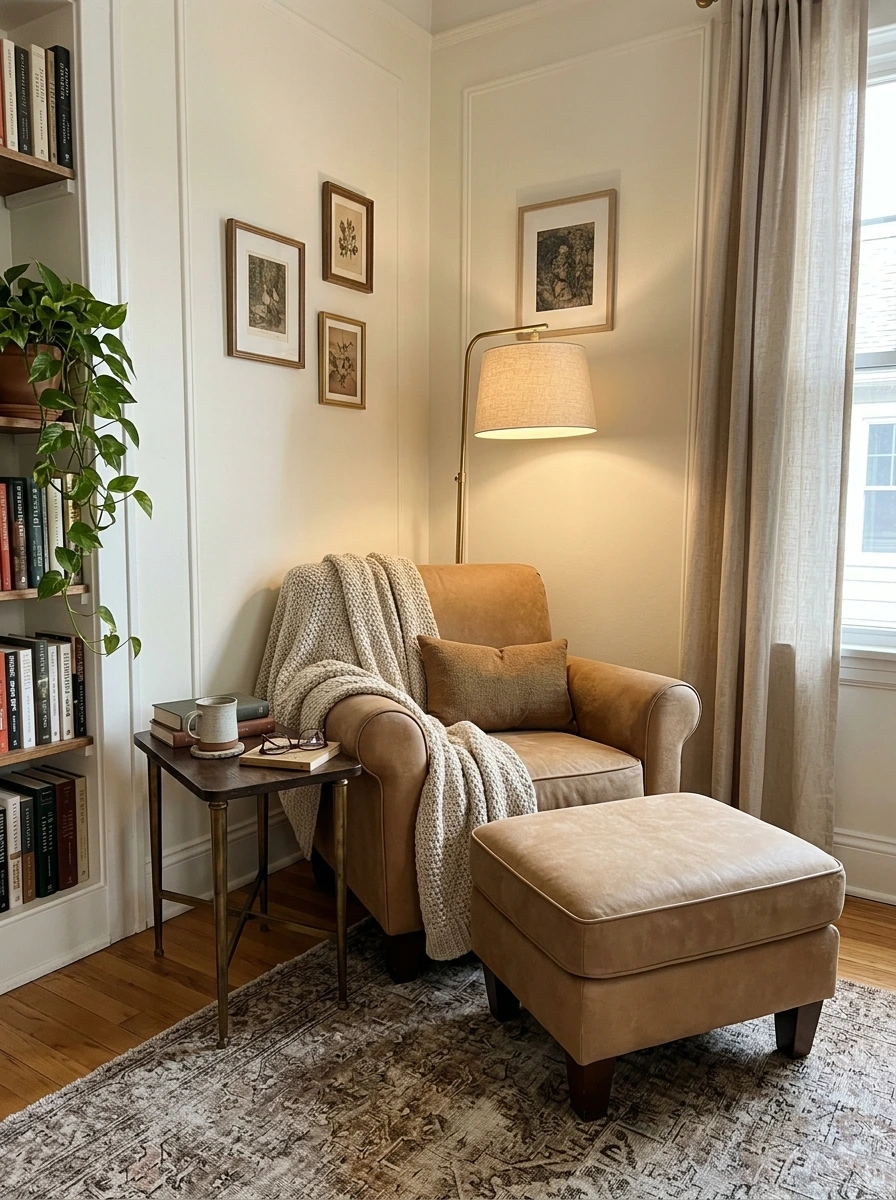
A reading nook gives a living room a destination other than the television, and that single addition makes the whole space feel like two. Tuck a comfortable chair with an ottoman into a corner or beside a window, then add a small side table, a floor lamp at shoulder height, and one throw within reach. A chair with no light, no table, and nothing to rest a cup on becomes a place to pile laundry. A reading nook cozy living room corner works best when the chair angles toward the room rather than the wall, so you stay part of the evening. The best part is that it needs only about four feet by four feet, which almost every American living room can spare.
23. Cozy Small Living Room Ideas: Warmth When Every Square Foot Matters
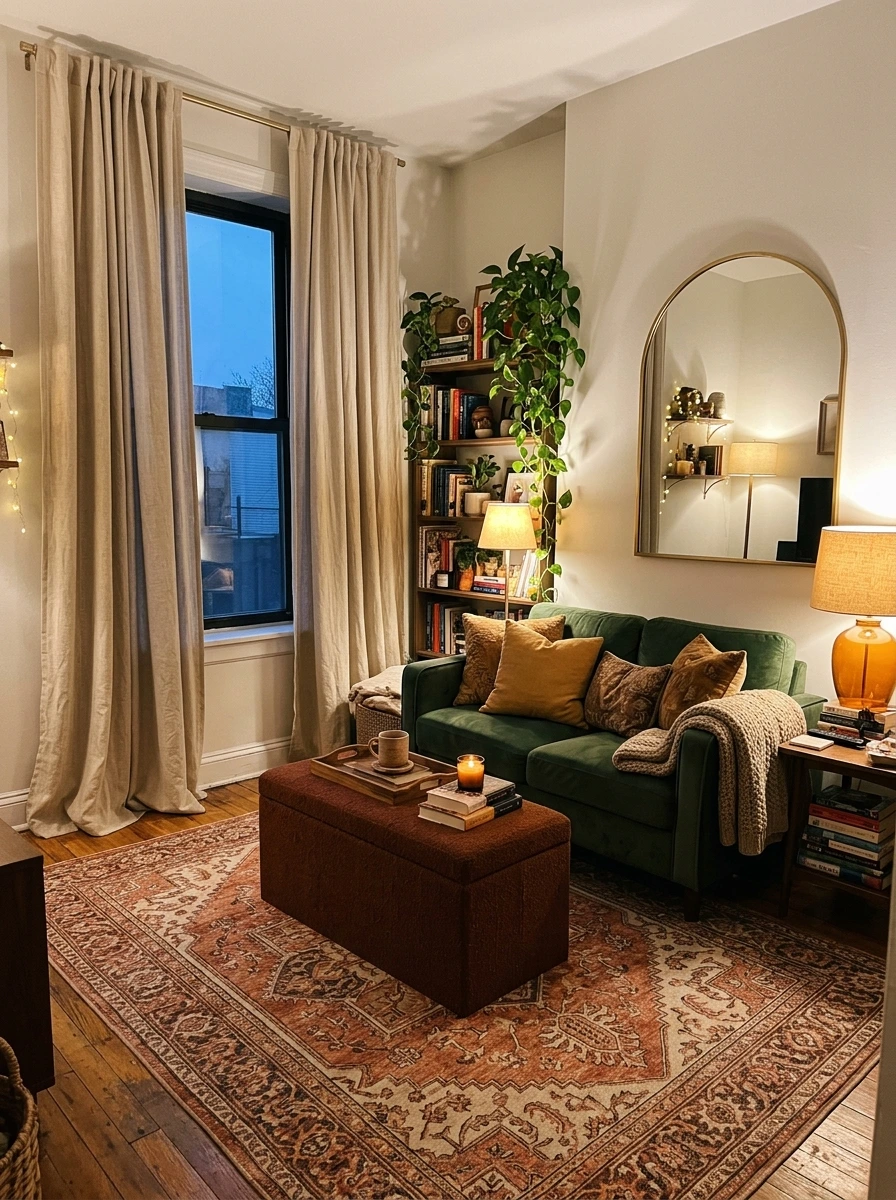
Small rooms hold warmth well when they’re edited, because less space means fewer surfaces and faster layers. Choose a rug that anchors the seating, a storage ottoman that doubles as a table, curtains hung high, and a mirror or art placed to bounce lamplight, keeping furniture few but substantial. Filling a small room with many tiny pieces, or lining everything against the walls, leaves it feeling both cramped and cold. In a cozy living room apartment, where the room also serves as dining and work area, vertical lighting and one large rug do most of the work. My honest note: remove one piece of furniture and add one lamp before you buy anything new.
24. The Complete Warm Living Room: Cozy Living Room Decor Ideas Working in One Room
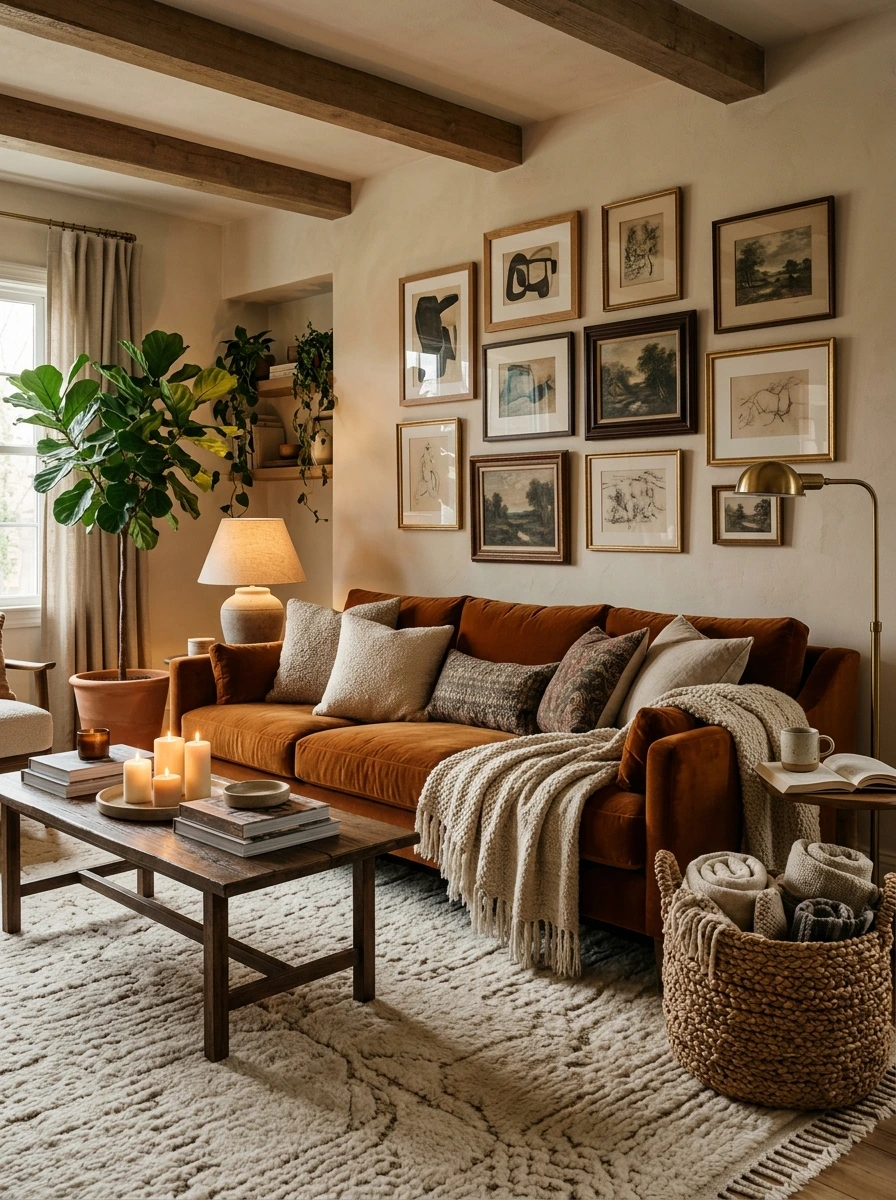
A complete warm living room isn’t a showpiece, it’s one where every edit points the same way. Picture a large wool rug, a velvet or linen sofa in caramel or oat, a rust cushion, two throws, three lamps glowing at 2700K, candles on a tray, a wooden table, a basket, a plant, and a gallery wall of personal frames. The version that fails has all of those things in matching sets, placed with perfect symmetry and no sign of life. A gallery wall for a cozy living room comes from mixing frame finishes and leaving the spacing a little uneven. The honest note: don’t try to do all of it in a weekend, add one layer a week and live in each one.
Living Room Warmth Questions, From the Home Warmth Specialist
How do I make my living room feel more cozy?
The most reliable cozy living room decor ideas add softness and low light: a large rug, two throws, three or five cushions, and lamps instead of the overhead. Warm living room decor depends on layers at seat height, so start where people actually sit. Swap cool bulbs for 2700K and let the room look used. These three changes usually do more than any new purchase.
What colors make a living room feel warm and cozy?
Cozy living room color ideas start with creams, oatmeal, soft greige, and buttery whites, with rust, olive, and ochre as accents. A warm living room color palette shares one undertone across walls, wood, and textiles, so everything feels related. Cool grays and stark whites pull the room the other way. Always test samples in your own light before you paint.
How do I add warmth to a living room on a budget?
A cozy living room on a budget begins with what costs least: bulbs, throws, cushion covers, and rearranged furniture. Paint one wall in warm cream, and thrift a wooden side table or frame. HomeGoods, Target, and IKEA fill in the rest. These are the cozy living room decor ideas that return the most warmth per dollar.
What lighting makes a living room feel cozy?
Cozy living room lighting ideas always involve several low sources instead of one bright one. Build warm lighting living room layers with a floor lamp, a table lamp, and candles, all at 2700K or lower. Put the ceiling light on a dimmer or leave it off. The glow should be pooled, not flat.
What is the best sofa color for a warm cozy living room?
Cozy living room furniture ideas favor sofas in oat, caramel, cream, soft olive, or warm camel, in a textured fabric such as bouclé, linen, or velvet. A warm and cozy living room can handle a deep color too, as long as the undertone is warm. Cool-based gray is the one to approach carefully. For the structural choices that support any sofa, our living room design guide covers the layout and design decisions that make every warmth-building layer work more effectively.
What rugs make a living room feel warm?
Wool or wool-blend rugs in warm ivory, oat, or rust add the most warmth, with enough pile to feel soft but not so much that furniture wobbles. An area rug cozy living room setup should be big enough for the front legs of every seating piece, usually 8×10 or larger. Cozy living room decor ideas always start from the floor. Avoid thin, cool-toned flatweaves that leave the edges bare.
How many throw pillows should a cozy living room have?
Three on a standard sofa and five on a sectional suits most cozy living room aesthetic goals, with a mix of velvet, linen, and one textured piece. Inviting living room decor needs variety in size and fabric, not matching pairs. Add a lumbar in front. Keep the inserts full so the cushions slump softly.
How do I make a small living room feel warm and cozy?
Cozy small living room ideas rely on editing: a big rug, high-hung curtains, and lamps at several heights. Cozy living room decor ideas for small spaces favor a few substantial pieces over many tiny ones. Bounce lamplight with a mirror or art, and let the coffee table work hard. For surfaces that add warmth without crowding, our table warmth styling guide covers the exact vignette approach that makes any surface feel genuinely inhabited.
What plants make a living room feel warm?
Warm living room decor gets a lot from plants, and the best plants for a warm living room, like pothos, rubber plant, and snake plant, forgive low light. Group them at different heights in terracotta or matte ceramic pots. Place them near a window or lamp so they glow. Avoid plastic pots and dusty faux ones.
What is the most impactful change I can make to a cold living room?
Cozy living room decor ideas rank lighting first: turn off the overhead, add two lamps with 2700K bulbs, and add a dimmer. Inviting living room ideas then layer on a bigger rug and two throws. The warmest traditional American rooms follow this pattern of layered texture, and our heritage warmth inspiration guide shows how that specific vocabulary of warmth works in any American home. Do these three and the room changes tonight.
The Warmth Settles
The best cozy living room decor ideas share one quality: every decision was made for how the room feels, not how it looks. The warmest rooms I’ve walked into weren’t the most decorated. They had a throw within reach, a lamp at shoulder height, and a reason to stay after dinner. Any American living room can have them.
A warm living room is the heart of a home that knows how to hold people. The Muse Vale has the living room, home decor, and interior guides to help you build every warm space from the ground up.
Come back to The Muse Vale whenever your living room needs a new warmth edit; we will have the cozy living room decor ideas, styling guides, and home warmth inspiration ready for every room and every season.