

Vision board ideas are everywhere, from the vision board party that follows the new-year reset to the endless Pinterest vision board inspiration saved and never opened again. Most of those boards fail for a reason that has nothing to do with commitment. They get built before the clarity that makes any goal real has been reached. A vision board is not a wishlist. It is a clarity document, and this guide teaches the method that makes it work.
Across 25 entries, you’ll move through the foundation, the goal categories, the build, the practice that follows, and the variations for every budget and season of life. You’ll learn how to make a vision board that names specific goals, pairs each one with a decision, and gets reviewed instead of ignored. Whether you’re working with a cork board, a Canva vision board template, or a stack of magazines for cutting, the method stays the same. Your goals need to be specific enough to act on before your board can help you act on them.
Before You Cut a Single Image: The 5 Clarity Questions Every Vision Board Needs Answered First
Whether you’re collecting vision board ideas for the first time or rebuilding an old board, these five questions decide how to make a vision board that holds up. Answer them on paper, in your own words, before you open a magazine or a design app.
◈ WHAT DOES YOUR LIFE LOOK LIKE IN THREE YEARS IF EVERYTHING GOES RIGHT?
If you can answer this clearly: you have the spine of your board, and every image can be measured against that picture.
If you cannot answer this yet: write for ten minutes without editing, then underline the three sentences that made you sit up. Those are your starting point.
◈ WHICH ONE AREA OF YOUR LIFE NEEDS THE MOST INTENTIONAL ATTENTION RIGHT NOW?
If you can answer this clearly: that area gets the largest section of your board, and the rest of your vision board categories ideas can stay smaller.
If you cannot answer this yet: rate each life area from one to ten and start with the lowest score, not the one you find easiest to picture.
◈ WHAT ARE YOU AFRAID TO PUT ON A BOARD BECAUSE IT FEELS TOO AMBITIOUS?
If you can answer this clearly: that goal belongs on your board, probably near the center, because the fear is telling you it matters.
If you cannot answer this yet: finish the sentence “I’d never say out loud that I want…” and give yourself one honest minute.
◈ WHAT DOES SUCCESS FEEL LIKE, NOT LOOK LIKE, IN YOUR MOST IMPORTANT GOAL?
If you can answer this clearly: you can choose feeling images that reinforce the goal instead of decorating it, which sharpens every one of your vision board goals ideas.
If you cannot answer this yet: picture an ordinary Tuesday after the goal is met and write down what you notice in your body and your schedule.
◈ WHO NEEDS TO SEE YOUR BOARD AND WHO DEFINITELY DOES NOT?
If you can answer this clearly: you know whether your board lives on a bedroom wall, in a private folder, or in front of an accountability partner.
If you cannot answer this yet: keep the board private until it’s finished, then decide who gets a look.
CLARITY CHAPTER 01: THE FOUNDATION
What Goes on the Board Before Anything Else and Why Most Women Skip It
Every board I’ve seen fall apart had the same flaw: it began with images instead of decisions. The women who build boards that work spend their first hour on paper, and it shows in everything that follows.
1. Build This Sentence Before You Touch the Aesthetics and Watch What Happens
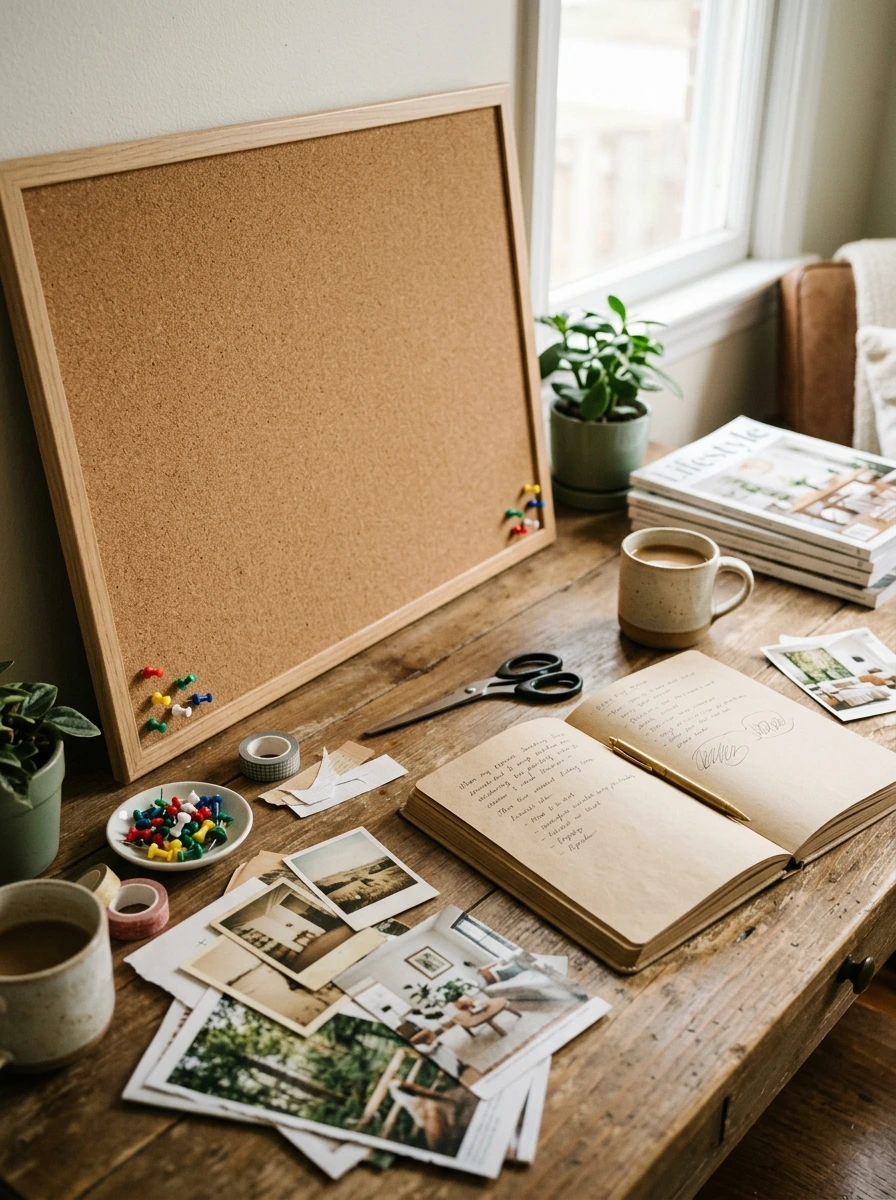
The clarity statement is one sentence, written before you choose a single image, that says what you’re building and by when. Write it in plain words, something like “In three years I run my own design studio with two steady clients and a four-day week,” and keep it visible while you work. Skip it and you’ll grab whatever photos feel nice, and the board becomes a mood collage that points nowhere in particular. The strongest vision board goals ideas start as a sentence you could say aloud to a friend without flinching. Women who write this sentence first almost always discard half the images they planned to use, and the board gets sharper for it.
2. The 7 Life Areas Every Complete Vision Board Should Address
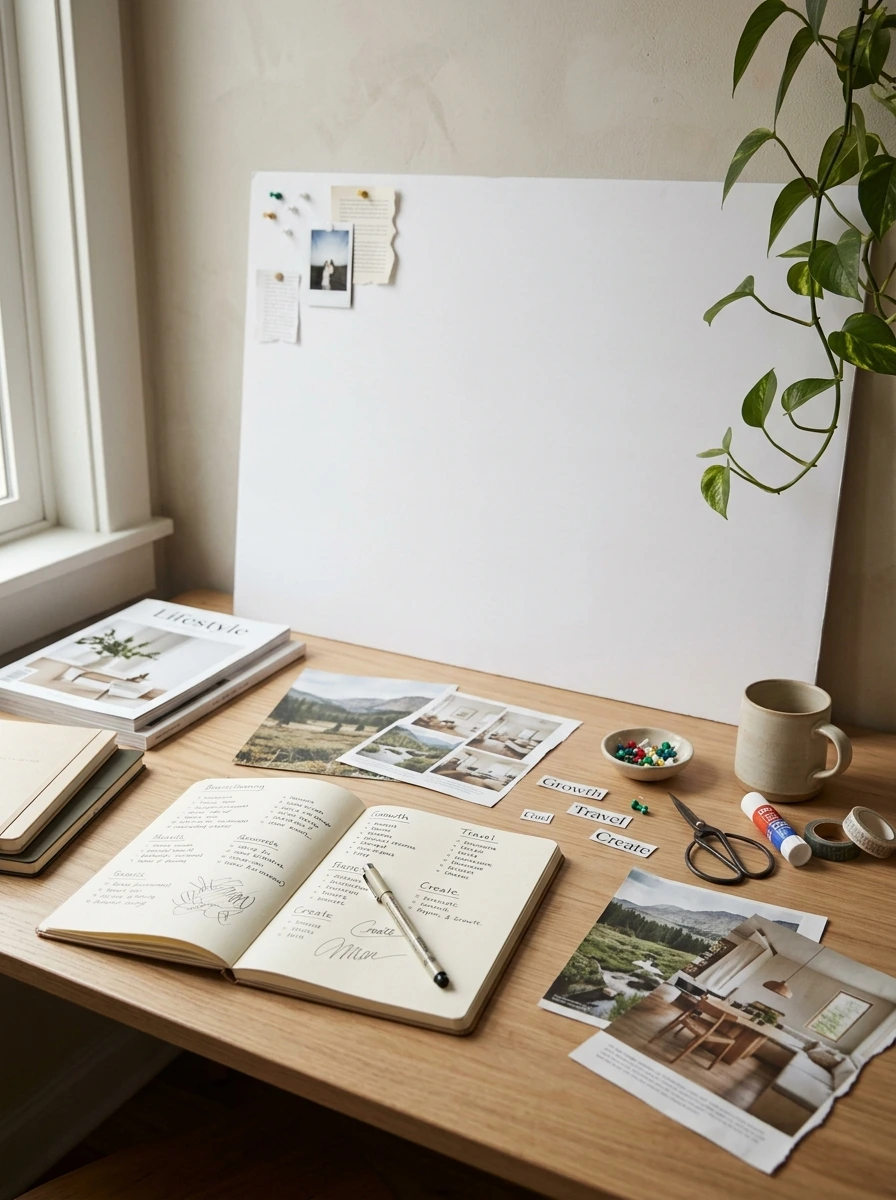
A complete board covers seven areas: career, health, relationships, finances, personal growth, home and environment, and experiences. Give each area its own zone, even if some zones stay small, so you can see at a glance which parts of your life are getting intention and which are being left to chance. When a board only covers the exciting areas, the neglected ones quietly pull against the rest, and a big career goal collides with a calendar that has no room for it. Good vision board categories ideas work like a balance sheet, showing you where your attention is actually going. Most women discover that one empty category explains a frustration they’ve been circling for months.
The Coach’s Clarity Note: Name Every Area
◈ Which of the seven areas can I describe in one specific sentence, and which can I only describe in a vague feeling?
◈ Divide your board into labeled zones first, even lightly in pencil, so no area gets crowded out later.
◈ Most women let the loudest goal take the whole board and leave the quieter areas unrepresented.
◈ Women who build boards that work give every area at least one image, even when that area is the hardest to picture.
3. The Vision Board That Works Is Not the One That Looks Best, It Is the One That Makes You a Little Uncomfortable to Look At
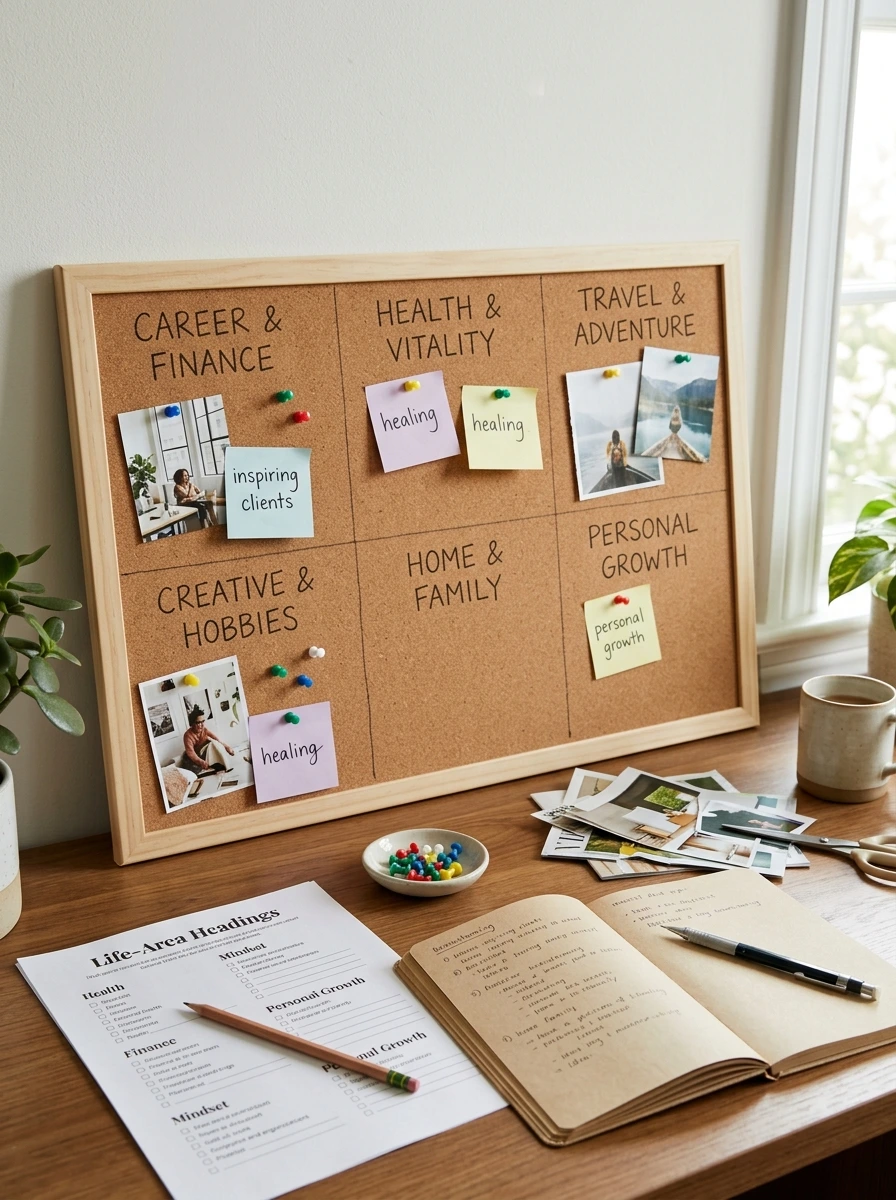
The uncomfortable goal section holds the one aim you’ve been keeping off your board because it feels too big, too expensive, or too visible. Give it real space and a specific image, then write the first small action beside it on a sticky note. If you avoid it, your board turns into a collection of safe goals you would have reached anyway, and nothing on it asks anything of you. A board that only reflects what’s already comfortable isn’t doing the job a clarity tool exists to do. In my experience, the goal women hesitate to cut out is almost always the one they’re most ready to pursue.
4. How You Want to Feel Belongs on the Board Next to What You Want to Have
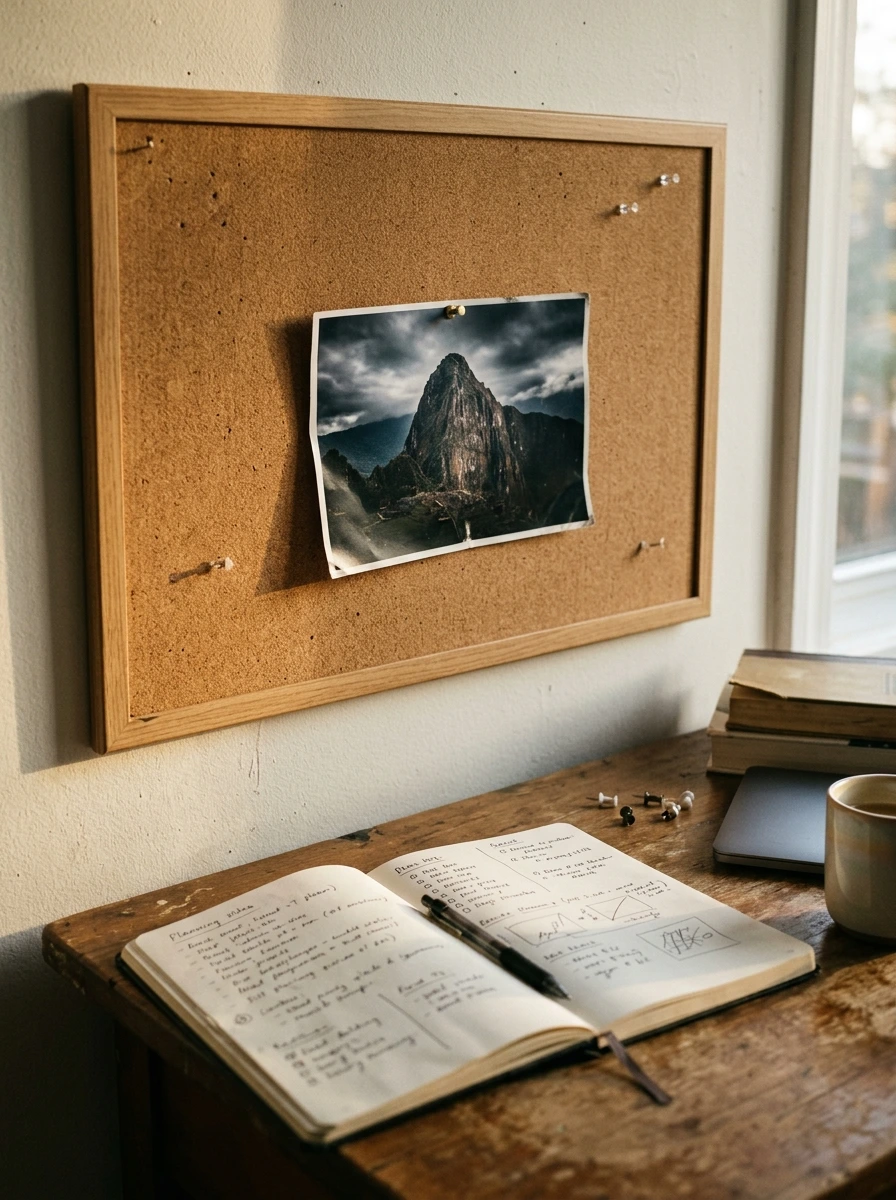
The feeling section captures the daily experience you’re building toward, such as calm mornings, financial breathing room, or work that energizes instead of drains. Pick one or two images that show a feeling without showing a product, like an open window, a clear desk, or a long dinner table. Without it, you can collect every item on your list and still end up in a life that feels tense, because nobody told the board what the goal was for. One useful vision board affirmation idea is to write the feeling as a short present-tense phrase and tape it beneath the image. Women who add this section tend to make better choices about which goals to pursue first, because they can tell which ones actually deliver the feeling.
5. One Year or Three: The Timeframe Changes Every Image You Choose
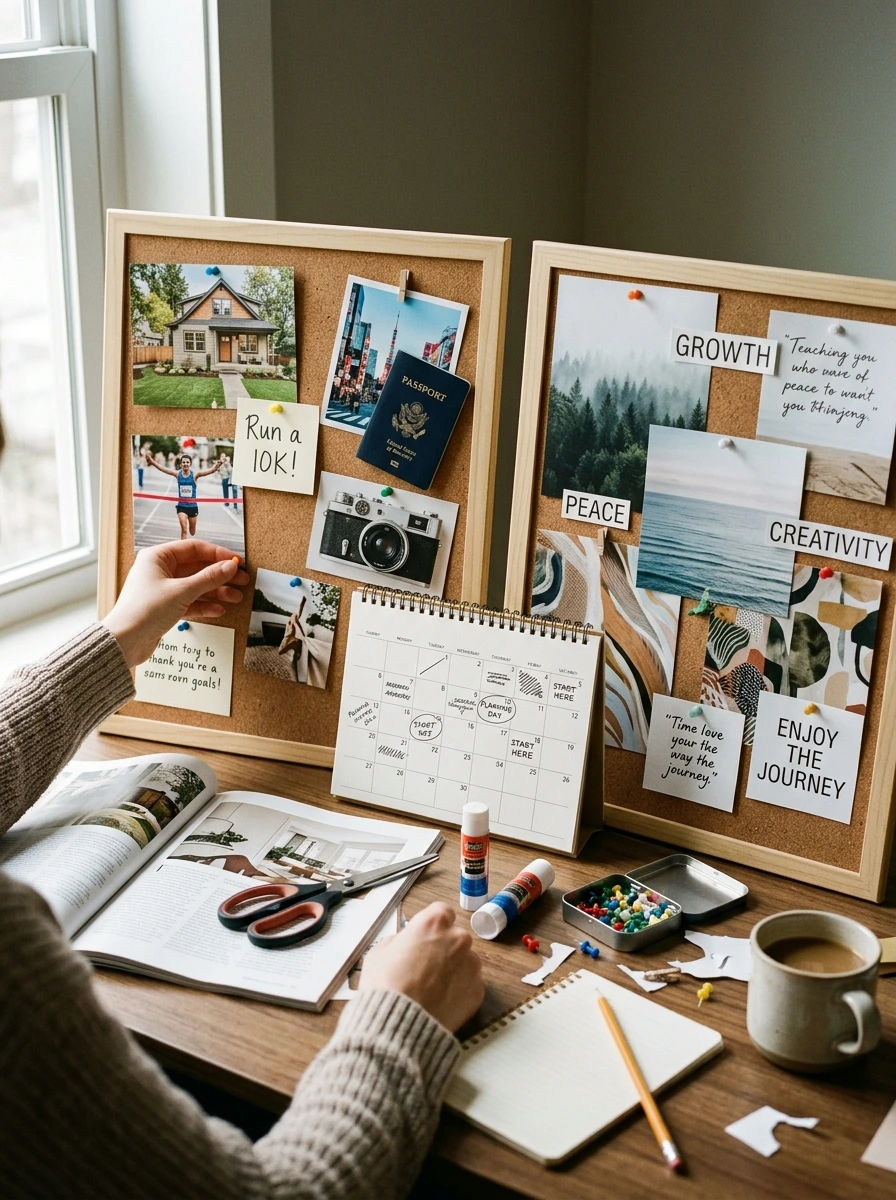
A one-year board is made of specifics, like a named certification, a savings figure, or a trip with dates, while a three-year board points toward a direction with a few concrete markers. Decide which you’re building before you gather images, because the same photo can mean very different things at each distance. When the timeframe stays blurry, the images drift between “next month” and “someday,” and your board loses its urgency. The Sunday planning session is a natural place to set this, with your calendar open and a pen in hand. Most women find that a one-year board gets reviewed more often, and a three-year board gets rebuilt more wisely.
📋 The Vision Board Foundation Worksheet: Answer These Before You Open a Single Magazine
The best vision board ideas start on paper, and our clarity journaling guide has the writing prompts that help any woman get honest about what she actually wants before she cuts a single image. Use these seven questions to set up your vision board categories ideas.
LIFE AREA 1: CAREER: What would you be doing in three years if you stopped waiting for permission?
LIFE AREA 2: HEALTH: What does your body need to do for you that it can’t do easily right now?
LIFE AREA 3: RELATIONSHIPS: Which relationship deserves more of your time, and what would that time look like?
LIFE AREA 4: FINANCES: What specific number would make your life feel meaningfully more secure?
LIFE AREA 5: PERSONAL GROWTH: What skill or habit would change your daily life if you had it a year from now?
LIFE AREA 6: HOME AND ENVIRONMENT: What one change to your living space would most improve how you start and end your day?
LIFE AREA 7: EXPERIENCES: What’s one experience you keep postponing, and what is it costing you to postpone it?
THE RULE: If you can’t answer an area yet, leave its zone empty and labeled on your board instead of filling it with filler images.
CLARITY CHAPTER 02: THE CATEGORIES
The Specific Vision Board Sections That Make Goals Stop Feeling Abstract
Categories are where a board stops being a feeling and starts being a plan. This is also where I see the biggest gap between boards that get used and boards that get admired for a week.
6. Career Vision Board Ideas for Changers, Founders, and Women Going for the Promotion
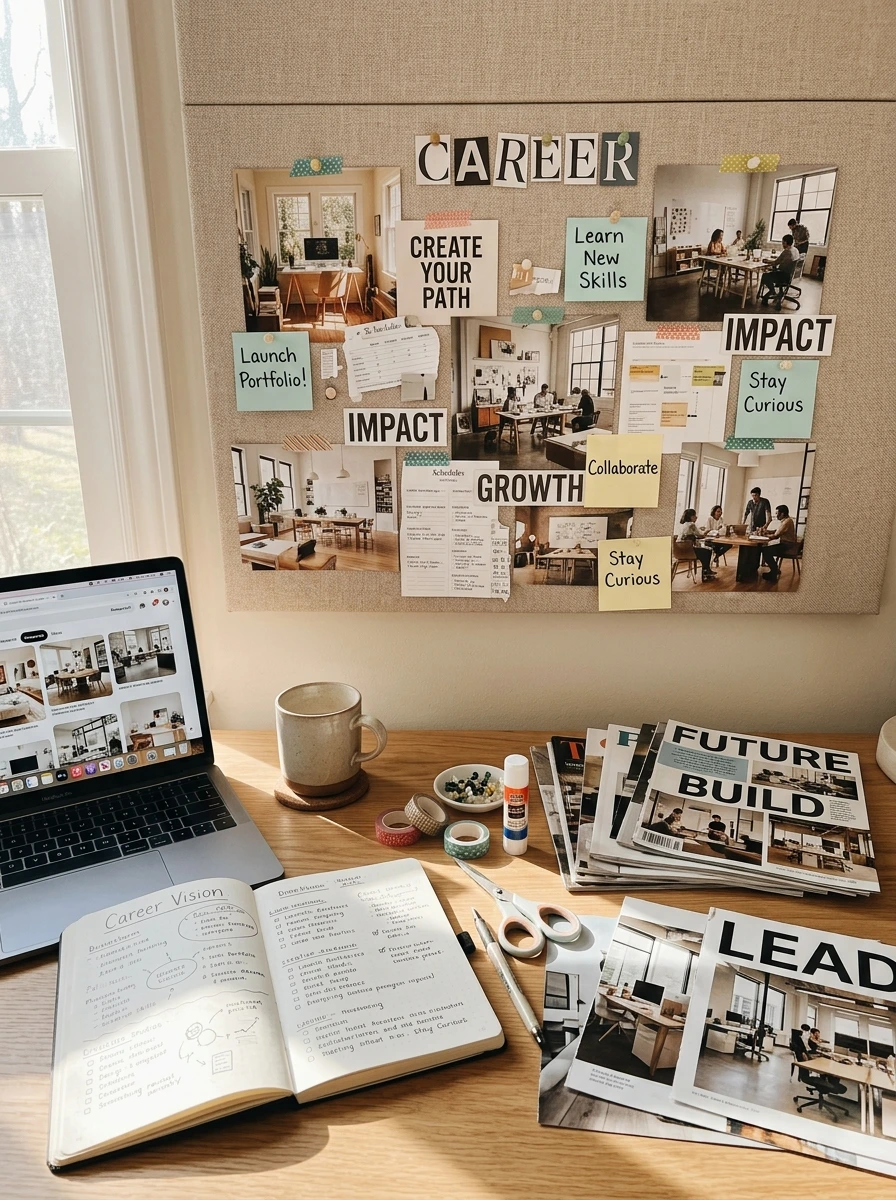
A career section works when it names a role, a workplace, or a revenue goal instead of showing a generic desk and laptop. Career changers should include an image of the new field’s actual environment, founders should include a milestone like a first client or product launch, and women seeking promotion should include the title itself. Without that specificity, the section turns into stock-photo ambition that doesn’t connect to any decision on your calendar. Career vision board ideas work best when each image is paired with a next step you can take this week, such as an informational interview or a portfolio update. I’ve watched a vision board for career change turn into a real pivot simply because the woman wrote the target job title in large letters at the center.
7. Health Goals on Your Board Without Making Them About Your Body
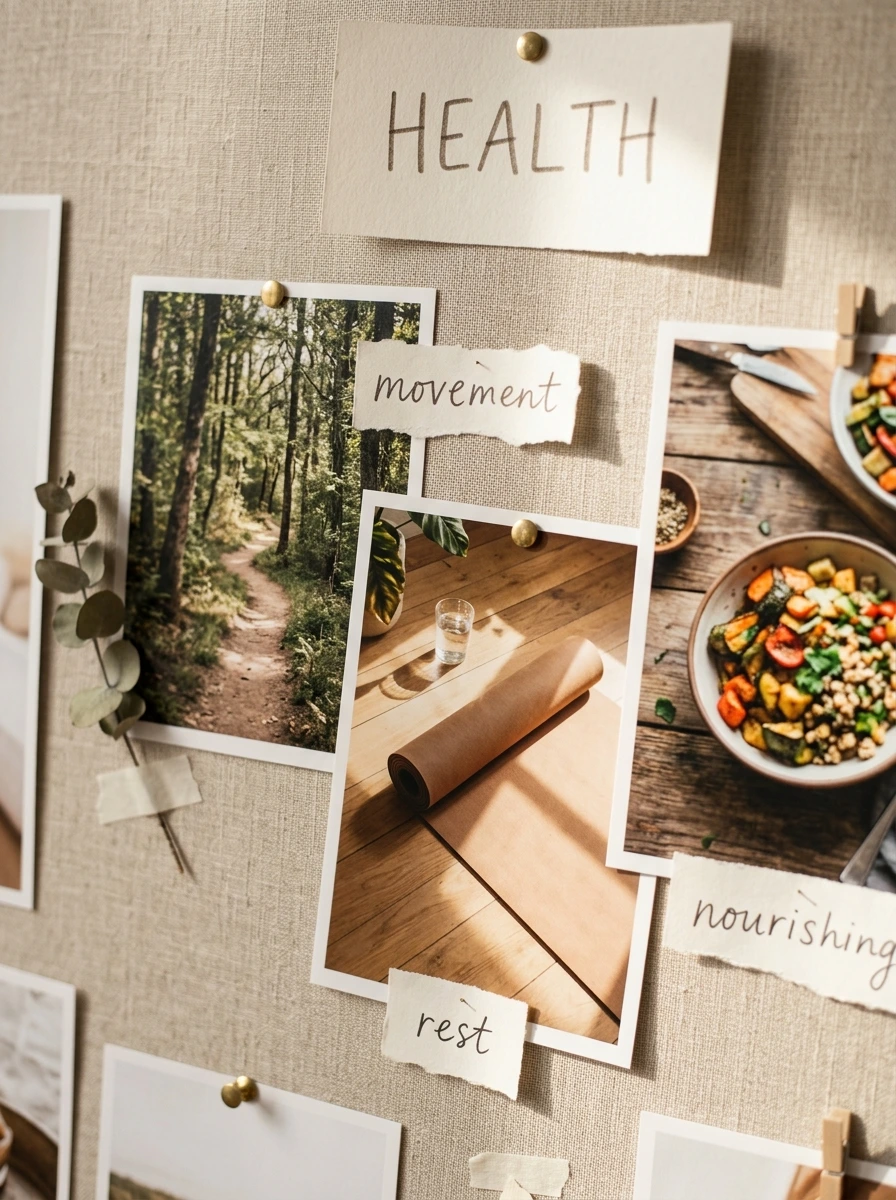
A health section is stronger when it shows what you want your body to do, such as hiking a trail, lifting a grandchild, or sleeping through the night, instead of how you want it to look. Choose images of movement, rest, and nourishment that connect to a daily routine you can actually keep. When the section focuses on appearance, the board tends to produce guilt instead of direction, and women often stop looking at it within weeks. For health vision board ideas, pair each image with one recurring habit, like a Tuesday morning walk or a weekly meal prep session. The women who make progress here are the ones who choose a routine they enjoy over a number they dread.
8. Financial Vision Board Ideas: Put the Number on the Board
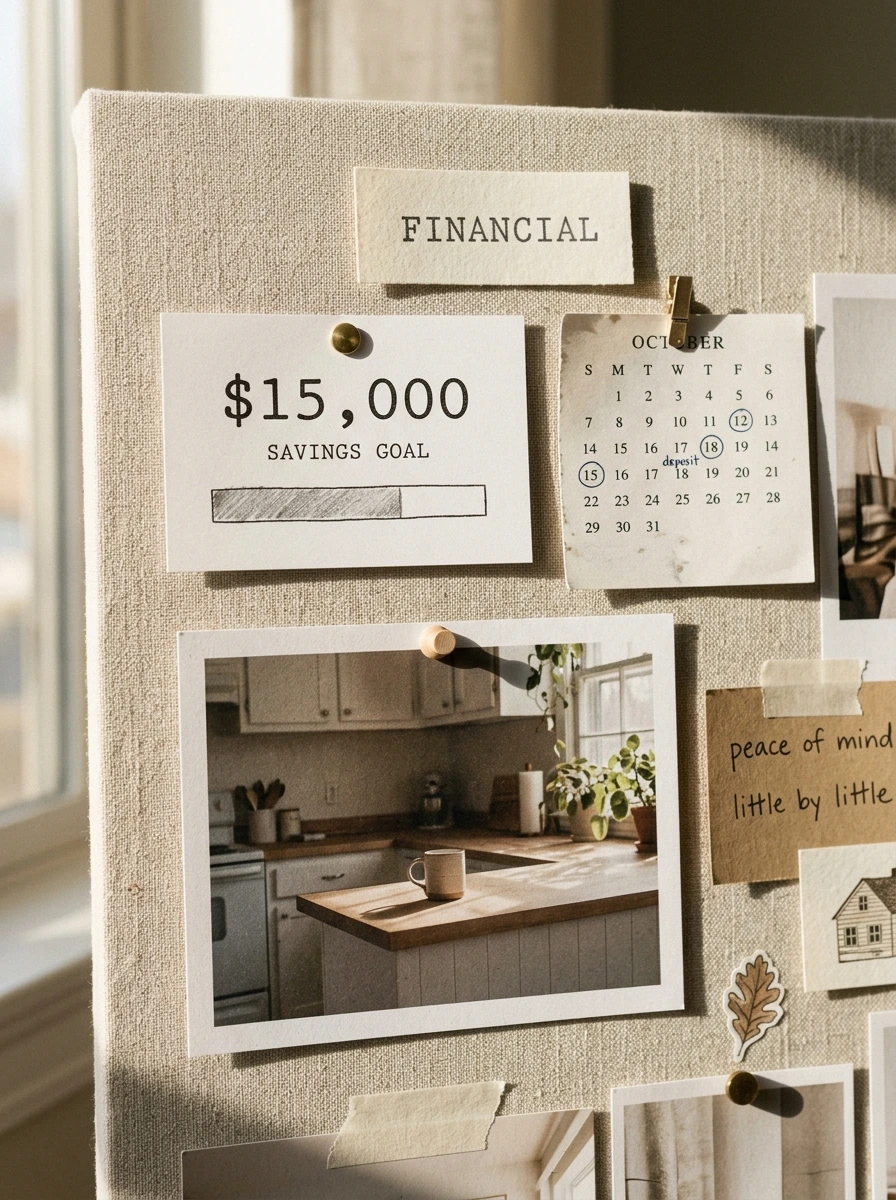
A financial section needs numbers, milestones, and one feeling image, because money goals stay abstract until they’re written down. Include a specific savings figure, a debt payoff date, or an income target, and add an image that shows what that security feels like in daily life. Without the numbers, the section becomes pictures of vacations and houses that don’t tell you what to do on payday. Financial vision board ideas work best when each milestone is paired with a monthly amount, so a large goal turns into a figure you can set up in a bank transfer. The honest observation from my own practice is that women who write the number down tend to take the first financial step within a week.
The Coach’s Clarity Note: Numbers Before Images
◈ What is the exact figure or date that would tell me this financial goal has been met?
◈ Write the number first, then choose a photo that represents what it makes possible.
◈ Most women use a photo of money or luxury and leave off the figure that gives it meaning.
◈ Women who build boards that work attach a monthly action to every financial milestone.
9. The Category Most Women Leave Off and Why It Is the Most Important One
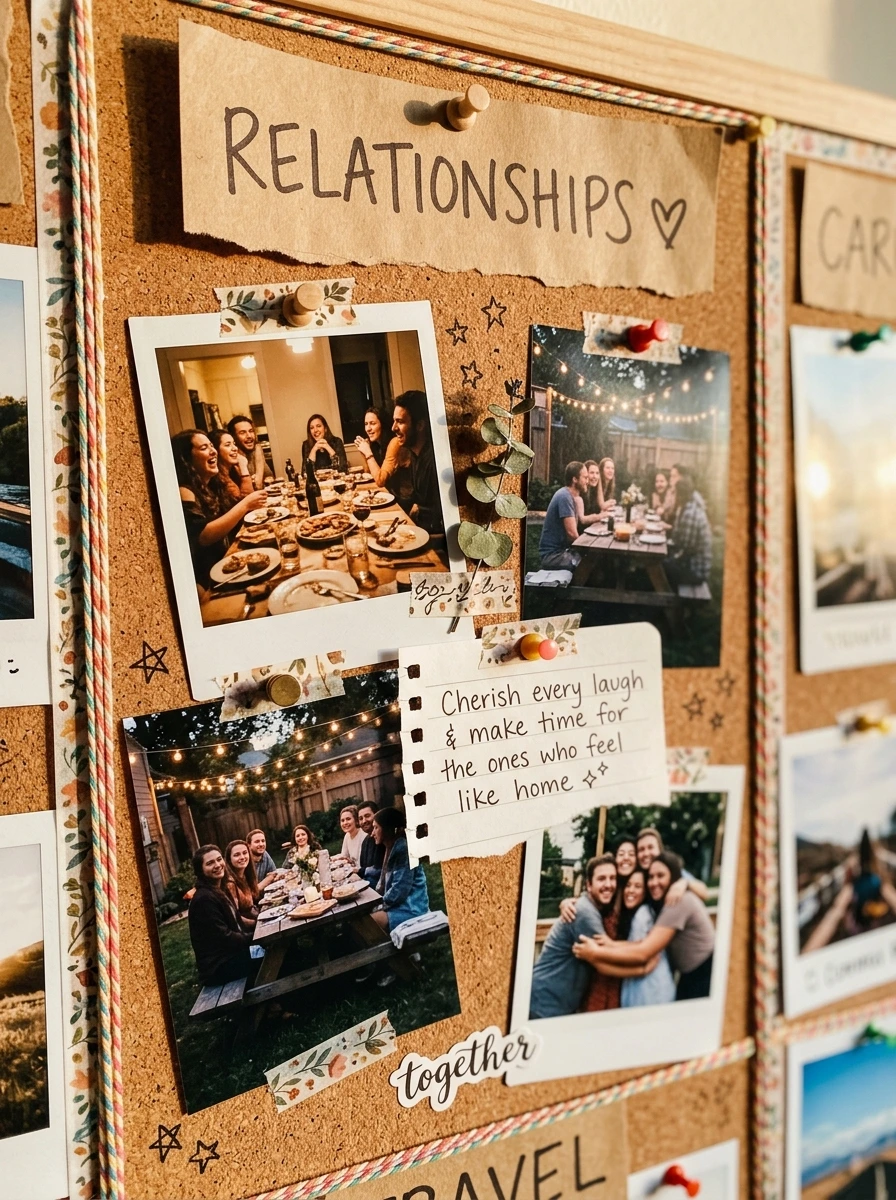
Relationships and connection are the section most women under-develop, because it feels less measurable than a salary or a fitness goal. Include one image that shows the kind of friendship, partnership, or family time you want more of, and one that shows what you’re ready to give. When this section is empty, every other goal absorbs the time and energy the relationships needed, and the board ends up supporting a life that’s busy but isolated. A board with relationship goals included usually changes how the career and health sections are paced. The pattern I’ve seen most often is that a woman adds this category late, and it ends up reshaping the whole board.
10. Specific Destinations Beat Generic Wanderlust on a Travel Vision Board
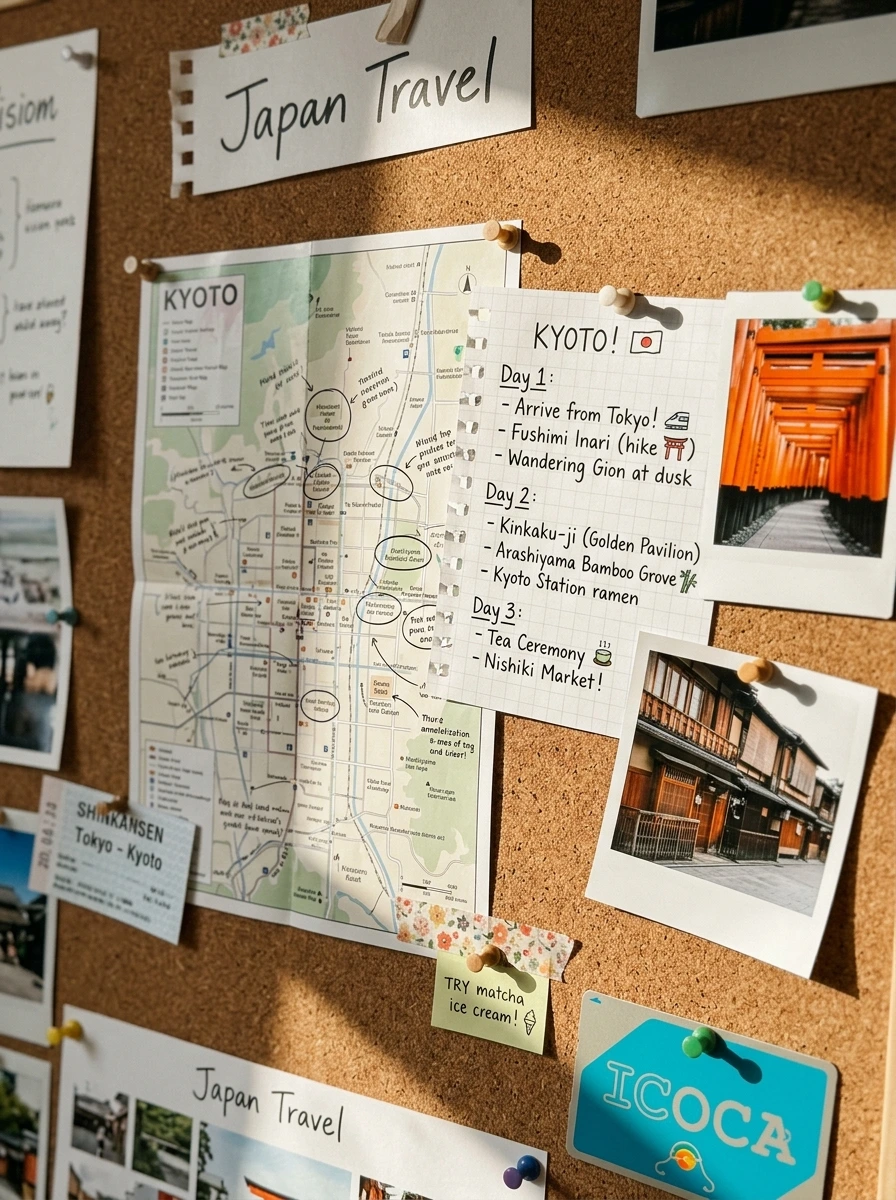
A travel section is more useful when it names a place, a season, and an experience, such as hiking a specific trail or spending a week in a particular city. Pick a single anchor destination and add two images of what you’d actually do there, because a generic beach photo doesn’t tell you what to plan. Without that detail, travel stays in the “someday” category and never earns a spot on your calendar or your budget. Travel vision board ideas work best when you add a rough cost and a target month in your journal, not on the board itself. Most women who name a specific destination end up booking something within the year.
11. Your Home Is a Clarity Anchor, Not a Backdrop
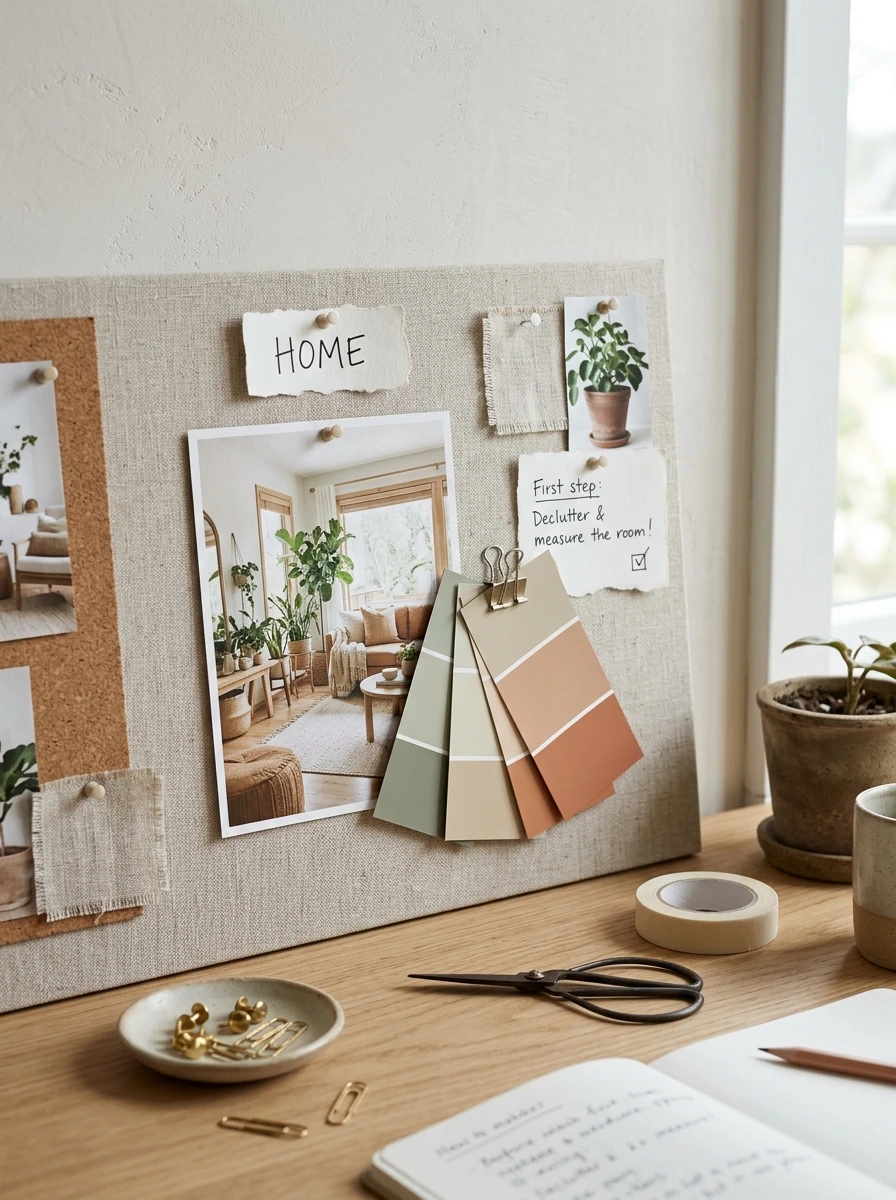
Home and environment goals give your board a physical anchor, whether that’s a first apartment, a kitchen renovation, or a corner of your living room that finally feels like yours. Choose one image of the space you’re building toward and one of the feeling it creates, and write the first small step beside it. If you skip this section, your living space stays on autopilot and often works against the goals on the rest of your board. A cluttered desk, for example, can quietly undermine a career goal. Women who include home goals often tell me that one small change, like clearing a surface, made the rest of the board feel more possible.
12. The Version of You Your Goals Are Building
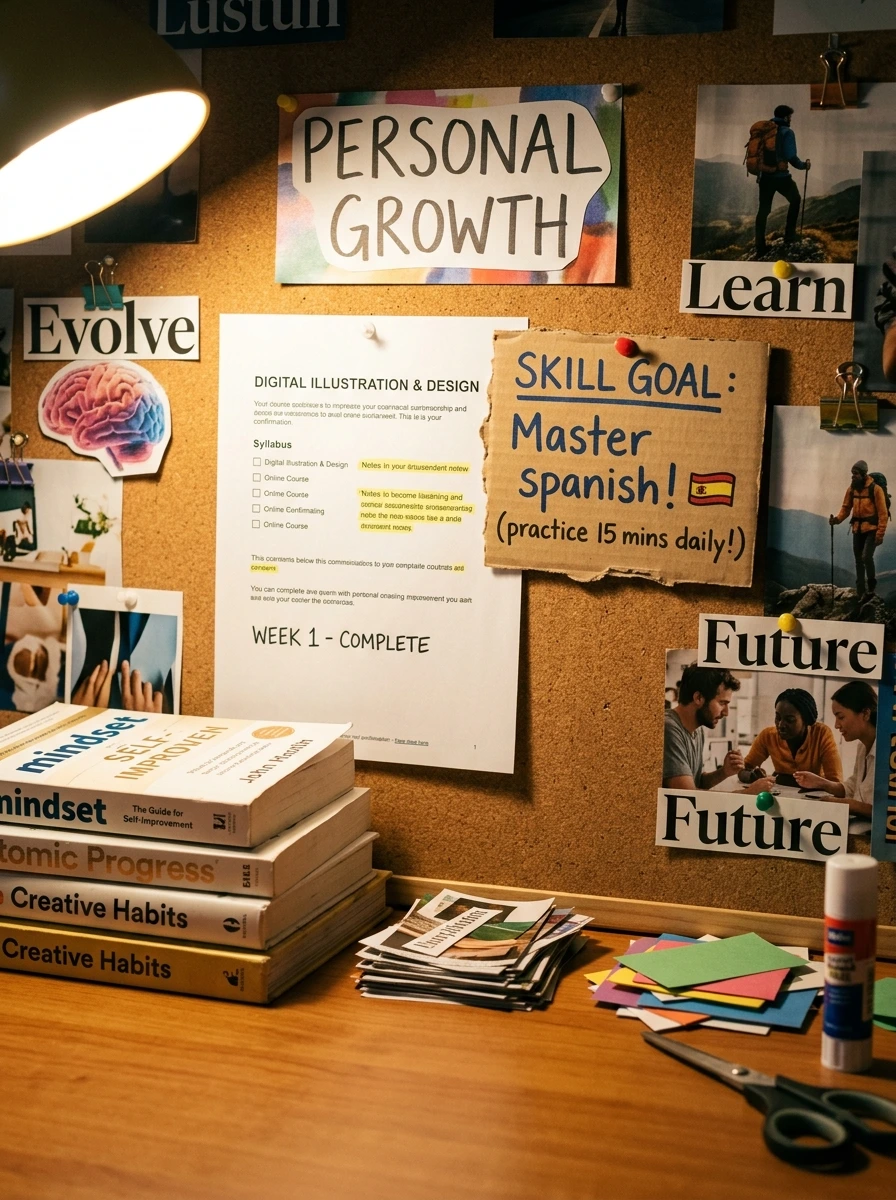
The personal growth section shows the skills, education, and habits that make the rest of the board possible. Name one specific thing you’re learning, like a course, a language, or a craft, and add an image of the person who has already learned it. When this section stays generic, with a few quotes and a sunrise, it doesn’t connect to a class you can enroll in or an hour you can protect. A board that includes a personal growth section works best when the growth item has a start date. In my experience, women who put a real course or skill on the board are the ones who use the other sections more often.
🎯 The Vision Board Category Depth Guide: How Many Images Per Section and What Each Image Should Actually Represent
Strong vision board images ideas come from deciding the job of each picture before you place it, and good vision board layout ideas depend on keeping each section’s image count balanced. Our intentional morning practice guide shows exactly how to build vision board review into a morning routine that actually happens.
ANCHOR IMAGE (1 per section): The single image that represents the specific goal itself, such as a named role, a place, or a target figure, and the one you’d keep if you had to remove everything else.
SUPPORTING IMAGES (2 to 4 per section): Images that show the steps, tools, or environment that make the goal possible, like a workspace, a training schedule, or a class you plan to take.
FEELING IMAGES (1 to 2 per section): Photos that capture how the goal feels in daily life without showing the goal directly, such as a quiet morning, a full table, or an open road.
WORD OR QUOTE (1 per section): One word or short phrase you chose yourself, written in your own handwriting if you can, and specific enough to act on, like “enroll,” “launch,” or “save.”
THE BALANCE RULE: A working board usually holds between 25 and 40 images in total, because beyond that range, no single goal gets enough visual weight to matter.
CLARITY CHAPTER 03: THE BUILD
The Specific Techniques That Separate a Working Board From a Beautiful One
Technique matters more than most women expect. The same goals can produce a board you ignore or a board you check daily, depending on how it’s built.
13. A Physical Vision Board on Cork or Foam That Stays Visible and Keeps Evolving
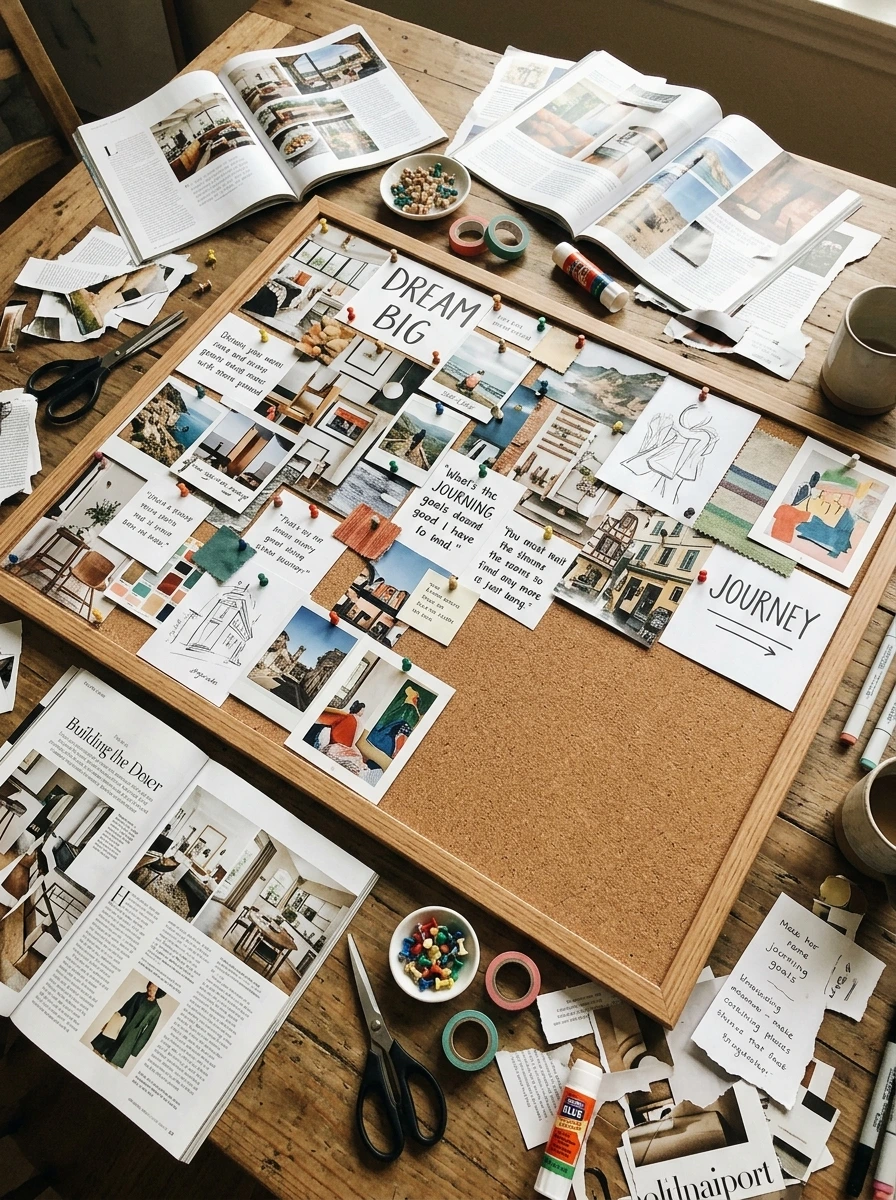
A physical board works best on cork or foam board, with pushpins or removable adhesive so you can swap images as your goals change. Michaels and Hobby Lobby carry the cork boards, foam backings, and mounting supplies you need, and Amazon and Target have reliable options if you’d rather shop from home. Gluing everything down on poster board feels satisfying in the moment, but it locks your goals in place and makes a quarterly update nearly impossible. Vision board cork board ideas work best when you leave about a quarter of the surface open for future additions. Women who leave that space usually keep adding to the board for years.
14. Digital Vision Board Ideas: The Canva Setup You’ll Actually Open

A digital board works when it lives where you already look every day, so set your finished Canva design as your phone lock screen or laptop wallpaper. Start from a simple Canva vision board template with a grid layout, then replace each box with your own images and one word per section. If the file sits in a folder you rarely open, the board becomes another forgotten document with the same problem as a dusty poster. Digital vision board ideas are especially useful if you travel often or share a living space and don’t want your goals on display. The women who keep their digital boards current are the ones who set a recurring calendar reminder to review them.
15. Layout Is a Narrative, Not a Collage
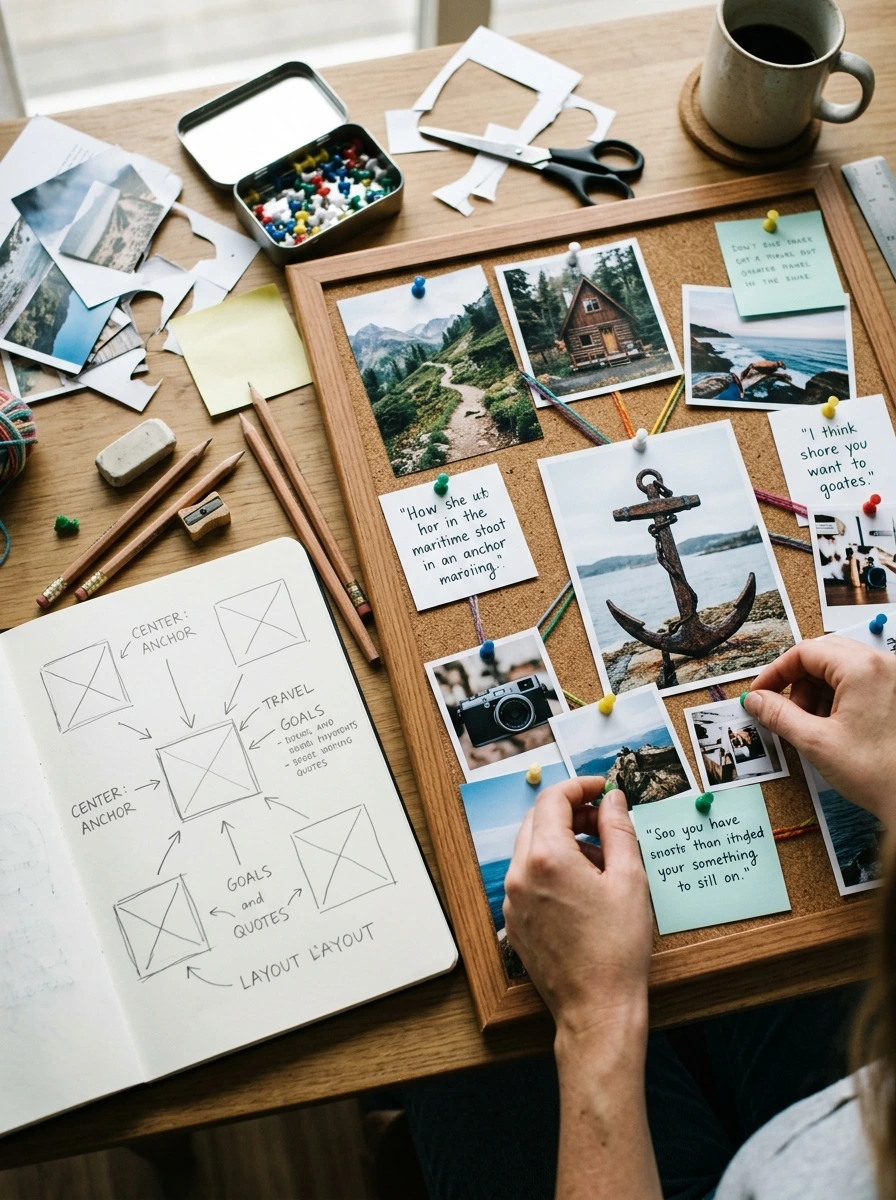
A strong layout reads like a story, with the present on one side, the goal in the center, and the feeling or outcome on the other. Place your clarity statement or anchor image at the center, then arrange each category around it so the eye moves from where you are to where you’re headed. When images are scattered randomly, the board reads as noise, and you stop noticing individual goals within a week. Pinterest vision board inspiration can show you layouts, but copy the structure, not the content, since your goals aren’t anyone else’s. In my experience, women who plan the layout on paper before gluing anything end up with boards they enjoy looking at for much longer.
The Coach’s Clarity Note: Story Not Collage
◈ What is the first thing I want my eye to land on, and what should it see next?
◈ Sketch a rough layout on paper with your anchor image at the center before placing anything.
◈ Most women fill every inch of the board evenly and leave no focal point at all.
◈ Women who build boards that work let their biggest goal take the most visual space.
16. Images Versus Words: The Ratio Depends on the Goal
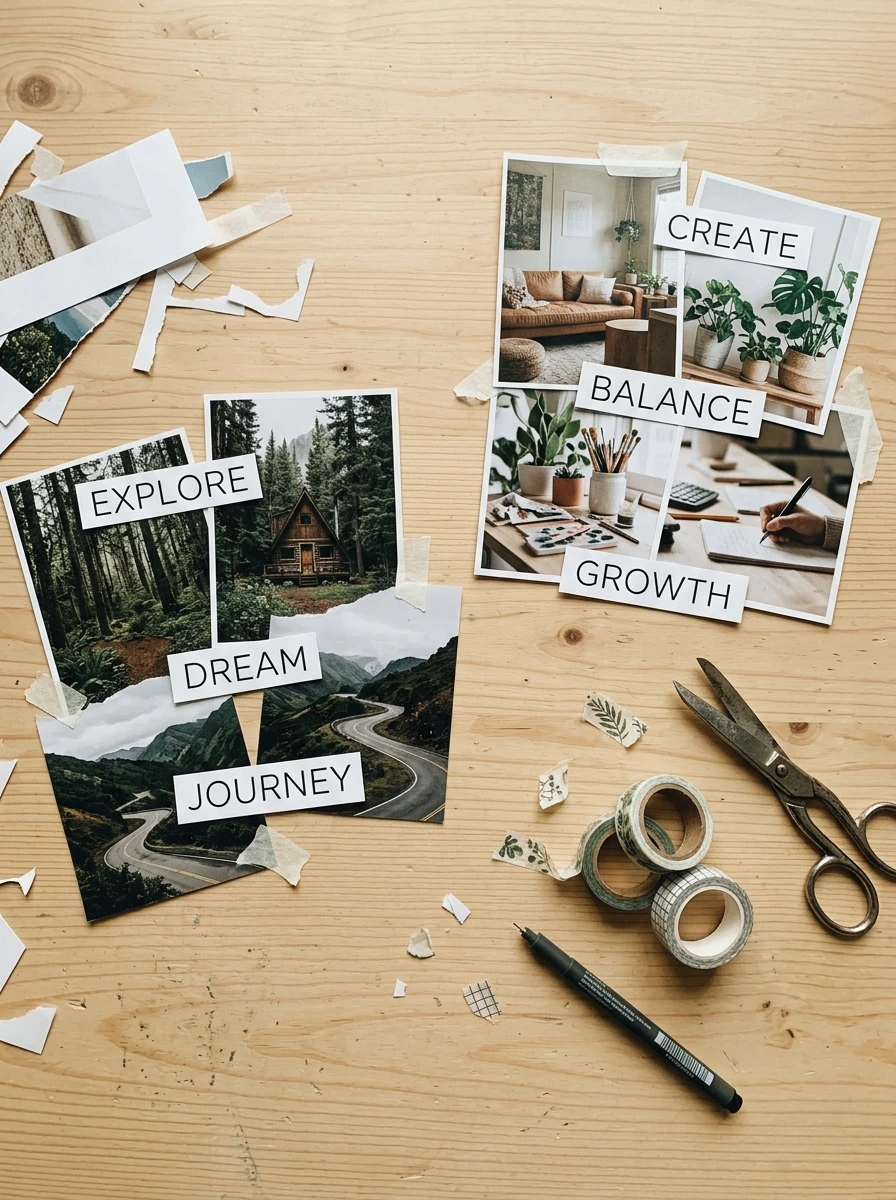
Goals with a visible outcome, like a home, a trip, or a workspace, need more images, while goals about habits or skills often need more words. A good starting ratio is roughly two-thirds images and one-third words, adjusted for each section. A board that’s all pictures can feel inspiring but vague, while a board that’s all words can feel like a to-do list nobody wants to read. A vision board word cloud can work well as a single corner of your board, summarizing the themes across all seven sections. The women who tend to use their boards most often are the ones who’ve chosen words that sound like commitments instead of wishes.
17. What Your Vision Board Color Scheme Does to You Every Time You Look
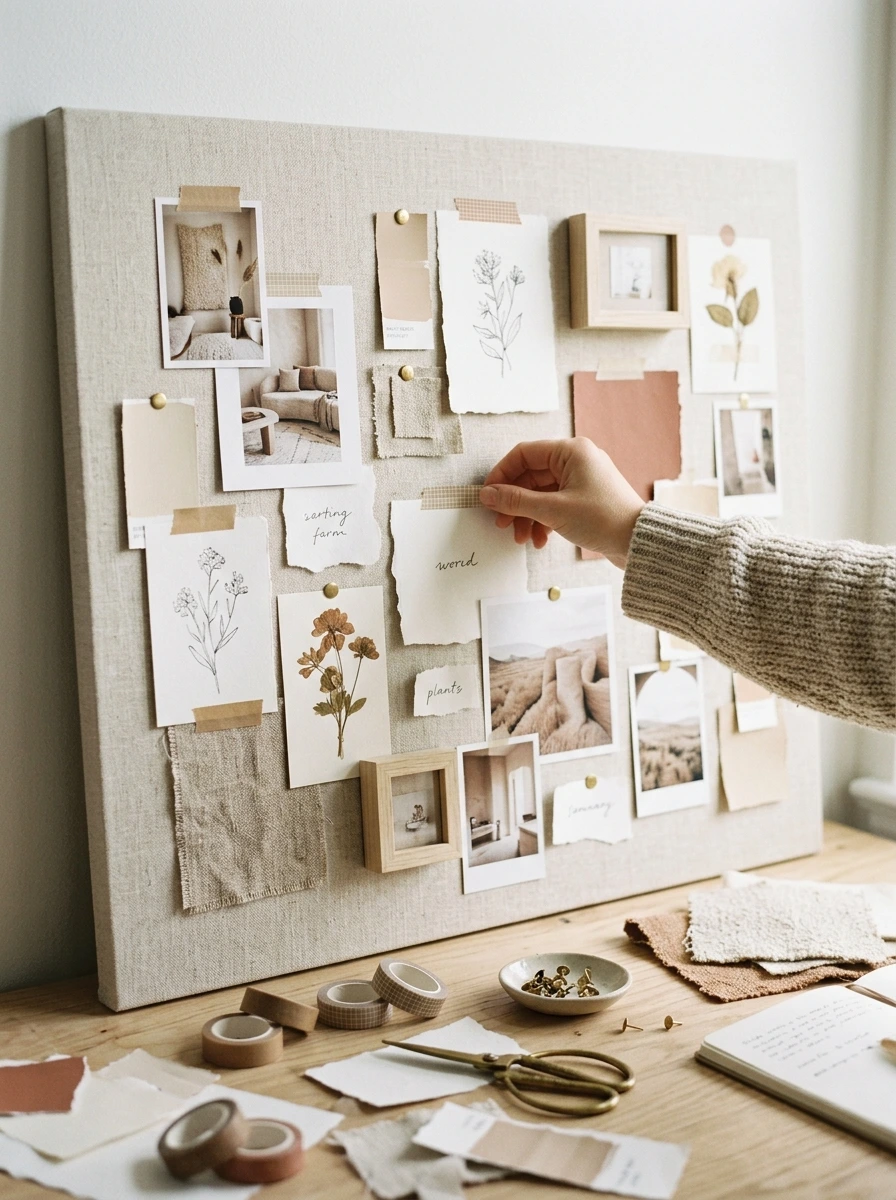
Color shapes how the board feels in daily use, so choose a palette that matches the energy you want, whether that’s calm neutrals, warm earth tones, or high-contrast brights. Pick two or three base colors, then let your images and washi tape follow that palette. A vision board color scheme that fights the room it hangs in can feel jarring, and women often stop looking at a board that irritates them. If a section’s colors feel off, that’s useful information about how you feel about that goal. I’ve noticed that a board you enjoy looking at gets reviewed far more often than one you merely tolerate.
🖥️ Physical vs Digital Vision Board: Which One Works Better and for Whom
Digital vision board ideas and aesthetic vision board ideas both work, and the right one depends on how you live. Whichever you choose, our intentional home retreat guide shows how to create a home environment that makes any creative or planning session feel like it has the space it deserves.
| ELEMENT | PHYSICAL BOARD | DIGITAL BOARD |
|---|---|---|
| Best for | Women who want a tactile, creative process and a visible daily reminder | Women who travel often, share a space, or want easy edits |
| Review frequency | Naturally reviewed each time you pass it | Needs a reminder or lock-screen placement to get seen |
| Editing ease | Moderate; requires reprinting and re-pinning | High; swap images in minutes |
| Cost | Moderate; supplies from Michaels, Hobby Lobby, Target, or Amazon | Low to free with Canva |
| Visibility | High on a wall or desk, but visible to everyone in the room | Private by default, visible only when you open it |
| Portability | Low; stays where it hangs | High; lives on your phone and laptop |
| Privacy | Lower; guests and housemates can see it | Higher; you control who sees it |
CLARITY CHAPTER 04: THE PRACTICE
What Happens After the Board Is Built That Determines Whether It Works
A finished board is a starting line, not a result. The women who see change are the ones who treat review as a habit, as seriously as the building.
18. Place It Where You’ll See It, Then Move It Before You Stop Seeing It
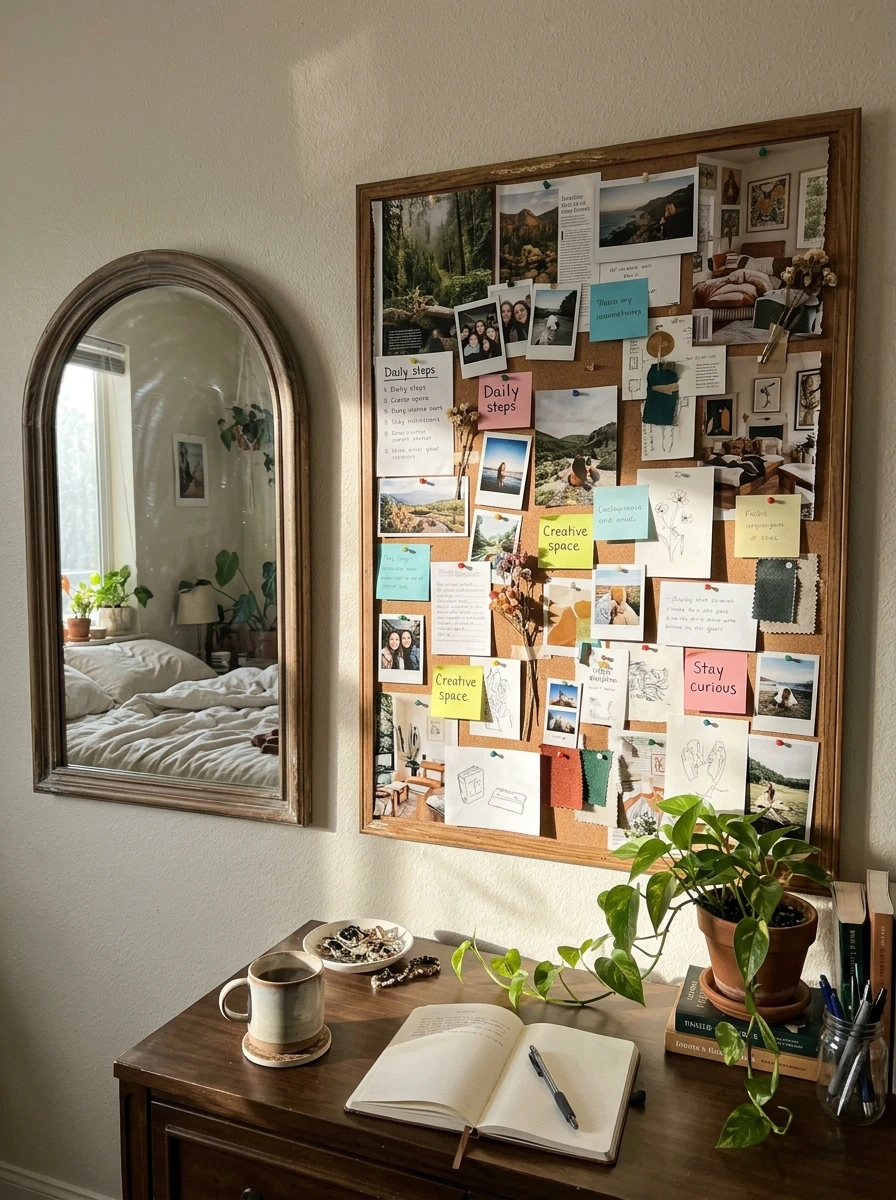
The best placement is somewhere you pass every day without effort, like beside your bedroom mirror, above your desk, or on the inside of a closet door. Vision board placement at home matters more than most women think, because a board in a hallway you rarely use becomes wallpaper by the second week. Even a well-placed board fades into the background after a few months, so move it or change its position when you notice you’ve stopped looking. A board in a private spot also removes the pressure of explaining it to every guest. Women who rotate their board’s position every season tend to keep noticing it long after the novelty wears off.
19. The Two-Minute Review and the Image You Keep Looking Away From
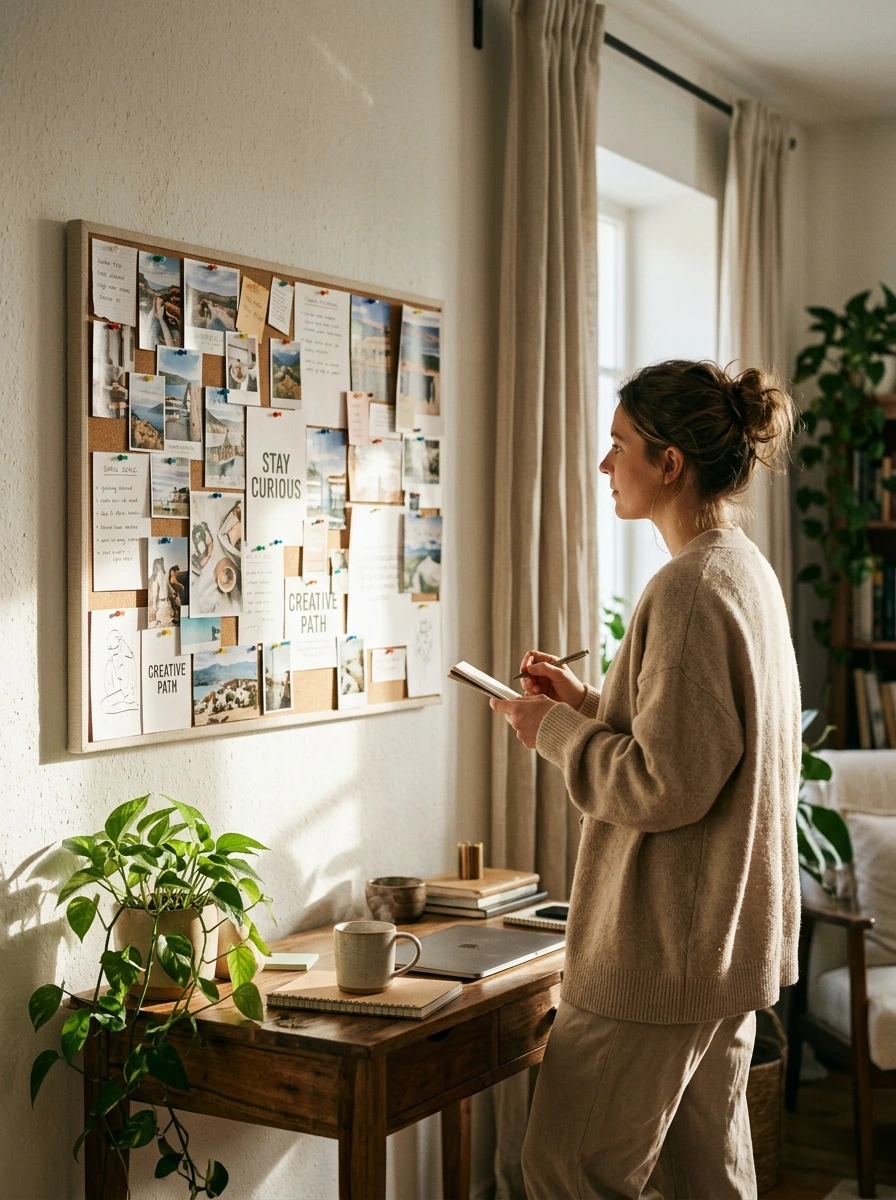
A daily review takes two minutes: stand in front of your board, read your clarity statement, and ask which goal needs attention today. Pay attention to the image your eyes skip, because that avoidance usually points to the goal you’re least ready to act on. If you review without noticing, the board becomes a morning glance with no consequences, and the habit fades. A vision board review practice works best when it ends with one concrete action, even a small one like sending an email or opening a savings account. In my experience, the image women avoid looking at is often the first one they act on once they name it.
20. Quarterly Updates: What Leaving a Goal on the Board Actually Means
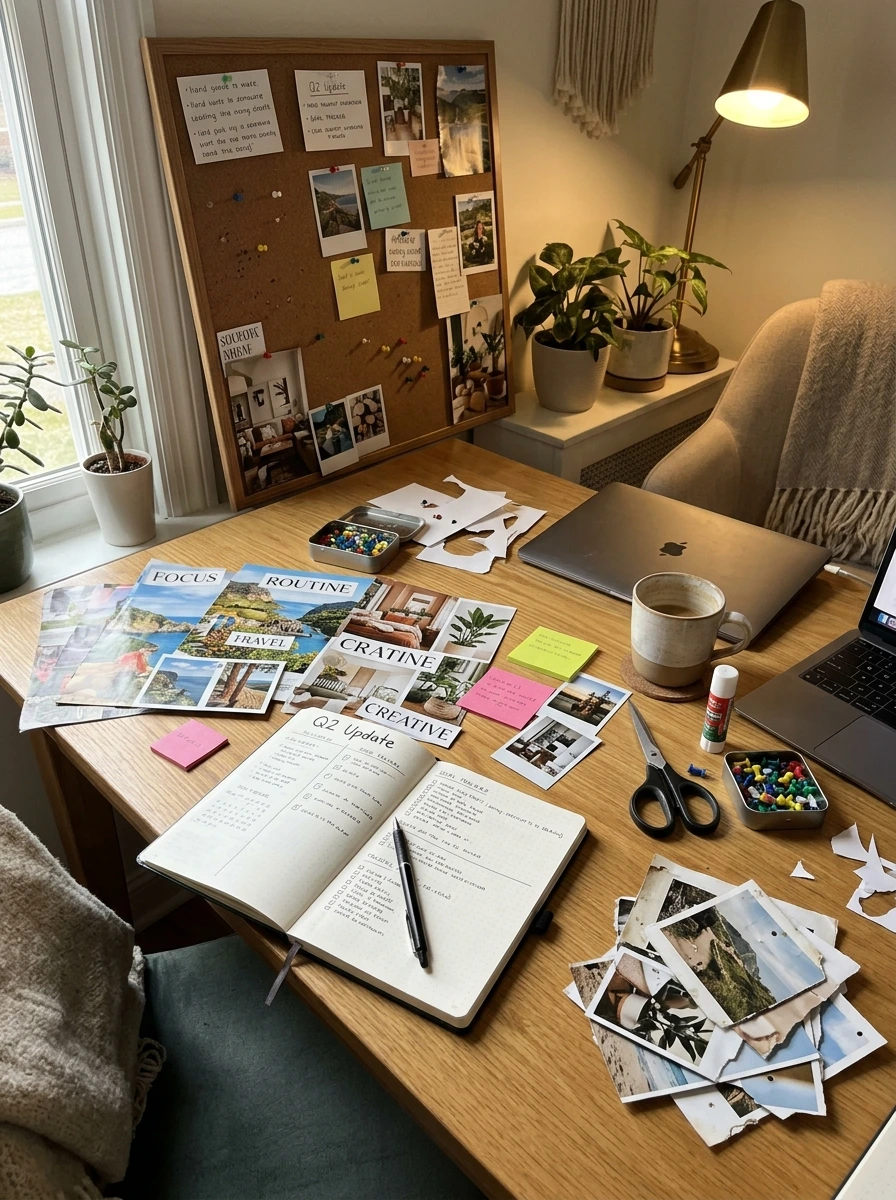
A quarterly update is a one-hour audit of what to remove, what to add, and what to keep, based on what you’ve actually done in the last three months. Remove goals you’ve completed, replace images that no longer feel true, and add anything new that has become clearer. If an image has stayed on the board for several quarters without any action, ask honestly whether it’s a goal or a comfortable wish. Keeping it means committing to a first step this week, and removing it means choosing a different direction, and both are legitimate answers. Women who run honest quarterly updates tend to feel lighter and clearer, even when the board gets smaller.
21. Vision Board Accountability: Who Sees It and How That Conversation Goes

Choose one person who will ask useful questions, not one who will simply cheer, and walk her through your board section by section. Tell her your clarity statement, name one action for each category, and agree on a monthly check-in. Sharing with someone who doubts or competes with you can quietly shrink your goals, so choose carefully. A vision board accountability partner works best when the conversation focuses on what you did last month, not on how you feel about the board. Women who have even one steady accountability conversation usually follow through on far more of their goals.
22. The Vision Board Journal That Tracks Movement, Not Mood
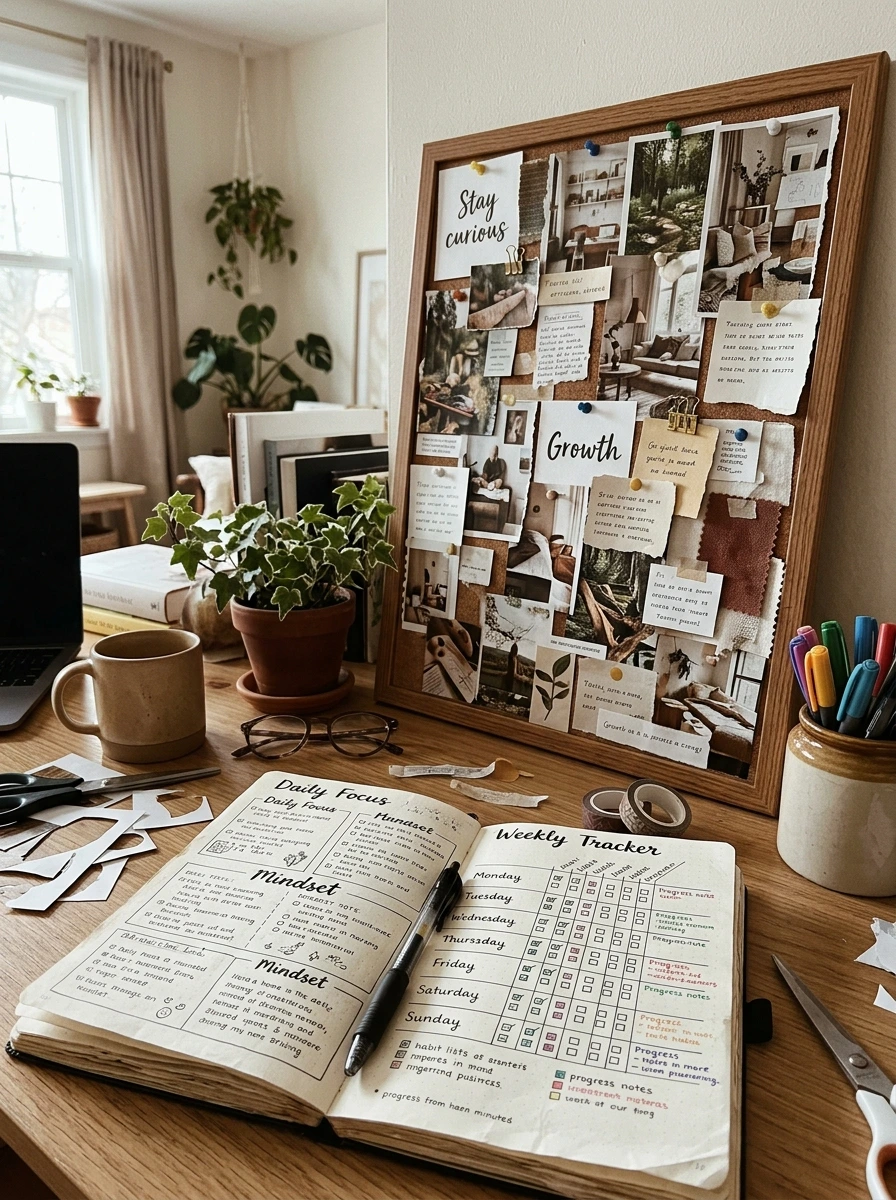
A vision board journal records what you did toward each goal, not how you felt about the board. Divide a notebook into the same seven sections as your board, and write one line each week about any step taken, however small. Without this record, progress stays invisible, and it’s easy to feel stuck when you’ve actually moved. Vision board journal ideas can include before-and-after photos, a monthly tally of actions taken, and a short note on what you’re avoiding. Women who keep this journal often discover they’ve made more progress than they realized, which makes the next quarter’s goals feel more credible.
The Coach’s Clarity Note: Track Not Judge
◈ What did I actually do this week that moved one goal forward, even slightly?
◈ Write one factual sentence per category each week, with no commentary on how it went.
◈ Most women journal about feelings and forget to record the specific actions they took.
◈ Women who build boards that work look back through their journal each quarter before changing the board.
📅 The Vision Board Review Calendar: When to Look, What to Look For, and When to Change It
A steady vision board review practice and a yearly rebuild keep your board honest, and a vision board annual review is where the biggest decisions happen. Vision board work does not only happen in the morning, and an evening reflection practice can be equally powerful, so our evening reflection routine guide shows how to build quiet intentional time into the end of every productive day.
DAILY (2 MINUTES): Read your clarity statement, then scan the board and notice which image your eyes skip.
WEEKLY (10 MINUTES): Write one action taken per category in your journal and pick one priority for the week ahead.
MONTHLY (20 MINUTES): Check each section against your actions, noting which goals are moving and which are stalled.
QUARTERLY (1 HOUR): Remove completed goals, replace outdated images, and decide honestly whether any stalled goal stays or goes.
ANNUALLY: Rebuild the board from a fresh clarity statement, carrying forward only the goals you’re still actively pursuing.
THE ONE SIGN: If you’ve stopped looking at the board for several weeks, or most of its images no longer feel true, it needs a rebuild rather than an update.
CLARITY CHAPTER 05: THE VARIATIONS
For Every Woman, Budget, Style, and Season of Life
There isn’t one correct way to make a board, only the method that gets you to look at it and act. These last three entries are for the woman who wants to do this with friends, with style, or with almost nothing at all.
23. Host a Vision Board Party That Produces Clarity Instead of a Craft Afternoon
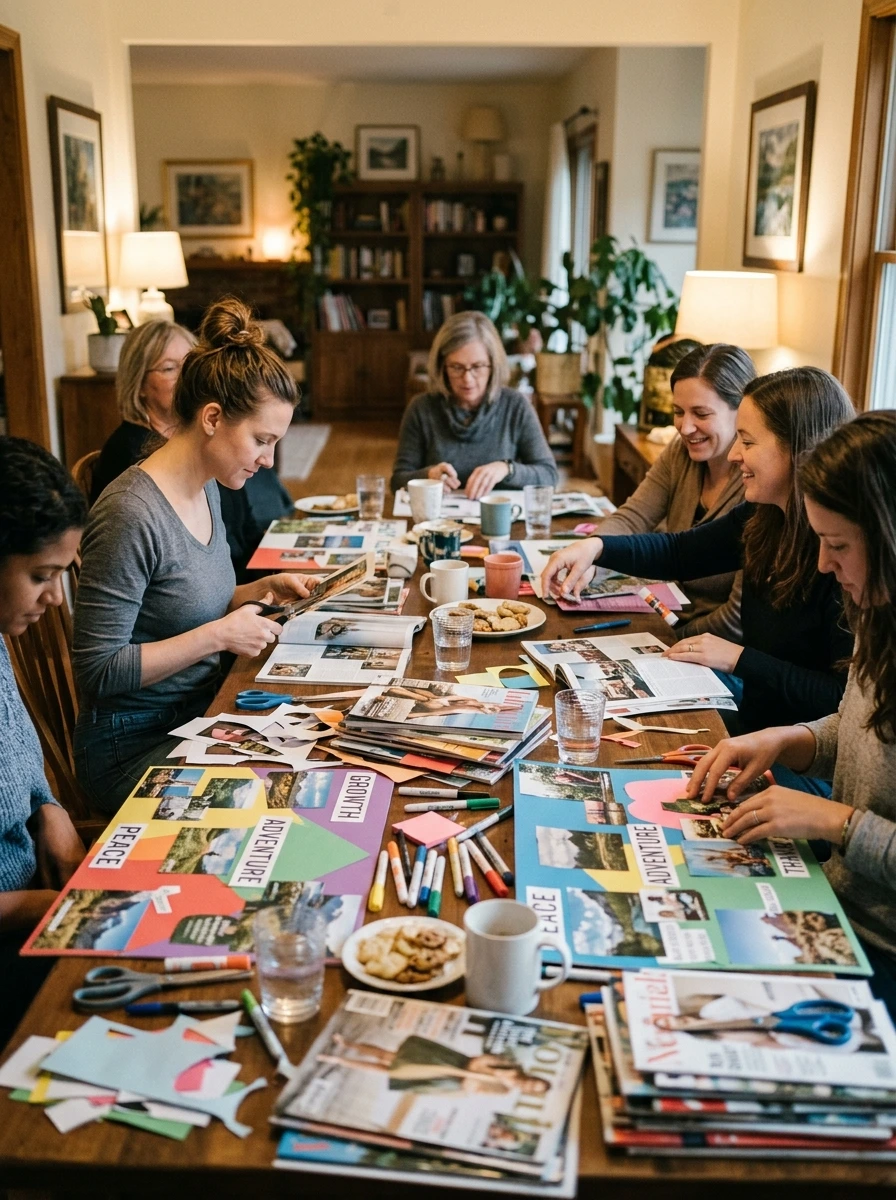
A good vision board party starts with ten minutes of quiet writing, so every guest arrives at the table with a clarity statement before anyone touches a magazine. Ask each guest to bring a few printed photos, supply the scissors, glue, and cork boards from Target or Amazon, and keep the playlist soft enough for conversation. Without the writing step, the afternoon becomes a craft session where everyone leaves with a pretty collage and no direction. Vision board party ideas work best when the last fifteen minutes are reserved for each guest to share one action she’ll take this month. Women who host this way tell me the quiet writing was the part their friends remembered most.
24. Aesthetic Vision Board Ideas That Look Good Without Letting the Look Be the Point
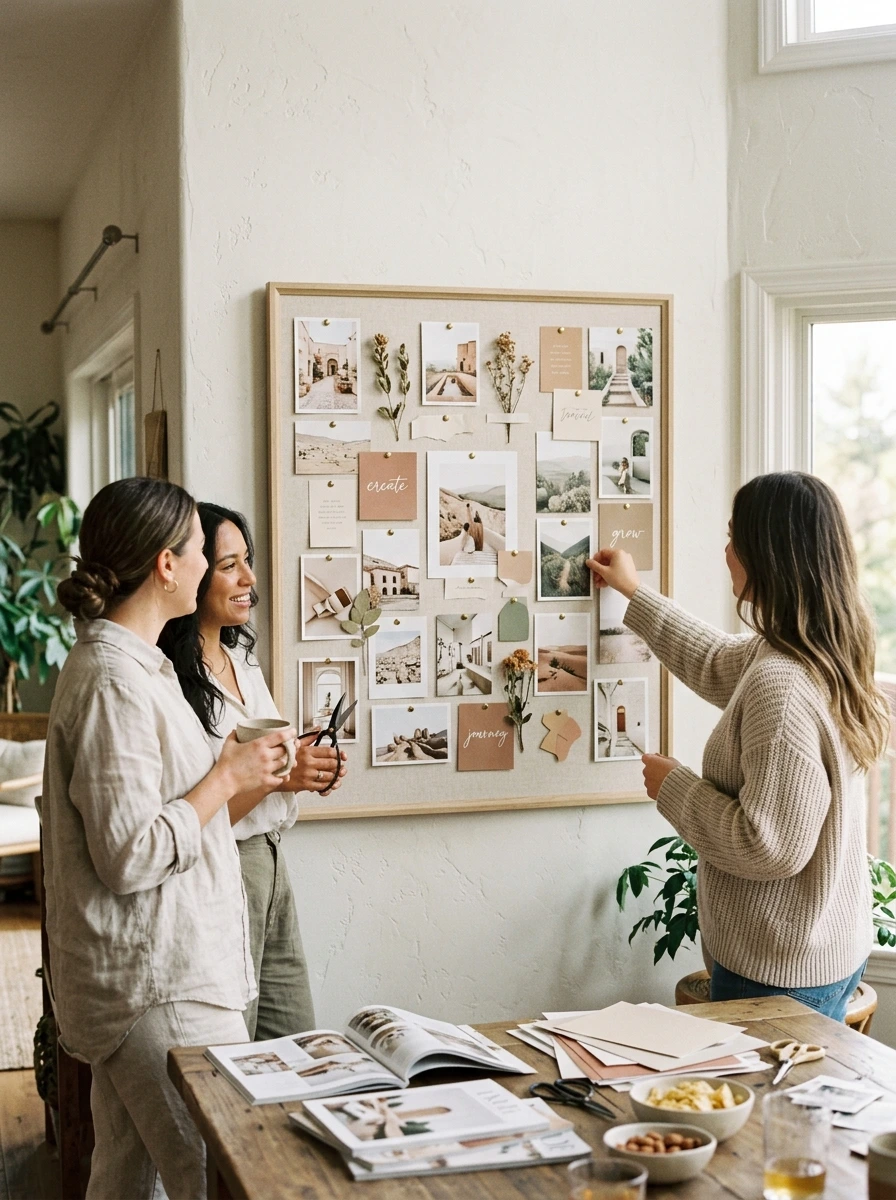
An aesthetic board works when the style supports the goals, with a restrained palette, consistent image sizes, and clean spacing that makes the board pleasant to review. Choose one theme, such as soft neutrals, black and white photography, or warm earth tones, and use it throughout. If the styling takes over, you spend the afternoon matching colors and never write down a single action. Aesthetic vision board ideas should always come after the clarity work, never before it. The boards that look best over time are the ones where every element earns its place, and the style comes from that discipline.
25. The Minimalist Vision Board: When Less Is Clarity and More Is Decoration
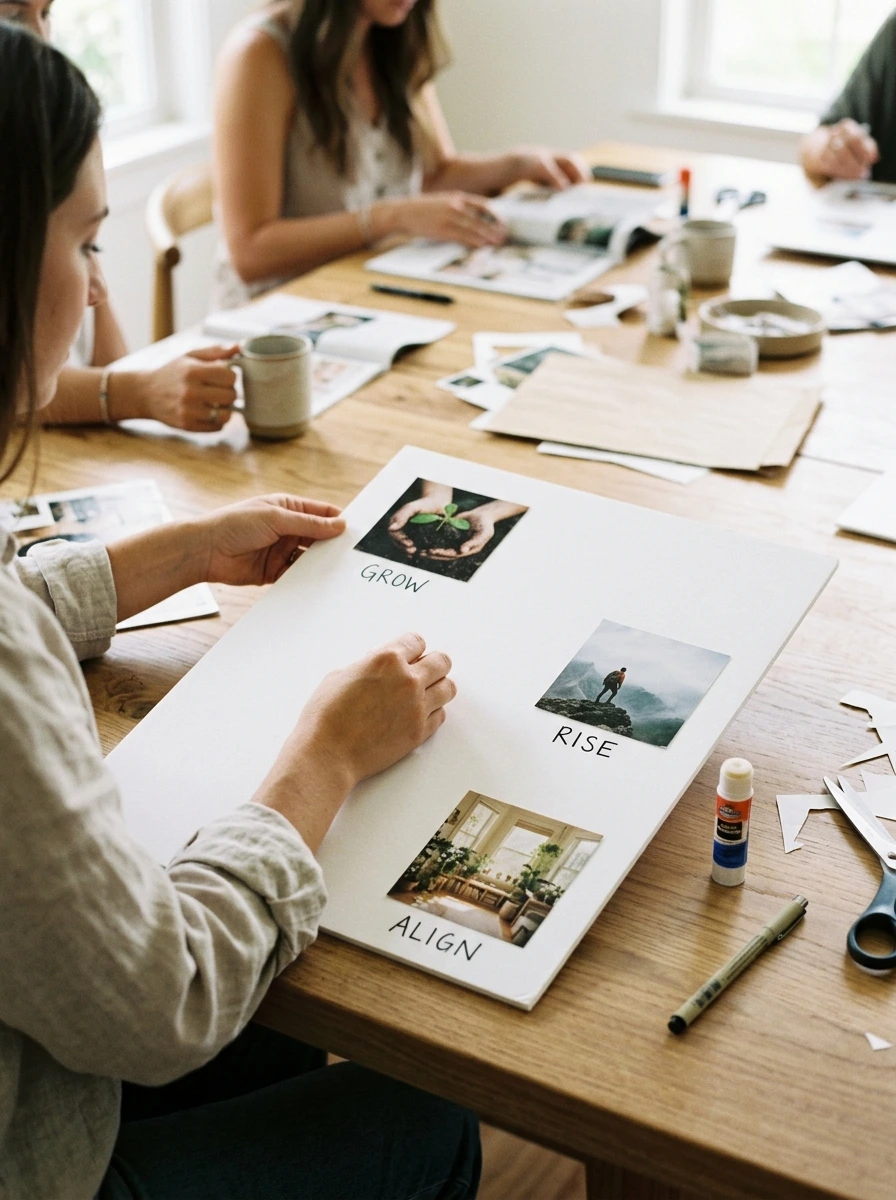
A minimalist board holds five to eight images, one per priority, with a single word or phrase beside each. Choose a small frame or a single sheet of foam board, and leave generous white space so each image carries weight. When a board becomes crowded, no single goal stands out, and the whole thing blurs into background. Minimalist vision board ideas work well for women who feel overwhelmed by choices or who want a board that fits a small space. The women who make this version tend to tell me it was the first board they actually kept looking at.
Vision Board Questions, Answered by the Clarity Method
What should I put on my vision board?
Start with your clarity statement, then add one anchor image for each life area that matters to you right now. The strongest vision board ideas combine career, health, relationships, finances, personal growth, home, and experiences, with a few feeling images and one word per section. Good vision board categories ideas also leave room for the goal you’ve been hesitant to name. If a goal doesn’t connect to a specific action, it probably isn’t ready for the board yet.
How do I make a vision board that actually works?
Learn how to make a vision board by writing first and cutting second: define your clarity statement, answer a question for each life area, and only then gather images. Pair every image with one small action, and review the board on a set schedule. The best vision board goals ideas are specific enough to produce a next step this week. A board that works is one you look at, update, and act on, not one that simply hangs on a wall.
What is the best vision board size?
The best size is one you can see from where you usually stand, which for most women means a board between 16 by 20 and 24 by 36 inches. Larger boards leave room for seven life-area zones, while smaller boards suit minimalist vision board ideas with five to eight images. A good size gives you room to follow vision board layout ideas that create a clear focal point. If a board feels crowded or empty, the size probably doesn’t match the number of goals you’re holding.
Should I make a physical or digital vision board?
Choose physical if you want a tactile process and a daily visual reminder, and digital if you travel often, share a home, or want quick edits. Digital vision board ideas are especially useful on a phone lock screen, where you’ll see them dozens of times a day. Many women build a physical board and keep a photo of it on their phone, which gives the same vision board ideas two places to work. Whichever you pick, the one you’ll actually look at is the better choice.
How many images should be on a vision board?
A working board usually holds 25 to 40 images, including anchor images, supporting images, feeling images, and words. Smart vision board images ideas favor fewer, stronger pictures over a crowded collage, since too many images dilute every goal. A health goal, for example, needs more than a photo, and our wellness goal space guide shows how to create the home movement space that makes a fitness goal feel like a decision rather than a wish. If you can’t remember what half your images mean, you probably have too many.
Where should I put my vision board?
Place it where you pass daily, such as beside your bedroom mirror, above your desk, or on a closet door. Vision board placement at home matters because a spot you rarely see turns even the best board into background decoration. Many vision board ideas fail simply because the board was hung in a room where no one spends time. If privacy matters, a digital board or a notebook version keeps your goals visible only to you.
How often should I update my vision board?
Review it daily for two minutes and update it quarterly, removing completed goals and replacing anything that no longer feels true. Vision board ideas stay useful when the board changes along with your life, instead of staying frozen. A vision board annual review is the right time for a full rebuild from a fresh clarity statement. If you find yourself avoiding the board entirely, that’s usually a sign it needs to be updated sooner.
Can I make a vision board with just words and no images?
Yes, and for some goals, words work better than pictures, especially for habits, skills, and values. Word-based vision board ideas can use a single sheet with short, specific commitments written in your own handwriting. Vision board affirmation ideas work best when they’re phrased as actions, like “I submit one application each week,” instead of vague hopes. Many women find that mixing a few strong images with a handful of words gives the board both emotional pull and practical direction.
How do I host a vision board party?
Invite four to eight women, ask each to write a clarity statement beforehand, and provide magazines, scissors, glue, and boards. Strong vision board party ideas include a quiet writing round, a cutting session, and a closing circle where each guest shares one action. Setting the right space helps, and our goal environment design guide shows how the physical space around you can reflect the life you are actively building. Keep the pace relaxed, and leave time for real conversation, since that’s where most of the clarity happens.
What are the best supplies for making a vision board?
A basic vision board supplies list includes a cork board or foam board, pushpins or removable adhesive, scissors, a glue stick, a pen, and a stack of magazines. Michaels, Hobby Lobby, Target, and Amazon all carry reliable options, and Canva covers the digital version for free. Vision board ideas don’t depend on expensive materials, and a simple setup often leads to a more focused board. Add washi tape, a photo printer, or a gallery frame only if they make you more likely to look at the board.
Conclusion
The best vision board ideas share one trait: they produce clarity before they produce anything else. A board doesn’t create outcomes. It shows you what you want, and clarity creates the decisions that create outcomes. Build yours slowly, review it honestly, and let it change as you do.
A vision board is one tool in a life that is being built intentionally, and The Muse Vale has the morning routine, self-care, wellness, and lifestyle guides to help you build the full infrastructure around every goal on your board.
Come back to The Muse Vale whenever your goals need a new perspective or your board needs a rebuild, and we will have the vision board ideas, clarity tools, and intentional living guides ready for every season of your life.