
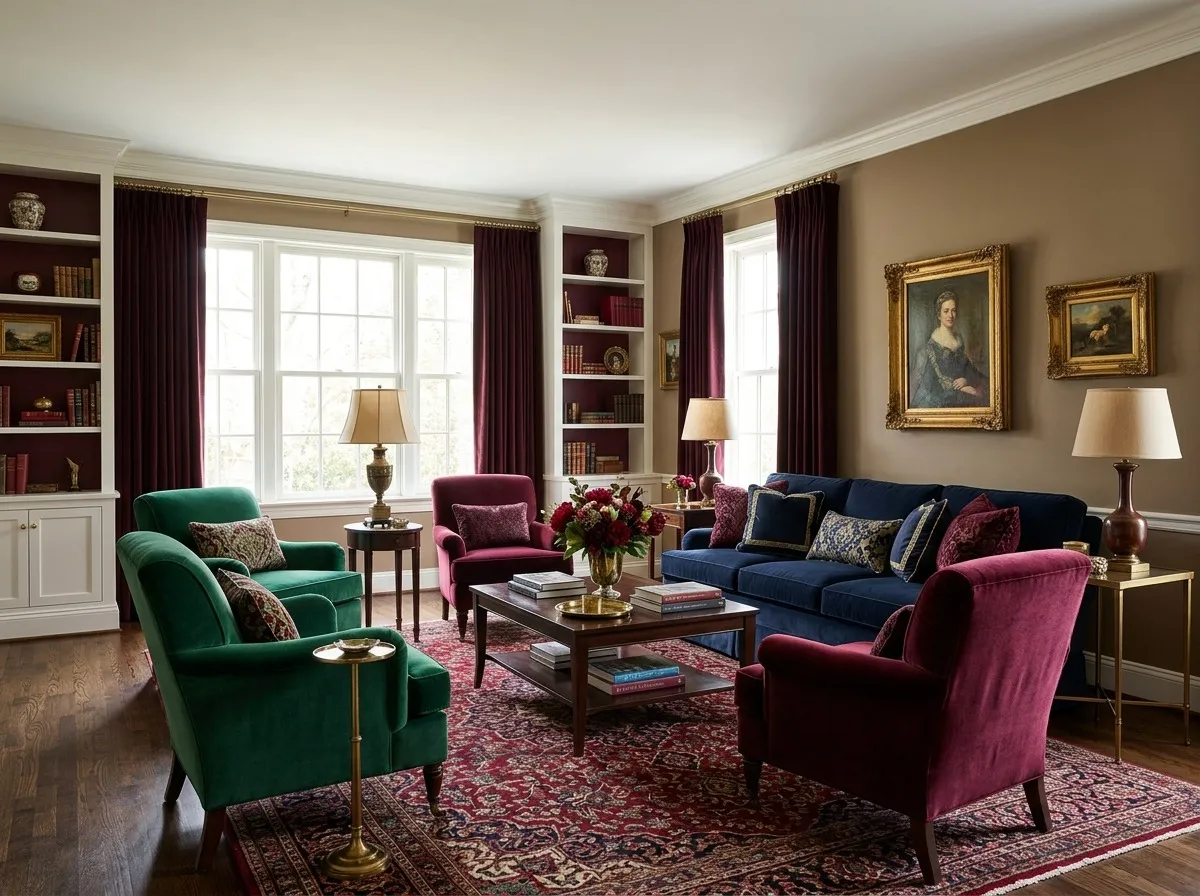
Traditional living room ideas aren’t a style choice made in a single season. They’re a commitment to a design vocabulary that has proven itself across generations, and this report maps every element of that vocabulary for your room. I’ve spent years tracing how American traditional design borrowed English Georgian proportion, French provincial warmth, and early Federal restraint, then combined them into something distinctly different from all three. The result is a living room built to outlast any one occupant’s taste, where quality is measured in decades rather than seasons. What follows are twenty-six heritage report entries across five layers, moving from the room’s oldest decisions in architecture through furniture, pattern, and color to the objects that finish it. Each entry documents one decision, why it entered the traditional vocabulary, and how it works in a modern American home. You’ll meet crown molding, wingback chairs, Persian rugs, damask, and chinoiserie in their proper context, along with the specific places each one goes wrong. Read it the way a historian reads a house, then take what your room needs.
The Traditional Living Room Decoded: Five Design Traditions That Built the American Interior
Before the entries begin, it helps to know where the vocabulary came from, because the best traditional living room ideas and any serious traditional interior design living room can be traced back to five distinct traditions.
◆ ENGLISH GEORGIAN DRAWING ROOM Origin: The drawing rooms of English townhouses and country houses, planned around ordered proportion and published in the pattern books that American builders carried across the Atlantic. What it contributed: The stepped crown molding and the balanced placement of windows and fireplace that still organize a formal room. How it appears in American homes: Mid-Atlantic Georgian houses keep the symmetrical hearth wall, which remains the template for formal living room ideas traditional in spirit.
◆ FRENCH PROVINCIAL SALON Origin: The regional salons of the French countryside, where local craftsmen translated court furniture into walnut, fruitwood, and cane. What it contributed: The cabriole leg, the bergère chair, and the printed pastoral toile. How it appears in American homes: A fruitwood bergère with a linen cushion beside the hearth gives a traditional American living room its softest, most lived-in corner.
◆ EARLY AMERICAN FEDERAL STYLE Origin: The young republic’s Roman-revival restraint, which pared Georgian grandeur down to slender legs, shallow carving, and inlaid detail in New England and mid-Atlantic towns. What it contributed: Delicate inlay, the swag-and-urn motif, and the convex mirror above the mantel. How it appears in American homes: New England Federal houses keep their fireplace walls spare, with a mirror, a pair of candlesticks, and very little else.
◆ SOUTHERN COLONIAL INTERIOR Origin: Plantation houses and the townhouses of Charleston and Savannah, planned for heat, hospitality, and cross-ventilation. What it contributed: Tall windows, high ceilings, and the plaster medallion that marks the chandelier. How it appears in American homes: Southern living rooms still hang floor-length drapery near the ceiling to exaggerate window height, and they still center the light fixture on a medallion.
◆ NEW ENGLAND CRAFTSMAN TRADITION Origin: The handcrafted-wood ethos of American Craftsman workshops, which valued visible joinery and local oak over applied ornament. What it contributed: Built-in bookcases, window seats, and the inglenook beside the hearth. How it appears in American homes: American Craftsman traditional interiors in older bungalows now pair those built-ins with camelback sofas and Persian rugs, the quietest route to an elegant traditional living room.
Heritage Layer 01: Architecture What the Room Says Before Anyone Sits Down
Architecture is the oldest layer of any traditional room because it was decided before anyone chose a fabric, and in the English Georgian houses that American builders copied it was the largest expression of status. In New England Federal homes and mid-Atlantic drawing rooms alike, the walls, ceiling, and hearth did the talking while the furniture merely agreed.
1. Crown Molding: The Architectural Detail That Signals a Traditional Living Room Before a Single Piece of Furniture Enters
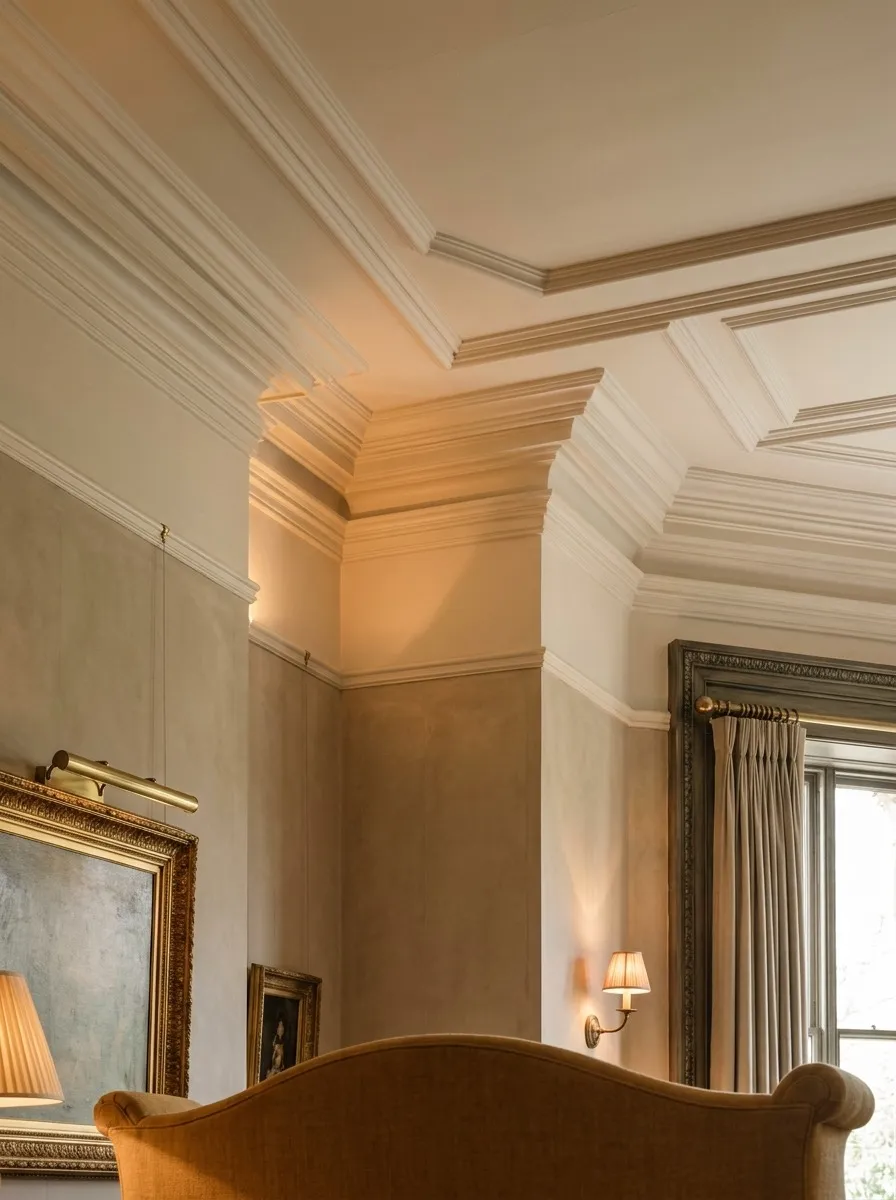
Crown molding came into the American house through the Georgian pattern books, where the cornice worked as the visual lid that gave a formal room its proportion. In a traditional living room, specify a stepped profile five to seven inches deep, painted the same warm white as the trim so it reads as one architectural gesture rather than a decoration. The heritage mistake is the thin, single-piece strip sold in a hardware-store bundle, which doesn’t read as period at all and tells everyone who walks into your room that a builder checked a box. Lightweight polyurethane sets give you the crown molding traditional living room walls depend on without structural carpentry, and they take paint as convincingly as plaster. Cornices have survived every decorating revolution since the Georgian period because a resolved ceiling line forgives almost everything that happens below it.
2. Why Wainscoting Proportion Decides Whether a Traditional Interior Reads as Heritage or as a Franchise
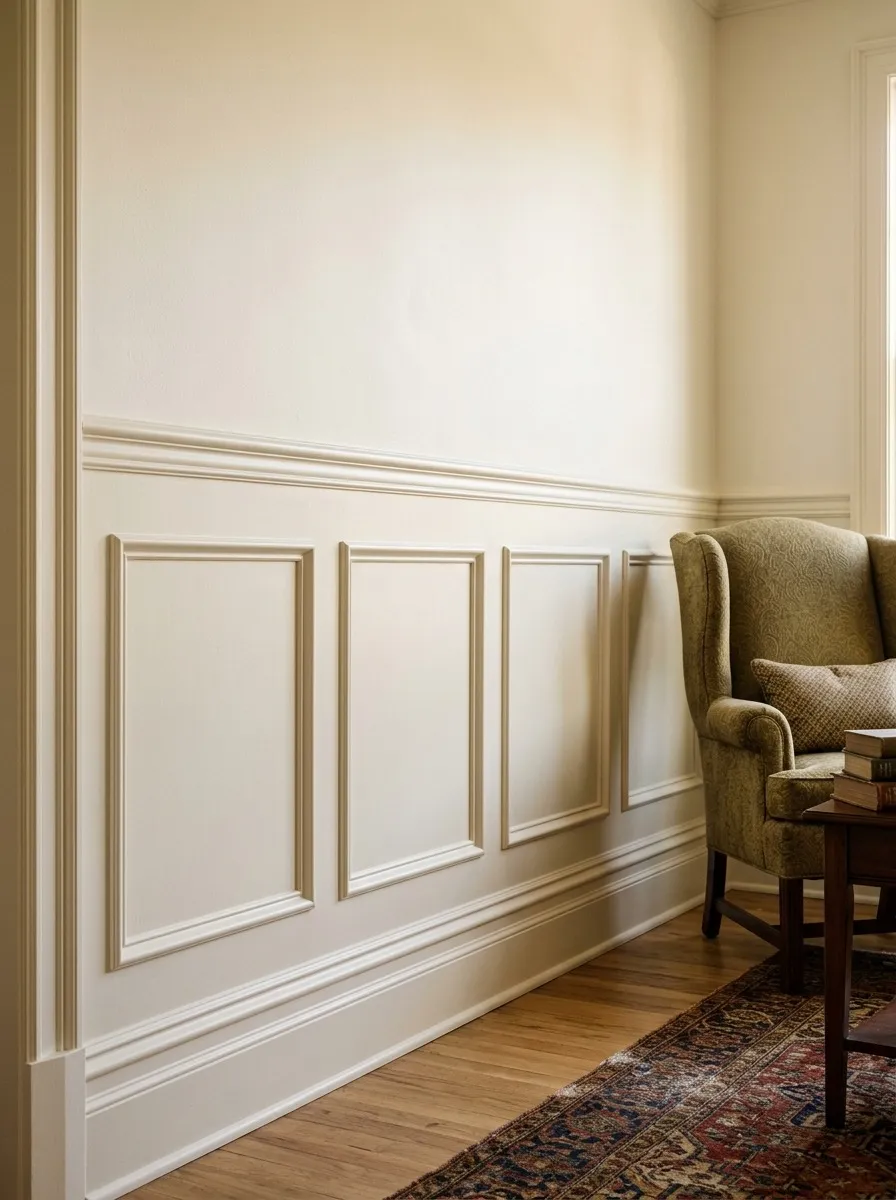
Wainscoting began as practical protection against damp and chair-back scuffs in Georgian halls, then became decoration in New England Federal houses. Set the chair rail at about one third of the wall height, usually thirty-two to thirty-six inches, and use raised or recessed panels painted a warm white or a deep color in your room. The mistake that makes a traditional interior feel like a franchise is a rail hung at half the wall height, which leaves tall, thin panels that look like a hotel corridor. Wainscoting in a traditional living room also gives you a scuff-resistant lower wall, which suits the layered, lived-in rooms Mark Hampton made familiar. Paneling has outlasted every wallpaper fashion because proportion, once it’s correct, never needs updating.
3. The Fireplace Decisions Behind the Best Traditional Living Room Ideas, and the Ones Most Homeowners Never Make
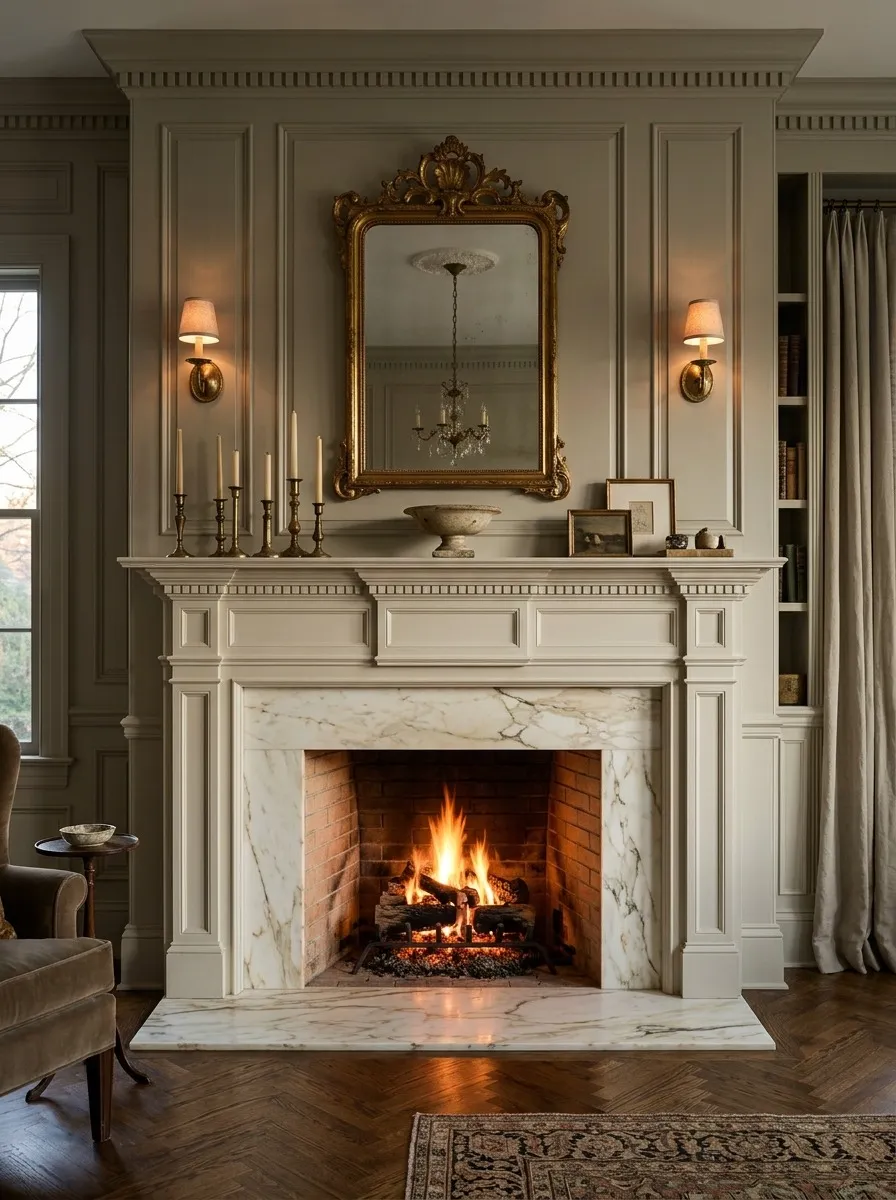
Hearths organized every Southern colonial and New England Federal room, and the mantel served as the facade that announced the room’s seriousness. In a traditional living room with fireplace, let the mantel shelf overhang the surround by two to four inches on each side, choose painted wood, marble, or limestone, and hang a mirror or oil painting about two thirds the shelf’s width with its lower edge a few inches above it. The mistake most homeowners make is hanging a television over the hearth or floating a tiny surround on a wide wall, which proves the room was built around a screen. Traditional living room mantel styling in your room works in odd numbers: a pair of candlesticks flanking a low bowl, one trailing branch, and the painting doing the vertical work. A fireplace that’s been designed around rather than merely accommodated has outlived central heating, gas, and electric light, which tells you the hearth was never really about warmth.
The Historian’s Design Note: Hearth Before Furniture
- ❦ The Georgian chimneypiece sat on the room’s central axis so every seat could face it, and the arrangement of the entire room followed from that single decision.
- ❦ A honed white marble surround or a hand-carved painted pine mantel honors the heritage far better than a thin veneer ever could.
- ❦ A flat-faced faux-stone insert with a bare shelf and no surround is the pastiche version, and it reads as a showroom display.
- ❦ In an apartment without a working chimney, install a painted wood mantel with a marble-look surround and an electric insert, then style it exactly as if it burned.
4. Hang the Drapery Higher Than Feels Reasonable: A Traditional Living Room Window Treatment Rule
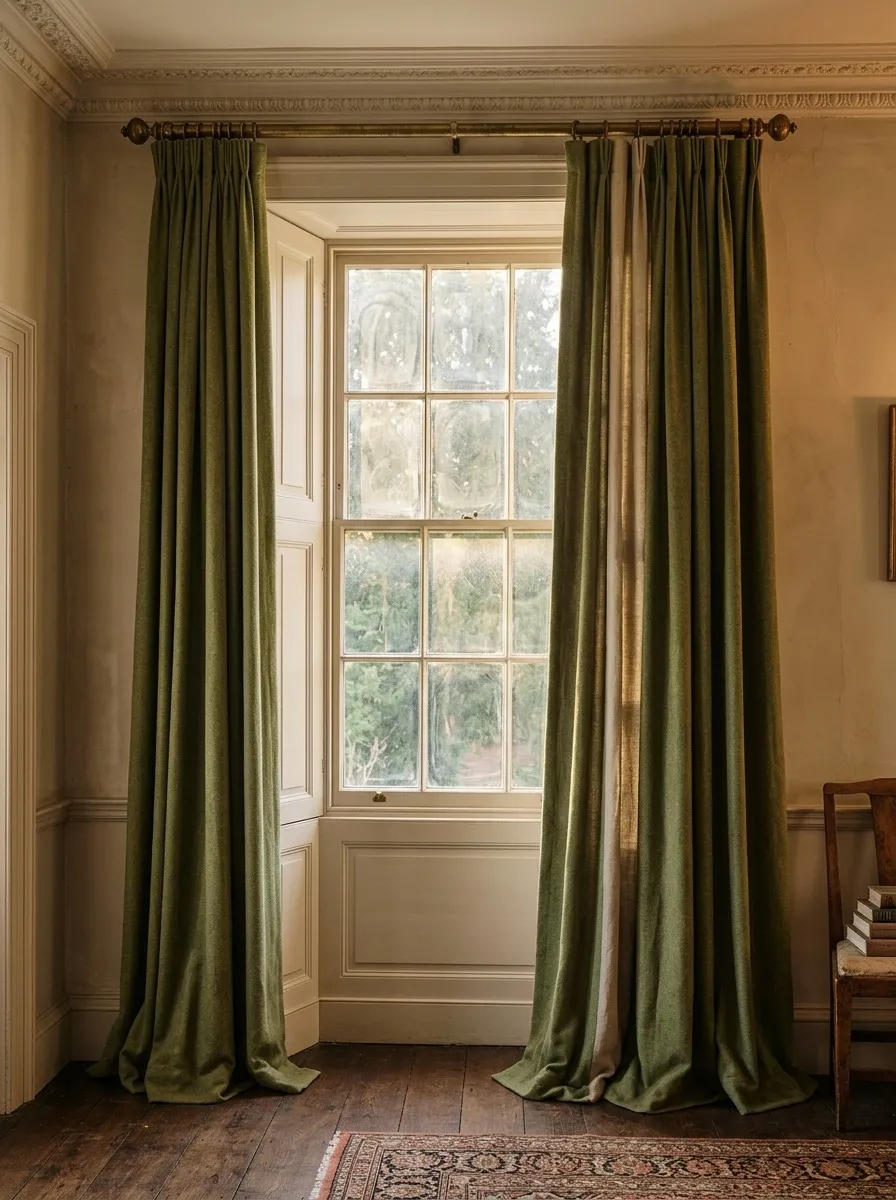
Georgian sash windows were tall by design, and the drapery that framed them was hung to exaggerate that height rather than to cover the glass. In your room, mount the rod within four inches of the ceiling or crown molding, extend it twelve to fifteen inches beyond the frame, and let lined panels touch the floor or break just slightly. Hanging drapery at the top of the window frame is the heritage mistake, because it shortens the wall and announces a ready-made curtain. A traditional living room window treatment works as a layered system, with a pinch-pleat panel over a plain roman shade, and lined panels from Pottery Barn or Ballard Designs can do the job when they’re hung correctly. Drapery has outlasted every blind and shade because it’s the one element that adds architecture, softness, and sound control at the same time.
5. Built-In or Freestanding? The Traditional Living Room Bookcase Question, Answered by Its History
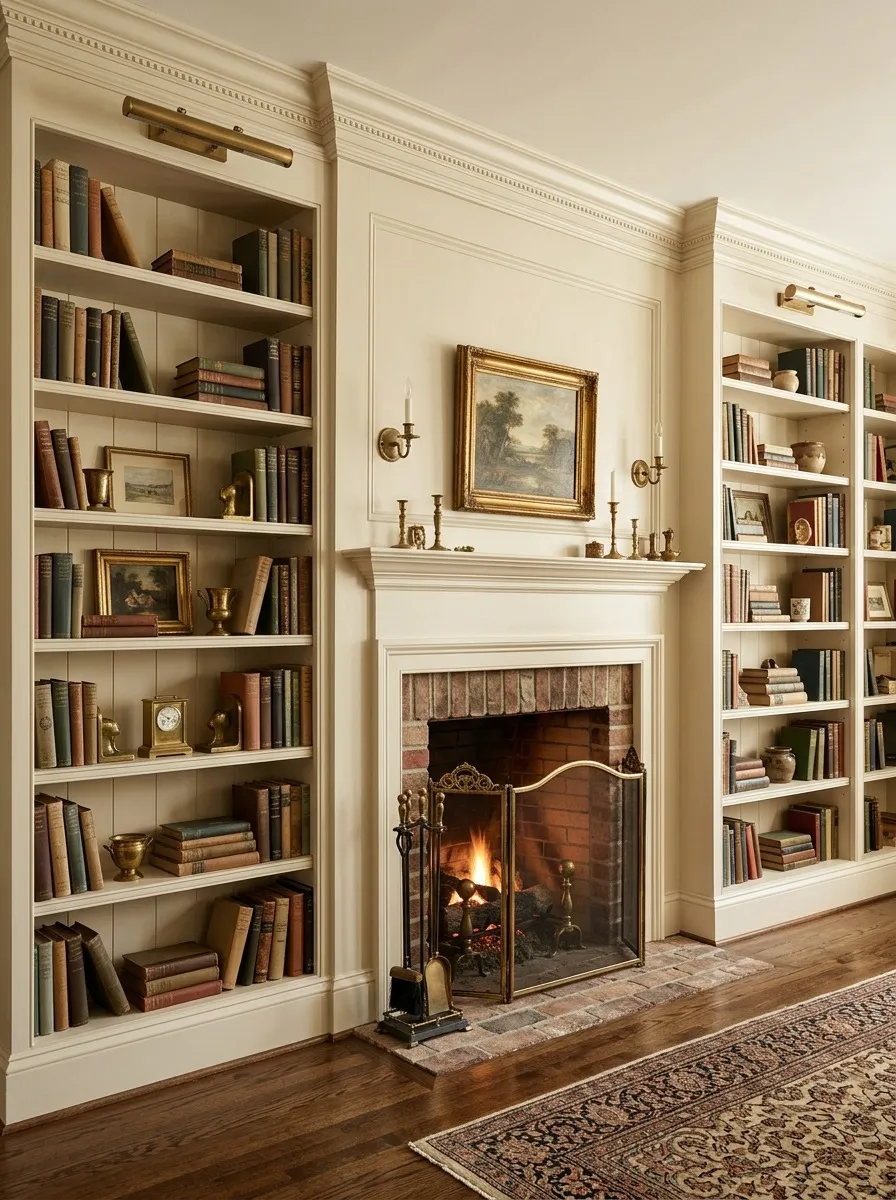
Libraries carried status in Federal houses, where a glass-doored case told every caller that the household read and, more importantly, owned. Flank the fireplace with built-ins painted the wall color, or place a pair of freestanding walnut or mahogany breakfronts against the longest wall, and style each shelf at roughly two parts books to one part objects. Shelves packed edge to edge with identical jackets read as a showroom, while shelves with no books at all read as a staged apartment, and neither one convinces anyone that your room is lived in. A traditional living room bookcase works best when horizontal stacks break up the vertical rows, and a framed miniature or brass candlestick sits where the eye wants to rest. The bookcase has survived because it’s the only architectural element that gets better the more life it’s asked to hold.
🏛️ The Traditional Living Room Architecture Checklist: What to Add, What to Restore, and What to Work Around
Of all traditional living room ideas, the architectural ones are the hardest to reverse and the easiest to get wrong, so assess the shell before you buy a single piece.
IF YOU HAVE THESE ALREADY:
- Original crown molding: repair gaps with caulk and repaint in a flat or satin finish, never gloss.
- A chair rail or paneled wall: restore the original rail height and match the sheen of the trim.
- A plaster ceiling medallion: clean it, repaint in the ceiling’s warm white, and center the chandelier on it.
- A working fireplace: keep the original surround, clean the firebox, and style the mantel in odd-numbered groups.
IF YOUR ROOM IS ARCHITECTURALLY PLAIN:
- Crown molding: it gives the room a defined ceiling line and the single largest jump in formality.
- Drapery hung near the ceiling: it adds apparent height without touching a wall.
- A chair rail with simple wainscoting: it grounds the lower wall and protects it.
- A painted mantel or a pair of built-in bookcases: they create the focal structure the room lacks.
WHAT CANNOT BE FAKED: A working masonry fireplace with a real chimney breast, and original plaster walls with their soft, slightly uneven surface.
THE SINGLE HIGHEST IMPACT ADDITION: A stepped crown molding traditional living room walls can hang their entire proportion from changes a plain room more dramatically than any other single architectural element.
A traditional living room is built on design principles that predate any trend, and our living room design principles guide covers the foundational layout decisions that make any living room work regardless of the aesthetic.
Heritage Layer 02: Furniture The Pieces That Carry the Room’s Design Intention
Furniture is the layer that carries a room’s design intention into daily use, and in American traditional homes it was bought slowly, one considered piece at a time. A Southern colonial family or a New England merchant furnished a room across decades, which is exactly why the vocabulary rewards patience.
6. Why the Traditional Sofa Is Never the Newest Thing in the Room and That Is Precisely the Point
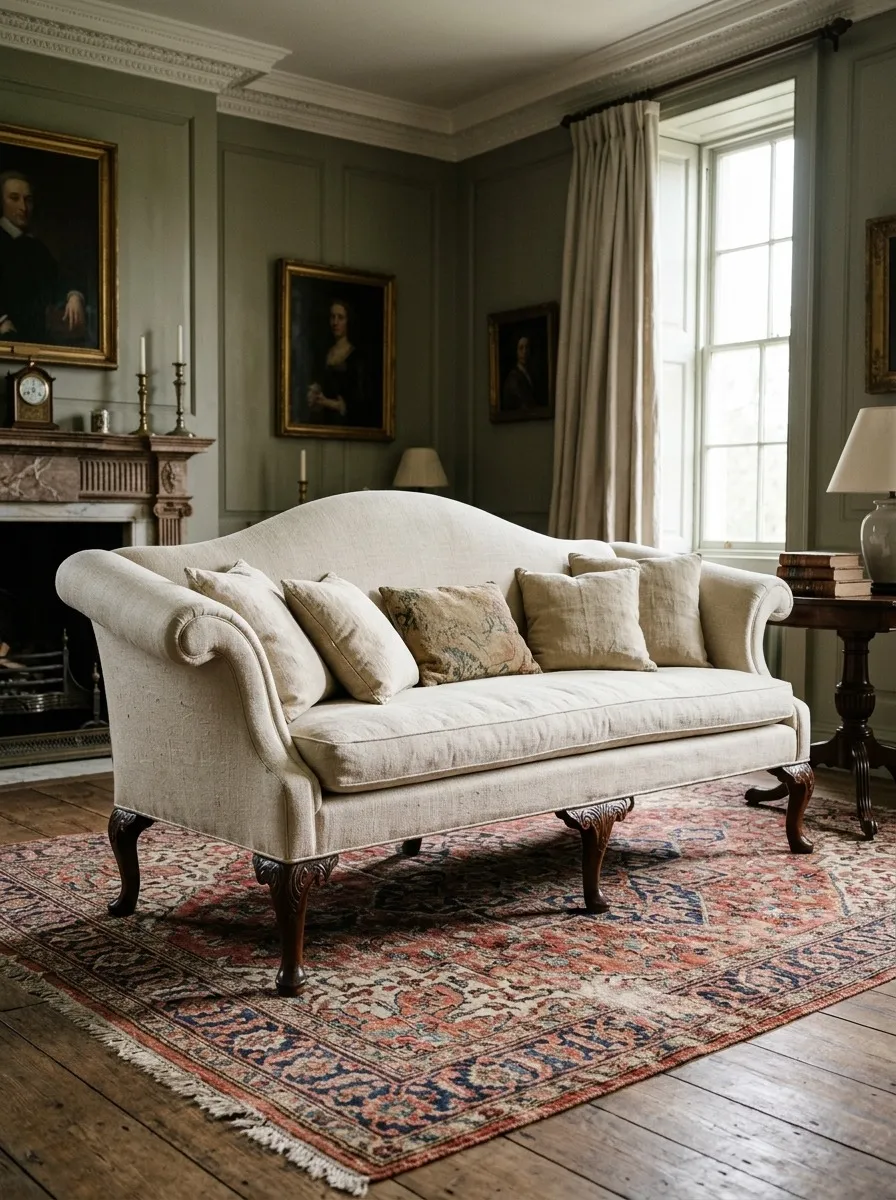
Frames were built to be reupholstered and handed down, which is why the traditional sofa is never the newest thing in the room, a habit Sister Parish made central to the American country-house look. Choose a camelback or rolled-arm sofa for your room, eighty-four to ninety-six inches wide in linen, cotton velvet, or a tight-weave performance fabric in cream, oatmeal, or deep green, with a loose, down-wrapped seat cushion. The heritage mistake is a low, boxy sectional with track arms, which doesn’t belong to this register and flattens every carved leg around it. Ethan Allen and Ballard Designs both build reliable camelback sofa traditional style frames, while a chesterfield sofa traditional interior suits a library-leaning room in leather or deep velvet. A sofa that looks slightly older than the room around it has always been the point, since it signals a household that sits rather than stages.
7. The Wingback Chair Has One Job in a Traditional Room, and Its Color Decides Whether It Does It
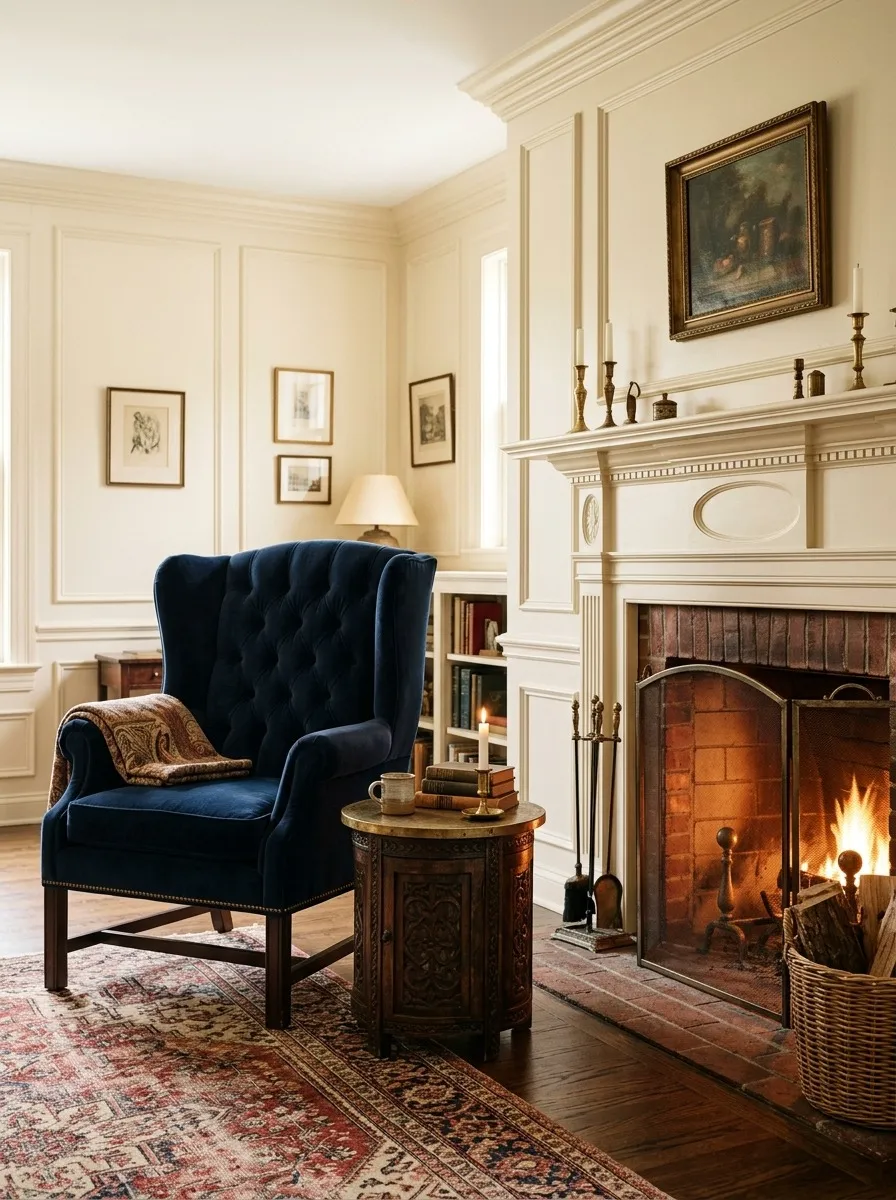
English fireside rooms gave us the wingback, whose winged sides were designed to keep drafts off a sitter near the hearth. Pair two wingbacks facing the sofa across the coffee table, or place a single one beside the fireplace with a small drum table, and upholster it in a color that differs from the sofa, such as navy, hunter green, or warm gold velvet. The mistake isn’t the chair, it’s the matched suite, a sofa and two chairs in identical fabric bought together, which turns a collected room into a catalog page. A wingback chair traditional room scheme gains its depth when one chair carries a small-scale stripe on the back and solid color on the seat, and RH and Anthropologie Home both offer well-scaled frames. The wingback is the chair that reveals whether your room was composed or merely ordered, which is why its color decides everything.
8. A Coffee Table Is Where a Traditional Living Room Keeps Its Receipts
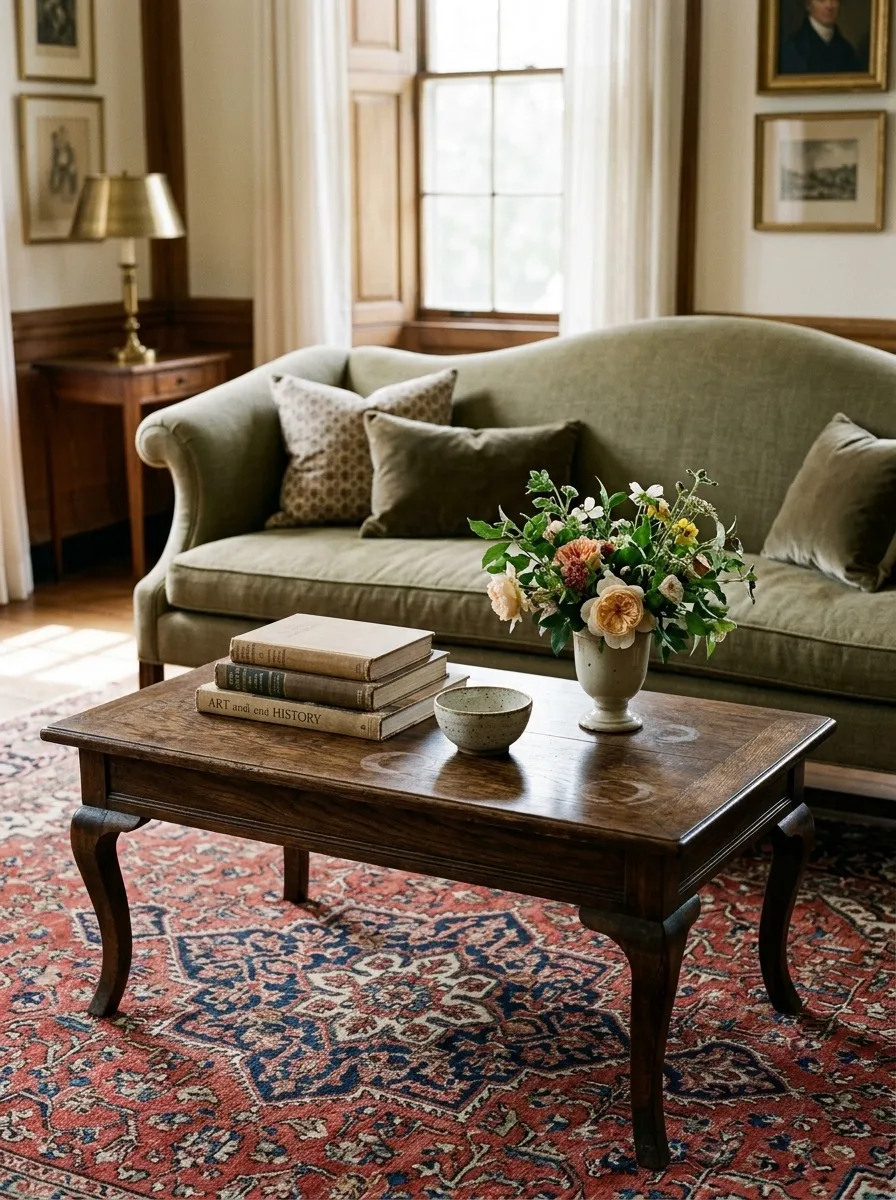
Coffee tables are a recent invention, so traditional rooms reached for what they already had: a low tea table, a leather ottoman, or a tray set on stools. Choose a dark walnut or mahogany table about two thirds the length of the sofa and seventeen inches high, or a tufted leather ottoman topped with a tray, and dress it with a stack of books, a small bowl, and flowers. The mistake is a glass top, which exposes the legs and makes heritage furnishings look nervous. Traditional living room furniture generally prefers surfaces that can age, so a wood top with a few honest watermarks reads as inherited rather than purchased. A table that can hold a drink, a book, and a bowl of fruit without ceremony is the one that’s stayed in your room.
9. One Genuinely Old Piece Changes Everything in Traditional Living Room Decor
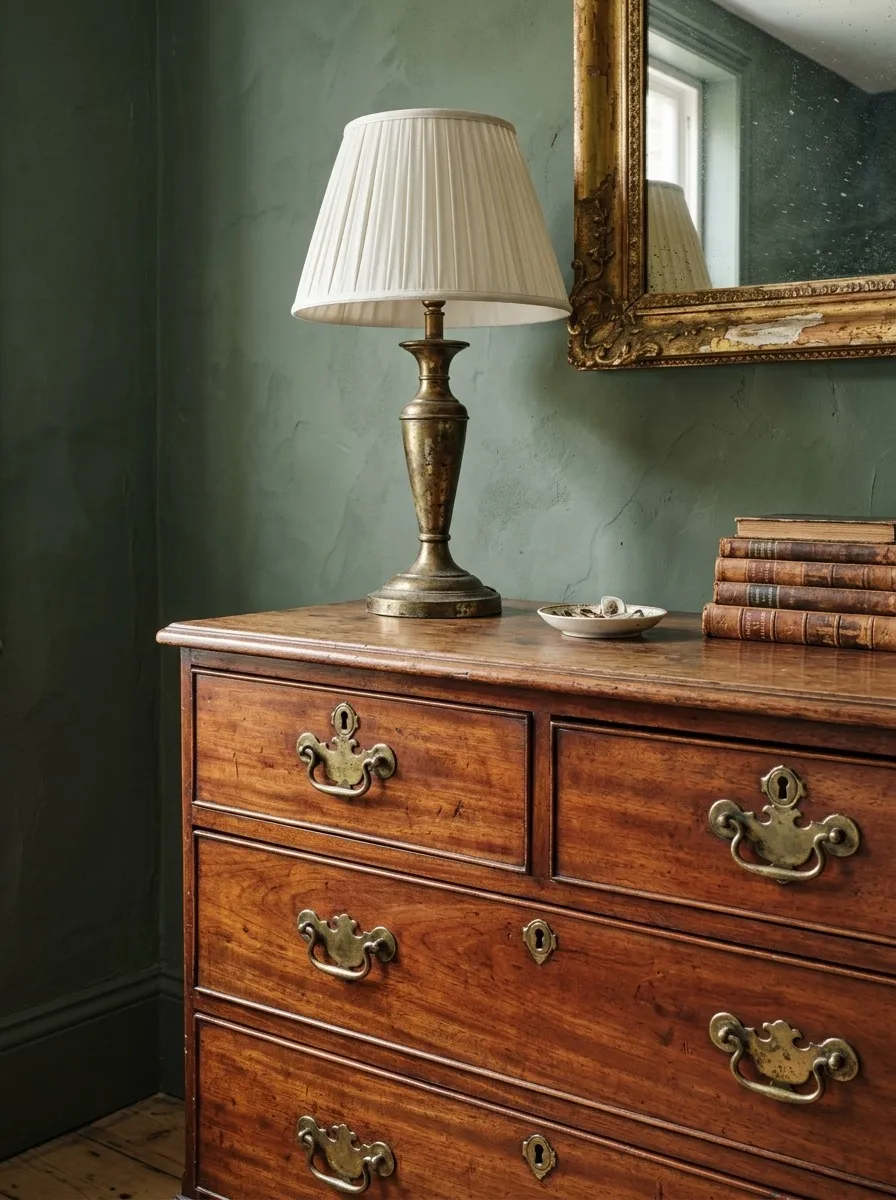
Early American rooms were furnished by inheritance, so a single old chest or secretary sat beside newer pieces without apology. In your room, let one genuinely old piece lead, whether it’s a chest of drawers, a drop-front desk, or a tavern table, and set it against the strongest wall with newer upholstery stepping back around it. The mistake is buying a complete reproduction suite where everything is equally new, or the opposite, an all-antique room that reads as a shop. Antique furniture traditional room guides always recommend mixing eras, and One Kings Lane and local estate sales are dependable sources for a traditional living room on a budget. One authentically aged surface gives the entire room a patina that new money can’t fake.
10. Persian, Oriental, and the Pattern Families That Belong Under Traditional Living Room Furniture
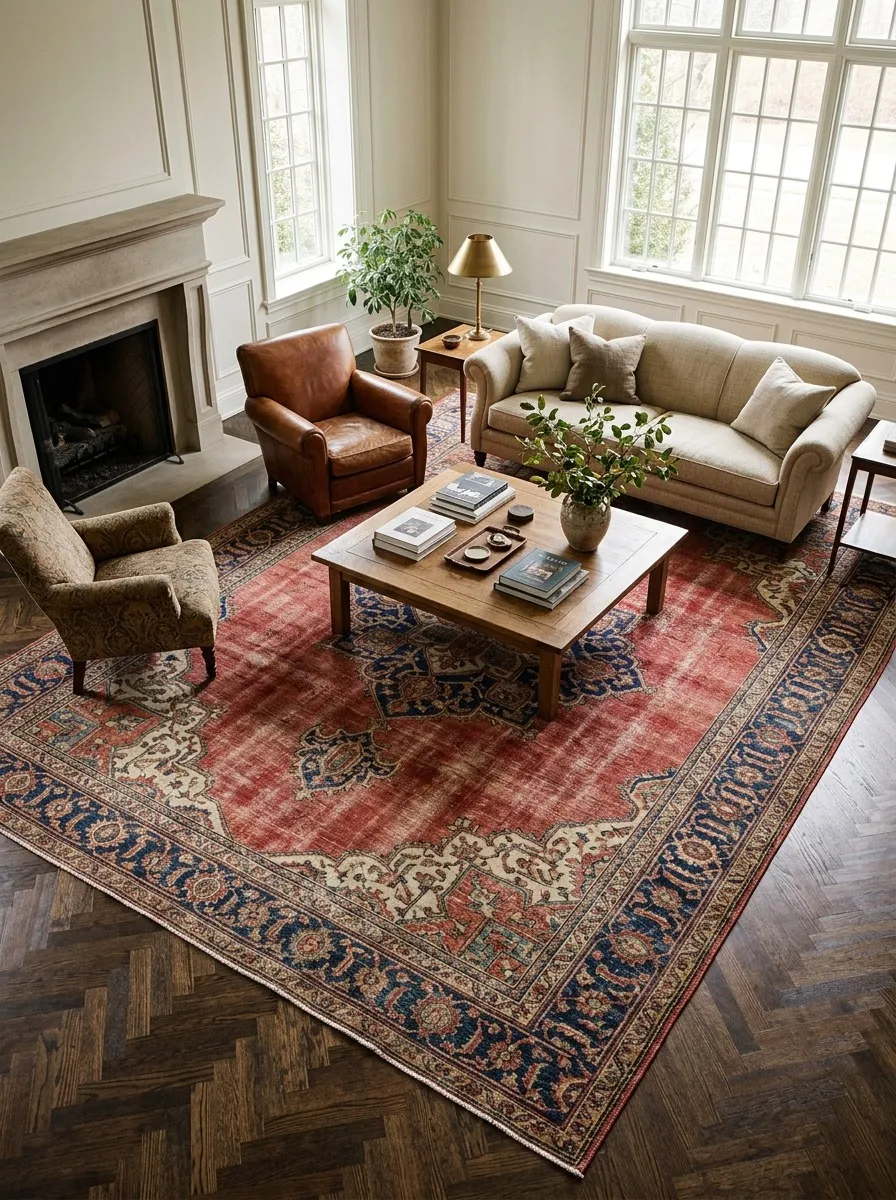
Persian and Oriental rugs crossed the Atlantic as trade goods and settled on American floors in Southern parlors and Boston drawing rooms alike. Size the rug so the front legs of every seating piece rest on it, typically eight by ten or nine by twelve, in a faded red, navy, or rose field with a medallion or an allover Herati pattern. The mistake is a rug that floats in your room’s center like a placemat, or a flat-woven geometric whose scale belongs to another decade of decorating. A Persian rug traditional living room scheme tolerates wear, and worn vintage rugs make some of the best traditional living room rug ideas for families with pets and children. A rug that improves with traffic is the one floor covering that’s never needed replacing for fashion.
The Historian’s Design Note: Pattern Outlasts Fashion
- ❦ Persian weavers developed the medallion and Herati designs, and American importers fixed them as the default floor of the formal room.
- ❦ Hand-knotted wool on a cotton foundation with natural dyes honors the heritage, and well-made wool reproductions from Ballard Designs or Pottery Barn come close.
- ❦ A printed polyester “vintage” rug with a manufactured distressed look is the pastiche version, and it flattens within a season.
- ❦ In an apartment, layer a smaller vintage Persian over a plain seagrass base, or buy one good reproduction in wool rather than three cheap ones.
11. Symmetry: The Rule, the Exception, and Why Most Traditional Interiors Get It Wrong
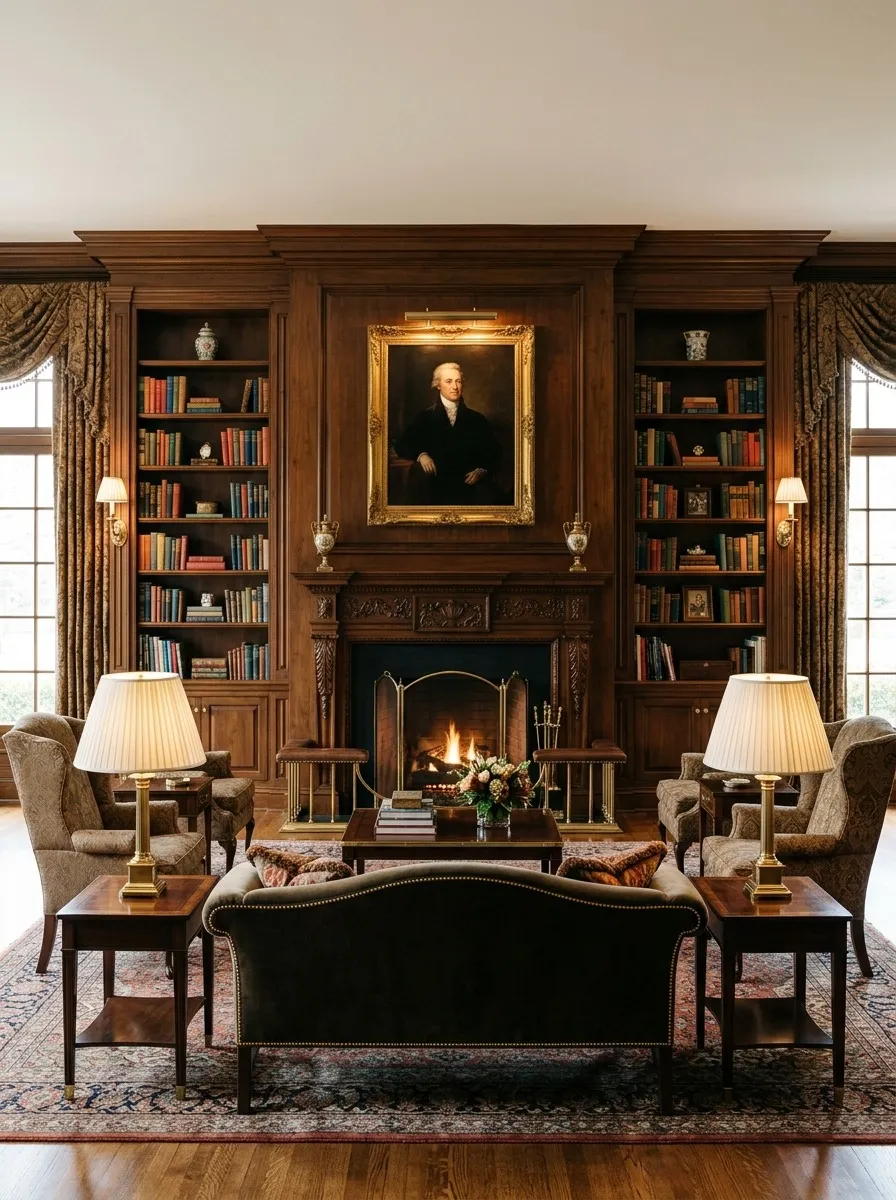
Georgian planners treated proportion as moral order, so symmetry sat at the center of every formal room, and American builders who followed the pattern books inherited it. Place symmetry where it counts, at the hearth wall and across the sofa, with matching lamps, matching sconces, and paired chairs, and let the rest of your room drift naturally. The most common mistake is applying symmetry everywhere, which makes the room formal in the cold sense, or abandoning it altogether, which leaves the room unfinished. Traditional living room symmetry is a structure rather than a rule, so an off-center window or doorway can be answered with a tall plant, a lamp, or a floor screen. Albert Hadley’s rooms show that a space needs one place where everything agrees, and the rest can then afford to disagree.
🛋️ The Traditional Living Room Furniture Placement Guide: The Symmetry Rule, the Exception, and the Decision That Ties It Together
Traditional living room furniture earns its place by how it’s arranged as much as how it’s made, and the best traditional living room ideas start with the plan before the purchase.
THE SYMMETRY RULE: Symmetry is required at the hearth wall and across the primary seating group, with matched lamps, paired chairs, and balanced sconces on either side.
THE EXCEPTION: Asymmetry is permitted in secondary zones, such as a window seat or a reading corner, as long as the main axis stays balanced and both sides carry roughly equal visual weight.
THE ANCHOR DECISION: The fireplace is the primary anchor, and when there isn’t one, the sofa takes its place and everything else is positioned from that choice.
SOFA PLACEMENT: Face the sofa toward the fireplace or run it parallel to the longest wall, with at least thirty inches of walking space behind it if it floats.
CHAIR RELATIONSHIP: Angle chairs slightly toward the sofa and set them eighteen to twenty-four inches from the coffee table’s corners so conversation doesn’t require raised voices.
COFFEE TABLE DISTANCE: Leave fourteen to eighteen inches between the sofa’s edge and the table.
THE RUG RULE: The front legs of every seat rest on the rug, with twelve to eighteen inches of bare floor visible around its border.
The sofa in a traditional living room is never a neutral decision, since it carries the room’s design intention more than any other piece, and our traditional sofa selection guide shows the specific styles, materials, and proportions that earn their place in a traditional interior.
Heritage Layer 03: Pattern and Textile The Visual Language That Has Spoken the Same Words for Two Centuries
Pattern is the visual language American traditional rooms inherited from English chintz, French printed cotton, and Chinese export trade, and it has spoken the same words for two centuries. The vocabulary stays small on purpose, which is exactly why a few patterns used well read as confident rather than busy.
12. The Pattern That Has Appeared in Traditional Living Rooms for Two Hundred Years and Shows No Sign of Leaving
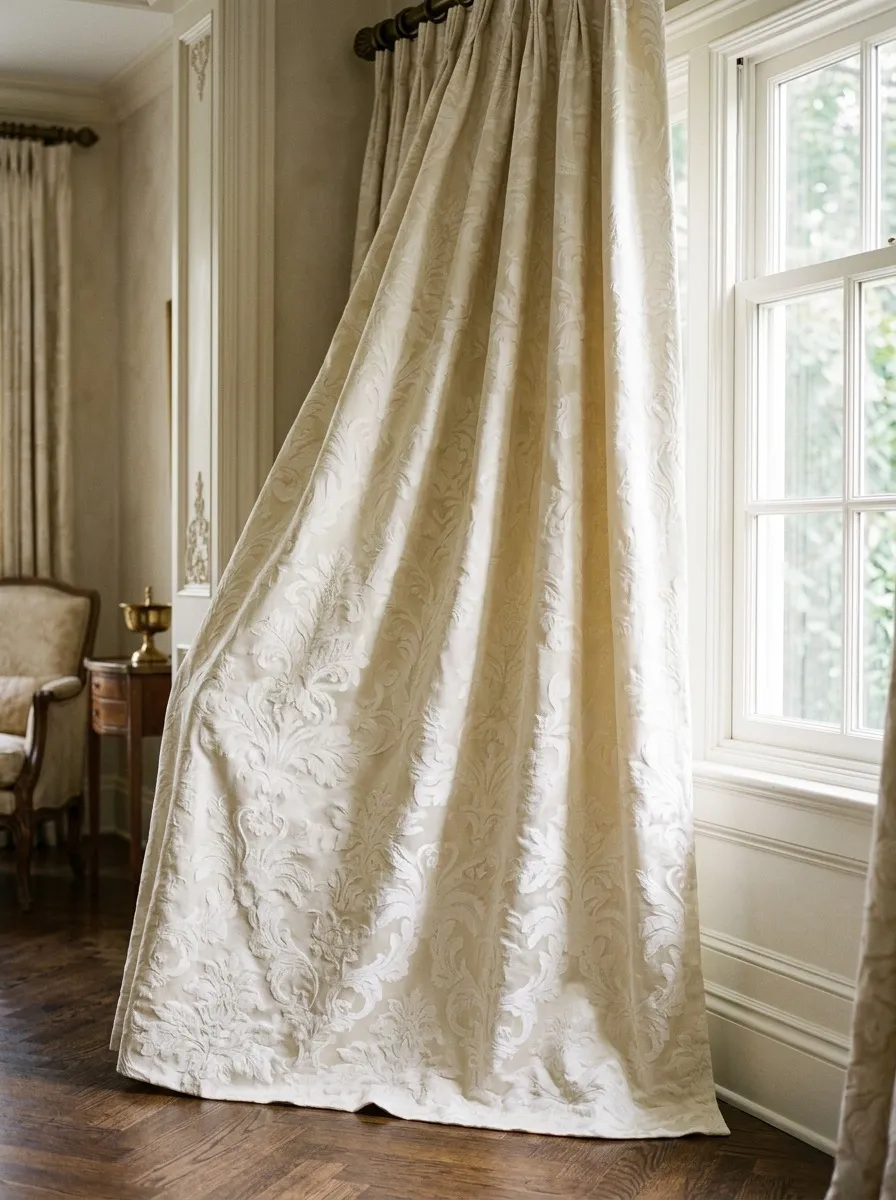
Damask arrived through Venetian and French weavers who borrowed the technique from Damascus, and by the Federal period it was upholstering American parlors from Charleston to Boston. Choose a tone-on-tone damask in ivory on cream, navy on ivory, or green on gold for drapery or an armchair, keeping the repeat between eight and twelve inches. The heritage mistake is a high-contrast black-on-white printed damask, which belongs in a hotel lobby rather than your room. A damask pattern traditional interior works best when it’s woven rather than printed, because the sheen shifts with the light across the day. Damask has survived because it’s the one pattern that behaves like a texture whenever a room needs it to.
13. Toile Was Never Meant to Cover Every Surface: Its Correct Use in a Traditional American Living Room
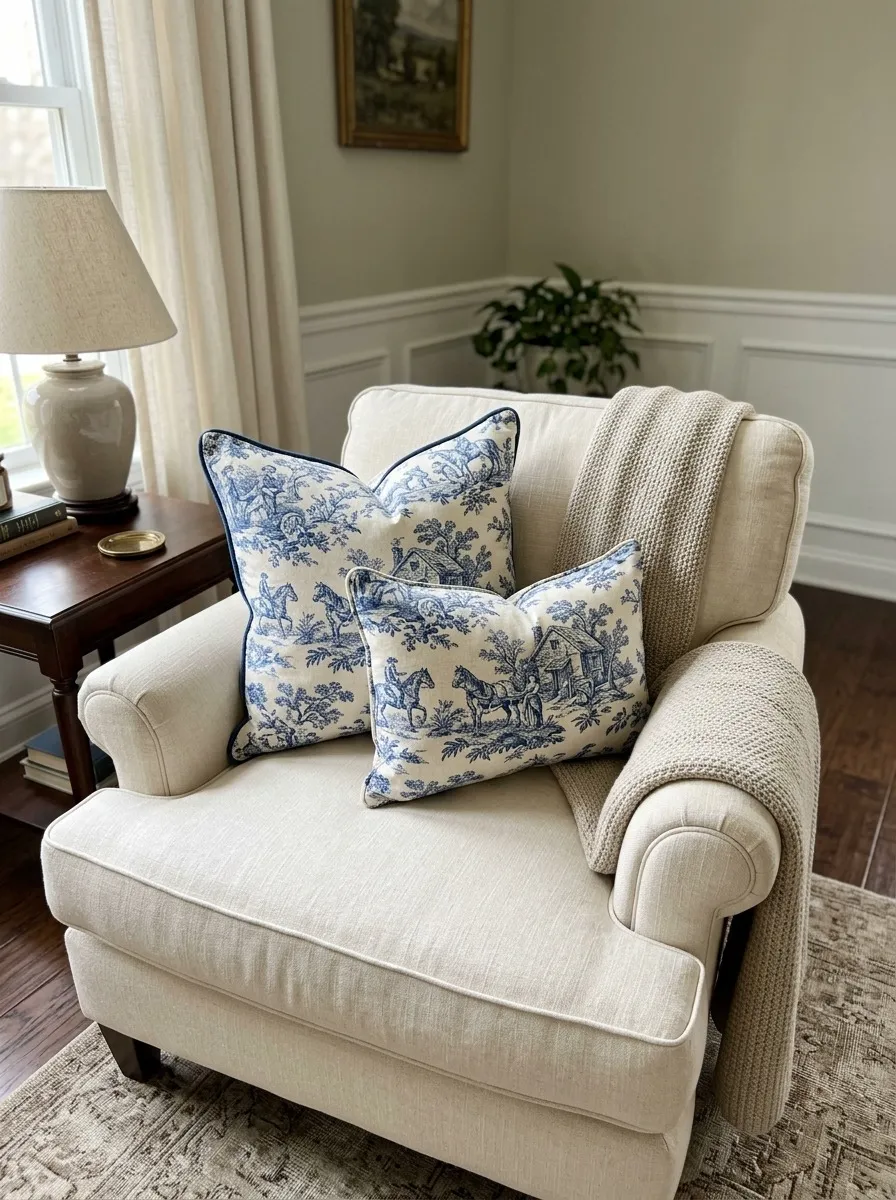
Toile de Jouy began as a French printed-cotton tradition of pastoral scenes, and American households adopted it to bring provincial warmth into Federal rooms. Use it in one place only in your room: a pair of drapery panels, a single armchair, or a set of pillow covers in blue, red, or green on cream. The mistake is toile on the walls, sofa, curtains, and pillows at once, which turns a heritage reference into a theme room. Ballard Designs and Pottery Barn both sell toile pillow covers that introduce the pattern in a traditional American living room without commitment. Its pastoral scenes have outlasted every minimalist decade because they tell a small story, and rooms haven’t stopped being grateful for stories.
14. Plaid and Tartan: A Heritage Connection Worth Understanding Before It Enters a Traditional Style Living Room
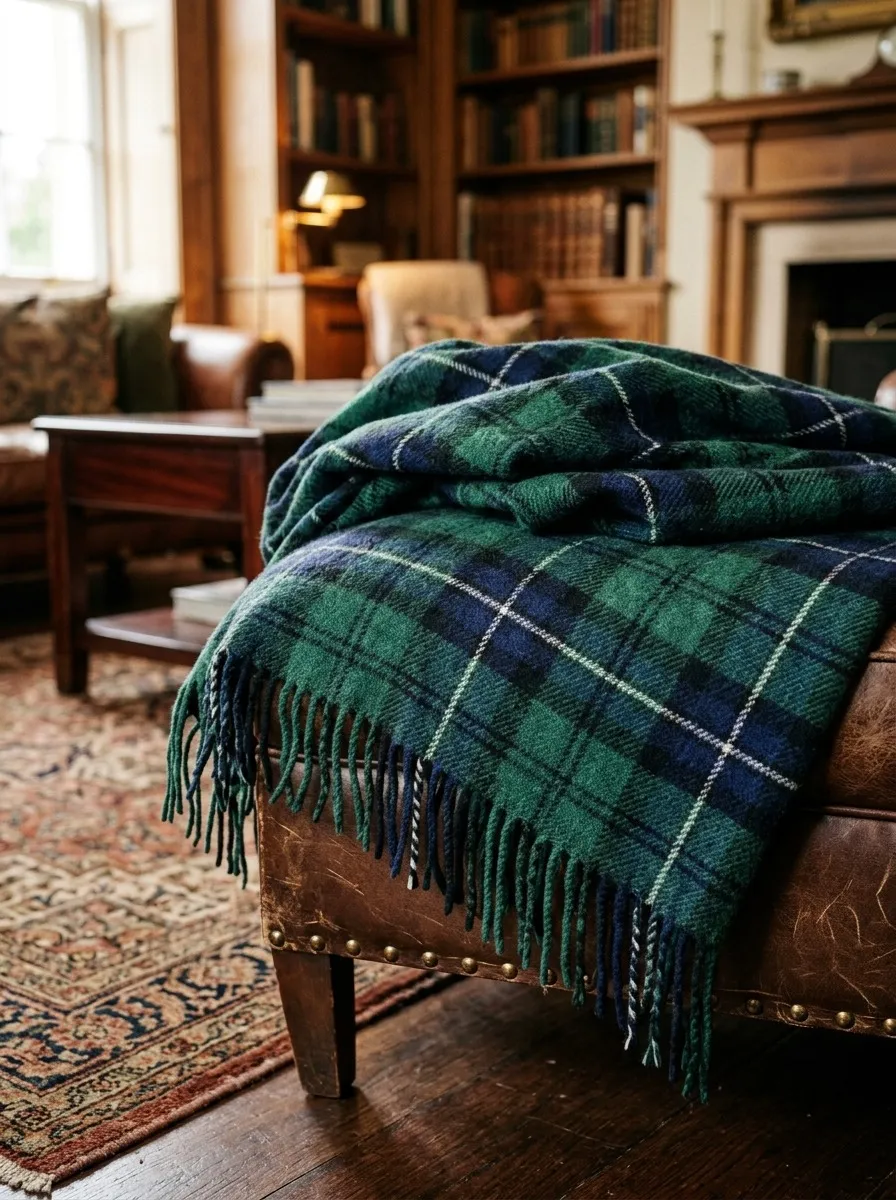
Tartan entered American rooms through Scottish emigrant households and later through the equestrian and hunting vocabulary of country houses. Use a wool plaid in your room as a throw, an ottoman, or a single armchair in hunter green and navy with a thin line of red, keeping the scale large and the repeat soft. The mistake is a bright holiday plaid or a synthetic one with an artificial sheen, which reads as seasonal costume. A traditional style living room tolerates plaid best as a seasonal swap, with a wool throw replacing a linen one when the weather turns. Plaid keeps returning because it’s the one pattern that makes formal furniture look comfortable.
15. Stripe, Scale, and the Narrow Window in Which It Reads Correctly
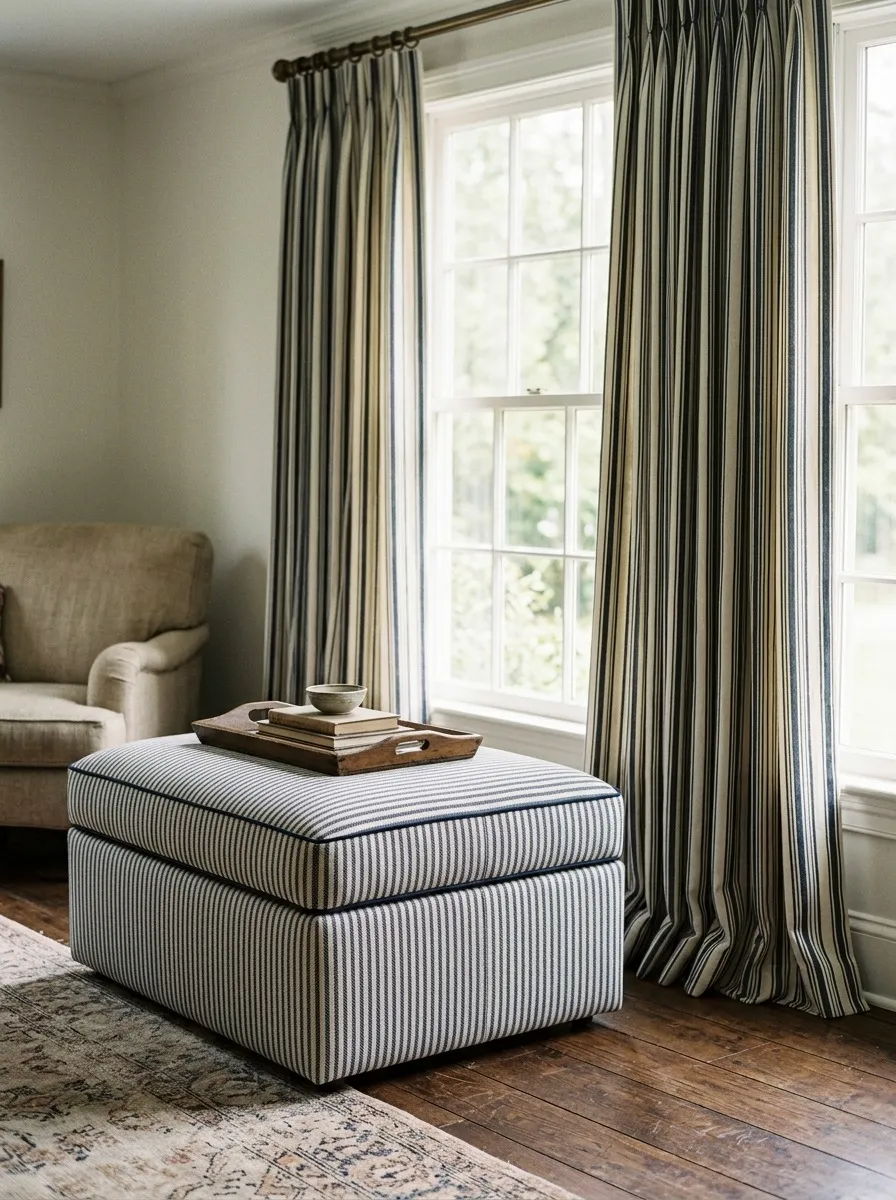
Stripes already covered Federal chair seats and Regency-influenced upholstery, and they’ve turned up in American parlors ever since. Use a half-inch ticking stripe on an ottoman or a three-inch stripe on a pair of drapery panels, in navy and cream or green and ivory, running vertically to lift your room. The mistake is a narrow stripe on a large sofa, which vibrates, or a wide stripe on a small chair, which swallows it. Among formal living room ideas traditional layouts depend on, stripe is the pattern that calms a floral by giving the eye a place to rest. Stripe endures because it’s the rare pattern that organizes a room instead of merely decorating it.
16. Which Drapery Fabric Earns Its Place in a Traditional Living Room?
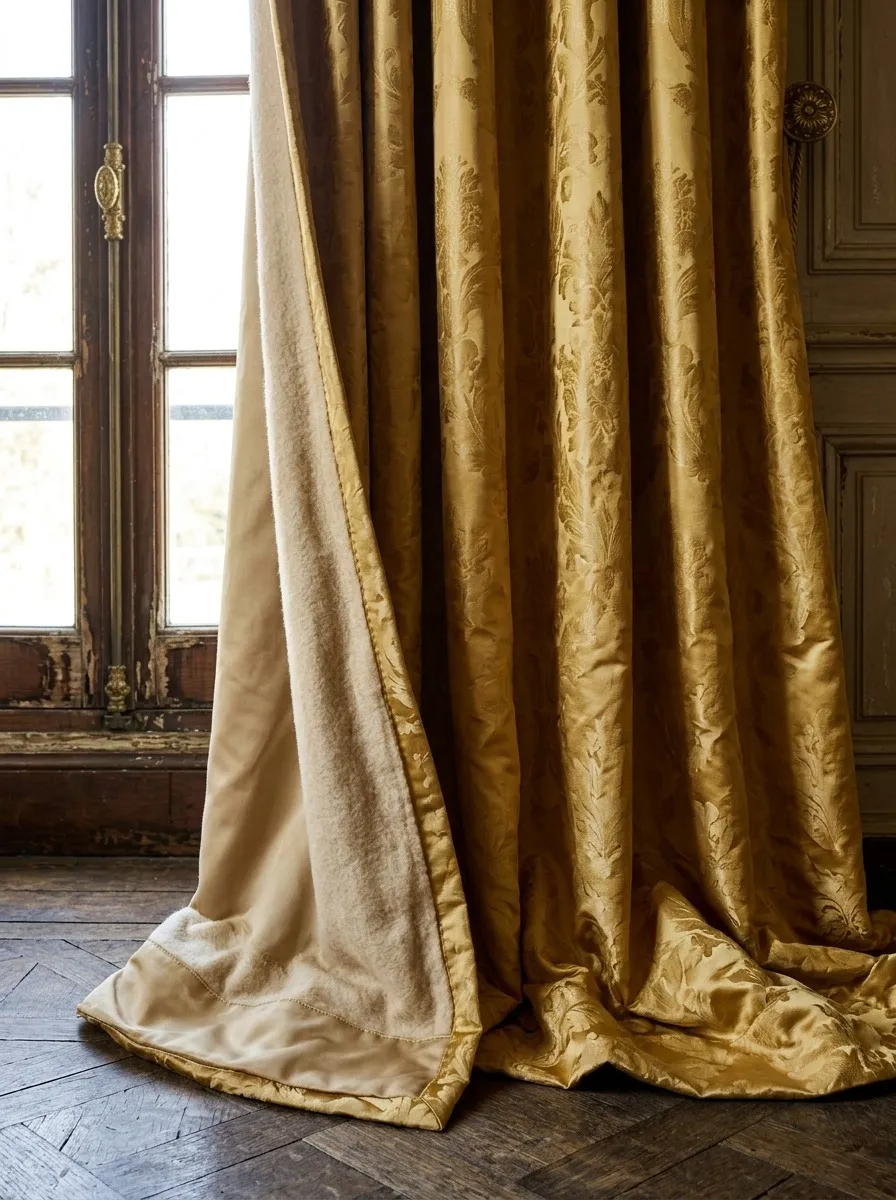
Silk was the drapery fabric of Georgian drawing rooms because it glowed under candlelight, and linen and velvet joined it as American rooms became more domestic. Choose silk taffeta or dupioni in gold, celadon, or ivory for a formal room, linen for a lighter one, and velvet for a library, and always line and interline the panels for weight and sun protection. The mistake is unlined cotton, which lets daylight fade the furniture and hangs without drama. Traditional living room drapes should be interlined and weighted at the hem, and drapery from RH or Ballard Designs performs best when you order generous width for fullness. Fabric weight rather than fashion is why a good pair of drapes outlasts three sofas, and it’s why your room should spend there first.
The Historian’s Design Note: Weight Over Gloss
- ❦ Georgian drawing rooms hung silk because candlelight made it glow, and heavy interlining kept winter drafts at the glass.
- ❦ Silk taffeta or dupioni with a cotton interlining and a weighted hem, or a heavy linen in a neutral, carries the heritage honestly.
- ❦ Thin polyester “silk” panels with a sheen, unlined and tab-topped, are the pastiche version and hang like a shower curtain.
- ❦ Order custom-width panels from a workroom or buy a ready-made lined pair from Pottery Barn, then have a tailor weight the hems.
17. Pattern Mixing Works When It Follows a Hierarchy and Fails When It Looks Like a Sample Room
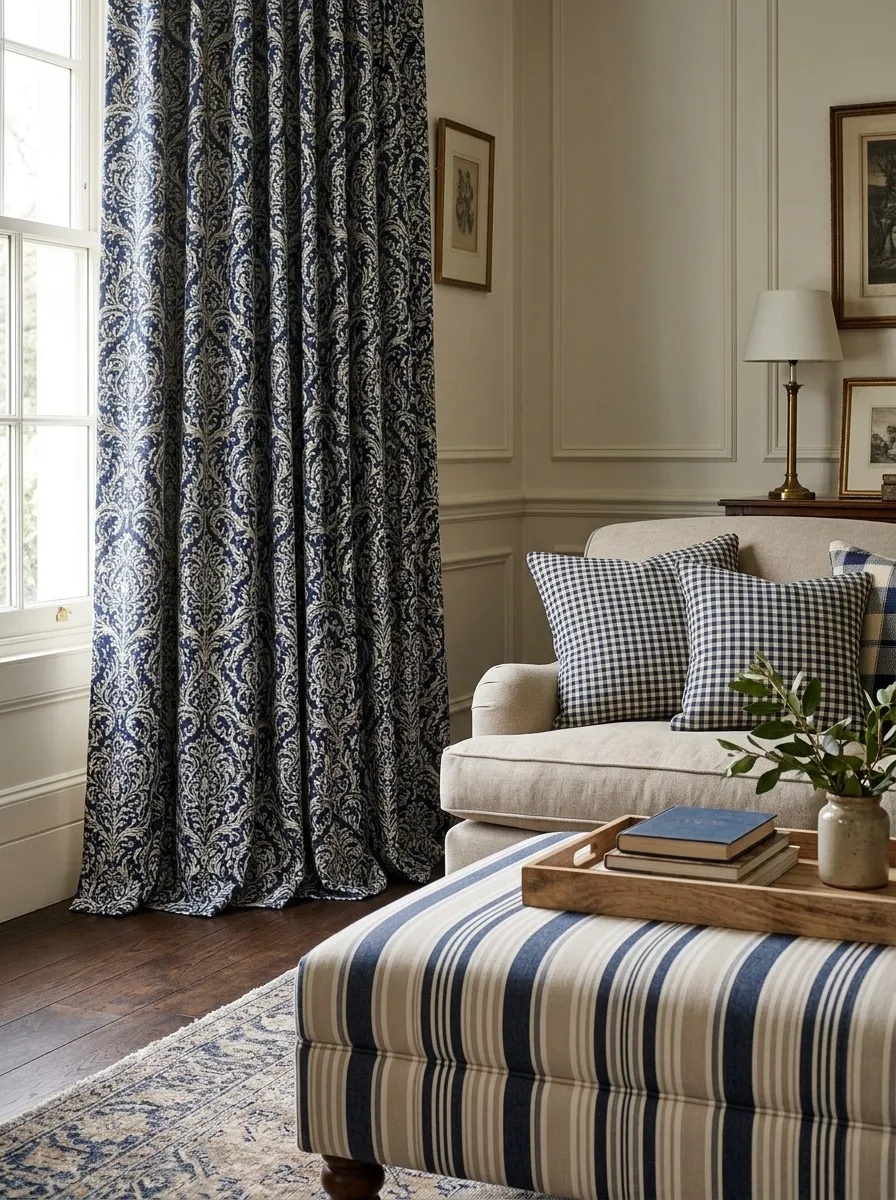
Pattern mixing in the American traditional room goes back to the trade houses of Salem and Charleston, where Chinese export, Indian chintz, and English stripe lived together in one parlor. Use three patterns at three different scales, say a large floral or damask, a medium stripe, and a small check, all within one shared color family. The mistake is buying every pattern from a single matched collection, which produces a sample room rather than a collected one. Pattern mixing in a traditional living room becomes simple when one color repeats across every pattern, and Anthropologie Home and Ballard Designs both sell coordinated-but-not-matched lines. A mixed room has always looked old because it implies a family that never stopped adding, and your room can’t fake that in a single shopping trip.
🎨 The Traditional Pattern Mixing Guide: How the Most Resolved Traditional Rooms Use Multiple Patterns Without Visual Chaos
Among all traditional living room ideas, pattern mixing is the one that most often goes wrong, and it goes right only when a hierarchy is in place.
THE DOMINANT PATTERN (1 in the room): A large-scale floral or woven damask with a repeat of ten to fourteen inches, on drapery or a single upholstered chair, because a damask pattern traditional interior can carry the lead role without shouting.
THE SECONDARY PATTERN (1 to 2): A medium-scale stripe or trellis in the same colors, used on a second chair or an ottoman so it supports the dominant pattern instead of competing with it.
THE TERTIARY PATTERN (1 to 2): A small check, fine ticking, or tiny geometric on pillows or a footstool, scaled to about half the size of the secondary pattern.
THE SCALE RULE: Vary the scale so each pattern is roughly half the size of the one before it.
THE COLOR CONNECTION: One shared color, such as navy or hunter green, makes three different patterns read as a family.
WHAT BREAKS THE SYSTEM: Two large-scale florals in the same sightline, and a toile and a damask in the same colorway at the same scale.
Traditional and enduring living room design share a vocabulary that has been refined across generations, and our classic living room guide explores those foundational principles in the depth they deserve.
Heritage Layer 04: Color The Palette That Signals Intention Before Anyone Reads the Room
Color is the layer that announces intention before anyone has read the room, and American traditional palettes have always leaned on deep pigments that ripened slowly on plaster walls. Heritage paint ranges exist today because those colors were never retired, only set aside and then rediscovered.
18. The Traditional Living Room Ideas Worth Borrowing for Color Begin With Deep Neutrals and Jewel Tones
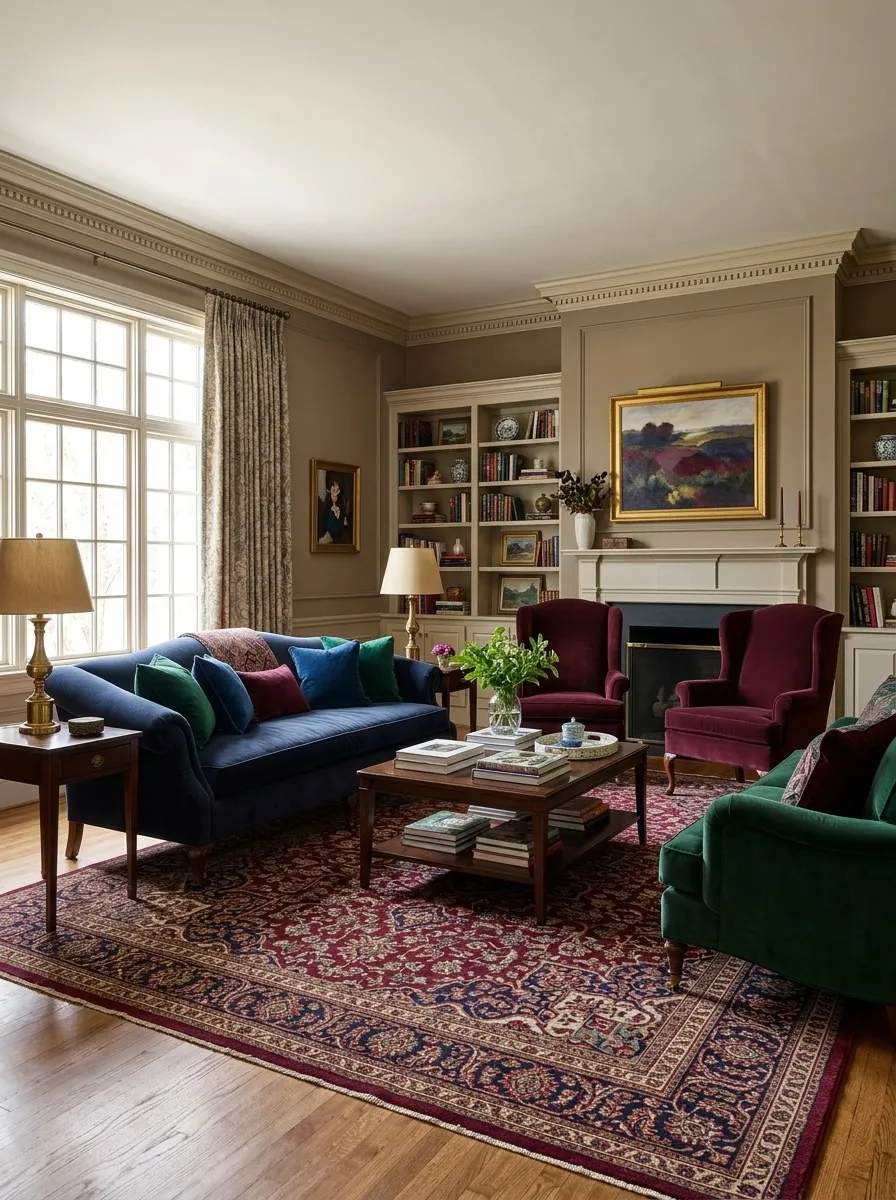
Federal rooms favored deep, mixed pigments such as Prussian blue, verdigris green, and warm putty that deepened as the plaster aged, and the habit has never really left. For color in your room, start with a deep neutral of warm taupe, putty, or stone on the walls and add two jewel tones, navy and hunter, in upholstery and drapery. The mistake is a stark cool gray that fights antique wood, or a white so bright it makes heritage furnishings look dingy. A traditional living room color palette works best when one dark color appears at least three times in your room, so it reads as a choice rather than an accident. Palettes of this kind have outlasted every trend color because they weren’t trends in the first place.
19. Navy: Where It Works in a Traditional Living Room and Where It Turns the Room Into a Men’s Club
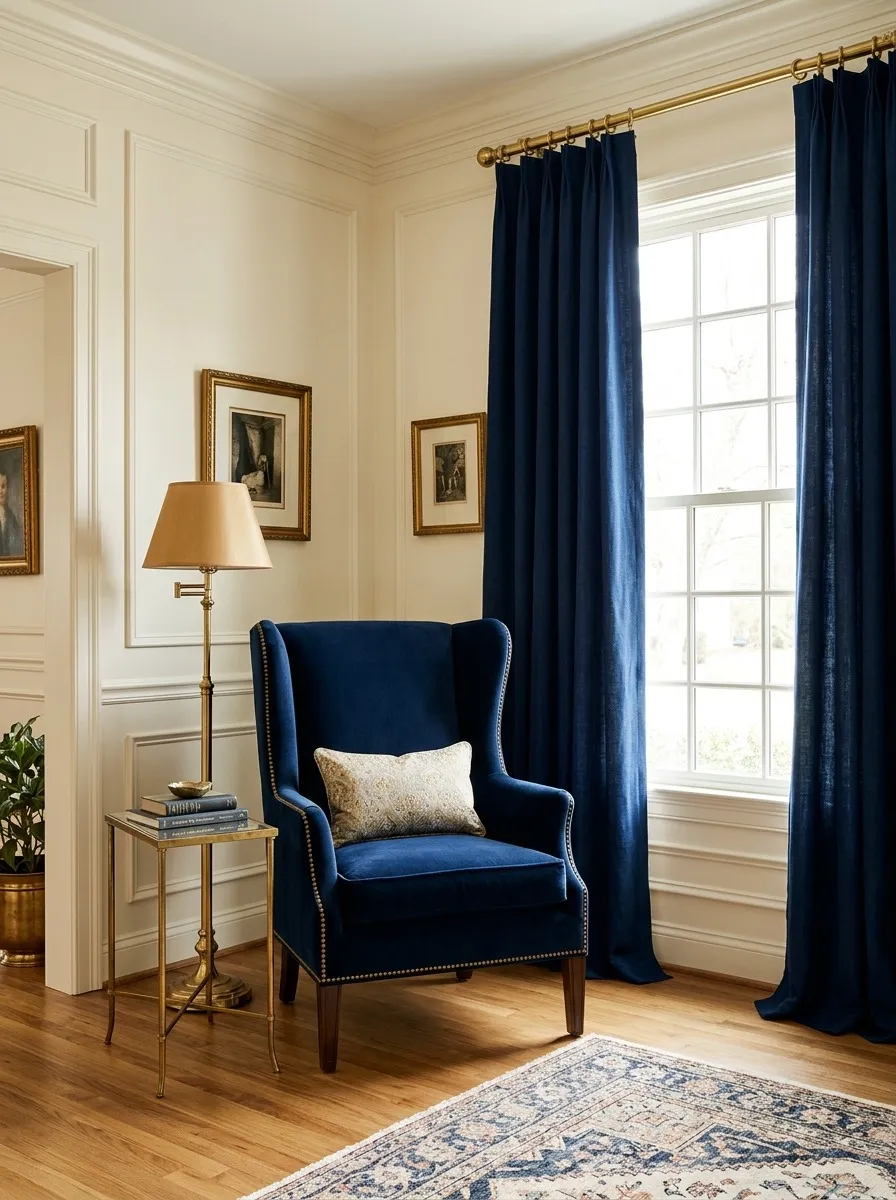
Navy came into traditional rooms through English naval and club culture, and it became a standard deep neutral in American houses because it behaves like black without the weight. Use it on a wingback, a pair of drapery panels, or a lacquered library wall, and pair it with brass, ivory trim, and warm wood in your room. The mistake that makes a room feel like a men’s club is navy on the walls, sofa, and rug at once with leather and dark wood, so break it up with cream, gold, and a soft floral. Treat navy as a deep neutral and your traditional living room color navy scheme will read as composed rather than corporate. Navy stays in the vocabulary because it flatters every other color you place against it.
20. Dark Green Asks for Commitment, and These Are the Paint Choices That Earn It in a Traditional Living Room
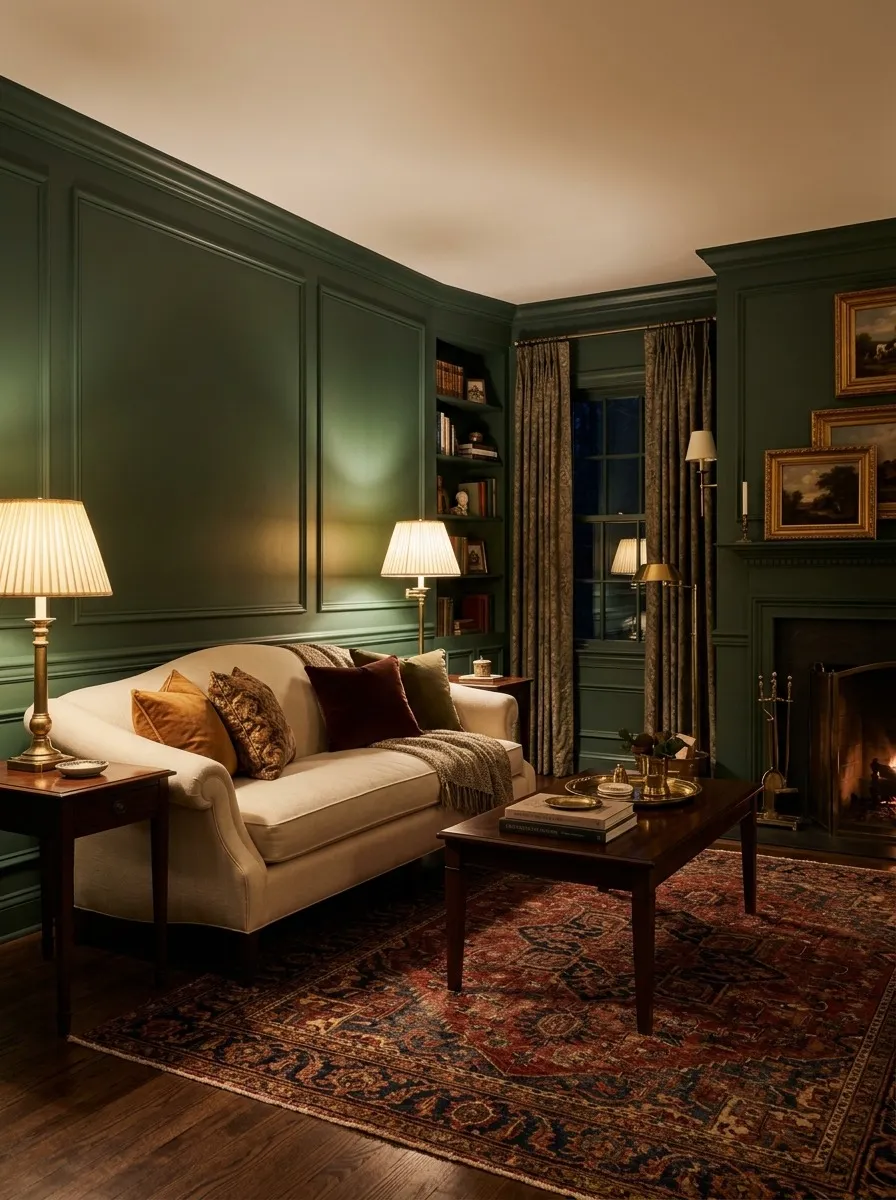
Hunter and forest green came into the American room through the English library tradition, where deep green absorbed lamplight and made books glow. Choose a matte or eggshell finish in a deep hunter or Essex green, paint the trim a warm white, and pair the walls with brass lamps, a Persian rug, and a cream sofa in your room. The mistake is a glossy, high-sheen green that reveals every wall flaw, or a green with a cool undertone that fights warm wood. Traditional living room dark green pairs best with the brass hardware traditional interior designers prefer, because the warm metal turns somber into rich. A color that commits this fully asks something of a room, and that’s why it has aged so well.
21. The Warm Neutral Traditional Living Room Ages the Way a Room Should
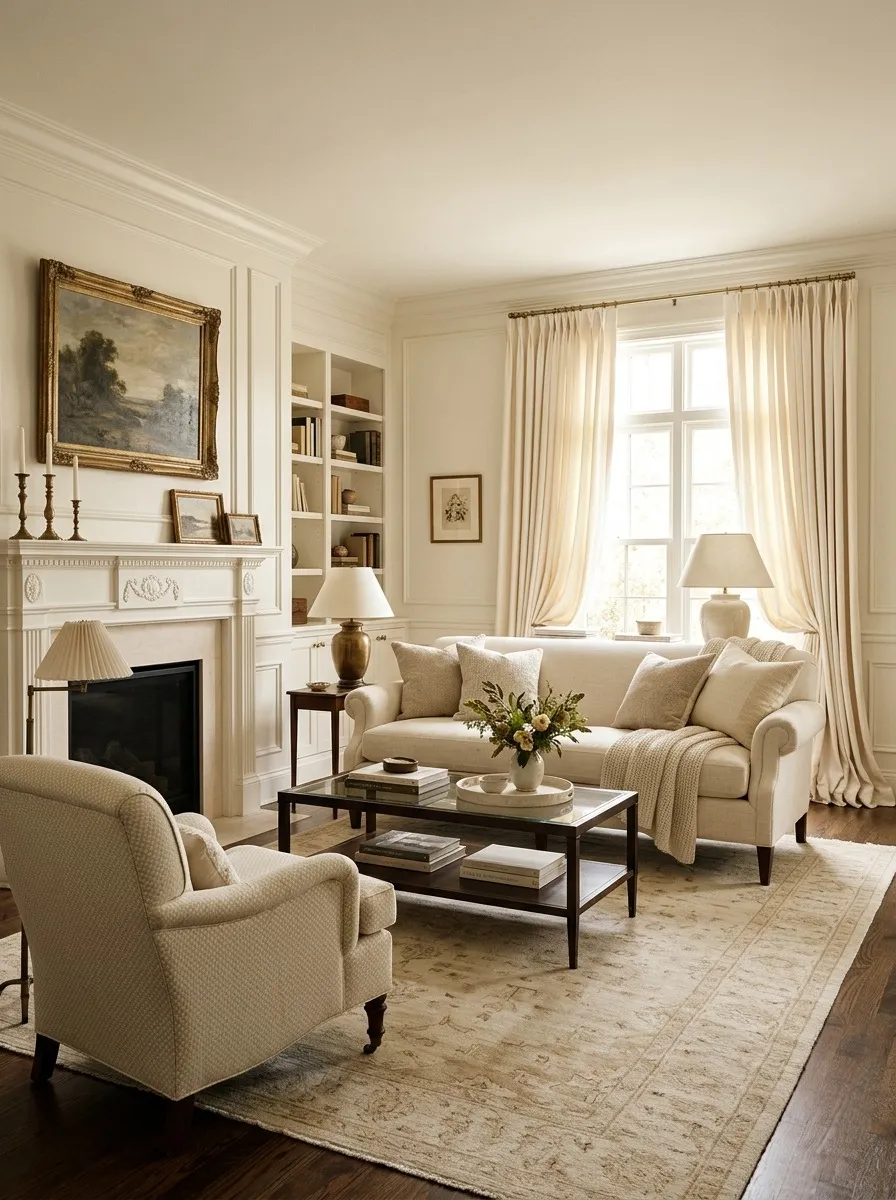
Ivory, cream, and warm whites were the walls of the Southern colonial house, where lime wash and plaster softened the light in a hot climate. Choose a warm white with a yellow or red undertone, use a flat finish on the walls and a satin finish on the trim, and let the color change from morning to evening in your room. The mistake is a cool, bright white beside antique wood, which makes the furniture look dingy and the room look unfinished. A traditional living room warm neutral scheme gains depth from layered whites, such as a cream sofa, ivory drapery, and slightly yellow plaster, and it’s the easiest base for a traditional living room on a budget. Warm whites have lasted because they age the way the room should, softening instead of fading.
🎨 The Traditional Living Room Color Report: Every Palette That Has Defined This Aesthetic and the Rooms That Prove It
A traditional living room color palette is never a single decision, and the best traditional living room ideas treat color as a heritage with five distinct branches.
THE JEWEL TONE TRADITION: Sapphire navy, emerald, and ruby came from Persian rug dyes and Georgian silk, and today they belong on upholstery and drapery rather than walls.
THE DARK NEUTRAL TRADITION: Chocolate brown, charcoal, and deep taupe came from the library rooms of English country houses, and today they work as painted trim, a library wall, or a ceiling.
THE WARM IVORY TRADITION: Ivory and cream came from Southern colonial lime wash and plaster, and today they work as wall color, drapery, and slipcovers that soften with age.
THE UNEXPECTED COLOR IN TRADITIONAL ROOMS: Faded rose, found in old Persian rugs and Federal wall colors, works as a soft accent against green or navy.
THE ONE COLOR RULE: Choose one deep color, repeat it at least three times, and let every other color be a warm neutral.
The most resolved traditional living rooms are never cold, because they balance refinement with genuine warmth, and our warm living room layers guide shows how that specific warmth is built layer by layer in any considered living space.
Heritage Layer 05: Objects and Finish The Accumulated Layer That Separates a Traditional Room From a Traditional-Looking One
Objects are the final layer, and it’s the one that separates a traditional room from a traditional-looking one, because it can only be built slowly. Paintings, brass, porcelain, and books were once accumulated across a lifetime, and a considered room still has to look as though they were.
22. What Hangs on the Walls of a Traditional Living Room Tells You How Long the Family Has Lived There
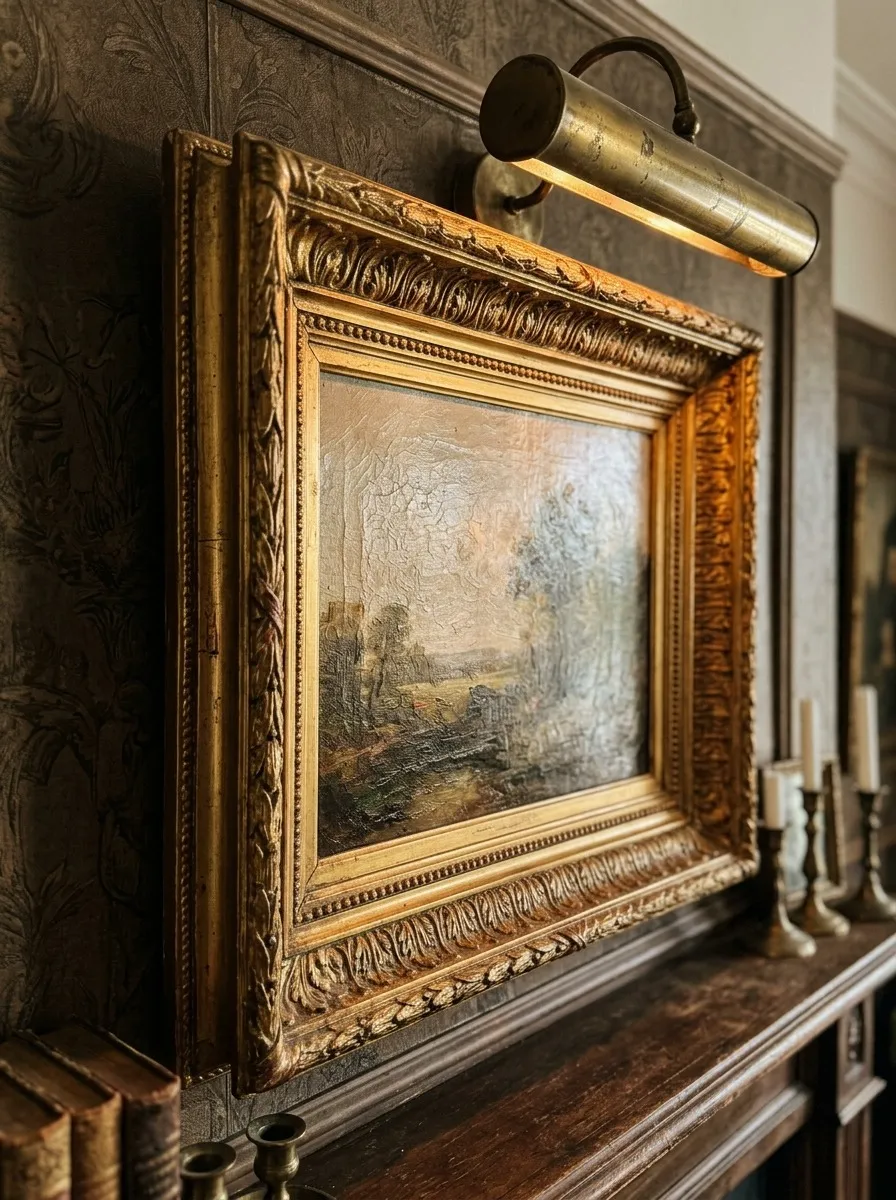
Portraits, landscapes, and still lifes hung in Georgian and Federal rooms as quiet evidence of family and travel. Hang oil paintings in your room with their centers at about fifty-seven inches from the floor in a gilt or dark walnut frame, and consider a brass picture light above the largest piece for traditional living room wall decor that looks collected. The heritage mistake is a gallery wall of matching black frames and digital prints, which reads as a contemporary substitute for traditional art. Oil painting traditional room decor works best when it’s a real oil, a good reproduction, or an estate-sale find, and Ballard Designs and One Kings Lane both offer framed reproductions in traditional subjects. A painting of someone else’s ancestors is the one object that makes a room feel inhabited before you’ve lived in it.
The Historian’s Design Note: Hung With Intent
- ❦ Portraits and landscapes signaled lineage and travel, and they were hung at eye level above the hearth so every visitor met them first.
- ❦ Oil on canvas in a gilt or walnut frame, or a well-made oil reproduction, honors the tradition.
- ❦ Digital prints in thin black frames with mats, ordered by the dozen, are the pastiche version to avoid.
- ❦ Buy one real estate-sale oil, hang it above the mantel or sofa, and repeat its frame finish elsewhere in the room.
23. Crystal, Brass, and the Finish Levels That Work in Traditional Decor
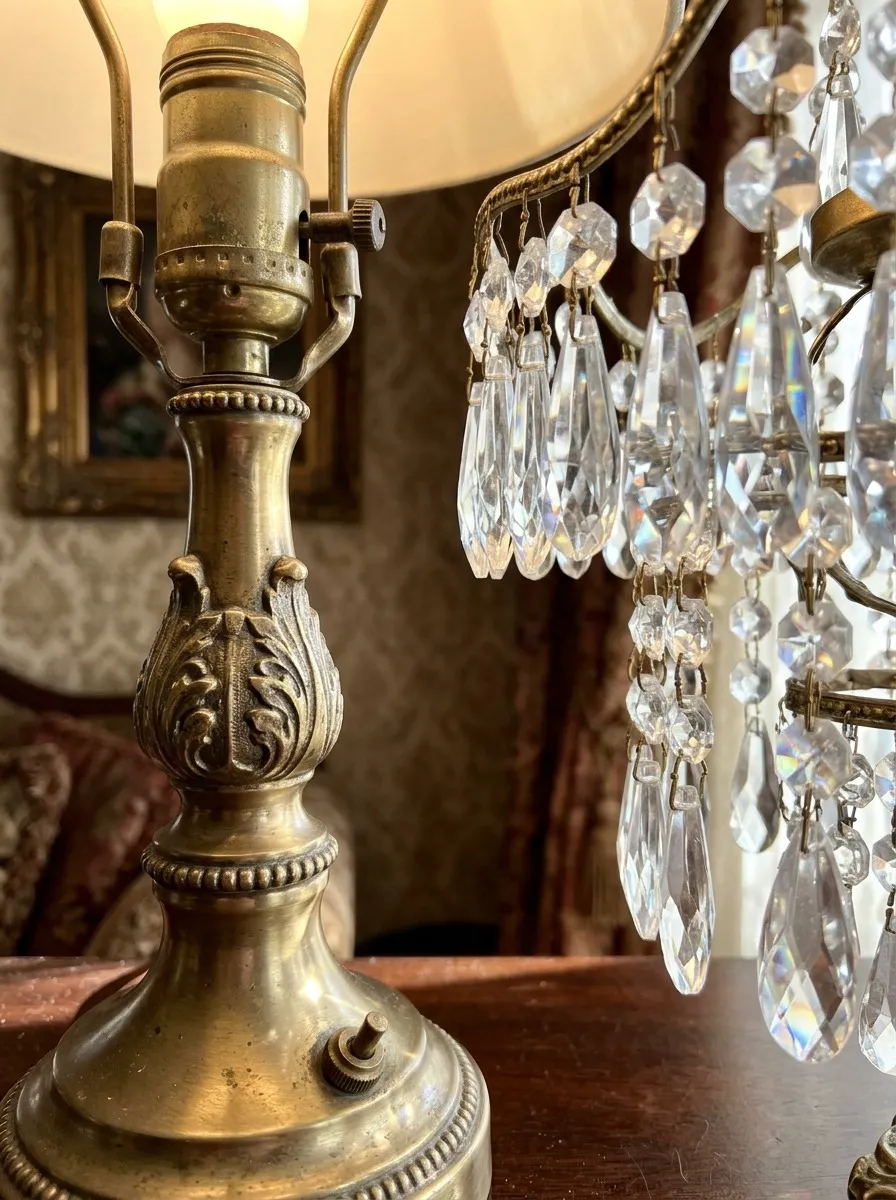
Candlelight made crystal and brass essential in Georgian rooms, because both multiplied light that would otherwise have been lost. Hang a crystal chandelier whose diameter in inches equals the room’s length plus its width in feet, choose aged or antique brass for hardware and lamps rather than polished lacquer, and keep the finishes warm across your room. The mistake is a mirror-bright, over-polished brass or a chandelier that’s too small for the space, both of which make the room feel recently purchased. A crystal chandelier traditional room scheme looks most resolved when the brass on the lamps, sconces, and cabinet pulls shares a single warmth. Candlelight’s descendants have stayed because crystal and brass do what no other material does, which is hold light at the end of the day.
24. Chinoiserie: The Heritage of Mixing That Defines This Aesthetic
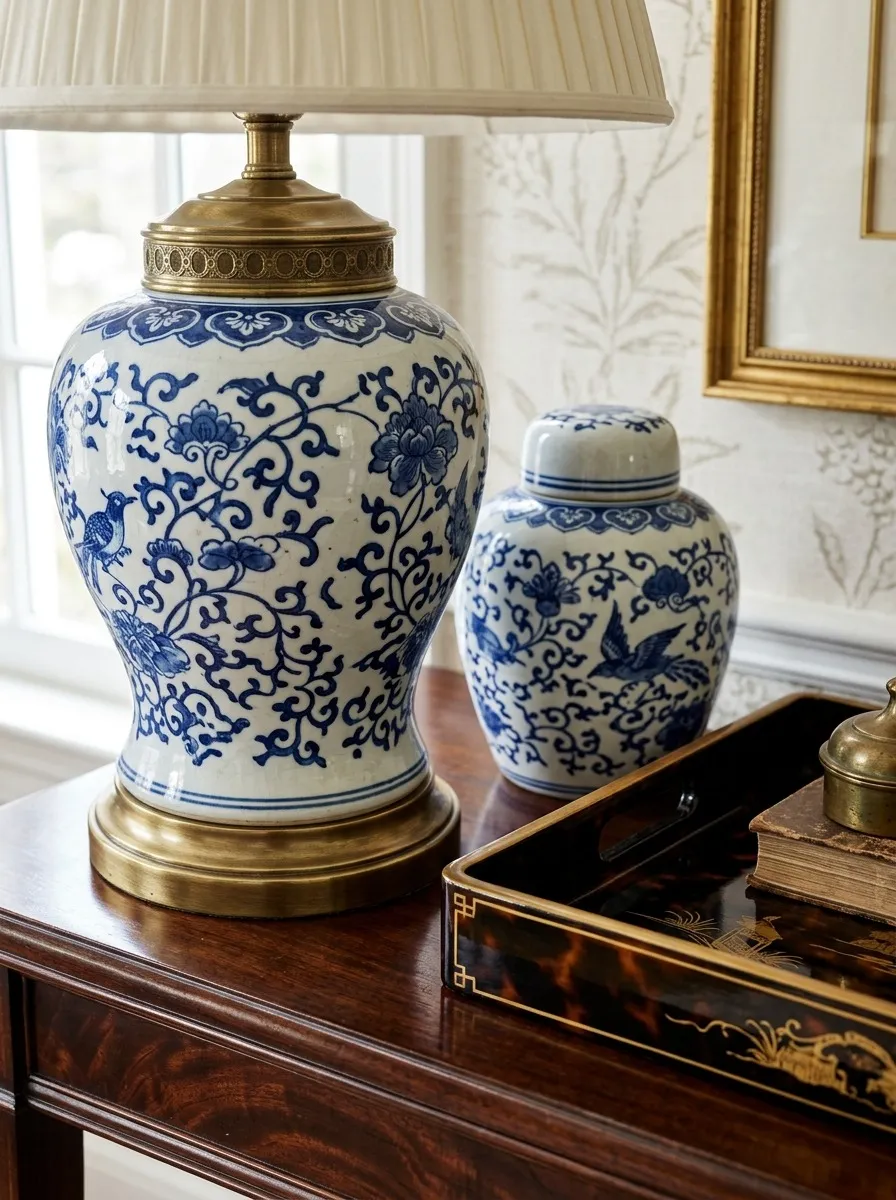
Export porcelain and lacquer arrived with the China trade, and by the time Federal rooms were finished, chinoiserie had become part of the American vocabulary of mixed collection. Use a pair of blue-and-white ginger jars as lamp bases, a lacquered tray, or a hand-painted wallpaper panel, and keep the count in your room to two or three pieces so they read as collected. The mistake is a themed room full of dragons and pagodas, which turns a heritage habit of mixing into a costume. A chinoiserie traditional living room feels most authentic when the pieces are slightly worn, a habit that runs through the rooms of Sister Parish and Albert Hadley. Mixing is the oldest habit in the American room, and it continues because nobody’s ever finished collecting.
25. Books Are Furniture Too: How a Traditional Interior Puts Them to Work
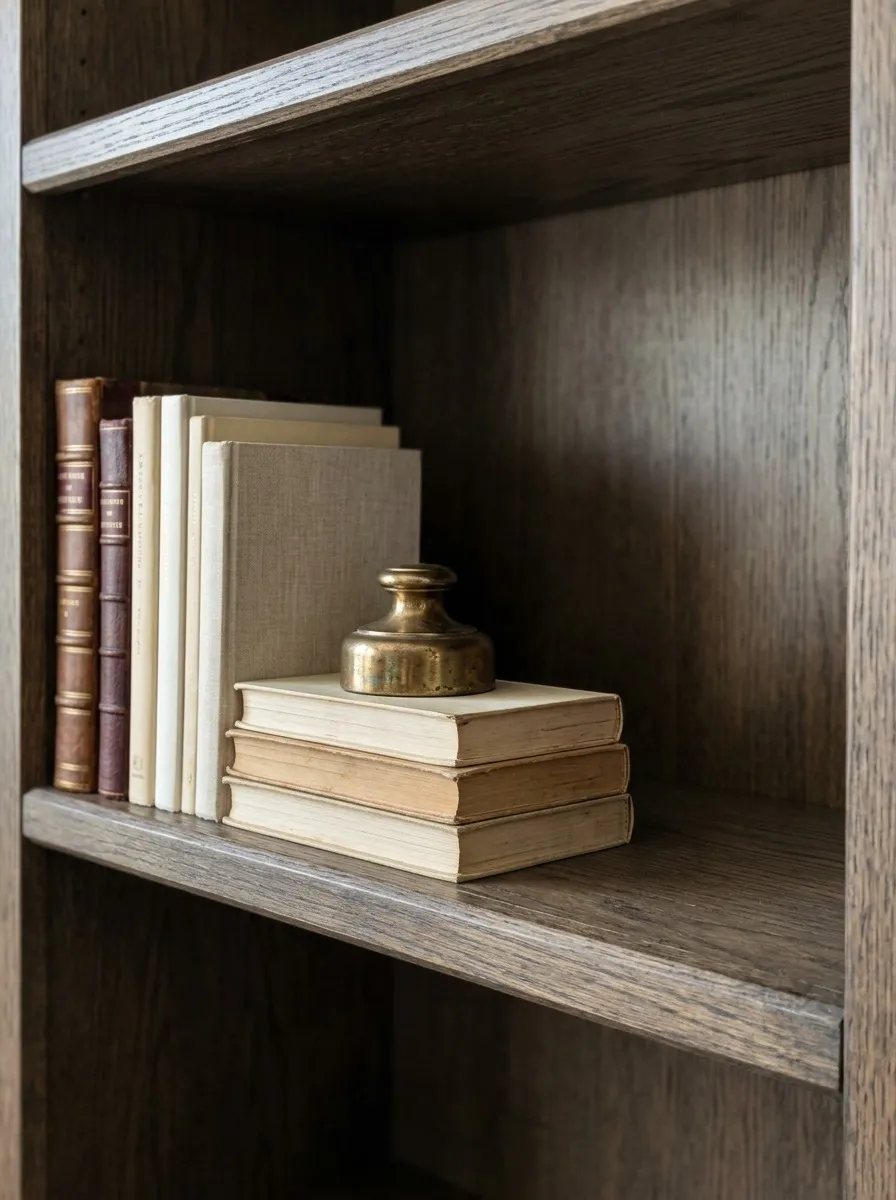
Books were once a household’s most portable wealth, and in Federal homes they stood in rows behind glass as proof of education. Style them with cream and leather spines grouped together, a few stacked horizontally with a small object on top, and one open shelf left as breathing space in your room. The mistake is buying books by the yard or turning the pages outward to hide the spines, which reads as pretense to anyone who looks closely. Leather-bound sets from Pottery Barn or Ethan Allen are fine as filler, but a traditional living room bookcase is better served by real paperbacks, atlases, and art books you’ve actually opened. A shelf of genuine books is the one design element that tells the truth about the people who live there.
26. Every Heritage Layer, One Room: Where Traditional Living Room Ideas Resolve Into One American Interior
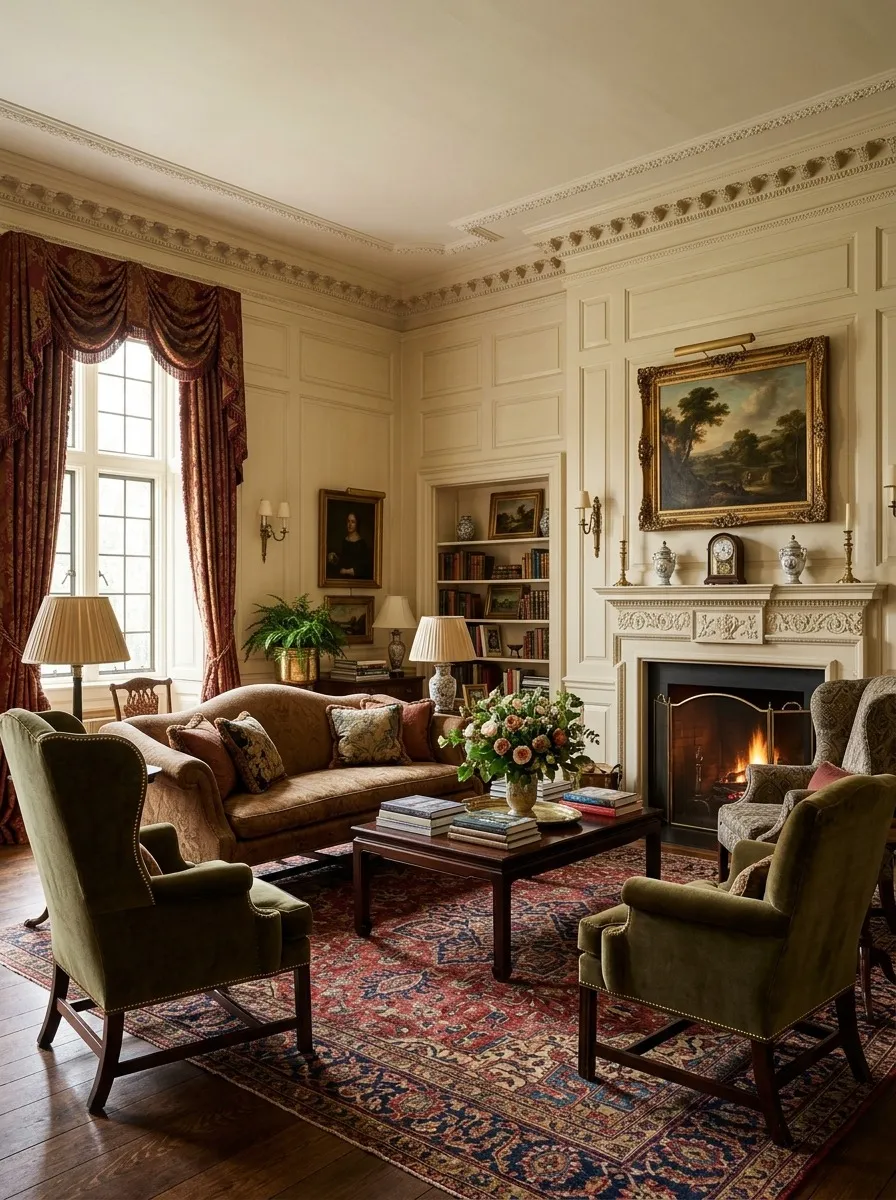
Every heritage layer, architecture, furniture, pattern, color, and objects, has to carry its share, because a traditional room fails the moment one layer is missing. A complete room might pair a stepped cornice and paneled lower wall, a camelback sofa, two wingbacks, a Persian rug, one old chest, damask drapery, a navy or green accent, and a painting above a styled mantel, all arranged around the hearth. The mistake is stopping at the furniture layer and expecting the room to look resolved, when the walls, patterns, and objects haven’t been asked to do their share. Each of these ideas has appeared in the most considered American interiors for generations, and your room can borrow the whole system or any single layer of it. A resolved traditional room has no hero piece, only a set of decisions that agree with each other.
Traditional Living Room Questions, From the Heritage Report
What is a traditional living room style?
A traditional living room style rests on symmetrical furniture, architectural molding, wood and fabric that can age, and patterns such as damask and toile that have stayed in use for generations. Traditional living room ideas draw on English Georgian proportion, French provincial warmth, and early American Federal restraint. A traditional interior design living room is built slowly, with inherited and collected pieces layered over a considered architectural base. The result is a room measured in decades rather than seasons.
What colors work best in a traditional living room?
A traditional living room color palette begins with warm neutrals such as ivory, cream, and putty, then adds deep navy, hunter green, burgundy, and gold in upholstery and drapery. A classic traditional living room repeats one deep color at least three times so it reads as a decision. Warm whites and creams suit the walls, while jewel tones belong on chairs and curtains. Avoid cool grays and stark whites, which fight antique wood.
What furniture defines a traditional living room?
Traditional living room furniture includes a camelback or rolled-arm sofa, a pair of wingback chairs, a wood coffee table or leather ottoman, and one antique chest or secretary. Traditional style living room ideas favor carved legs, nailhead trim, and fabrics such as linen, velvet, and damask. Everything is scaled to look substantial in the room. Ethan Allen, Ballard Designs, and RH cover most categories, while one antique anchors the whole.
How do I mix patterns in a traditional living room?
Choose one dominant pattern, one or two secondary patterns, and a small-scale tertiary pattern, varying the scale across all three. Traditional living room ideas succeed when a shared color links every pattern, whether that’s navy, green, or gold. A damask pattern traditional interior makes a good dominant pattern, with a stripe and a small check supporting it. Avoid matching every pattern from a single collection.
What is the difference between traditional and classic interior design?
Traditional design is anchored in specific historical periods such as Georgian, Federal, and Southern colonial, and its rooms are organized around architecture, symmetry, and inherited furniture. The related aesthetic describes enduring, restrained decor that borrows from the same vocabulary but is less tied to one period. Traditional living room ideas often begin at the hearth, and our traditional fireplace styling guide covers every mantel decision from surround to arrangement. Understanding that distinction helps you decide whether your traditional interior design living room should be period-specific or broadly enduring.
What rug should I use in a traditional living room?
Use a Persian or Oriental rug in faded red, navy, or rose, sized so the front legs of all seating rest on it. Traditional living room rug ideas favor an eight by ten or nine by twelve in hand-knotted wool, with a visible border of floor around the edge. A Persian rug traditional living room scheme also forgives wear, which makes vintage rugs a smart purchase. Skip the thin, printed polyester versions.
How do I create a traditional living room on a budget?
A traditional living room on a budget starts with one strong architectural investment, such as crown molding or a chair rail, then adds secondhand antiques and ready-made drapery panels. Traditional living room ideas reward patience, so buy the sofa frame first and add pieces from estate sales and One Kings Lane over time. Our heritage interior inspiration guide shows how the Ralph Lauren heritage vocabulary stretches across every price level. Spend on upholstery frames and lighting, and save on pillows and accessories.
What window treatments work in a traditional living room?
A traditional living room window treatment starts with lined pinch-pleat or goblet-pleat panels hung high and wide, over a roman shade or sheer for privacy. Traditional living room drapes in silk, linen, or velvet, interlined and weighted, give the room the weight the vocabulary demands. Mount the rod near the ceiling and extend it past the frame so the window looks taller. Ready-made panels from Pottery Barn or Ballard Designs work when they’re hemmed to the floor.
What is a modern traditional living room?
Modern traditional living room ideas keep the heritage structure of symmetry, molding, and wood furniture while loosening the fabric, color, and styling so the room feels current rather than preserved. A modern traditional room often swaps damask for solid linen, opens the layout, and uses a lighter, warmer palette. That’s why the bones stay recognizable, and our traditional table vignette guide covers the exact object combinations and arrangements that make any surface feel genuinely collected. The test is whether the room looks lived in rather than staged.
How do I add antiques to a traditional living room?
Add antiques one piece at a time, starting with a chest, a drop-front desk, or a mirror that fits an existing wall. A traditional American living room works best with a single genuinely old surface among newer upholstery, which keeps the room from looking like a shop. Traditional living room ideas improve with provenance, so buy sound pieces from estate sales and reputable dealers and check joinery and finish. Let the antique lead the room and arrange everything else around it.
The Report Closes: What Earns Permanence in a Traditional Living Room
The best traditional living room ideas share one quality: they understand which design decisions have earned permanence and which were always temporary. A traditional living room isn’t a room frozen in the past. It’s a room built by someone who has studied the vocabulary, kept what endured, and let the rest go, leaving space for your own accumulating objects.
A traditional living room is the beginning of a home that takes American design heritage seriously – The Muse Vale has the living room, home decor, and interior design guides to help you build every room in that same considered spirit.
Come back to The Muse Vale whenever your traditional living room needs a new reference point or a deeper understanding – we will have the design heritage guides, inspiration, and traditional living room ideas ready for every decision you are working through.