
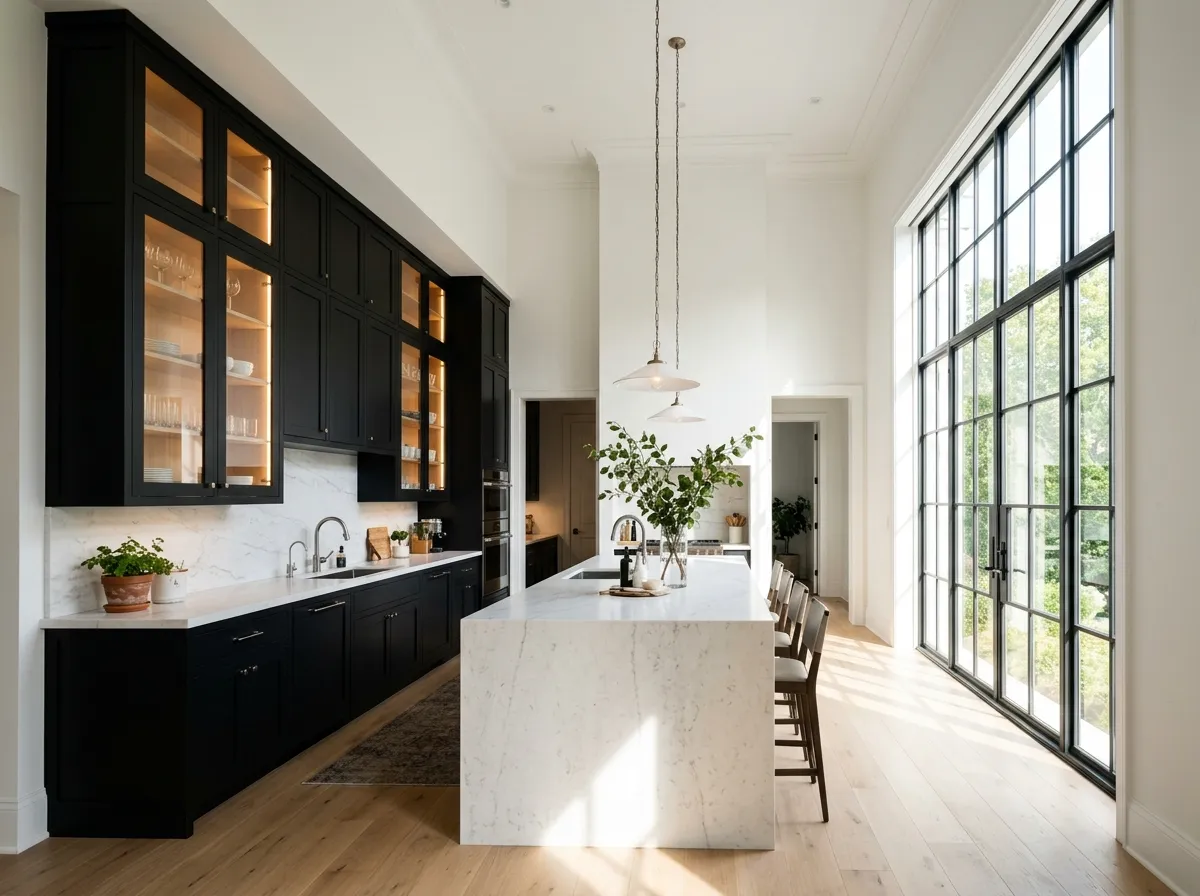
Black and white kitchen ideas look simple on a mood board, and that is exactly where most projects go wrong. Two colors leave nowhere to hide: every cabinet shade, every hardware finish, and every light bulb either supports the contrast or fights it. Think of this guide as the design specification I’d hand a client before any decision gets made, because in this palette every choice has a consequence, and this guide maps all of them. Across 24 specification entries, we’ll cover cabinets, surfaces, hardware and fixtures, layout, and warmth, plus the lighting that decides whether your whites read clean or clinical. You’ll find exact shades, proportions, and finishes, along with the mistakes I see most often in American homes, from the open-plan kitchen to the galley kitchen in a city apartment. A white shaker cabinet kitchen and a matte black faucet kitchen can share one room and still disagree if the undertones don’t match. Read the specification, then decide what your kitchen needs.
Before You Choose: Four Contrast Decisions
Every set of black and white kitchen ideas comes down to four choices, and settling them first keeps your black and white kitchen design from drifting. Each decision below has a high contrast route and a low contrast route, and your room will usually favor one.
⬡ YOUR CABINET CONTRAST RATIO High contrast choice: Black bases with white uppers, or a black island against white perimeter cabinets, which is classic two-tone cabinet kitchen design. Low contrast choice: All-white cabinets with black limited to hardware and fixtures. Which suits your kitchen: Go high contrast in rooms with daylight and nine-foot ceilings, and low contrast in compact or dim kitchens.
⬡ YOUR SURFACE CONTRAST LEVEL High contrast choice: Black quartz against white cabinets, or black grout on white tile. Low contrast choice: White marble or quartz with a plain white backsplash. Which suits your kitchen: In contrast ratio kitchen design, the surfaces should take less contrast than the cabinets, so choose one bold surface and keep the rest quiet.
⬡ YOUR HARDWARE CONTRAST CHOICE High contrast choice: Matte black pulls on white doors. Low contrast choice: Brushed brass or a white-on-white finish that blends into the doors. Which suits your kitchen: Black hardware suits most white-dominant rooms, and brass suits rooms that already lean cool.
⬡ YOUR LIGHTING CONTRAST APPROACH High contrast choice: Layered lighting with dimmable overhead light, under-cabinet strips, and black pendants. Low contrast choice: Even, diffused light at one warm color temperature throughout. Which suits your kitchen: Choose layered lighting for a kitchen you cook in at night, and even light for a kitchen you mostly pass through.
Cabinets make up most of the visible surface in any kitchen, so every other decision in a black and white scheme answers to them. Settle the cabinet contrast first, because correcting it later means repainting or replacing the largest elements in the room.
1. All-White Cabinets: The Baseline
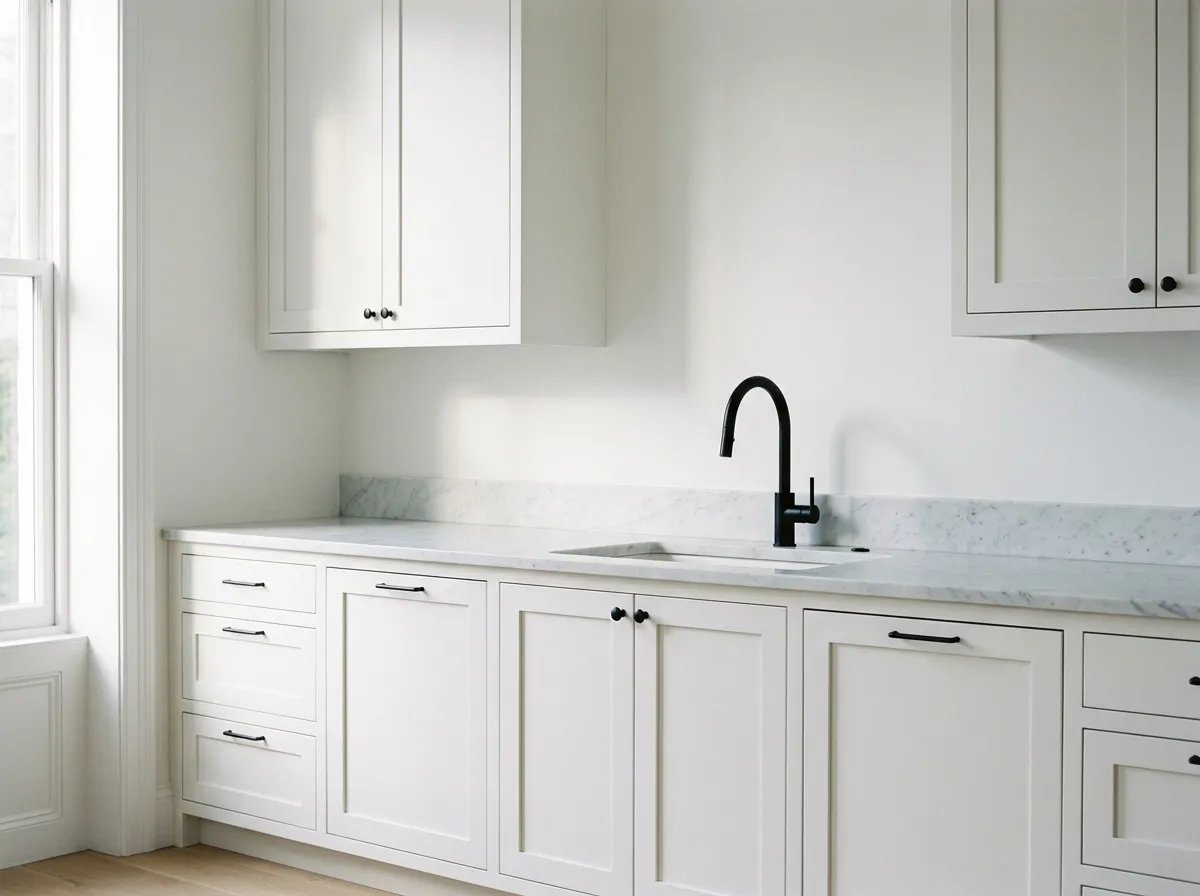
An all-white kitchen sets the baseline for this palette, and every bit of black you add afterward does a specific job against it. Choose the white by undertone before you choose it by name: Benjamin Moore Simply White leans soft and warm, Sherwin-Williams Extra White runs bright and cool, and Farrow and Ball All White sits quieter than either. Most American homeowners pick from a two-inch paint chip under showroom lighting, then watch the cabinets turn blue in a north-facing kitchen or yellow beside warm bulbs. Paint a sample board and view it at morning, midday, and evening, because the white kitchen warm versus cool question gets settled by your light and not by the showroom. The version that works repeats one white across cabinets, trim, and walls with black in at least three places, and the version that misses uses three whites and calls it layering.
⬡ Specification note: Best for: Open-plan American kitchens with generous daylight and a clean palette. Avoid with: A cool cabinet white beside a warm trim white. Pairs with: Matte black hardware and one black focal point such as the faucet or a pendant. Specialist verdict: One white, repeated with discipline, beats any clever mix of whites.
2. Black Lower Cabinets for Balance
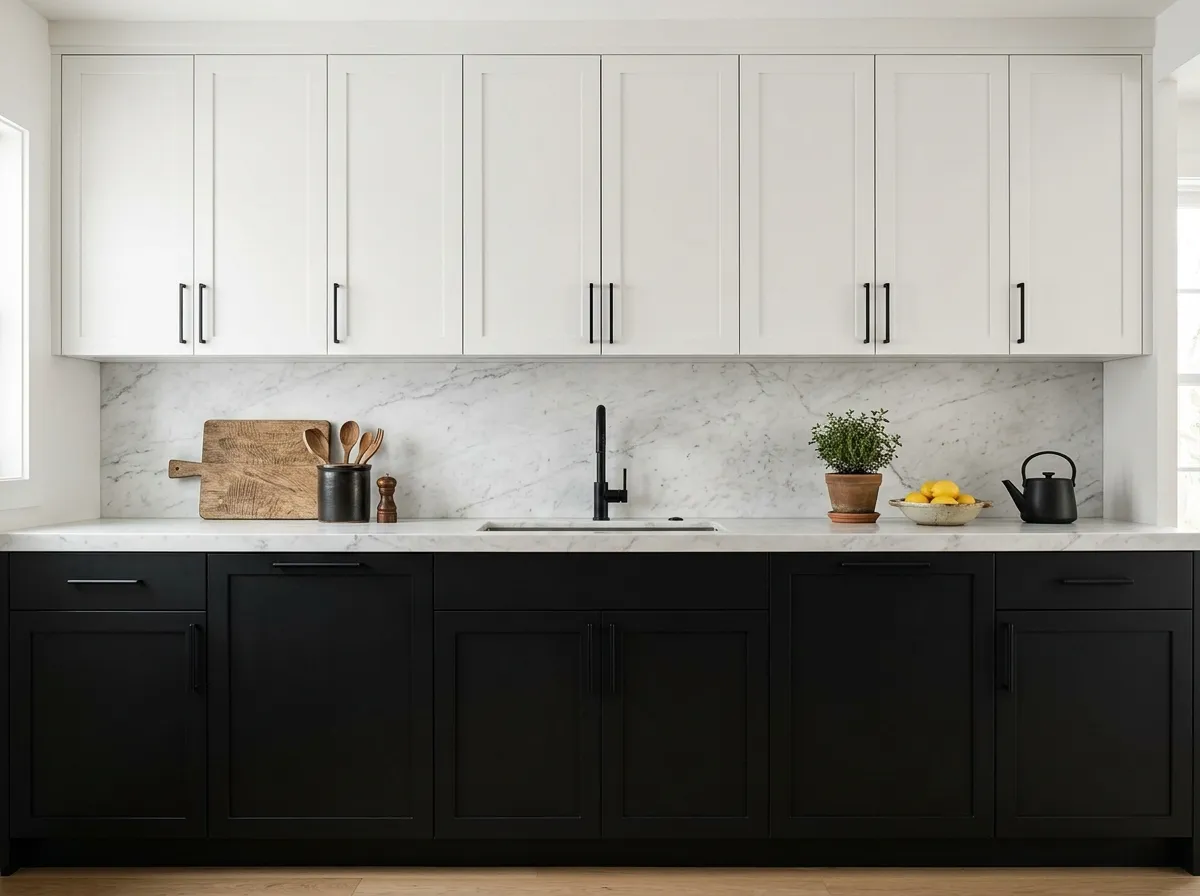
Black lower cabinets anchor the room by placing the visual weight at floor level, where the eye expects it. Specify a true neutral black such as Sherwin-Williams Tricorn Black, or the softer Iron Ore if you want a trace of charcoal, in a satin or matte sheen, and keep everything above the counter a clear step lighter. The usual mistake is running black bases around every wall of a small room, which shrinks the footprint and turns the aisle into a trench. A black lower cabinet white upper layout works best when the black stops at the counter line and the white carries all the way to the ceiling. Handled that way, the combination reads grounded and tailored, and handled without restraint, it reads heavy once the novelty fades.
⬡ Specification note: Best for: Medium and large kitchens with eight to nine foot ceilings. Avoid with: A black countertop that erases the cabinet edge. Pairs with: White uppers to the ceiling and a white marble or quartz counter. Specialist verdict: The most forgiving way to bring black into a kitchen without darkening the room.
Specialist’s Specification Detail: Lower Cabinet Proportions
⬡ Specify a factory-finished black door in a satin sheen from Home Depot, Lowe’s, or Cabinet Depot rather than brushed paint on high-touch bases. ⬡ Keep base cabinets at the standard 34.5 inches tall with a 1.5-inch counter, and start white uppers 18 inches above the counter. ⬡ Avoid pairing black bases with black hardware and a black counter, which leaves no edge for the eye to read. ⬡ For a budget match, degloss, prime with a bonding primer, and spray stock IKEA or builder-grade bases with cabinet-grade enamel.
3. The Two-Tone Proportion Rule
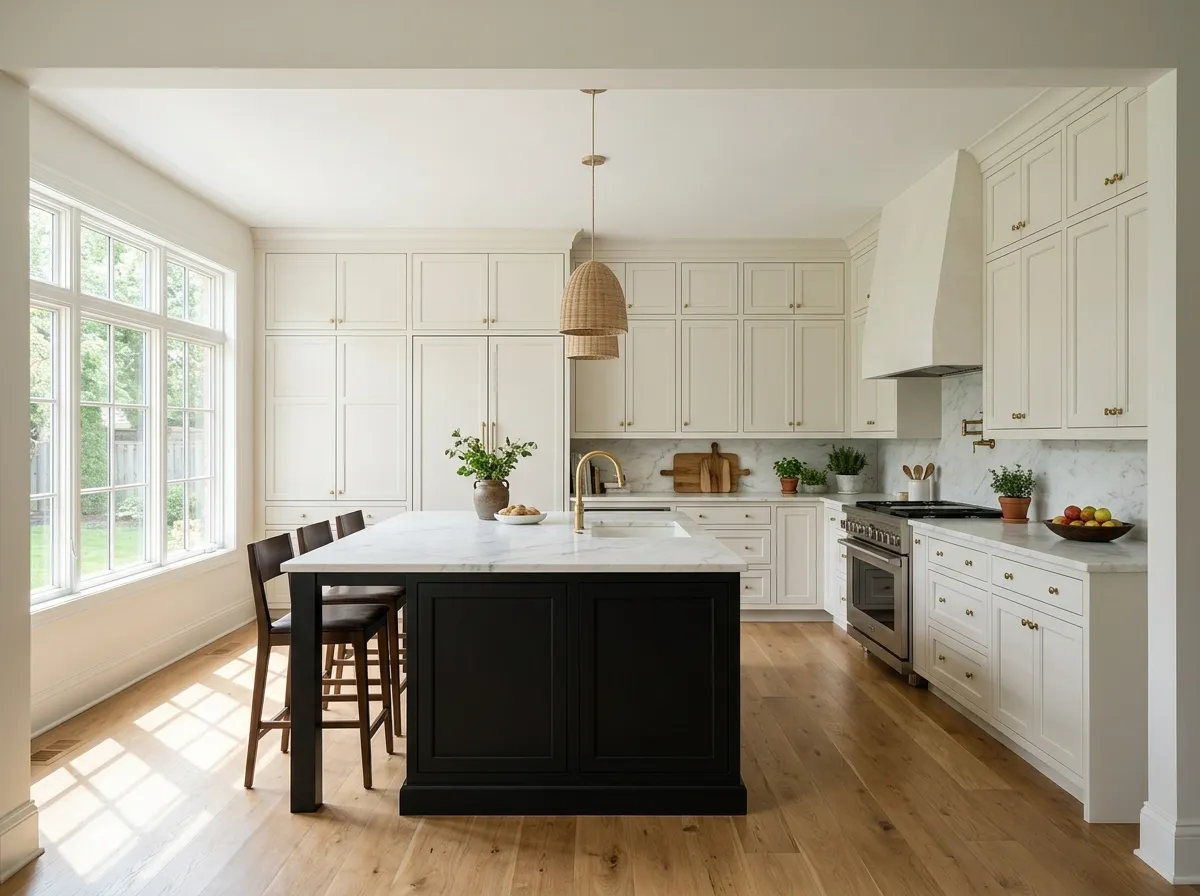
Proportion decides whether two-tone cabinetry looks planned, and the rule is that one color should own roughly two-thirds of the visible cabinet mass. In practice that means white across the perimeter with a black island, or black bases with white uppers, but never a fifty-fifty split of door fronts. Homeowners miss this by dividing the colors evenly, which creates a checkerboard effect with no clear lead color. Strong two-tone cabinet kitchen design treats the minority color as an accent that can afford to be darker and bolder, while the countertop stays in the majority tone to bridge both. A seventy-thirty split reads intentional, and an even split reads indecisive.
⬡ Specification note: Best for: Large suburban kitchens with a central island. Avoid with: A fifty-fifty split between black and white doors. Pairs with: A countertop in the majority color to bridge both tones. Specialist verdict: Two-tone only works when one color is clearly in charge.
4. Black Upper Cabinets: A Bold Call
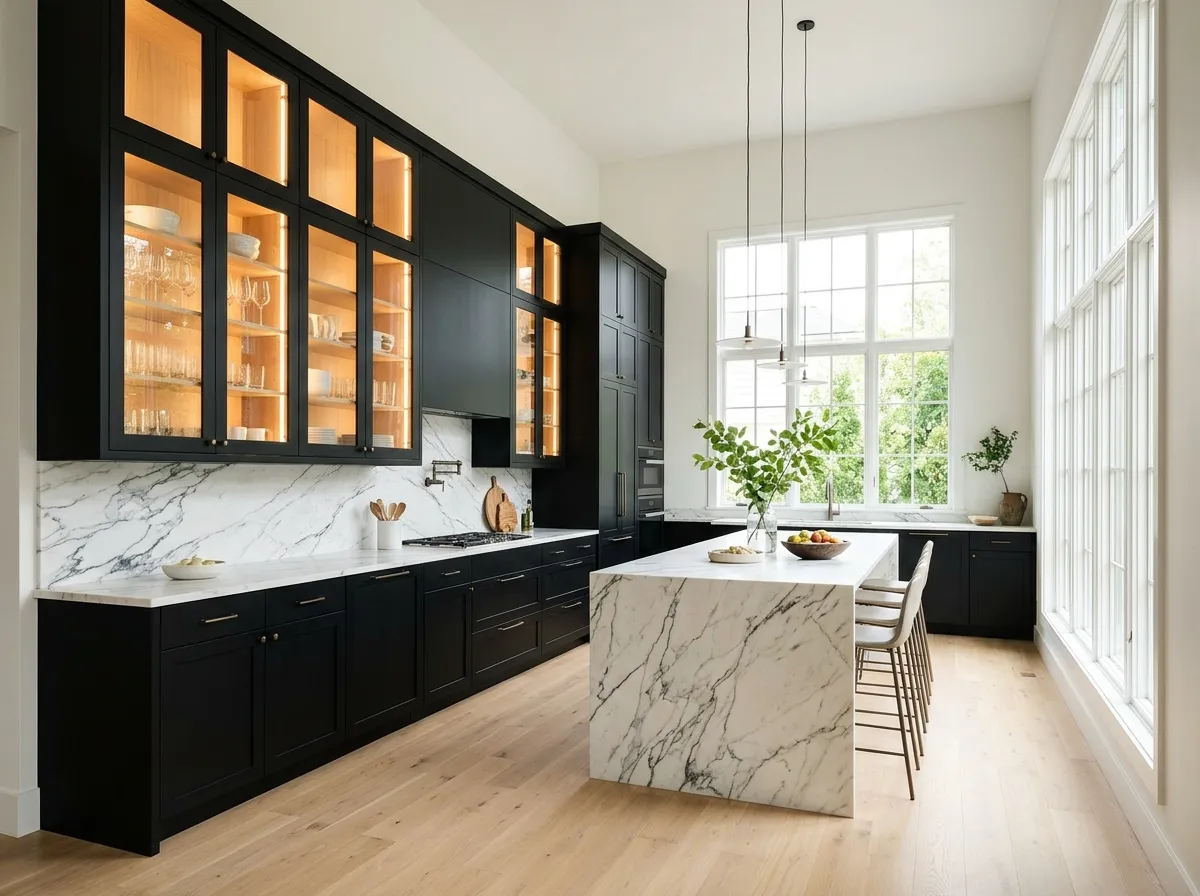
Upper cabinets in black are the boldest move in the palette, because they pull the ceiling line down and place the darkest mass at eye level. They need real daylight, a ceiling of nine feet or higher, and light stone underneath to bounce the brightness back up, and glass fronts with interior lighting lighten them further. In a standard eight-foot American kitchen with one small window, black uppers turn the cooking zone into a cave, and no bulb fixes that. If black kitchen cabinet ideas are what you’re after, confine the black uppers to a single wall, ideally the one without the range hood or the window. Treat black uppers as a commitment for tall, bright rooms: the version that works has a window and glass doors, and the version that misses has neither.
⬡ Specification note: Best for: Tall, bright kitchens with a window on the opposite wall. Avoid with: Low ceilings and a single small window. Pairs with: Light stone counters and glass-front doors with interior lighting. Specialist verdict: Dramatic in the right room and oppressive in the wrong one.
5. White Shaker Versus Flat Front
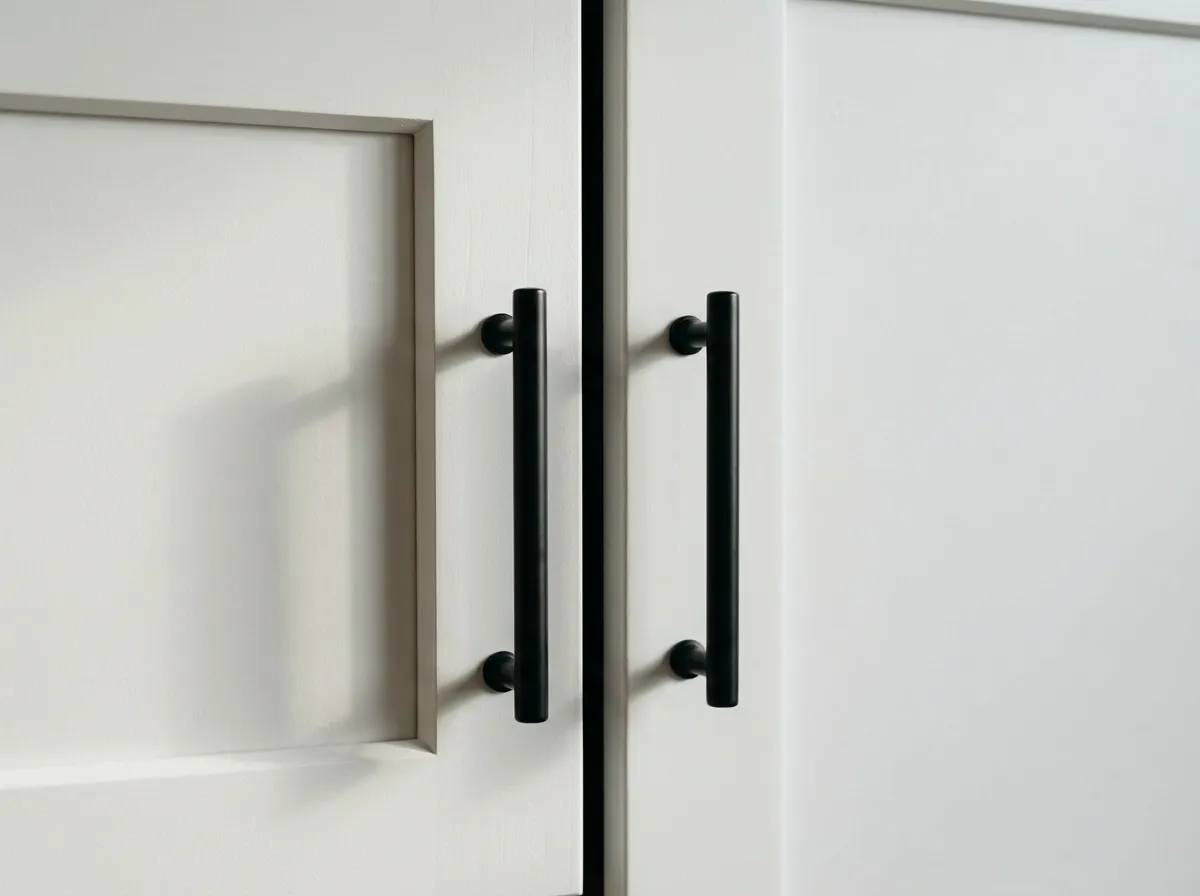
Door profile matters as much as door color, because shaker doors add shadow lines and flat fronts remove them. A white shaker cabinet kitchen with rails around 2.5 inches wide gives you a traditional frame that softens black hardware, while a slab front pushes the same palette toward modern. The usual mistake is mixing both profiles in one run, so the island is flat, the perimeter is shaker, and neither reads as deliberate. IKEA, Home Depot, and Lowe’s all sell both profiles in white, and a KCMA certification seal tells you the box will outlast the finish, which keeps a black and white kitchen on budget without cutting corners. Choose shaker for warmth and tradition, choose flat for architecture, and don’t try to split the difference.
⬡ Specification note: Best for: Shaker in traditional and transitional kitchens, flat fronts in modern and compact ones. Avoid with: Mixed profiles within the same cabinet run. Pairs with: Hardware scaled to the width of the door rail. Specialist verdict: Pick one profile and let the hardware, not the doors, do the talking.
6. Choosing Matte or Gloss Finish
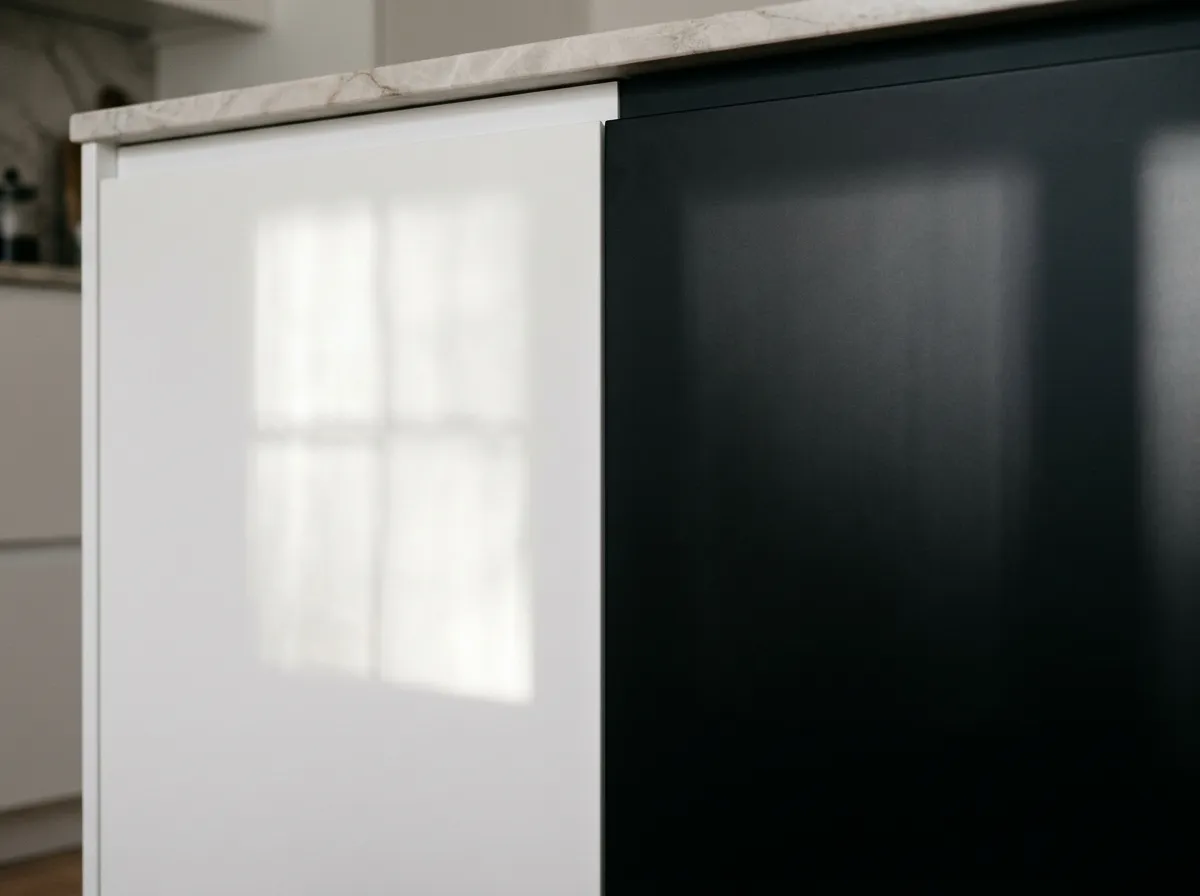
Sheen controls how much light bounces off your cabinets, which controls how white reads and how black behaves. Satin is the working choice for most American kitchens because it reflects enough light to stay wipeable without magnifying flaws, while matte hides door-face imperfections but marks easily, and gloss amplifies every reflection. Homeowners choose gloss black for drama and then find that every fingerprint, drip, and slightly wavy door face is magnified. In a transitional black and white kitchen, a satin white paired with a matte black base is the most forgiving combination. Choose satin by default, gloss only on flawless slab doors, and matte only where you’ll accept wiping marks.
⬡ Specification note: Best for: Satin for family kitchens, gloss for small modern kitchens with flawless slab doors. Avoid with: High gloss black on doors that aren’t perfectly flat. Pairs with: A honed counter that offsets reflective doors. Specialist verdict: Satin is the right answer far more often than gloss.
🏠 Cabinet Contrast Guide: Which Combination Works
Every one of these black and white kitchen ideas begins with a proportion question, and the combinations below show how each one resolves.
ALL WHITE CABINETS: This needs one disciplined white and at least three black details, such as hardware, a faucet, and a pendant, to keep the room from reading blank. It’s completed by a dark floor or rug and one wood element for warmth.
ALL BLACK CABINETS: This needs strong daylight, warm 2,700K lighting, and white or light stone counters to keep the room from closing in. It’s balanced by brass or wood and a pale backsplash.
WHITE UPPER BLACK LOWER: The proportion rule is black below the counter line only, with white uppers to the ceiling. A black lower cabinet white upper layout suits medium and large kitchens with eight to nine foot ceilings.
BLACK UPPER WHITE LOWER: This works only in tall, bright rooms with a window and ideally glass fronts. Avoid it in low-ceiling kitchens and in any kitchen with one small window.
TWO-TONE ISLAND: Make the island black, keep the perimeter white, and let the island hold about thirty percent of the cabinet mass. Carry a white countertop across both so the two tones read as one design, and choose wood or white stools.
The most resolved black and white kitchens are built on the same enduring design principles as any great American interior, and our classic home design principles guide covers the foundational decisions that make any space feel genuinely considered.
Surfaces carry the pattern in a two-color kitchen, and they’re where most homeowners let the palette get noisy. Decide which single surface is allowed to be busy, then keep the others quiet.
7. Specifying a White Marble Countertop
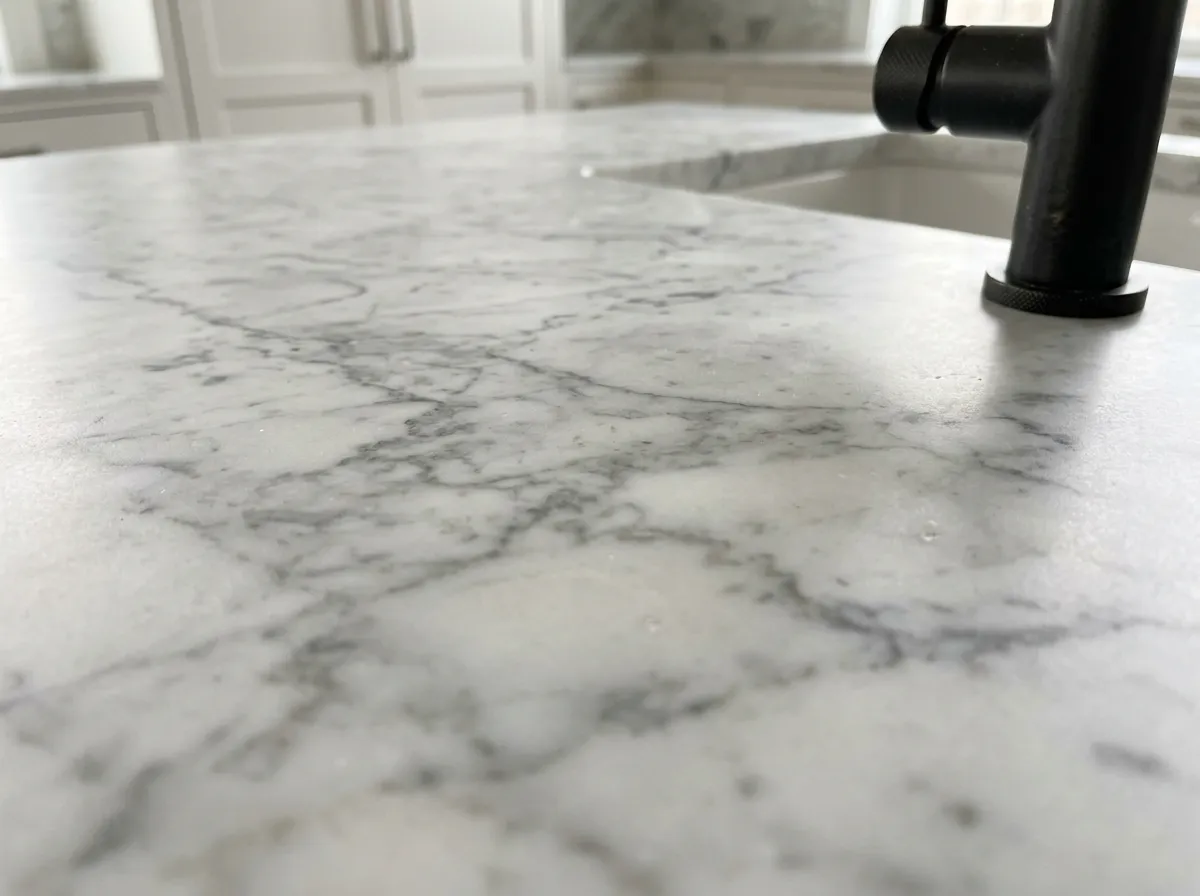
White marble earns its place in this palette because its veining adds the one thing two colors can’t produce alone, which is gradient. Specify Carrara for soft gray veining or Calacatta for bolder veins on a warmer white ground, and choose a honed finish over polished if your kitchen sees heavy cooking. The mistake is skipping the sealer and the etching conversation, so a splash of lemon juice or red wine leaves a dull ring within the first week. For black and white kitchen countertops, pick marble with gray veining rather than gold, because black accents echo gray and clash with gold. Choose marble if you can live with patina, and choose a marble-look quartz if you can’t.
⬡ Specification note: Best for: Traditional and transitional kitchens that welcome patina. Avoid with: A busy patterned backsplash and acidic cleaners. Pairs with: Black lower cabinets and brass or matte black hardware. Specialist verdict: Marble is a commitment to a living surface, so choose it only if you like how it ages.
8. What Black Quartz Does to Contrast
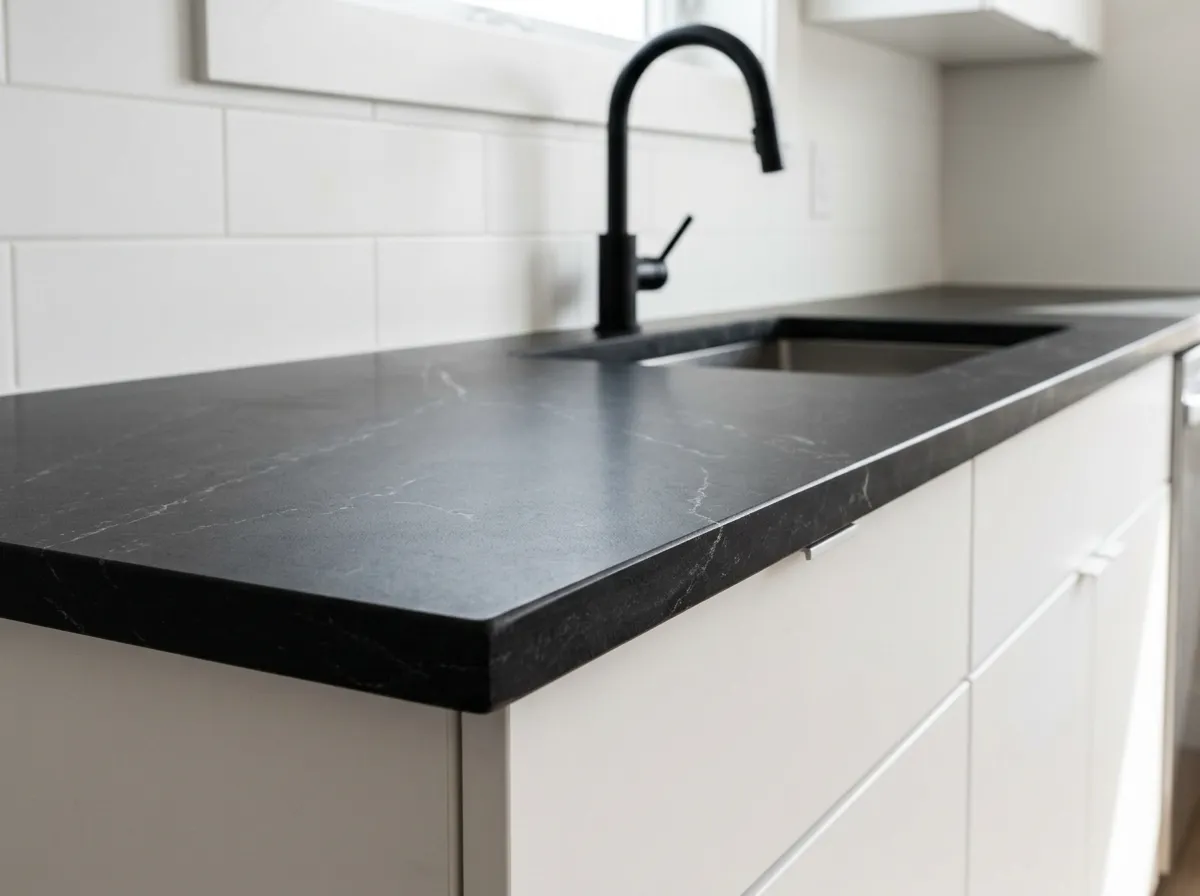
Black quartz raises the contrast ratio more than any other single surface, so it needs a clear job in your kitchen. Caesarstone, Silestone, and Cambria all make solid blacks and softly veined blacks, and a honed or suede finish hides the water spots that polished black quartz shows. Homeowners pair it with black bases and lose the cabinet edge entirely, or run it beneath a bright window where glare turns it into a mirror. Quartz countertop black and white pairings work best when the black stone sits against white cabinets and a white backsplash, so the counter becomes one dark horizontal line. Use black quartz on the island or the perimeter, but not on both unless every cabinet is white.
⬡ Specification note: Best for: Modern kitchens and large islands. Avoid with: Black base cabinets and polished finishes under a bright window. Pairs with: White cabinets, plain white tile, and brushed brass. Specialist verdict: Use it as the one dark horizontal line and not as the whole kitchen.
9. The Black and White Backsplash Choice
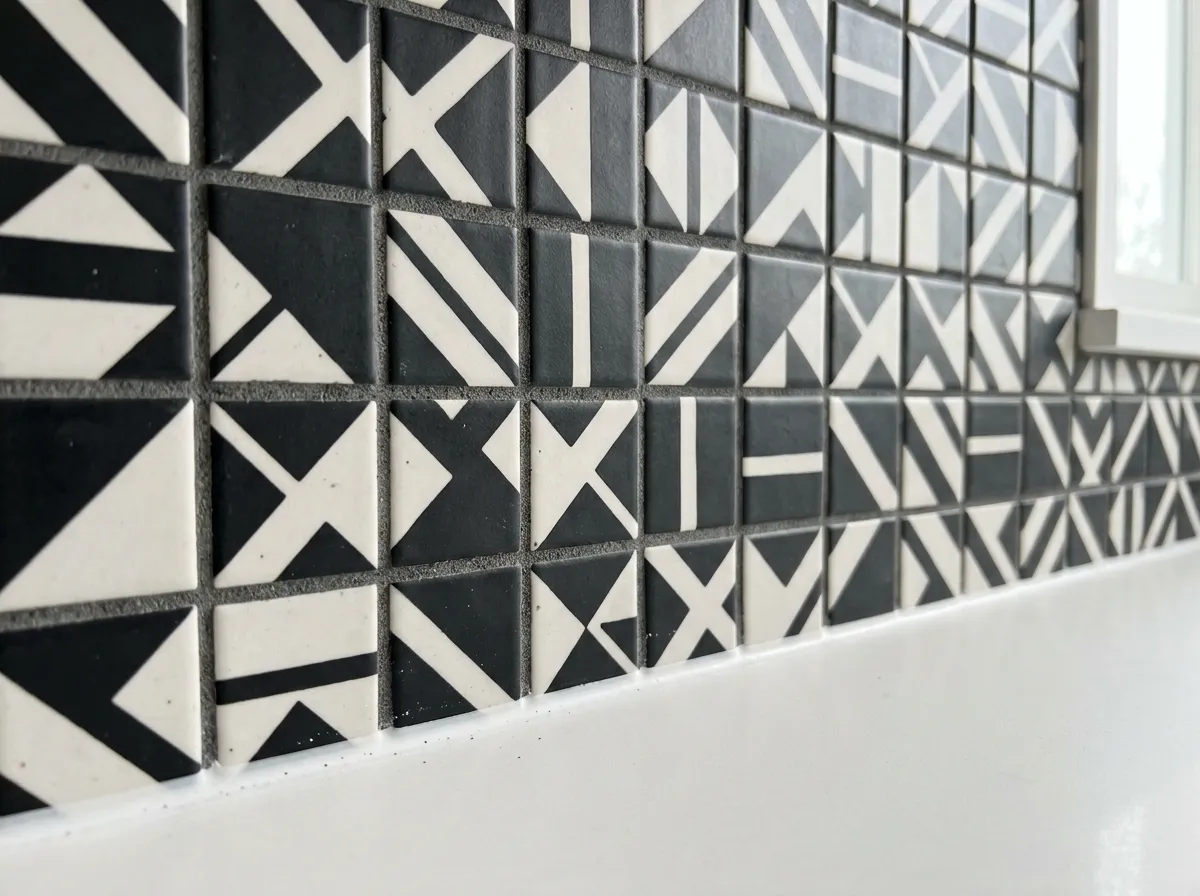
The backsplash is where a black and white scheme either gains pattern or gets noisy, so decide its job before you choose tile. Commit to one pattern family: plain white tile with a dark grout line, a black and white geometric laid tight, or a full-height slab of the countertop stone. The mistake is putting a busy patterned tile beside veined marble, which makes two competing patterns share one wall. A black and white kitchen backsplash works hardest when it is quiet, and plain tile in a bold layout beats loud tile in a plain one. Spend your pattern budget on the counter or the backsplash, never both.
⬡ Specification note: Best for: Kitchens with plain counters and a visible wall of backsplash. Avoid with: Heavily veined marble beside a patterned tile. Pairs with: Matte black hardware and plain white cabinet fronts. Specialist verdict: Pattern belongs on one surface only.
Specialist’s Specification Detail: Backsplash Height Rules
⬡ Specify a 3×6 porcelain or ceramic tile with a rectified edge, which allows the tightest and cleanest grout line. ⬡ Run the standard backsplash 18 inches from counter to uppers, take it to the ceiling behind a range, and run it full height behind open shelving. ⬡ Avoid stopping the tile at an uneven height beside a window or hood, where the cut line becomes the first thing you see. ⬡ For a budget match, peel-and-stick subway-pattern panels cost a fraction of ceramic and work well in a rental kitchen.
10. Subway Tile and Black Grout
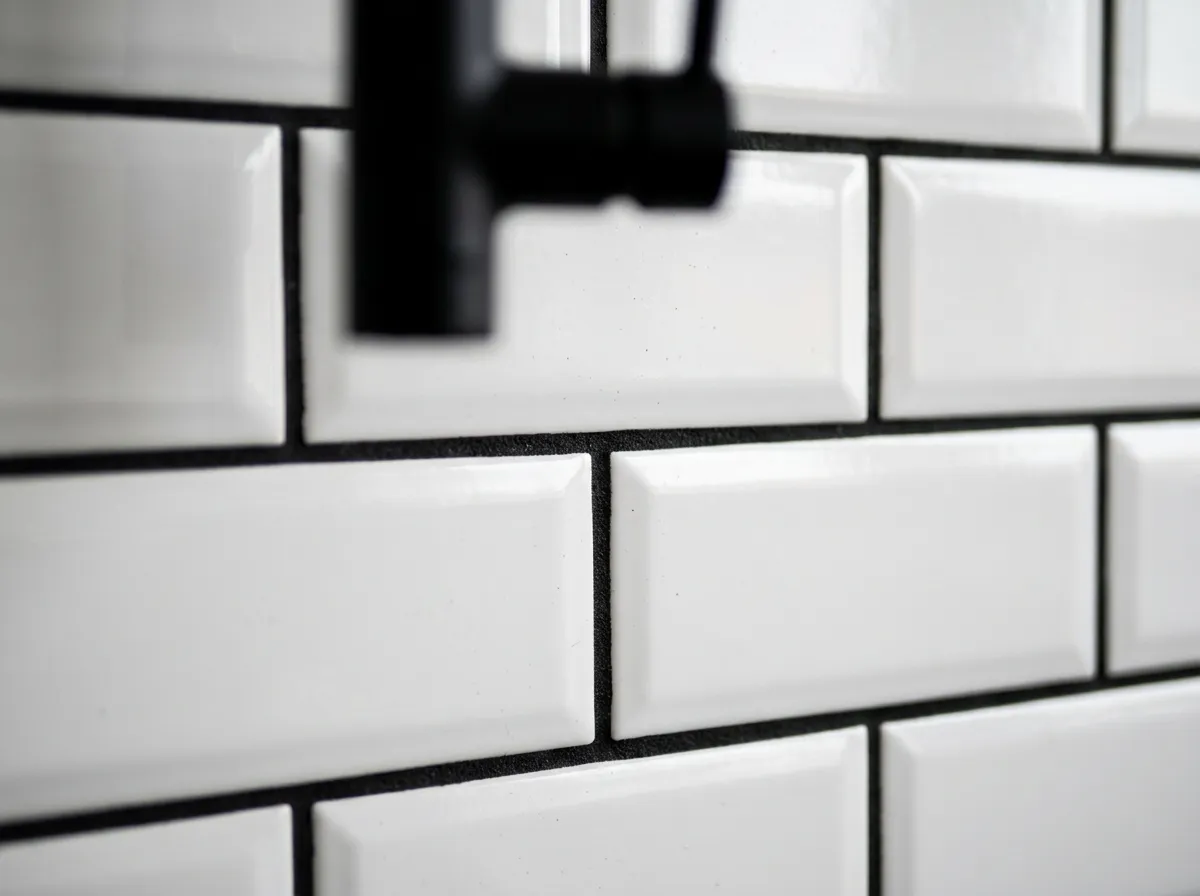
Joint color changes how tile reads, and black grout on white subway tile turns every seam into a drawn line. Use a 3×6 white tile with eighth-inch joints and a sanded black grout, sealed after curing, and choose a satin tile over a high-gloss one to limit reflection. The failure points are mixing grout too wet, which cures with a chalky gray cast, and skipping the haze cleanup, which leaves a white film on the tile face. Subway tile black and white kitchen plans need a layout decision before the setter arrives, because brick bond reads traditional and stacked reads graphic. Black grout white tile kitchen results are high reward and high maintenance: the version that works is sealed and wiped within the hour, and the version that misses is a gray smear.
⬡ Specification note: Best for: Traditional, farmhouse, and graphic modern kitchens. Avoid with: Unsealed grout behind a busy cooktop. Pairs with: A matte black faucet and white shaker cabinets. Specialist verdict: The most graphic single upgrade per dollar, provided you accept the upkeep.
11. Black and White Kitchen Ideas: Floors
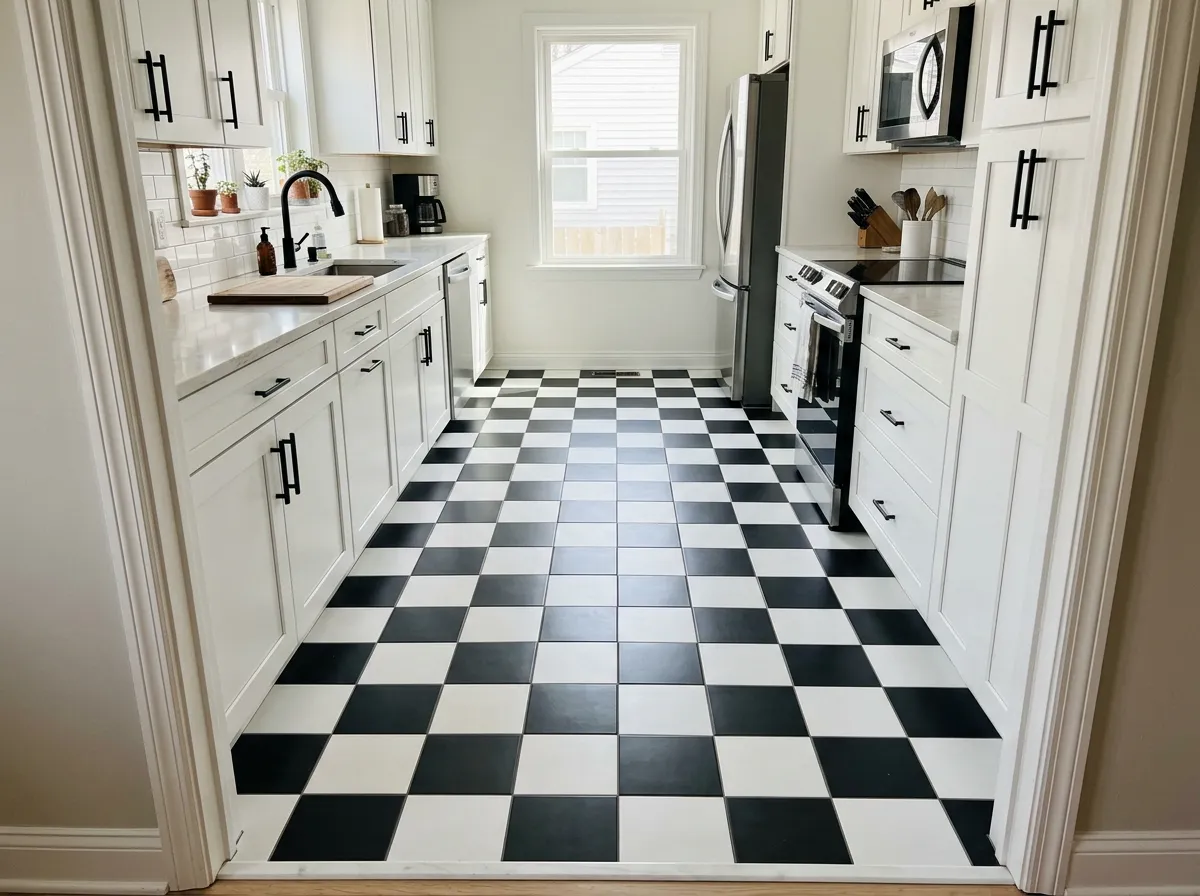
Floors set the foundation of the contrast, and a black and white kitchen flooring plan has three honest options: all dark, all light, or patterned. A twelve-inch porcelain checkerboard reads classic, a hex mosaic leans nostalgic, and herringbone tile black and white reads modern when the tile is small. The mistake is a patterned floor under a patterned backsplash and a veined counter, which asks the eye to read three patterns at once. Porcelain, luxury vinyl plank, and honed stone all work here, and heated mats under porcelain suit colder climates. Pick a patterned floor when everything above it is plain, and pick a plain floor when the walls carry the pattern.
⬡ Specification note: Best for: Traditional and transitional kitchens where the floor can carry the pattern. Avoid with: A patterned backsplash and veined marble. Pairs with: Plain white cabinets and matte black hardware. Specialist verdict: One pattern per room, and the floor is a good place for it.
🏛️ Surface Specification Guide: What Works With What
Good black and white kitchen design treats surfaces as a matrix, and the table below shows which pairings agree. A marble countertop white kitchen, for example, takes its contrast from the cabinets and hardware rather than from a second pattern.
| SURFACE | PAIRS WITH | AVOID WITH | BEST FOR |
|---|---|---|---|
| White marble | Black bases, brass or matte black hardware, plain white tile | Patterned backsplash, acidic cleaners | Kitchens that welcome patina |
| Black quartz | White cabinets, plain white tile, brushed brass | Black bases, polished finish under a bright window | Modern kitchens and islands |
| White subway tile | Black grout, marble or quartz counters, matte black faucet | Patterned counters, gloss tile in a splash zone | Backsplashes in any kitchen size |
| Black grout | Plain 3×6 white tile in brick bond or stacked | Mottled or heavily veined tile | Kitchens where graphic line is the goal |
| Black and white floor | Plain white cabinets and plain walls | Patterned backsplash, veined marble | Large rooms and one-statement galleys |
The black and white kitchen has deep roots in American traditional design, and our traditional design vocabulary guide shows how those same heritage principles work across every room in a considered American home.
Hardware and fixtures are the smallest elements in the room and the ones that most often undo the scheme. Finish, sheen, and temperature all have to agree, because there’s no pattern here to distract the eye from a mismatch.
12. Matte Black Hardware Sets the Standard
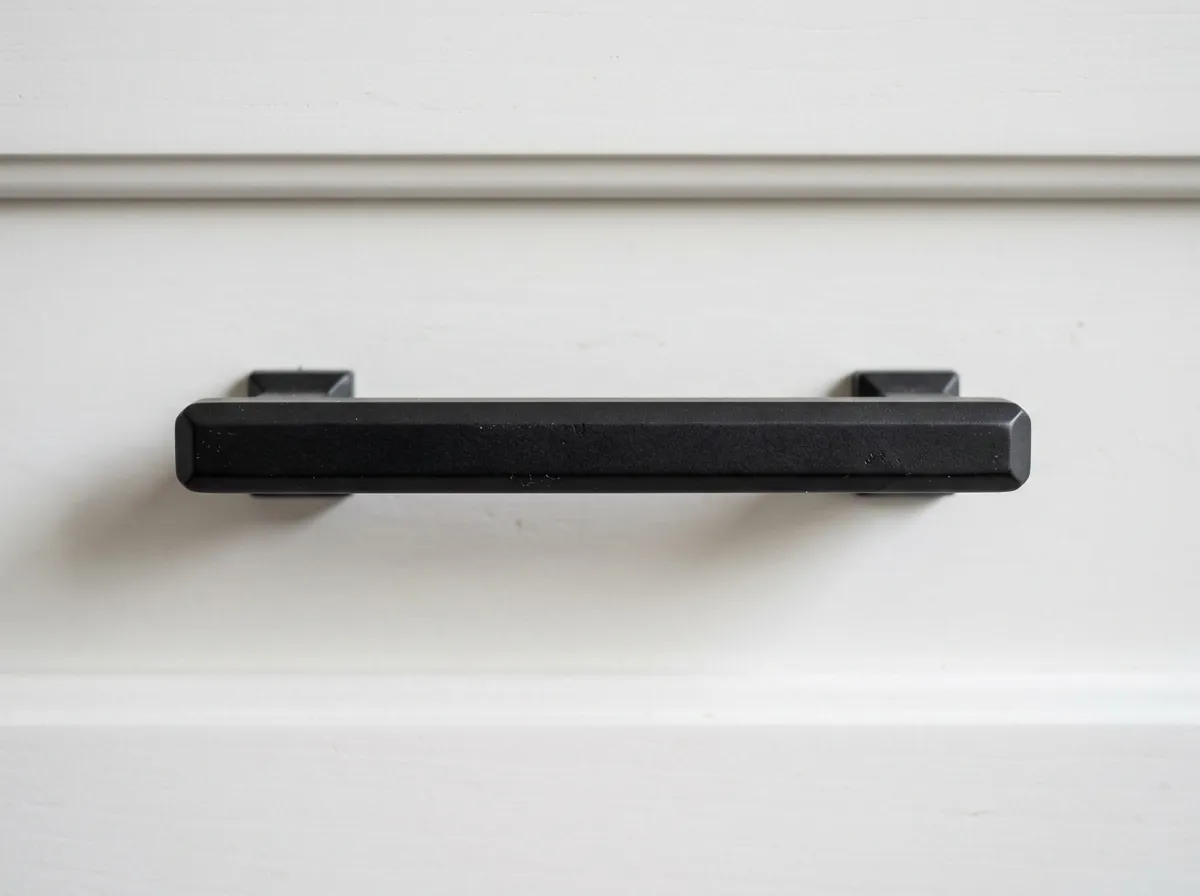
Hardware in matte black is the standard for this palette because it’s the smallest way to repeat the black across a white room. Size the pieces by proportion: a knob around 1.25 inches across for doors, and for drawers a pull about one-third the width of the drawer front. Homeowners order by price and end up with three blacks, one satin, one flat, and one with a bronze undertone, that never quite match. A white kitchen with black accents depends on that sameness, so buy black and white kitchen hardware in one order from one maker. One order, one finish, and one placement rule is the entire specification.
⬡ Specification note: Best for: Every white-dominant kitchen. Avoid with: Hardware bought across different orders or brands. Pairs with: A black faucet and one black light fixture. Specialist verdict: Cheap to change and expensive to get wrong in sheen.
13. Brass Hardware in Black and White
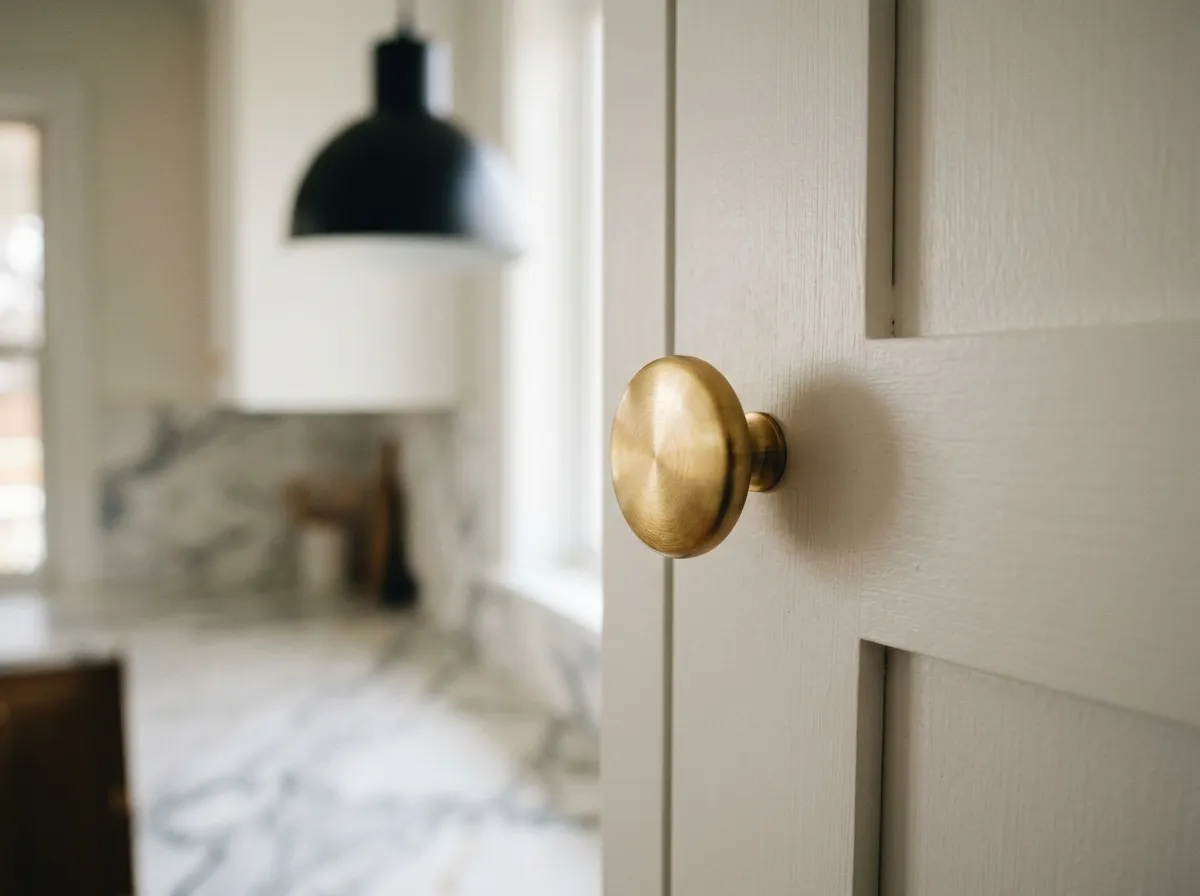
Brass adds the single warm note a two-color palette can’t produce by itself. Specify brushed or satin brass rather than polished, and keep it to one hardware family so the finish reads as a decision and not an accident. The mistake is pairing brass pulls with a chrome faucet and a black pendant, so three metals compete for attention. A brass hardware black and white kitchen works when brass appears in exactly two places, usually the cabinet hardware and one light fixture. Used twice it reads warm and confident, and used four times it reads like a hotel lobby.
⬡ Specification note: Best for: White kitchens that need a warm note. Avoid with: Chrome faucets and polished nickel. Pairs with: Marble counters and a single brass pendant. Specialist verdict: Brass works as punctuation, not as a paragraph.
14. The Matte Black Faucet Specification
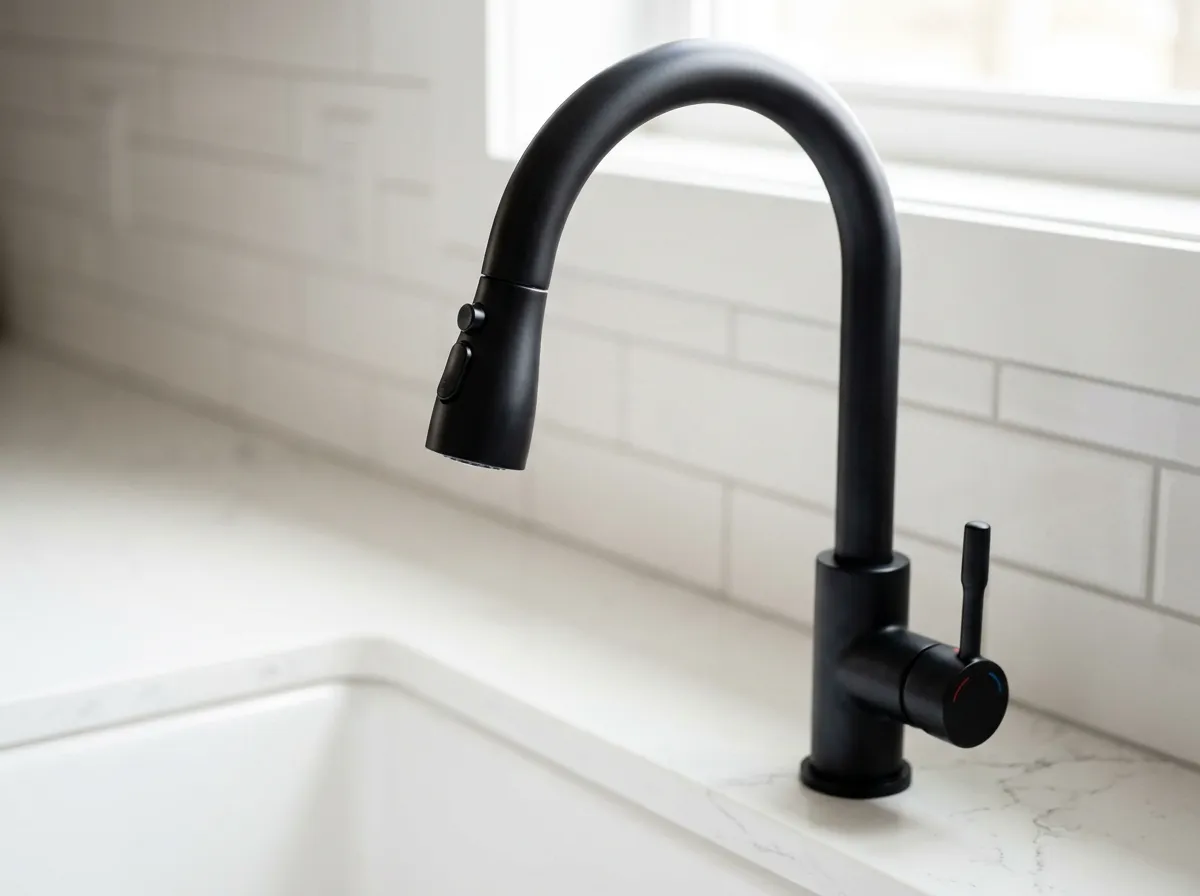
Your faucet is the most-handled piece of hardware in the room, which makes its finish the one that has to be right. Specify a single-handle pull-down in a solid brass body with a PVD matte black finish, which resists scratches and water spotting better than painted coatings. The common mistakes are choosing a faucet without matching its sheen to the cabinet hardware and cleaning it with abrasive pads, which polish the finish into patches. A matte black faucet kitchen setup needs the faucet, pulls, and any pendant frames to share the same level of sheen. A faucet that matches the hardware looks planned, and one that almost matches looks like a replacement.
⬡ Specification note: Best for: Any kitchen where the faucet is visible from the living space. Avoid with: Mixed sheens between the faucet and the hardware. Pairs with: White farmhouse or undermount sinks. Specialist verdict: The cheapest way to repeat the black.
Specialist’s Specification Detail: Faucet Finish Durability
⬡ Specify a solid brass body with a ceramic disc cartridge and a PVD matte black finish, widely available through Home Depot and Lowe’s. ⬡ Choose a spout reach that lands the stream at the center of the sink bowl, typically 8 to 9 inches from the base. ⬡ Avoid abrasive pads and vinegar, which dull the finish; mild soap and a soft cloth are enough. ⬡ For a budget match, a painted matte black pull-down costs less and can work well if you accept a shorter finish life.
15. Black Window Frames in Kitchens
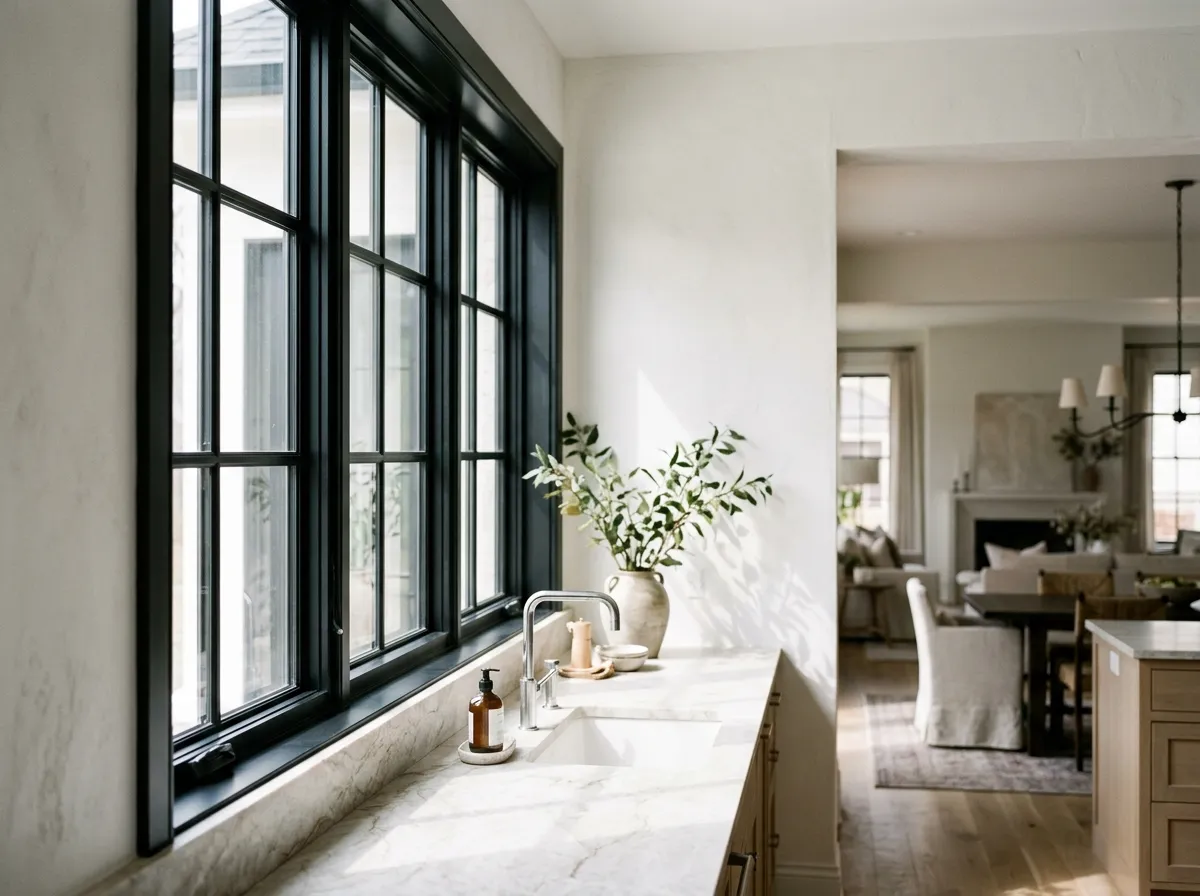
Window frames in black draw a graphic line around daylight, which is exactly what a white kitchen wall needs. Specify aluminum-clad or steel-look frames in a flat black with slim sightlines, and paint the casing the same black so the window reads as a single frame. The mistake is black sashes inside white casings, which creates a double outline, or black frames on one window and white on the one beside it. A black window frame kitchen works best when the frames repeat in the adjacent room, which is easy in an open-plan American kitchen with a shared wall of glass. Commit to black on every window in the sightline, or commit to white on all of them.
⬡ Specification note: Best for: Open-plan kitchens with large windows. Avoid with: Mixed black and white frames in one sightline. Pairs with: Black hardware and a light stone counter. Specialist verdict: A strong move that only works when applied everywhere.
16. Under-Cabinet Lighting: Warm or Cool?
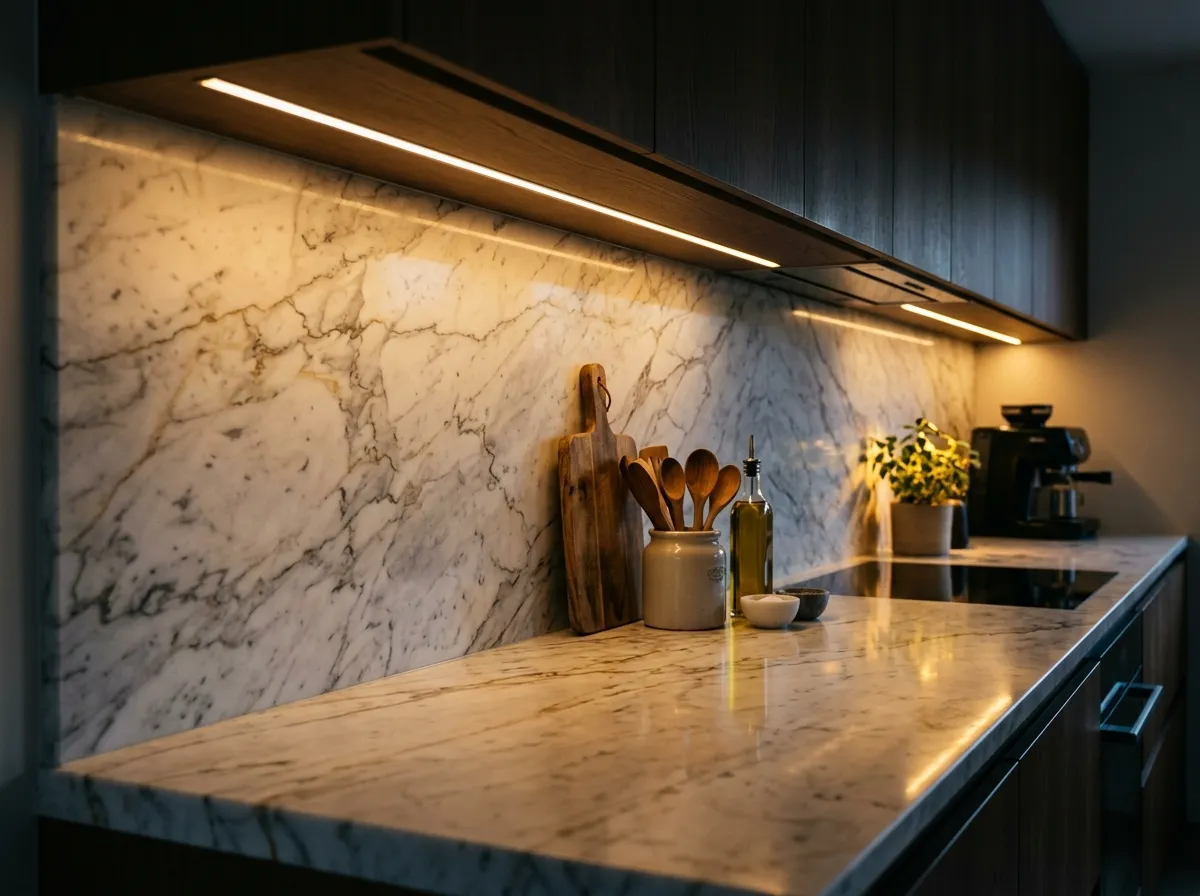
Under-cabinet lighting decides how your counter and backsplash actually read after dark. Specify LED strips rated 90 CRI or higher at 2,700K to 3,000K, behind a diffuser and set near the front edge of the cabinet so the backsplash doesn’t show scalloped hot spots. Most homeowners buy cool 4,000K strips for task brightness, and every white surface in the room turns blue-gray. Black and white kitchen lighting is a balance of temperatures, and the under-cabinet layer is the one that shows the error first. Warm, dimmable, and diffused is the version that works, and cool, bare, and bright is the version that misses.
⬡ Specification note: Best for: Every kitchen with upper cabinets. Avoid with: Cool white strips beside warm overhead bulbs. Pairs with: Dimmers and a white marble or quartz counter. Specialist verdict: The most overlooked specification in the room.
⚙️ Hardware and Fixture Decision Guide: The Finish That Ties the Whole Kitchen Together
Black and white kitchen hardware is where the scheme is won or lost, and each finish below has a job and a risk.
MATTE BLACK HARDWARE: This is the right choice on white cabinets with white or light stone counters. It needs a black faucet and at least one more black element, such as a pendant or window frame, so it doesn’t read as isolated.
BRASS HARDWARE: This is correct when the room is white-dominant and needs warmth. The balance required is black in the lighting and faucet, with brass limited to two placements.
CHROME HARDWARE: This works in traditional rooms with white marble and shaker doors. It risks reading cold and diluting the black if the rest of the room leans modern.
THE ONE RULE: Choose one dominant finish and one supporting finish, and never introduce a third.
THE FAUCET DECISION: The faucet finish matters more than any other fixture because it’s the most-used, most-seen piece of metal in the room, and a matte black faucet kitchen anchors every other finish around it.
The black elements in a black and white kitchen share their design confidence with the boldest dark interiors in American homes, and our dark contrast interior ideas guide shows how that same commitment to depth works in a different room entirely.
Layout decisions change how much black your kitchen can carry, and a large suburban island and a city galley don’t follow the same rules. Match the amount of black to the room, not to the photograph that inspired it.
17. Black Islands in White Kitchens
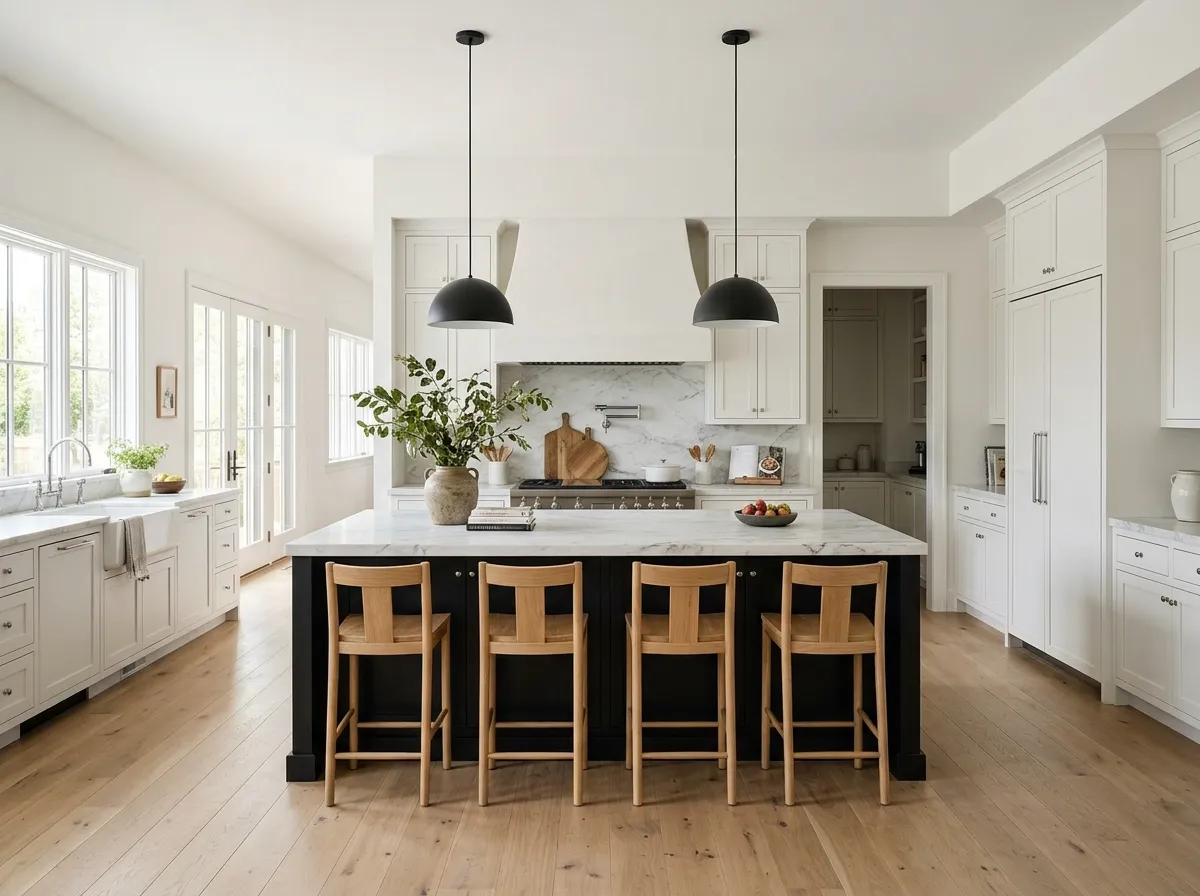
An island in black is the cleanest way to add weight to a white kitchen without darkening the perimeter. Keep 42 inches of clear aisle between the island and the perimeter run for one cook and 48 inches for two, and allow a 12-inch seating overhang at counter height. The mistake is oversizing the island until the aisles pinch, then adding black stools, black pendants, and a black counter until nothing contrasts with it. Pair black kitchen island white cabinets with pendants hung 30 to 36 inches above the surface, and choose a pendant light black kitchen finish that matches the faucet. Large suburban kitchens carry a black island easily, and smaller rooms are better served by a white one.
⬡ Specification note: Best for: Large suburban kitchens. Avoid with: Black stools, black counter, and black pendants all together. Pairs with: White perimeter cabinets and a white or marble counter. Specialist verdict: One black mass in the center of the room is plenty.
18. Open Shelving in Black and White
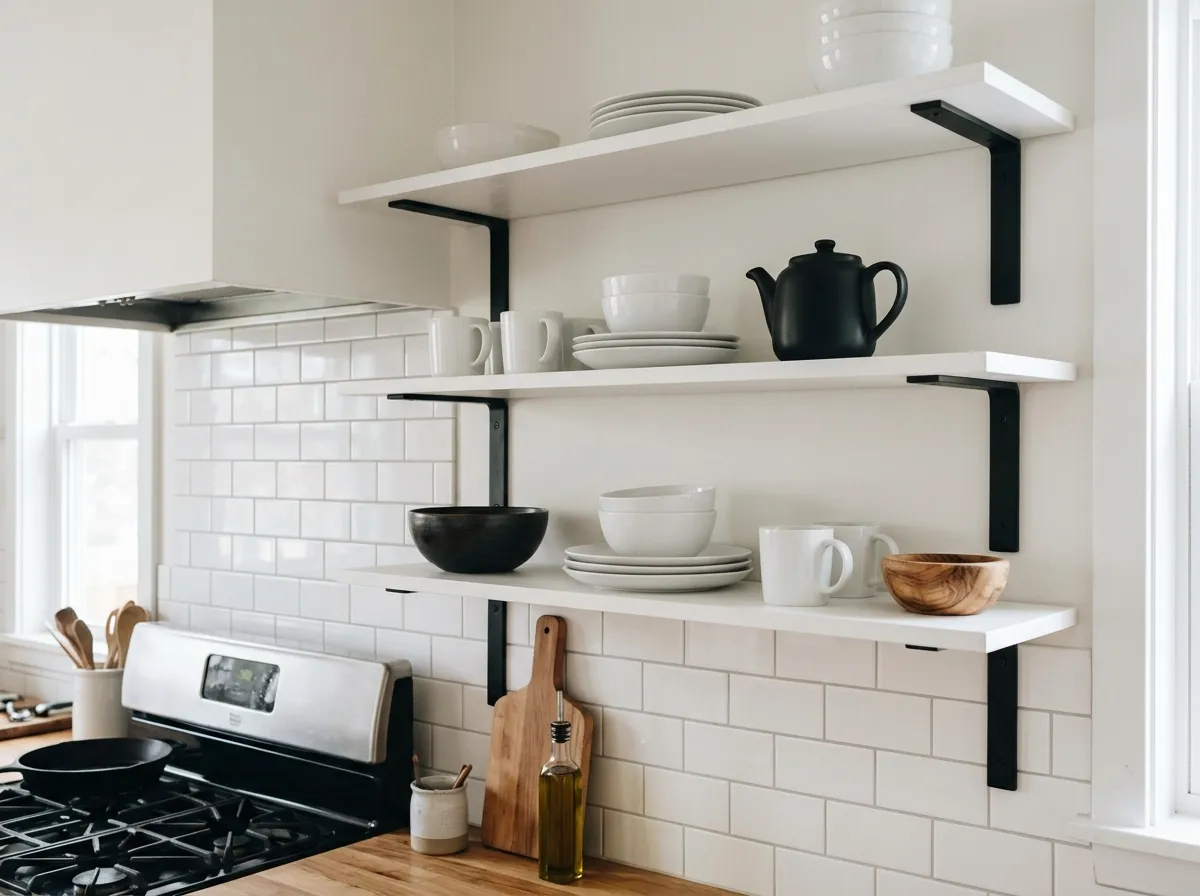
Shelves in place of upper cabinets break up a wall of doors, but in this palette they only work if the contents obey the palette. Use solid wood or white-painted shelves 10 to 12 inches deep on black brackets, and limit what sits on them to white dishware, a few black pieces, and one wood or green accent. The mistake is loading the shelves with colorful mugs and mismatched cookbooks, which dissolves the palette within a week. Open shelving black and white kitchen styling works best on a single stretch of wall beside the range or sink, not as a replacement for all the uppers. Two shelves styled with intent beat five shelves filled by habit.
⬡ Specification note: Best for: Open kitchens with one clear wall near the sink. Avoid with: Replacing every upper cabinet. Pairs with: Black brackets and white dishware. Specialist verdict: Style it like a vignette, not a pantry.
19. Black Appliances: When They Work
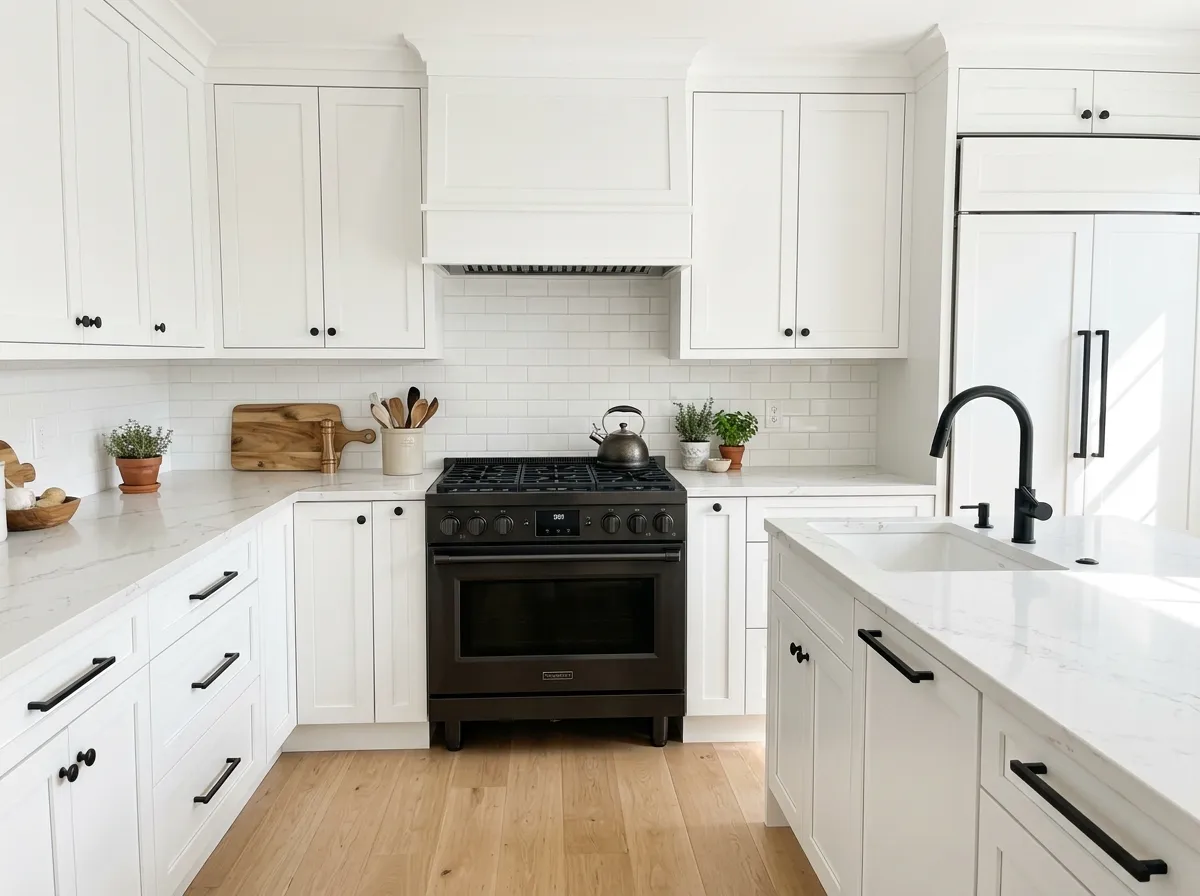
Appliances in black vanish against black cabinets and stand out against white ones, and that fact decides the whole choice. Samsung and KitchenAid both make black stainless and matte black lines, so compare the finishes in person under your own lighting, and consider a panel-ready Sub-Zero refrigerator that accepts the cabinet finish. Homeowners mix black stainless with regular stainless in one kitchen, and the two finishes disagree at every junction. Black appliances white kitchen schemes work when the range becomes a deliberate focal point and the hardware and faucet follow it in black. Go all black on appliances or panel them away, because a half-and-half approach looks like a budget compromise.
⬡ Specification note: Best for: A black range in a white kitchen, or panel-ready appliances in an all-black one. Avoid with: Mixing stainless and black stainless. Pairs with: A black faucet and matching hardware. Specialist verdict: Choose one finish across every appliance.
20. Small Kitchen, Full Contrast
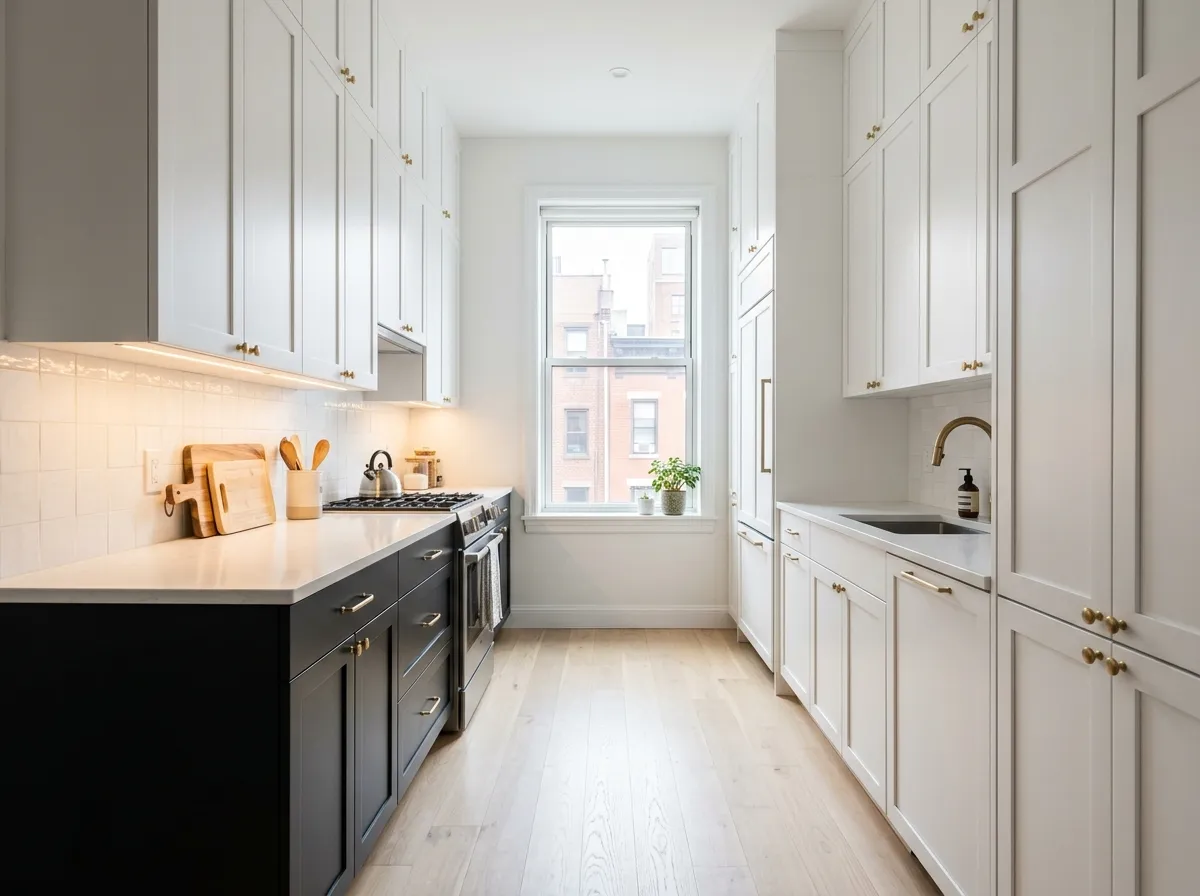
Small rooms can carry full black and white contrast if the contrast is organized in planes rather than scattered in pieces. In a galley kitchen in a city apartment, run white uppers to the ceiling, put black bases on one side only, and keep the floor light so the aisle feels wider. The mistake is putting black on both sides of a narrow aisle, which makes the room feel like a corridor. A black and white small kitchen needs under-cabinet lighting and as close to 42 inches of clear aisle as the room allows. Treat black as a single plane in a small kitchen, and let white do the rest.
⬡ Specification note: Best for: City apartment galley kitchens. Avoid with: Black on both sides of a narrow aisle. Pairs with: White uppers to the ceiling and warm under-cabinet light. Specialist verdict: Black in a small room is a single plane, not a theme.
21. Farmhouse Black and White Kitchen Ideas
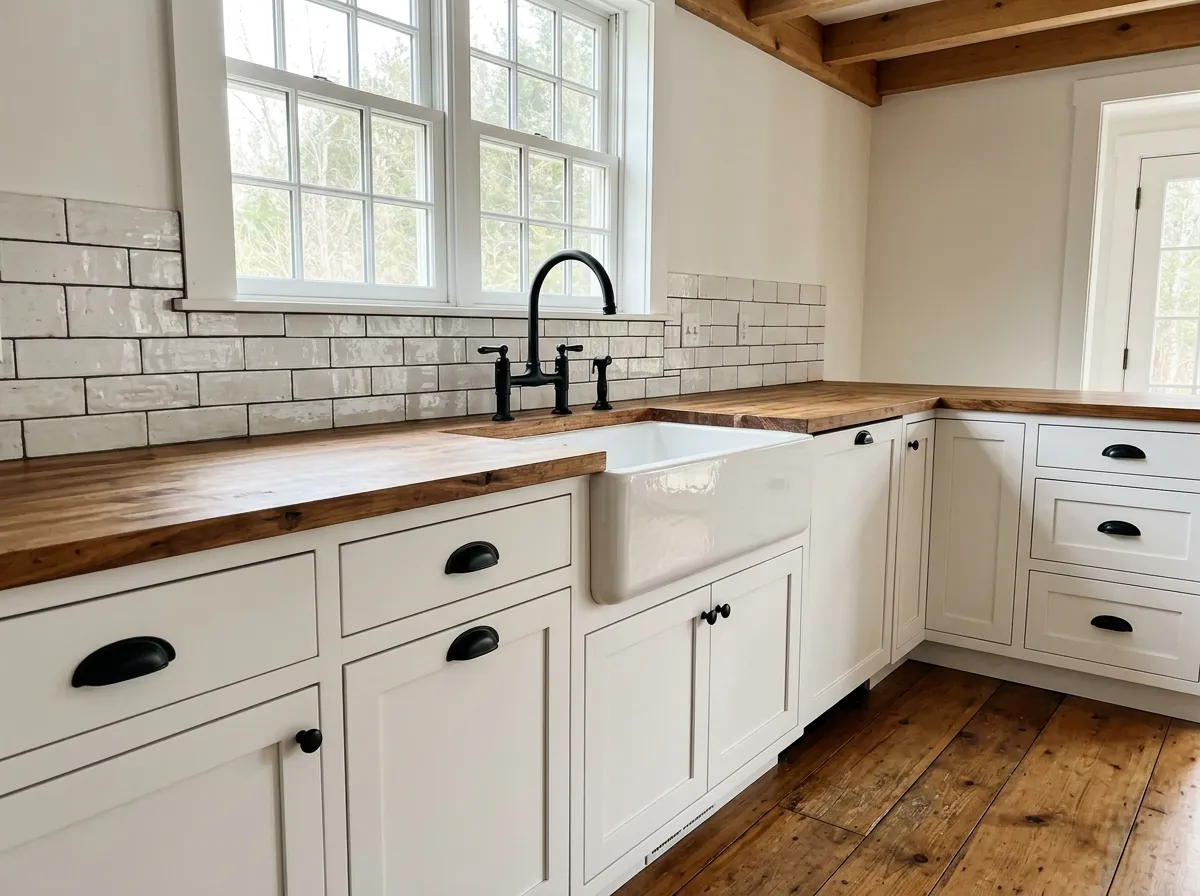
Farmhouse versions of this palette get their character from texture, not from contrast. Specify a fireclay apron-front sink, white shaker or beadboard cabinets, black cup and bin pulls, and a butcher block or soapstone-look counter. The mistake is stacking black accents, shiplap, barn-door hardware, and rustic signage in one room until it reads like a set. A black and white farmhouse kitchen can borrow the checkerboard floor from a vintage black and white kitchen, but only one nostalgic element at a time. Pick texture over contrast: the version that works feels lived in, and the version that misses feels staged.
⬡ Specification note: Best for: Suburban and rural American homes with a traditional shell. Avoid with: Stacked rustic props. Pairs with: Butcher block and black bin pulls. Specialist verdict: Texture does the work that contrast does elsewhere.
💡 Lighting Guide: What Black and White Kitchens Need
Black and white kitchen lighting is a layered specification, and each layer below has a color temperature and a job.
NATURAL LIGHT ASSESSMENT: Check your kitchen at morning, midday, and evening before choosing a white. North light reads cool and blue, south light reads warm and golden, and your white should lean the opposite way to balance it.
OVERHEAD LIGHTING: Specify 2,700K to 3,000K with a CRI of 90 or higher, on dimmers. Cooler bulbs turn white cabinets blue-gray and make black look flat.
UNDER-CABINET LIGHTING: Use diffused LED strips at 2,700K to 3,000K near the front edge of the cabinet. The under-cabinet lighting warm versus cool decision shows first on the backsplash, so test a strip before buying a full run.
PENDANT SELECTION: Black pendants suit white kitchens and repeat the faucet and hardware, white pendants suit kitchens that already carry a lot of black, and brass pendants suit rooms where brass appears in the hardware too.
THE LIGHTING RULE: Choose one warm color temperature for every bulb in the room and change it only on a dimmer.
A black and white kitchen in an open-plan home needs to speak the same design language as the adjacent living space, and our open plan design guide shows how to carry a clean palette through every connected room.
A black and white kitchen without warmth reads like a showroom, and warmth is the one thing the palette can’t supply itself. Add it deliberately, in materials, and only then call the specification finished.
22. Adding Warmth to White Kitchens
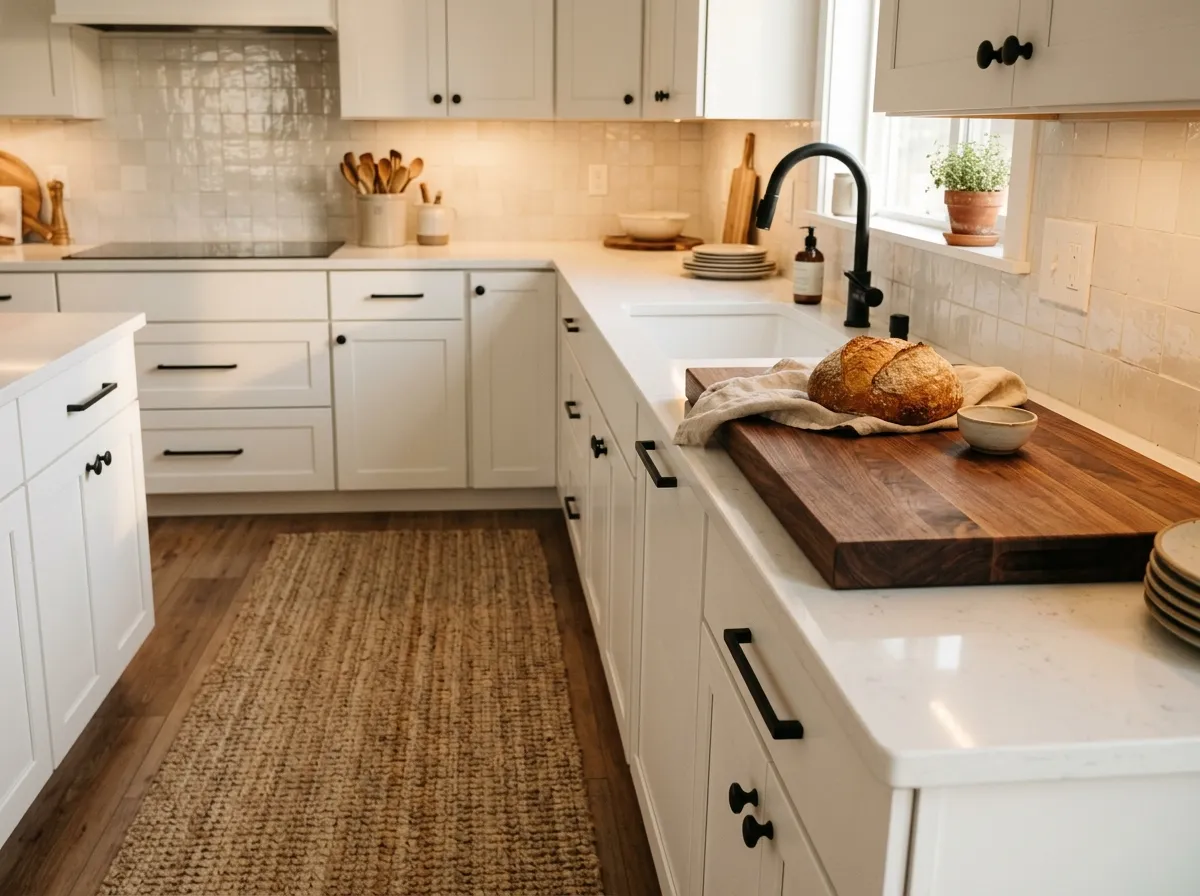
Warmth in a white kitchen has to be specified like any other material, because hard surfaces alone read cold. Layer three sources, wood, textile, and light, for example a walnut cutting board, a natural-fiber runner, and 2,700K bulbs throughout. The mistake is trying to add warmth with cream paint on a few walls, which fights the cabinet white instead of balancing it. A black and white open plan kitchen can borrow warmth from the adjoining living room’s wood floors and textiles, which saves you from over-decorating the kitchen itself. Warmth belongs in the materials you touch, not in the paint you argue about.
⬡ Specification note: Best for: Cool-leaning white kitchens and rooms with north light. Avoid with: Cream paint patches on a white wall. Pairs with: 2,700K bulbs and a single wood tone. Specialist verdict: Warmth is a materials decision.
Specialist’s Specification Detail: Layered Warmth Sources
⬡ Specify oiled walnut or white oak in a satin oil finish rather than a gloss varnish, which reads plastic against matte black. ⬡ Aim for roughly one warm element, such as wood, rattan, or brass, for every three hard surfaces in the sightline. ⬡ Avoid matching the wood stain exactly to the floor, which flattens the room instead of warming it. ⬡ For a budget match, cut Home Depot butcher block to size for shelves or an island top and finish it with food-safe oil.
23. Wood Accents in the Palette
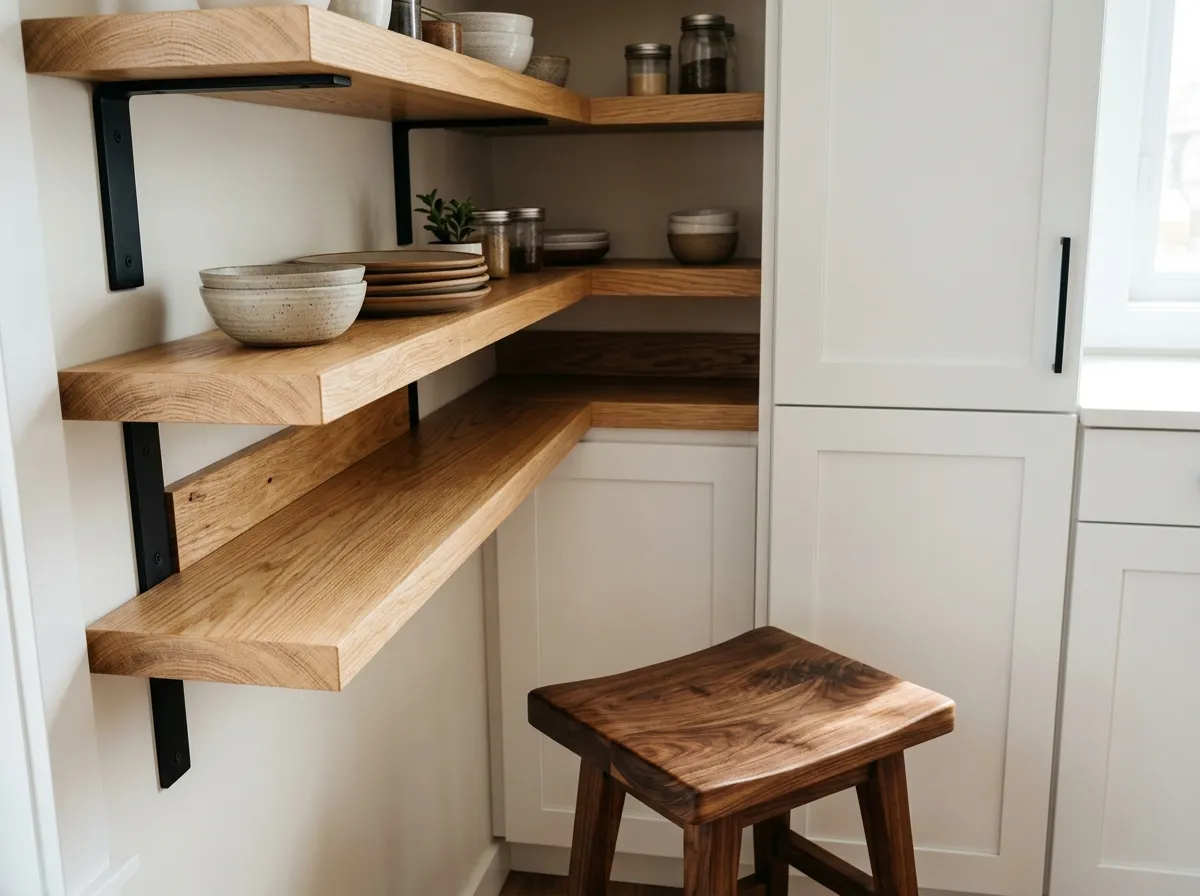
Wood is the one material both ends of the palette welcome, and it’s the cleanest way to soften contrast. Specify white oak or walnut with an oil finish in a single tone, used on shelves, stools, a butcher block island top, or a range hood wrap. The mistake is using three species and three stains in one room, which turns warmth into noise. Black and white kitchen decor stays calm when wood plays the quiet third color and appears in no more than three places. One wood, three placements, and the palette feels finished.
⬡ Specification note: Best for: White cabinets with black hardware. Avoid with: Three wood species in one room. Pairs with: Brass hardware and white marble. Specialist verdict: One wood tone, repeated.
24. Black and White Kitchen Ideas, Specified
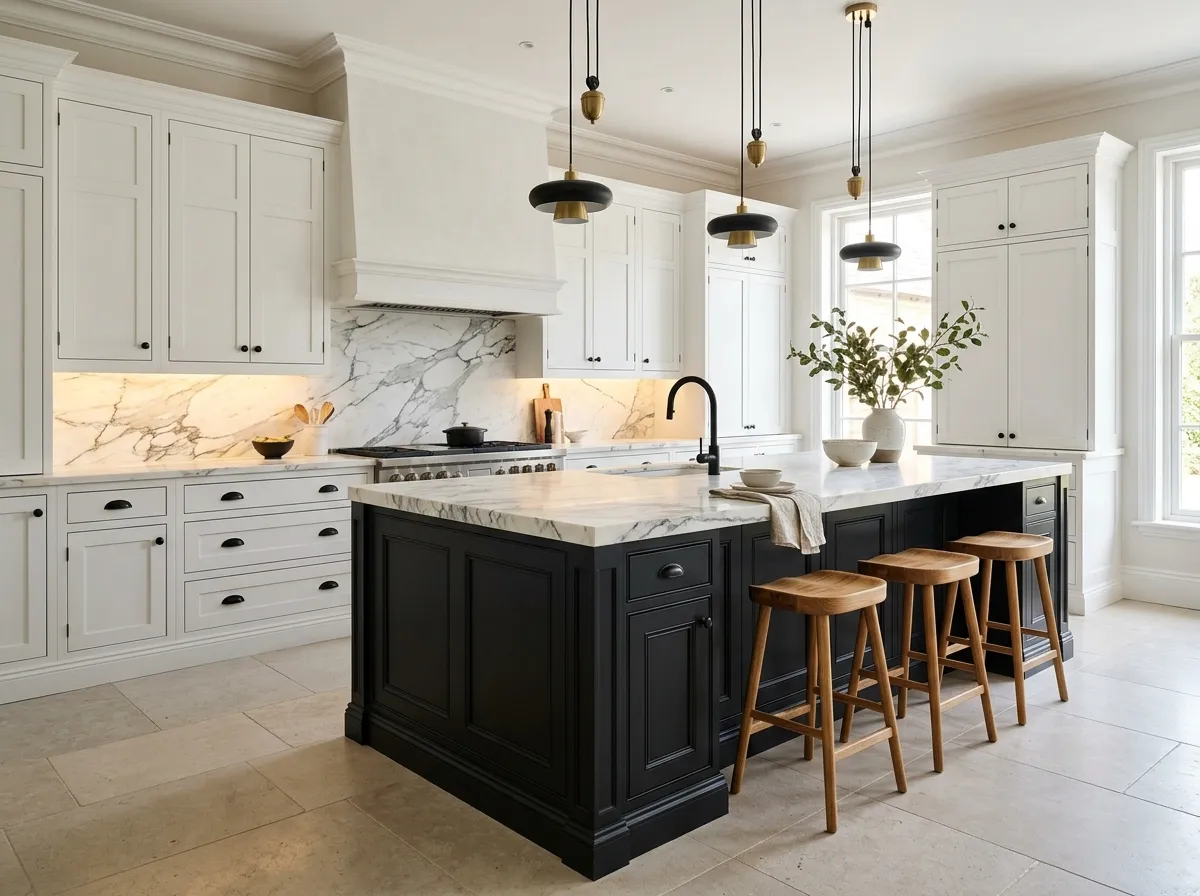
The complete specification is a short list of decisions that agree with each other. A resolved room might use one warm-neutral white such as Benjamin Moore Simply White, black bases or a black island, marble or quartz counters, matte black hardware and faucet, 2,700K lighting, and one wood element. The mistake is collecting twenty-four good ideas and using all of them, which turns a kitchen into a showroom. A modern black and white kitchen is built by subtracting until every element has a job. Keep what earns its place, and cut what only decorates.
⬡ Specification note: Best for: Any kitchen size once the other entries are decided. Avoid with: Adding every idea you’ve seen. Pairs with: A written list of each finish, sheen, and color temperature. Specialist verdict: The kitchen is finished when removing anything makes it worse.
Specification Files: Kitchen Questions Answered
Are black and white kitchens still in style?
Yes, and black and white kitchen ideas remain among the most requested kitchen palettes in American homes because the contrast adapts to every style of detailing. A modern black and white kitchen uses flat fronts, matte black hardware, and quiet surfaces, while a traditional one uses shaker doors, marble, and brass. What dates the room isn’t the palette but the finish choices, such as high-gloss black or heavily patterned tile. Choose the sheen and hardware carefully and the room stays current.
What shade of white works best for kitchen cabinets?
It depends on your light, and your black and white kitchen design should start with that. Benjamin Moore Simply White and Sherwin-Williams Pure White suit rooms that need warmth, while Sherwin-Williams Extra White and Benjamin Moore Chantilly Lace suit bright south-facing rooms. The white kitchen warm versus cool decision is settled by testing a large sample at several times of day. Choose the white that looks clean at dusk, because that’s when your under-cabinet lighting does its work.
What backsplash works best in a black and white kitchen?
Plain white subway tile with a dark grout line is the most reliable black and white kitchen backsplash, because it adds pattern without competing with the counter. Herringbone or geometric tile works when the counters are plain, and a full-height slab of the countertop stone gives the cleanest result in a small room. Across almost all black and white kitchen ideas, a quiet backsplash wins over a loud one.
What hardware finish works in a black and white kitchen?
Matte black is the default, and it works because it repeats the black in the smallest, most consistent way. Black and white kitchen hardware in brass suits rooms that need warmth, and chrome suits traditional rooms with marble. Matte black hardware black and white kitchen schemes need one more black element nearby, usually the faucet or a pendant, so the hardware doesn’t read as isolated. Whichever finish you pick, buy it in one order so the sheen matches.
How do I make a black and white kitchen feel warm?
Start with a white kitchen with black accents instead of large black masses, then layer in wood, brass, and 2,700K bulbs. These black and white kitchen ideas work because the warmth comes from materials rather than from a third paint color. The most successful black and white kitchens avoid coldness by borrowing warmth from the rooms around them, and our warm home aesthetic guide shows exactly how warmth is built into any clean-palette space. A walnut cutting board and a woven runner will do more than any repaint.
What countertop works best in a black and white kitchen?
White marble and white quartz suit most kitchens, while black quartz works as the single dark line against white cabinets. When planning black and white kitchen countertops, match the stone to the majority cabinet color so it bridges the two tones. In black and white kitchen design, the counter is the surface that controls the contrast ratio, so choose it before the backsplash. Honed finishes hide water spots and etching better than polished ones.
Is a black kitchen island a good idea?
Yes, as long as the perimeter stays white and the island is sized with clear aisles. The best black and white kitchen island ideas keep 42 to 48 inches around the island and limit the black to its base. Black kitchen cabinet ideas work especially well here because the island is a single, contained mass. Keep the stools and the counter lighter so the island doesn’t swallow the room.
How do I do a black and white kitchen on a budget?
A black and white kitchen on budget starts with paint: a cabinet-grade satin enamel over existing doors costs a fraction of replacement. Add matte black hardware, a laminate or butcher block counter, and peel-and-stick tile, and shop IKEA, Home Depot, and Lowe’s for affordable shaker fronts in both colors. These black and white kitchen ideas hold up when you spend on the faucet and lighting and save on the doors.
What flooring works in a black and white kitchen?
A checkerboard porcelain tile is the classic answer, and a plain dark or light floor is the quiet one. Black and white kitchen flooring should carry pattern only if the backsplash and counter stay plain. Porcelain, luxury vinyl plank, and honed stone all hold up under American family use, and among all black and white kitchen ideas, the floor is the easiest place to get pattern right.
What is the difference between gray and white versus black and white kitchens?
Gray and white kitchen ideas rely on tone and softness, while black and white kitchen ideas rely on contrast and definition. Gray reads gentler and hides wear, while black adds graphic edges and shows dust. A kitchen this considered deserves to be cooked in, and our fall kitchen inspiration guide has the specific fall recipes that make a beautiful kitchen feel as functional as it looks.
The Specification Closes
Black and white kitchen ideas only work when every element follows the same specification, and that’s the real lesson of these 24 entries. A black and white kitchen isn’t a trend decision. It’s a specification decision, and each cabinet shade, finish, and light temperature in this guide is a line in that specification. Choose them to agree and your kitchen will outlast the mood board.
A black and white kitchen is one room in a home that takes design seriously: The Muse Vale has the interior design, home decor, and room styling guides to help you build every room with the same precision.
Come back to The Muse Vale whenever your kitchen needs a new design direction. We will have the black and white kitchen ideas, interior specification guides, and home design inspiration ready for every decision you are working through.